
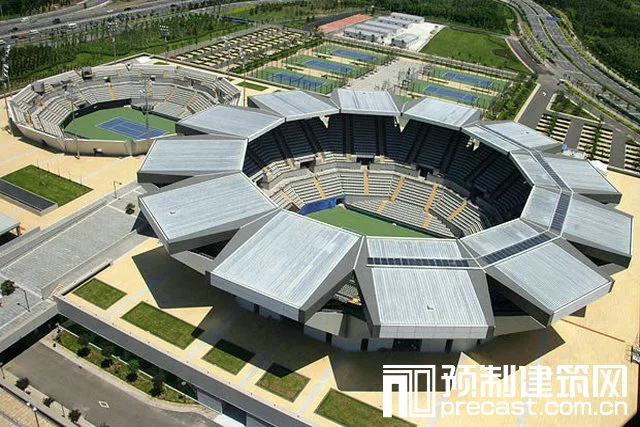
Clear Water Concrete: Decorative and Functional Excellence
Clear water concrete, also called decorative concrete, is named for its highly aesthetic finish. It is cast in one go without any additional surface decoration, using the natural texture of the cast-in-place concrete as its decorative face. Unlike ordinary concrete, it features a smooth, even surface with uniform color and sharp edges, free from impact marks or contaminants. Typically, one or two layers of transparent protective coating are applied, preserving a natural and dignified appearance.
Development Characteristics
Clear water concrete represents the pinnacle of concrete material expression, showcasing its intrinsic beauty and embodying the philosophy of “plain face facing the sky.” Its simple, natural charm conveys a sense of heaviness and elegance unmatched by many modern building materials. The inherent qualities of softness, hardness, warmth, and coolness affect human perception and spirit, allowing architects to express emotional depth through architectural design. This noble simplicity, seemingly minimalistic, is often considered more artistic than elaborate decoration.
Globally, an increasing number of architects embrace plain concrete techniques. Renowned figures like I.M. Pei and Tadao Ando have extensively incorporated it in their works. Iconic buildings such as the Sydney Opera House, Japan’s National Centre for the Performing Arts, and the Prehistoric Museum in Paris exemplify this architectural art.
International History of Clear Water Concrete
Emerging in the 1920s, clear water concrete gained attention as concrete transitioned from merely a structural material to an expressive architectural element. Architects began to exploit its natural texture to convey architectural emotion, often within the International Style. Notable examples include Louis Kahn’s British Art Gallery at Yale University, Eero Saarinen’s Global Aviation Building at New York’s Kennedy International Airport, and the terminal at Dallas/Fort Worth International Airport.
By the 1960s, plain concrete had become prevalent in Europe and North America. The 1980s saw a new generation of architects, including Richard Rogers and Norman Foster, blend their internationalist approach with high technology, exemplified by projects like Hong Kong’s HSBC Bank. In Asia, Japan led the way, especially post-World War II, when many concrete structures were left exposed without plaster or decoration. Japanese advancements have refined fair-faced concrete techniques, employing modern exterior repair technologies to create delicate, natural cement surfaces. This approach resonates with Eastern Zen principles, as embodied by architect Tadao Ando, often hailed as the “poet of plain concrete,” whose designs deeply reflect Eastern cultural aesthetics.
Development History in China
China’s use of plain concrete has evolved alongside its concrete structural technology. In the 1970s, it was primarily employed in precast concrete exterior wall panels within internal pouring and external hanging systems. However, focus shifted to brick and glass curtain walls, causing a stagnation in plain concrete’s development. The revival began in 1997 with Beijing’s “Structural Great Wall Cup Project” award, which promoted its use.
Recently, select high-profile projects such as Hainan Sanya Airport, Beijing Capital Airport, Shanghai Pudong International Airport Terminal, and the inclined tubes of the Oriental Pearl TV Tower have adopted fair-faced concrete. The growing demand for green buildings and environmental awareness, alongside a natural inclination toward simplicity, has expanded plain concrete’s applications beyond infrastructure to industrial and residential buildings. The Lenovo R&D Base, constructed by China Construction First Engineering Bureau Second Company, is recognized by the Ministry of Construction as China’s first large-scale plain concrete project, marking a significant milestone.
Significance of Development
Clear water concrete is a truly green building material. Its structural form requires no additional decorative coatings or chemical finishes, reducing environmental impact. The one-time formation process eliminates chiseling, repairs, and plastering, significantly cutting construction waste.
It also mitigates common quality issues such as plaster cracking, hollowing, peeling, grout leakage, and floor cracking. Because there is no scope for post-pour corrections, construction teams are forced to rigorously control each step, improving overall quality management.
Though labor- and resource-intensive, plain concrete reduces maintenance costs by eliminating the need for plastering, suspended ceilings, and decorative layers, ultimately lowering total project costs despite a longer construction period.
Technical Considerations
Plain concrete remains an emerging technology in China, with few teams mastering its design and construction. The final decorative effect depends roughly 60% on the quality of concrete pouring and 40% on transparent protective coating application, posing significant challenges.
Differences from Traditional Concrete
Construction demands are high: each pour must be pre-tested against color standards, vibrated evenly, and carefully monitored. Suitable construction temperatures range from April to October. Precise pre-planning and positioning of door and window openings and embedded components are essential due to the one-time pour nature, with no allowance for subsequent modifications. Exposed elements like rainwater pipes or ventilation openings must be integrated with visible joints on the concrete surface.
Four Process Types
- Pure Transparent Protection: Applied when the pour quality is excellent, preserving the full texture and allowing minor defects.
- Transparent Partial Repair: Suitable for good pours where only major defects are corrected, maintaining most of the natural texture.
- Comprehensive Coloring Repair: Used when pour quality is average, with significant color variation and surface imperfections like honeycombs and roughness.
- Imitation Clear Water Construction: For poor-quality pours with extensive defects or on non-clear water concrete surfaces.
Construction Essentials
- Strict consistency in concrete mix design and raw material quality, especially cement ratios.
- Fresh concrete must have excellent workability and cohesion, with no segregation or layering.
- Raw materials must be sourced uniformly—same manufacturer and batch for cement, consistent color and particle size for aggregates.
Formwork Requirements
Formwork must be custom-designed and highly rigid to prevent deformation under concrete pressure, ensuring uniform geometry and preventing slurry leakage. Materials should have smooth surfaces, high strength, corrosion resistance, and controlled water absorption. Tight sealing of joints and bolts is critical to avoid grout leakage. Tie rods require metal caps or plastic buckles for easy removal without damaging the concrete surface. Most formwork is disposable and expensive, with imported formwork recommended for important areas like corners and column joints.
Curing and Maintenance
Improper curing can cause micro-cracks from water loss, compromising appearance and durability. Exposed surfaces should be covered promptly with adhesive films or sprayed curing agents to maintain moisture.
Challenges in Development
Absence of National Standards
China currently lacks unified quality and acceptance standards for plain concrete, causing confusion. Adapting international technical standards, acceptance should ensure:
- Accurate alignment and dimensions
- Square edges and straight lines
- Smooth, clean surfaces with consistent color
- No visible bubbles, sand belts, or black spots
- No honeycombing, rough patches, cracks, or exposed reinforcement
- Regularity in formwork joints, bolts, and construction joint reservations
- No grout leakage or sagging at joints
Project Management Obstacles
While mature abroad, large-scale plain concrete projects in China face challenges in scientific and rigorous project management. Success depends on well-structured organizational design, construction scheduling, project management, and supervision, ensuring every step is executed flawlessly. This explains why plain concrete is common internationally but rare domestically.
Client Perception Barriers
Although many Chinese architects favor plain concrete and advocate its use, homeowners often hesitate due to coordination difficulties among subcontractors and may abandon plans mid-project, preventing full realization of design intent. Additionally, cost concerns persist: conventional concrete costs approximately 700-800 yuan per square meter, while plain concrete exceeds 1000 yuan—about 20% higher. Despite higher upfront costs and longer schedules, savings in plastering, suspended ceilings, and maintenance ultimately reduce total expenses. Changing client mindset remains a key hurdle.
Conclusion
In China, plain concrete’s structural design and construction require further theoretical research and practical application. The process is currently labor-intensive, with limited mechanization and standardization. However, with growing international integration and emphasis on green building, plain concrete’s use in industrial and residential construction is poised for significant growth.
Clear Water Concrete Protective Coating System
Overview: This system comprises water-based, eco-friendly, super weather-resistant resin combined with inorganic nano-functional materials and additives. It repairs color inconsistencies from poor pours, prevents uneven gloss, preserves concrete’s natural texture, and highlights the unique style of concrete buildings.
Features: It offers excellent permeability, compactness, and resistance to corrosion from acids, alkalis, salts, and oils. Its breathable yet waterproof one-way migration function effectively blocks acid rain, salt, and fog. The coating is highly UV-resistant, preventing sun damage, and remains transparent to maintain concrete’s natural look. Superior mold, algae, and pollution resistance keep surfaces clean and fresh for extended periods.
Applications: This protective coating is widely used on exterior walls of historic (industrialized) buildings, municipal bridges, sports venues, highway guardrails, large factories, and other structures.













Must log in before commenting!
Sign Up