
Project Introduction
Located in the Lujiazui Financial Center, the Shanghai Center Building is a multifunctional skyscraper that integrates business offices, commercial spaces, and hotel sightseeing. The total floor area of the building is approximately 30,370 square meters, with a total construction area of 574,058 square meters. This includes 410,139 square meters above ground. The building reaches a height of 632 meters and includes 5 underground floors with a foundation pit depth of 31.4 meters.
The main structure employs a hybrid system composed of reinforced concrete and steel. Vertically, it consists of a core tube and giant columns, while horizontally, it includes floor steel beams, floor trusses, ring trusses, cantilever trusses, and composite floor slabs.
Key Points and Measures in Construction Technology
1. Main Building Foundation Pit Project
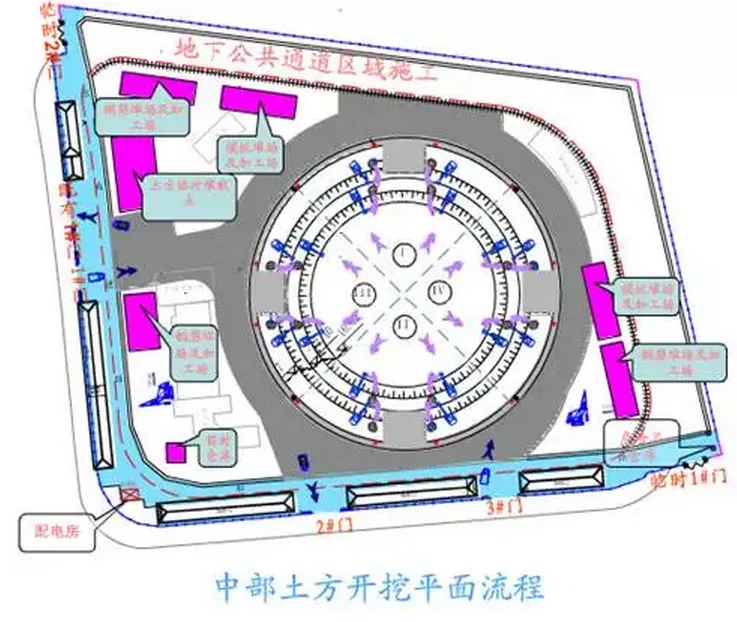
The foundation pit for the main building is constructed initially by the open cut method. The tower enclosure features a circular underground continuous wall, 121 meters in diameter and 1.20 meters thick, supported by six circular ring beams. After excavation, an unobstructed “wellbore” is formed inside, facilitating smooth structural operations.
The skirt area structure was subsequently constructed using the reverse method.
1.1 Dewatering Plan
- Install 42 vacuum tube wells and 4 observation wells, each 25 meters deep and spaced every 25 meters, for dewatering purposes.
- Set up 12 pressure relief and dewatering wells at 55 meters depth and 3 observation wells at 45 meters depth inside the main foundation pit.
- Place 28 depressurization and dewatering wells 65 meters deep outside the foundation pit.
- Install four observation wells at 45 meters depth inside and three observation wells at 45 meters depth outside the underground continuous wall that connects the two walls of the podium.
1.2 Earthworks
The total excavation volume is roughly 380,000 cubic meters. Excavation proceeds by first removing the central earthwork, then the surrounding ring earthwork, divided into six layers as follows:
- First and second earthwork layers (-10.37m)
- Third earthwork layer and second purlin (-16.42m)
- Fourth earthwork layer and third purlin (-21.42m)
- Fifth earthwork layer and fourth purlin (-25.42m)
- Sixth earthwork layer and fifth purlin (-29.30m)
- Seventh earthwork layer and sixth purlin (-31.60m)
2. Pile Foundation Engineering
2.1 Foundation Piles
The foundation piles are post-grouting drilled piles, with C50 concrete strength and a characteristic bearing capacity of 10,000 kN per pile. Two types of piles with a diameter of 1 meter are used:
- Type A: 86 meters long with an effective length of 56 meters, 247 piles located in the core cylinder area.
- Type B: 82 meters long with an effective length of 52 meters, 708 piles located in the expansion area.
2.2 Post-Grouting Construction
Each pile has three pre-installed grouting pipes at the pile end, with cement dosage of 4,000 kg per pile end. The acceptance of the grouting is controlled by both grouting volume and pressure, with volume as the main criterion.
2.3 Construction Process of Post-Grouting Drilled Piles
- Drilling is done by positive circulation, followed by reverse circulation hole cleaning.
- Specialized bentonite and additives are manually mixed for mud preparation; sand removal is performed using ZX-250 mud purification equipment.
- Drill bits used are three-wing double-waist types with counterweight drilling tools.
- The first cleaning uses reverse circulation with pump suction; the second cleaning uses reverse circulation with gas lift pump suction.
- Reinforcements are pre-processed, formed, and connected with straight thread connectors.
- Concrete is poured underwater using the conduit method.
- After the pile concrete reaches C45 strength, grouting is performed at the pile end.
2.4 Testing and Inspection
Foundation piles undergo 100% low strain variation testing, ultrasonic transmission testing, and hole quality inspections (including depth, diameter, and verticality). Additionally, 1% of the piles (11 piles total) undergo vertical compressive static load tests.
3. Large Volume Concrete Pouring of the Main Building Bottom Plate
3.1 Structural Details
The main building’s bottom plate is octagonal, covering approximately 9,370 m² with a thickness of 6 meters. A deep elevator shaft pit at the center was poured in advance. The skirt area’s bottom plate is 1.6 meters thick and adjacent to the underground wall. A transitional zone 3.5 meters wide connects the main building and skirt area, with thickness transitioning from 6 meters to 1.6 meters. The bottom plate surface elevation is -25.40 meters.
3.2 Concrete Specifications and Pouring
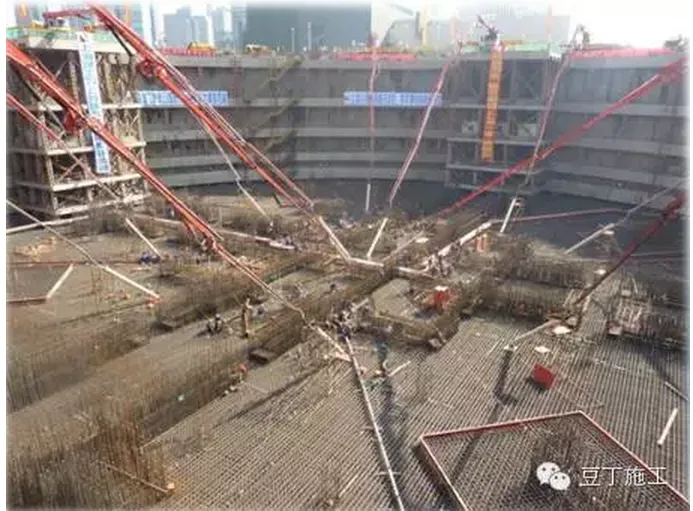
The bottom plate is made from C50R90 commercial concrete with an anti-seepage grade of P12. The total concrete volume poured was 60,000 m³. Eighteen concrete pumps were deployed, completing the pour in 60 hours at a rate of 1,000 m³ per hour.
Construction of the Upper Structure of the Main Building
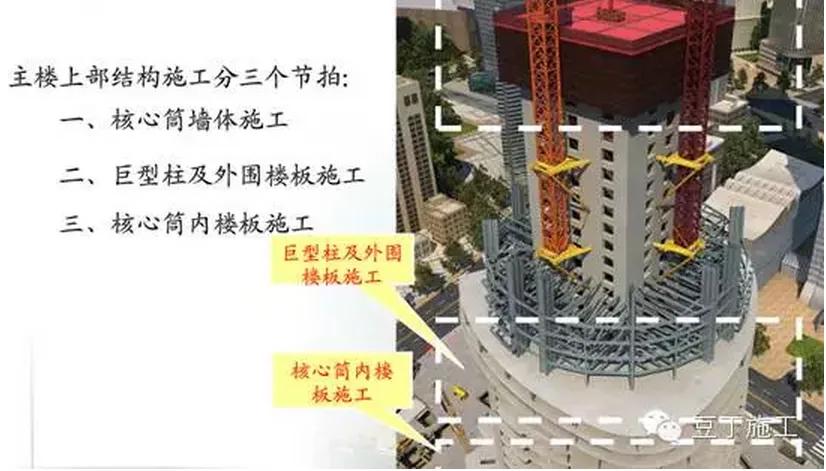
Construction of the Four Core Tubes
The core tubes are reinforced concrete structures with embedded steel columns at wall junctions throughout their height. Some walls feature single-layer steel plates connected by hidden beams between floors. The core tube accommodates a cantilever truss layer, with a cross-shaped cantilever truss installed inside the wall, running through the entire belly wall.
4.1 Reinforcement Engineering
Rebars with diameters 20 mm or larger are connected using upsetting straight thread mechanical joints; smaller rebars are connected by binding and overlapping.
4.2 Concrete Engineering
Core tubes use C60 grade concrete, while profiled steel plate composite floors use C35. Concrete pouring is accomplished with a fixed pump connected to two fabric dispensers.
4.3 Template Engineering
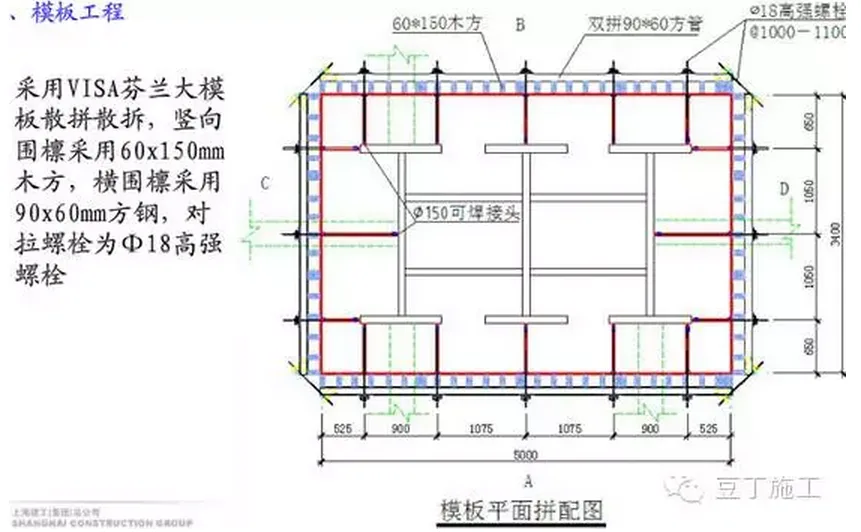
For floors below 12, VISA Finnish large templates are used; above floor 13, steel frame large templates are applied. Finnish Visa plywood shapes the template surfaces, with ribs and purlins made of steel sections.
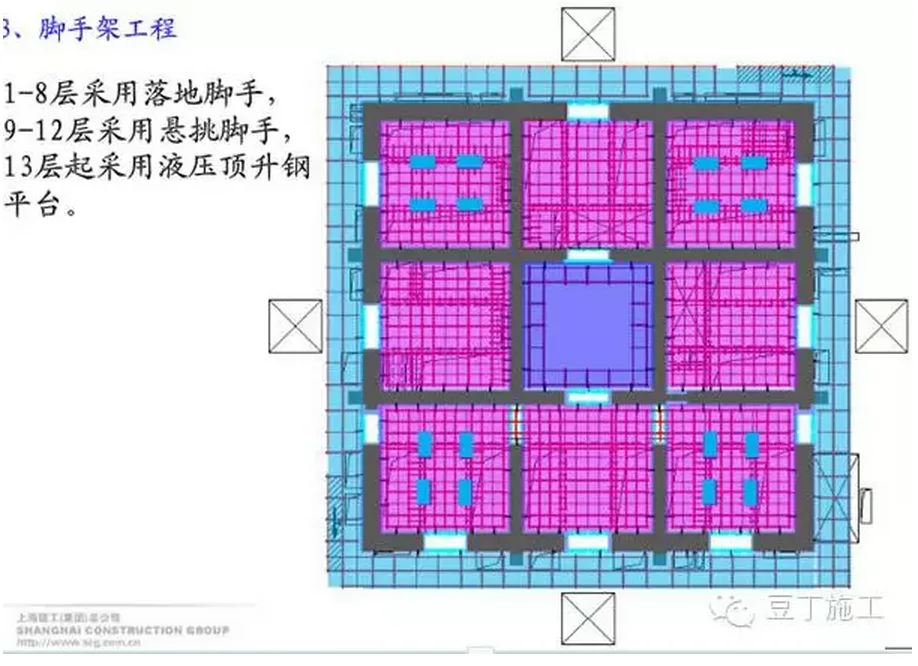
4.4 Scaffolding Engineering
Floor-standing scaffolding is used for floors 1–8, cantilever scaffolding for floors 9–12, and hydraulic lifting steel platforms for floors 13 and above.
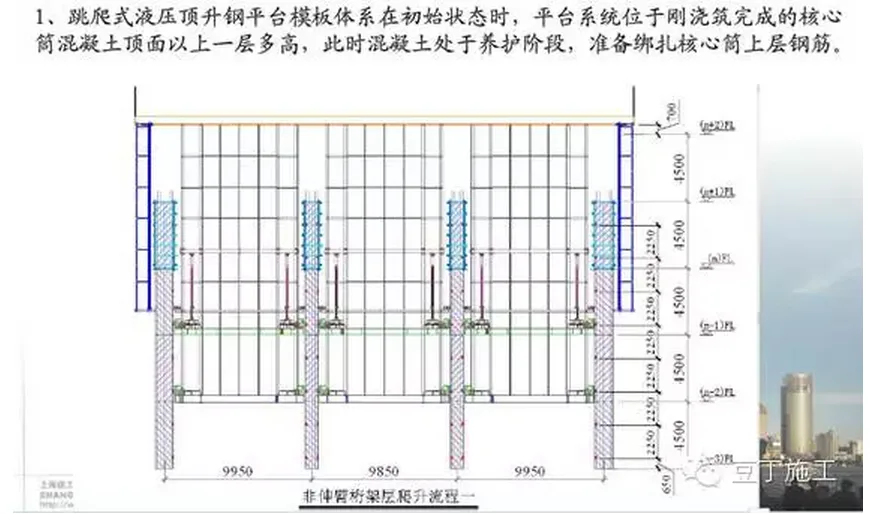
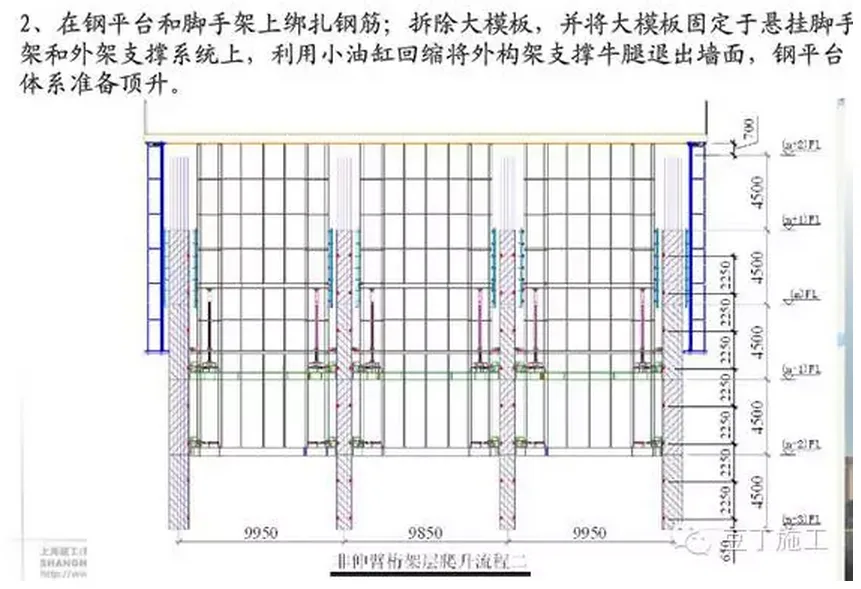
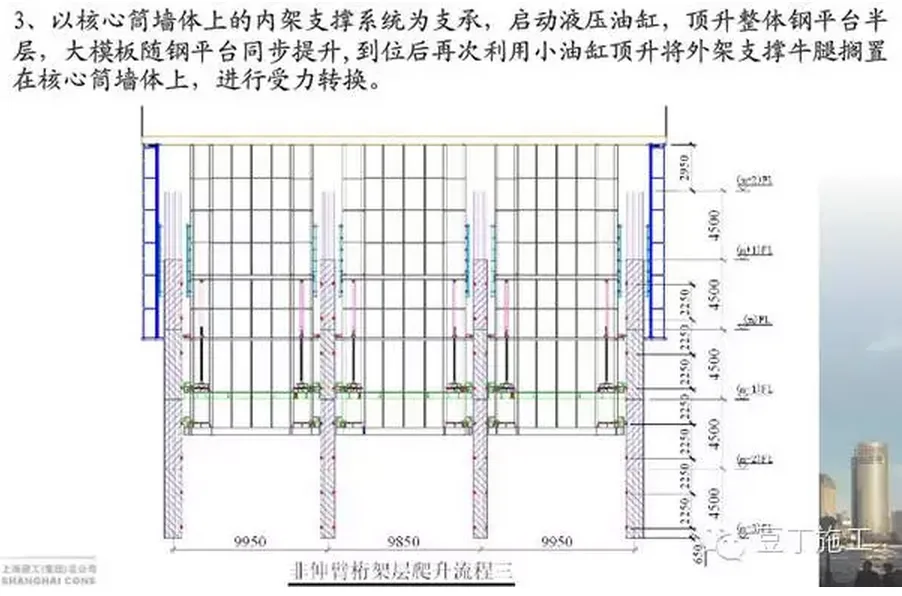
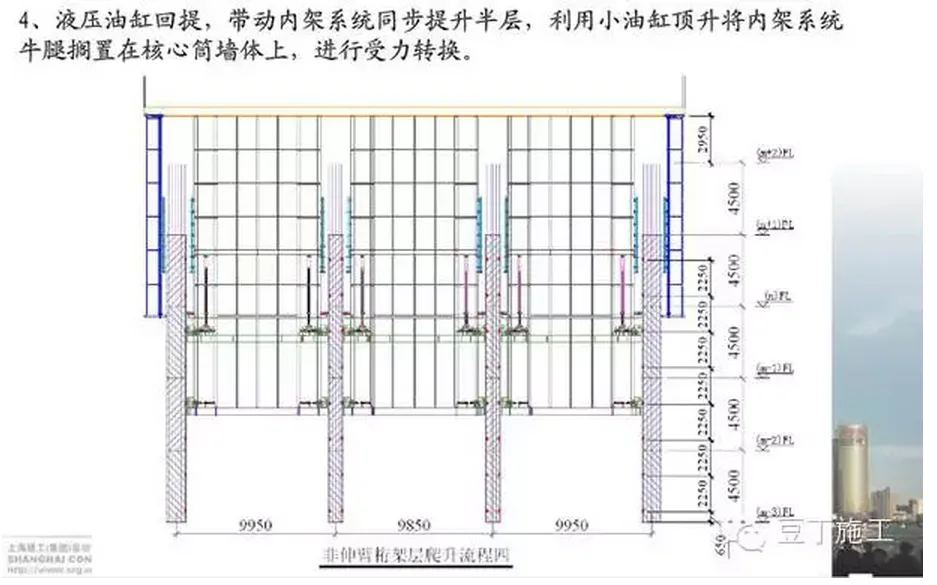
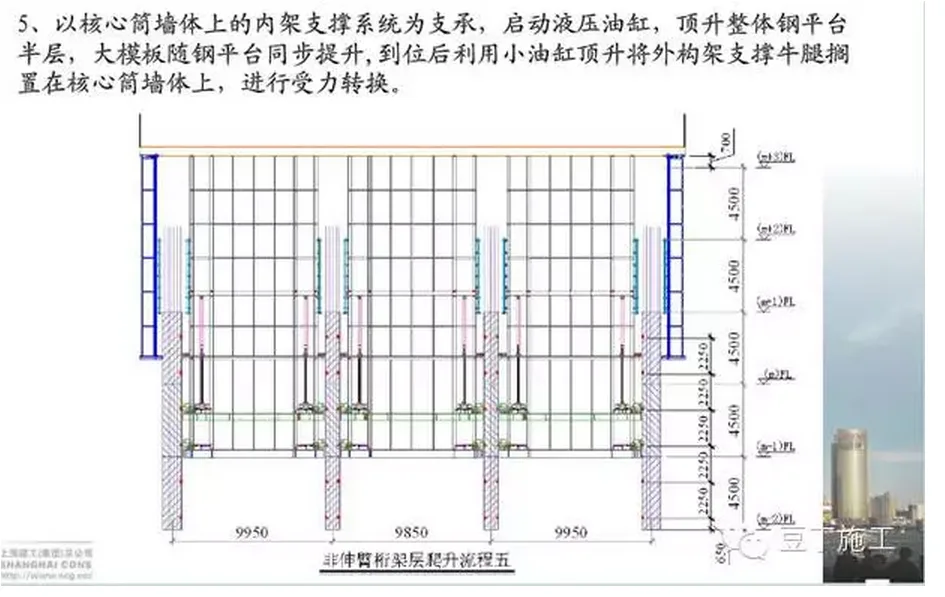
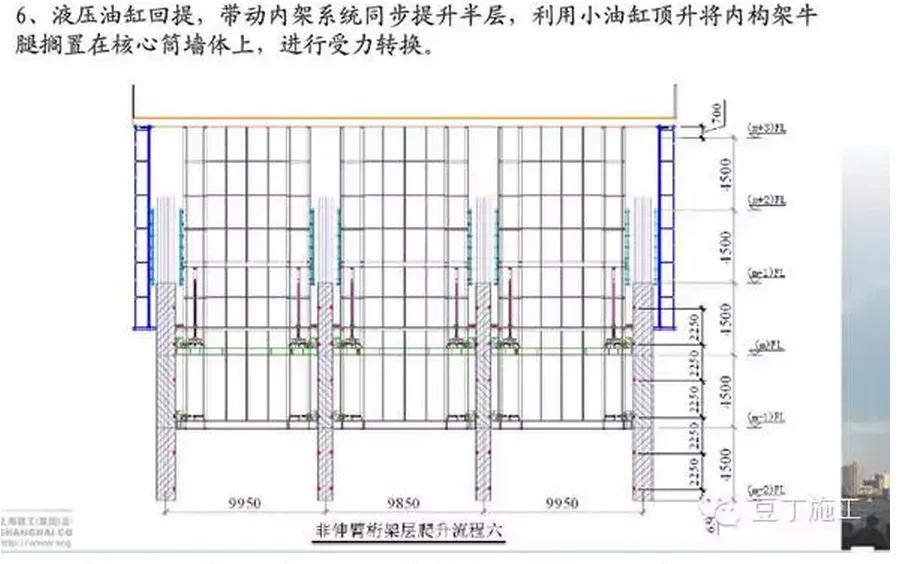
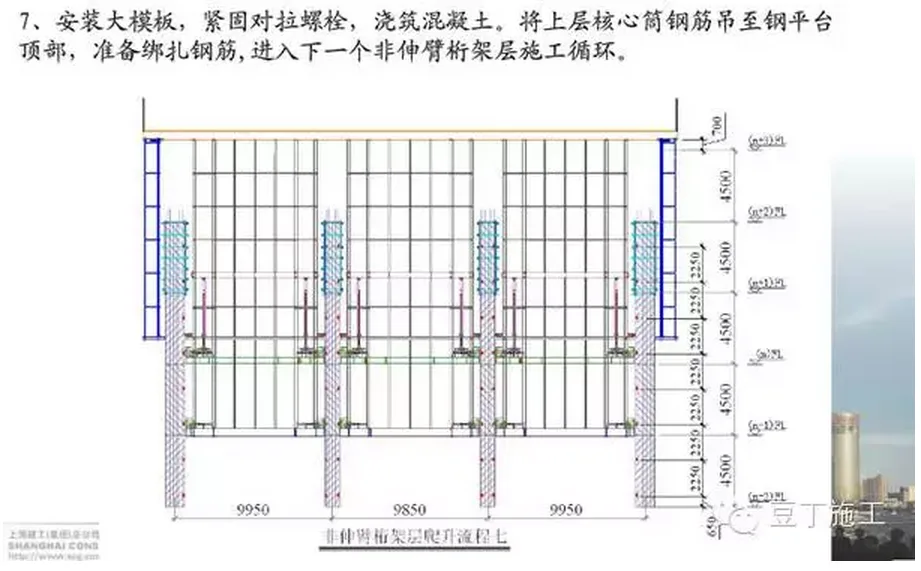
4.5 Climbing Process of Steel Platforms for Standard Core Tube Layers (Non-Cantilever Truss Layers)
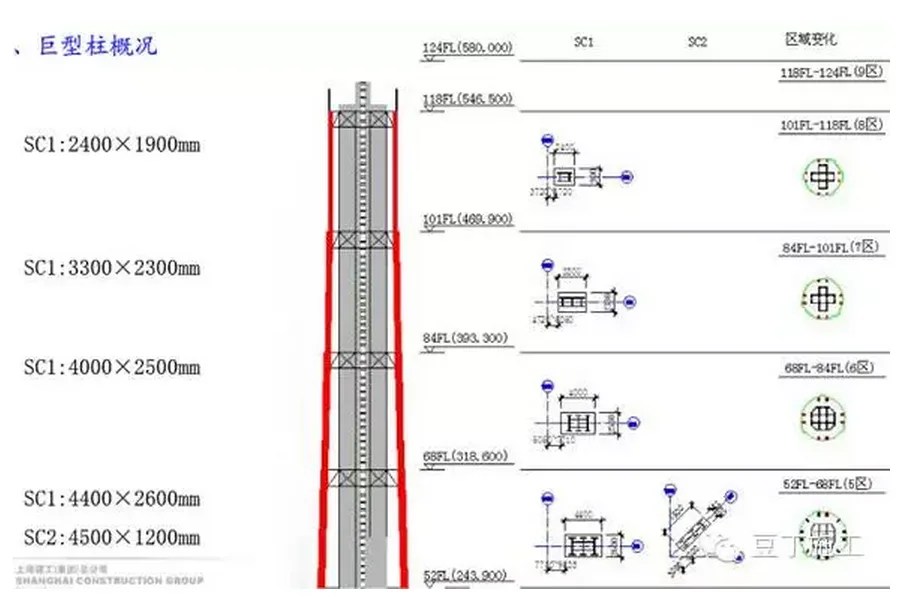
Construction of Five Peripheral Frames (Giant Columns) and Floor Slabs
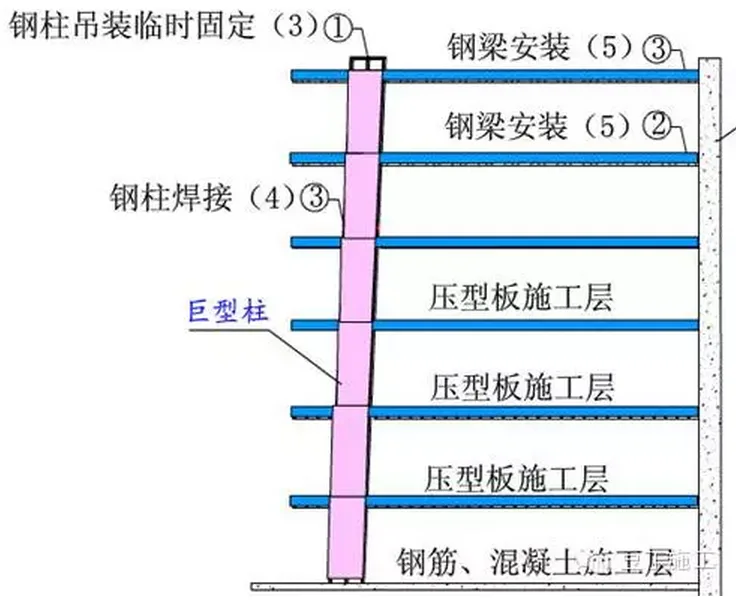
Schematic Diagram of Construction Process for Peripheral Framework of Core Tube
5.1 Giant Column Template
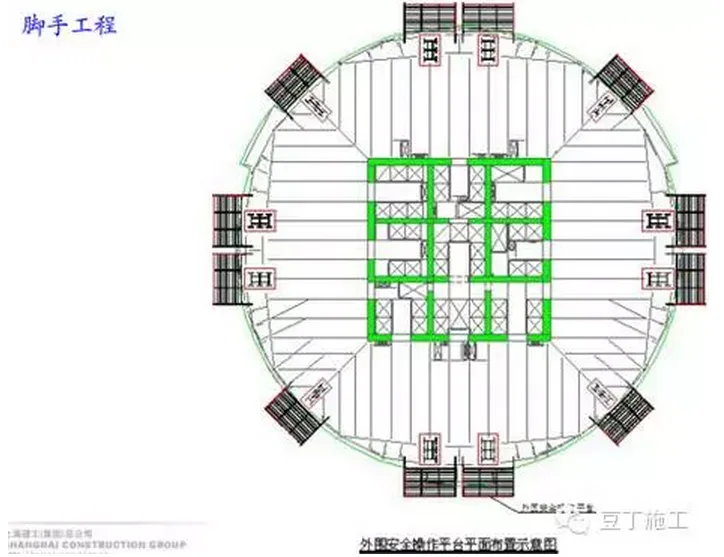
5.2 Construction Scaffolding for Peripheral Framework
Construction of Internal Floor Slabs for Six Core Tubes
Profiled steel plate composite floor slabs are used.
Important Machinery and Equipment in Construction Technology
1. Construction Elevators
Twenty construction elevators are installed inside the core tube. Of these, 11 serve both passengers and cargo, while 9 permanent elevators are repurposed as construction elevators.
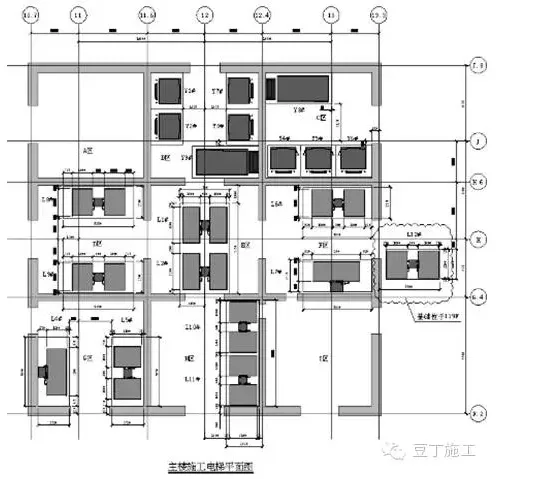
Classification by Purpose
- A: High-speed, double-cage elevators for both personnel and goods transportation.
- B: High-speed, single or double-cage elevators for curtain wall work, secondary structures, decoration, mechanical and electrical installation, and other material and personnel transport.
- C: Permanent elevators used as construction elevators.
2. Concrete Fixed Pumps
Construction plans focus on concrete pumping equipment, pipe laying technology, and concrete performance.
- For pumping concrete below 200 meters in the core cylinder, the HBT90CH-2135 pump from Sany Heavy Industry is used.
- Between 200 and 556 meters, two backup HBT90CH-2150 pumps operate for the core tube.
- From 556 to 632 meters, one backup HBT90CH-2150 pump is employed.
- Concrete vertical conveying pipes have a diameter of 150 mm and a wall thickness of 10 mm, made from wear-resistant alloy steel composite materials. The inner surface is high-frequency quenched to achieve a hardness of HRC60 or higher.
3. Fabric Machines
Two concrete laying machines with 28-meter arms are used for pouring concrete in the core tube construction.
4. Tower Cranes
- Four ultra-large tower cranes are installed on the four outer facades of the core tube. Three are Fakefu M1280D cranes, and one is a Nanjing Zhongsheng ZSL2700.
- The Fakefu M1280D cranes have a lifting moment of 2450 tm and a maximum lifting capacity of 100 tons within a 20-meter radius.
- The Nanjing Zhongsheng ZSL2700 crane can lift up to 100 tons within a 26-meter radius.
- All tower cranes use external climbing systems. A custom-designed climbing frame is fixed to the outer facade of the core tube, transmitting the crane’s weight to the core tube through this frame.
- Climbing frame stress is monitored in real time using vibrating wire strain sensors and wireless data acquisition systems. This ensures that the climbing frame’s stress during tower crane assembly, climbing, and operation meets design requirements, providing critical data for structural calculations.












Must log in before commenting!
Sign Up