
1. Preparation Tasks, Content, Classification, and Requirements
Basic Tasks of Construction Preparation
The primary goal of construction preparation is to establish the necessary technical and labor conditions for the project. This involves coordinating and organizing construction teams and preparing the construction site effectively.
The Importance of Construction Preparation
Construction preparation plays a vital role in the production and operational management of construction enterprises. It serves as a critical phase in the construction process to minimize risks and enhance the overall economic benefits of the enterprise.
Classification and Content of Construction Preparation Work
(1) Classification Based on the Scope of Work
1. Overall construction preparation (full site preparation)
2. Preparation of construction conditions for individual or unit projects
3. Preparation of operating conditions for sub-projects or sub-items
(2) Classification Based on Construction Stages
1. Preparation before construction commencement
2. Preparation before each stage of construction
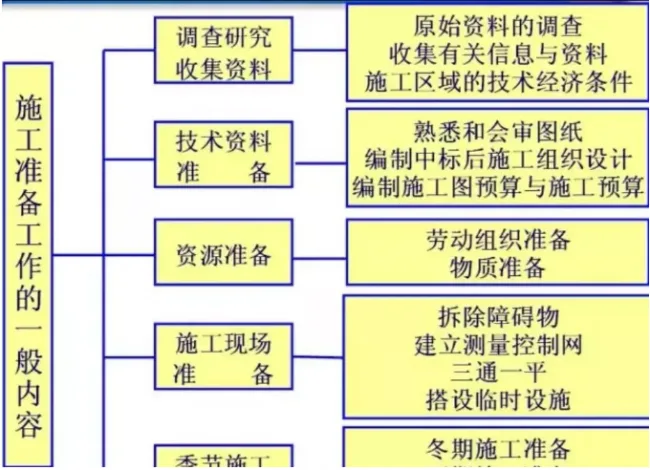
Requirements for Construction Preparation
Construction preparation must be organized and executed in a phased, systematic manner. It requires a strict responsibility system and a corresponding inspection framework. Adherence to standard construction procedures and the construction commencement reporting system is mandatory. Preparation activities should persist throughout the entire construction process and benefit from cooperation among all involved parties.
2. Construction Site Personnel
Labor organization preparation covers not only the entire construction enterprise but also large-scale complex projects and smaller unit projects. Using a proposed construction project as an example, labor organization preparation includes:
1. Labor Organization Preparation
This involves managing both the construction leadership and operational teams:
- Establish a leadership structure tailored to the project’s scale, complexity, and characteristics.
- Organize an efficient, lean construction team ensuring collaboration across professions.
- Mobilize construction forces and coordinate labor entry onto the site.
- Conduct construction organization design, planning, and technical briefings for the teams and workers.
- Develop and refine management systems.
Leadership Structure Establishment
The leadership should be composed based on project needs, emphasizing reasonable division of labor, close cooperation, experience, innovation, and responsibility adherence. The project management department is then created with clearly defined tasks, hierarchy, departments, personnel responsibilities, and assessment systems.
Project Management Department Formation Steps:
- Define management tasks and organizational form per the approved project management plan.
- Establish hierarchical structures, functional departments, and job roles.
- Assign personnel, responsibilities, and authorities.
- Decompose objectives based on management agreements.
- Set up rules, assessment, and incentive systems.
Determining Organizational Form:
- Large and medium projects typically adopt matrix project management.
- Projects distant from enterprise management might form business unit-style management departments.
- Small projects often use linear functional project management.
Lean Construction Team Formation
Form team groups ensuring rational cooperation among professions, balancing skilled and general workers to optimize labor organization. Develop a detailed labor demand plan accordingly.
Mobilizing Construction Labor
Once leadership and teams are established, organize labor entry according to schedules and demand plans. Provide safety, fire prevention, and civilized construction training, and arrange suitable living accommodations.
Construction Organization Design and Technical Briefings
- Purpose: To clearly communicate design details, construction plans, and technical requirements to all workers, ensuring accountability.
- Timing: Conduct prior to the start of sub-projects to guarantee compliance with design, safety, and quality standards.
- Content:
- Site conditions and coordination requirements.
- Scope, quantity, workload, and progress expectations.
- Design drawings explanation including potential construction challenges.
- Construction plans emphasizing organization, safety, and civility.
- Operating techniques and quality assurance measures.
- Process quality standards, evaluation methods, and inspection requirements.
- Efficiency improvement and resource-saving strategies.
- Technical record-keeping protocols.
- Other construction precautions.
- Methods: Written, verbal, and on-site demonstrations.
Management Systems Development
Establish and improve various systems including job responsibilities, technical management, quality control, safety, scheduling, cost accounting, materials and equipment management, site management, reward systems, meeting protocols, subcontracting, coordination, and information management.
Labor Optimization and Training
- Organize technical personnel to inspect similar projects and address construction challenges.
- Provide specialized training to adapt to new processes and materials.
- Enhance quality awareness and education.
- Implement optimized labor combinations, dynamic management, and two-way selection to maximize employee motivation.
- Thoroughly implement construction organization design and technical disclosures.
- Strengthen safety, fire prevention, and civilized construction education.
3. Construction Site Preparation
Concept and Purpose
The construction site serves as the operational arena where the construction team engages in coordinated activities to achieve high quality, speed, and cost-efficiency. Preparation focuses on creating favorable conditions and ensuring material readiness for the project.
Site Preparation Tasks
- Ensure the “three connections and one leveling” (water, road, electricity, and site leveling).
- Measure and establish control networks for the site.
- Construct temporary facilities for production, offices, living, and storage.
- Install and debug construction equipment.
- Conduct supplementary site explorations to identify hidden obstacles.
- Organize storage and stacking of building components, products, and materials.
- Prepare timely testing plans for building materials.
- Set up fire safety and security facilities.
- Remove obstacles from the site.
Details of Key Preparations
“Three Connections and One Leveling” Explained:
- Roads (Lutong): Essential for material transport; repair permanent and temporary roads to ensure smooth logistics.
- Water (Shui Tong): Connect construction and domestic water pipelines, integrate with permanent supply, and establish drainage systems.
- Electricity (Dentsu): Connect power and telecommunications, ensure supply of energy sources for smooth operation.
- Site Leveling: Remove obstacles, calculate earthwork, and level the site according to design elevations.
Site Control Network Measurement
- Conduct measurements based on design plans using calibrated instruments; establish permanent benchmarks and control points.
- Develop measurement plans for alignment, elevation, settlement, and completion checks.
- Ensure building layout aligns with urban planning regulations and does not exceed designated boundaries.
Temporary Facilities Construction
Build temporary structures for production, offices, living quarters, and storage as per the construction master plan.
Equipment Installation and Debugging
Organize entry, placement, and setup of construction machinery. For fixed equipment, complete positioning, sheltering, power connections, maintenance, and testing before operation.
Supplementary Site Exploration
Identify hidden obstacles such as dry wells, underground pipelines, shelters, or roots to plan proper handling strategies.
Material Storage and Stacking
Store components, products, and materials according to demand plans and designated areas outlined in the master plan.
Material Testing Plans
Schedule tests for steel properties, concrete and mortar mixes, and other building materials as required.
Fire Safety and Security Setup
Install fire protection and security systems per the construction organization design and master plan, along with relevant organizational structures and regulations.
Obstacle Removal
- Clear above and underground obstacles before construction begins.
- Coordinate the demolition of buildings, ensuring proper utility disconnections and permits for blasting when necessary.
- Dismantle overhead lines and underground cables with appropriate departmental coordination.
- Handle pipelines and trees with required approvals and professional assistance.
- Remove debris promptly after clearing obstacles.
4. Technical Preparation
Technical preparation is critical to prevent safety hazards and quality issues. Its main components include:
- Familiarizing and reviewing construction drawings.
- Preparing the construction organization design after winning the bid.
- Preparing construction drawing budgets and overall construction budgets.
- Investigating and analyzing original data.
Familiarizing and Reviewing Drawings
Purpose:
- Ensure construction aligns with design requirements to deliver the intended final product.
- Guarantee that technical and management personnel understand the design intent, structural features, and technical standards.
- Identify and correct errors before construction begins, providing accurate drawings.
Basis for Review:
- Preliminary and detailed design documents from design units.
- Collected original data.
- Applicable design, construction, acceptance standards, and regulations.
Content of Review:
- Verify design licensing and official signing.
- Check completeness of geological data.
- Ensure compliance with local design and seismic requirements.
- Identify contradictions within drawings and between professional disciplines.
- Confirm consistency in dimensions, elevations, and representations.
- Check fire prevention measures and embedded parts.
- Assess material sources and suitability.
- Evaluate foundation treatment methods and structural feasibility.
- Review pipeline, electrical, equipment layouts, and safety/environmental compliance.
- Ensure drawings meet supervisory requirements.
Review Process:
- Self-Review: Construction teams review drawings internally, documenting questions and suggestions.
- Joint Review: Involves design, construction, and supervision units reviewing together, resolving issues, and formalizing a review summary to guide construction.
- On-Site Verification: During construction, discrepancies or improvement suggestions lead to technical verification and design changes, documented properly and approved as necessary.
Preparation of Construction Organization Design
This key document guides all construction activities, balancing relationships between personnel, processes, equipment, and resources. It is developed based on project scale, characteristics, and original data to ensure efficient management.
Construction Drawing Budget and Construction Budget
Construction Drawing Budget: A technical-economic document estimating project costs based on drawings, methods, quotas, and standards. It supports contract signing, account settlement, financing, cost calculation, and management.
Construction Budget: An internal economic document based on contract price and project plans, controlling internal cost accounting.
Difference: The drawing budget sets economic terms between client and contractor, while the construction budget manages internal enterprise costs. Comparing both (“two calculations”) helps optimize material consumption and economic efficiency.
5. Preparation of On-Site Production Materials
Materials, components, products, machinery, and equipment form the foundation for smooth construction. Preparation includes identifying sources, arranging transport and storage, and ensuring continuous supply based on demand plans. Key areas include:
- Building materials preparation
- Components and products preparation
- Building installation equipment preparation
- Templates and scaffolding preparation
- Production process equipment preparation
Details:
- Building materials: Analyze budgets to summarize specifications, reserves, and consumption quotas, forming material demand plans to guide procurement and storage.
- Components and products: Plan processing, supply, storage, and transport based on budgeted specifications and consumption.
- Installation equipment: Schedule and coordinate machinery type, quantity, timing, supply methods, and storage location.
- Templates and scaffolding: Prepare as required for construction needs.
- Process equipment: Define names, models, capacities, quantities, entry timing, storage, and transport plans based on process flow and layout.
Material Preparation Procedure
- Develop comprehensive material requirement plans based on budgets, methods, and schedules.
- Organize sources and sign supply contracts.
- Plan transportation and logistics.
- Manage storage and preservation per the construction master plan, ensuring materials arrive and are stored appropriately.
6. Seasonal Construction Preparation
Rainy Season Preparation:
- Schedule rain-sensitive tasks like foundations and outdoor work before the rainy season; reserve indoor work during the rainy period.
- Enhance management and safety education.
- Ensure effective flood control and drainage.
- Maintain roads for smooth transportation.
- Properly store materials and protect machinery.
Winter Preparation:
- Arrange machinery, additives, and insulation materials in advance.
- Construct boiler rooms, mixing plants, pipelines; perform safety tests.
- Calculate power supply capacity and energy-saving measures.
- Insulate temporary water and drainage systems; clear snow to maintain transportation.
- Test winter concrete mixtures and adjust proportions.
- Ensure indoor construction insulation and heating systems are operational.
Summer Preparation:
- Develop specific summer construction plans.
- Install lightning protection devices on-site.
- Implement heatstroke prevention and cooling measures for workers.
Article source: Prefabricated Building Network in the Construction Industry
















Must log in before commenting!
Sign Up