
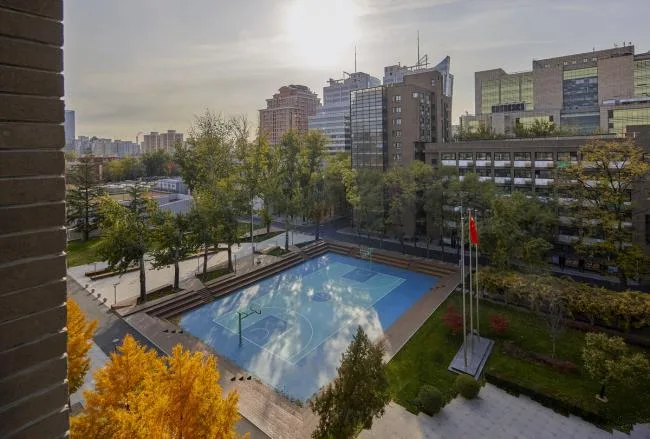
▲ The renovated core area of Peking University Affiliated High School campus
Reflecting on my youth, the most unforgettable memories—the most thrilling moments and heartfelt conversations—often took place in some quiet corner of the campus. Last year, while renovating the campus landscapes of Peking University Affiliated High School and its Chaoyang Future School branch, Crossboundaries revisited the vibrant spirit of student life and reconsidered the campus’s essential role in education.
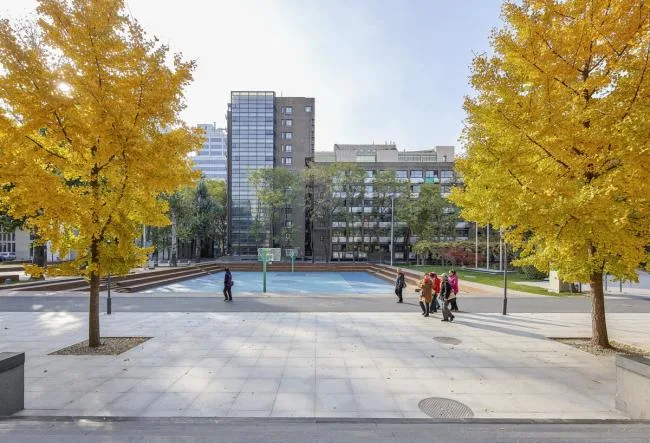
Alumni returning to Peking University Affiliated High School pass by the old stadium and today’s sunken activity area
Today, many innovative educational spaces adopt freely arranged classrooms and corridors to give learners more control and foster independence. But what about the campus itself? As the central hub for movement, activities, and daily life of teachers and students, the campus reflects society’s complexity and offers diverse opportunities for education and exchange. Therefore, it deserves an open, relaxed, and welcoming atmosphere, where students can rehearse their futures on this vibrant stage during their most formative years.
Guided by this vision, our renovation transformed the traditionally segmented and enclosed “rigid spaces” into more open and continuous “free spaces” that respond to the real needs and experiences of students.
Campus Story 1:
Peking University Affiliated High School — Free Paths, Open Spaces
In many Chinese campuses and corporate courtyards, functional areas like main buildings, sports fields, and green zones are usually arranged in a regular layout, connected by vehicle lanes. Established in the early 1960s, Peking University Affiliated High School follows this pattern. Despite several landscape changes over the decades, much of its history remains visible.
Currently, the school promotes a “student-centered” educational philosophy, encouraging students to express their nature and make independent decisions. After commissioning Crossboundaries to renovate its teaching spaces, gymnasium, and art center in 2016, the school sought to refresh the core campus landscape.
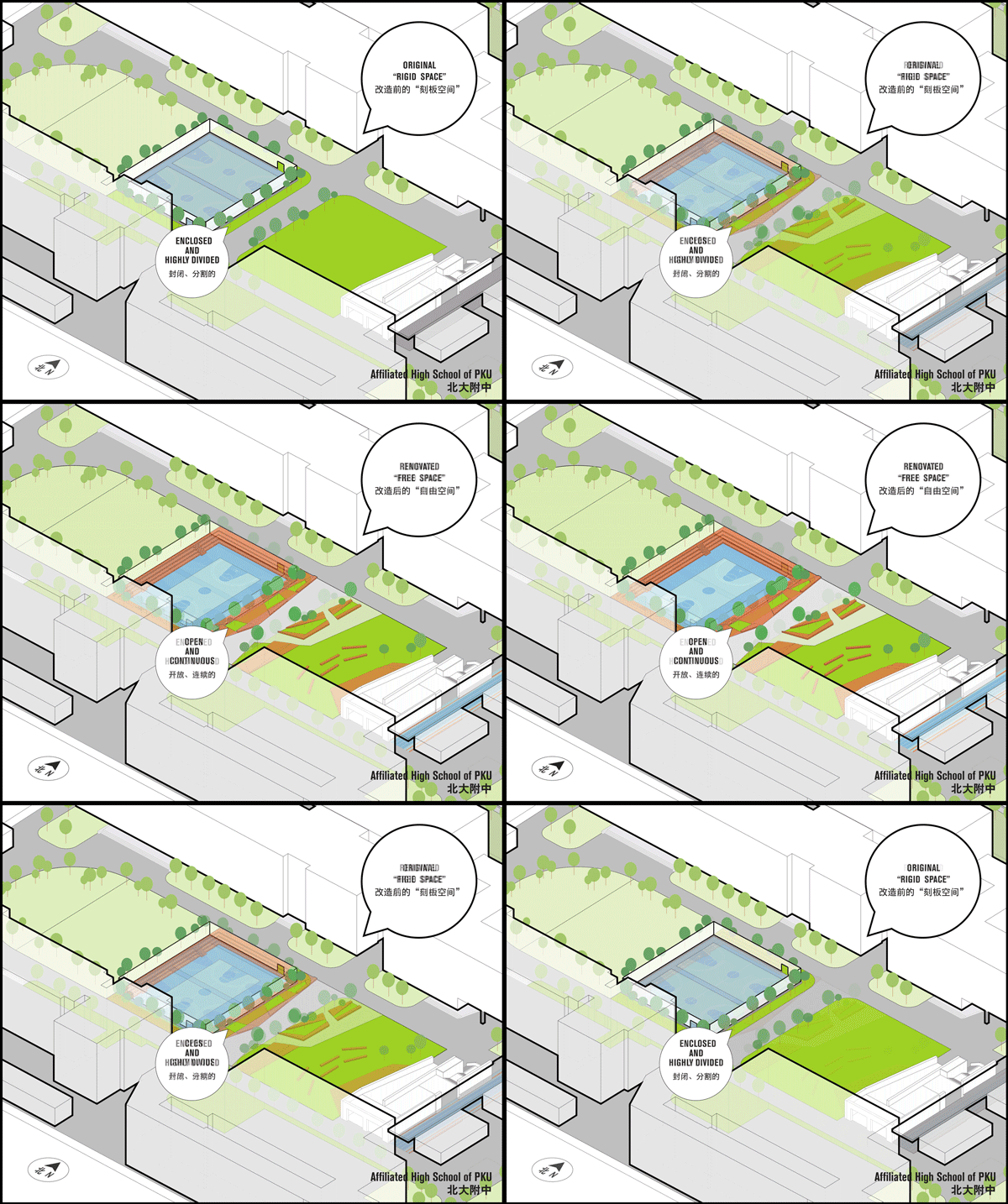
▲ Transformation Strategy
Putting People First
We observed that traditional campus traffic prioritizes vehicle lanes, with pedestrian routes confined to the sides. Although foot traffic is far more frequent and widespread, it ranks secondary to vehicles.
This dominance of “driving” logic over “walking” creates inefficiencies: pedestrians must take lengthy detours, reducing accessibility and convenience, while the constant risk of vehicle-pedestrian interaction compromises safety and comfort. Moreover, teachers and students need spaces for leisure and socializing—not just basic passage. But such spaces are often fragmented by vehicle lanes.
To address this, we collaborated with the school to completely remove one of the main motor vehicle lanes in the campus core, reclaiming space for pedestrian movement and activity. This change prioritizes people over vehicles, granting more freedom and opportunities to pause and connect.
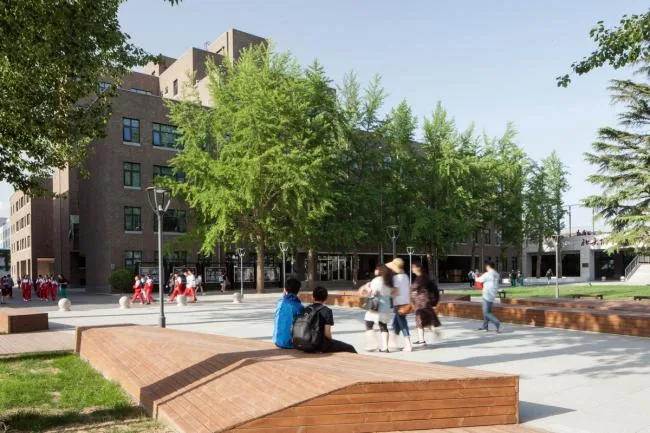
▲ Campus center after the removal of the motor vehicle lane
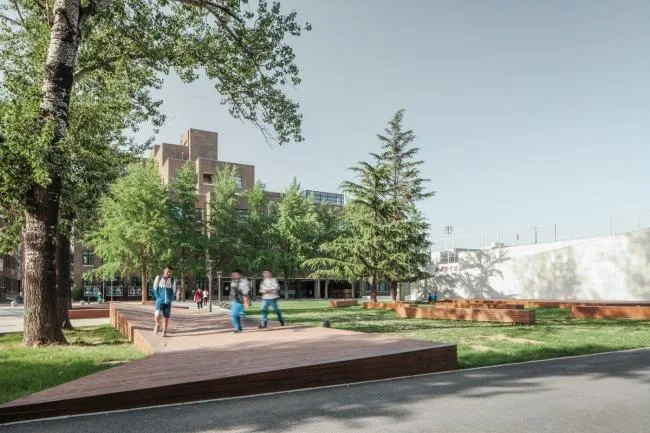
▲ Enjoy a free-flowing campus, travel your way
Breaking Down ‘Isolated Islands’
With the vehicle lanes resolved, we tackled several enclosed or single-purpose “islands” on campus to create a more unified, open space.
At the heart of the campus stood a closed basketball training ground, surrounded by tall barbed-wire fences. When gathering feedback, the most cherished request was to preserve the old stadium, as it holds countless treasured memories: grabbing a quick game between classes, braving the sun or snow, friendships forged through competition, impressive shots from midfield, moments of collective pride, and heart-pounding excitement.
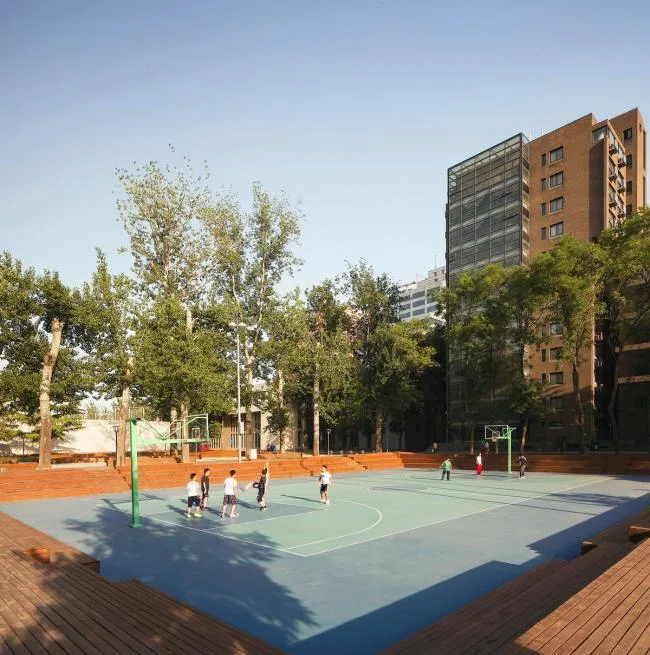
▲ Preserving the basketball court’s function
Following construction of the new gymnasium, we reimagined this space for greater efficiency: the “iron cage” was removed, two practice courts merged into a standard basketball court, and seating plus free-form benches were added around it. This sunken activity area was fully opened and integrated naturally into pedestrian paths, enhancing both the physical and visual connections across campus.
Now, teachers and students can easily enjoy lively outdoor basketball games and find comfortable spots to gather or rest.
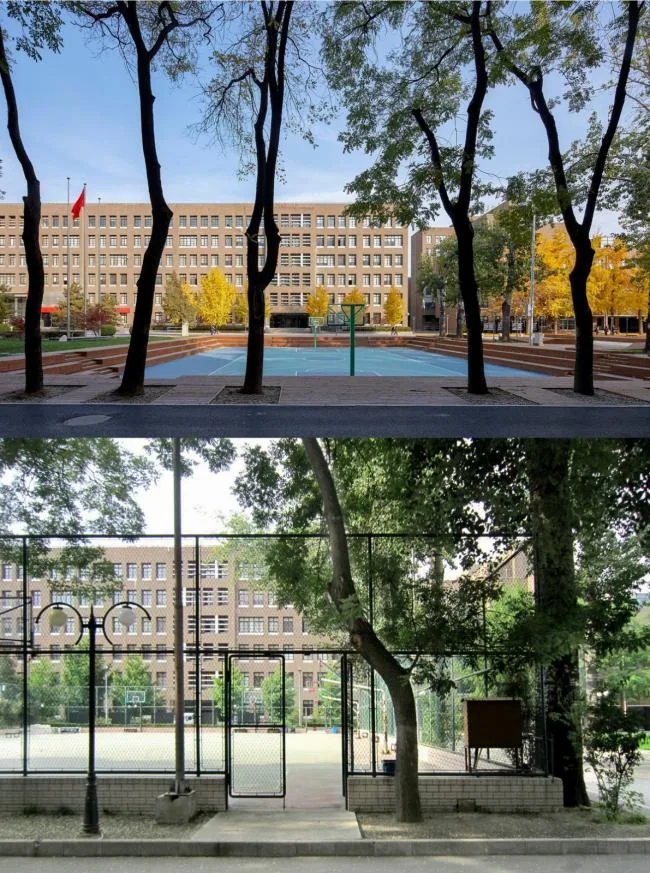
▲ Removing the “Iron Cage” around the court
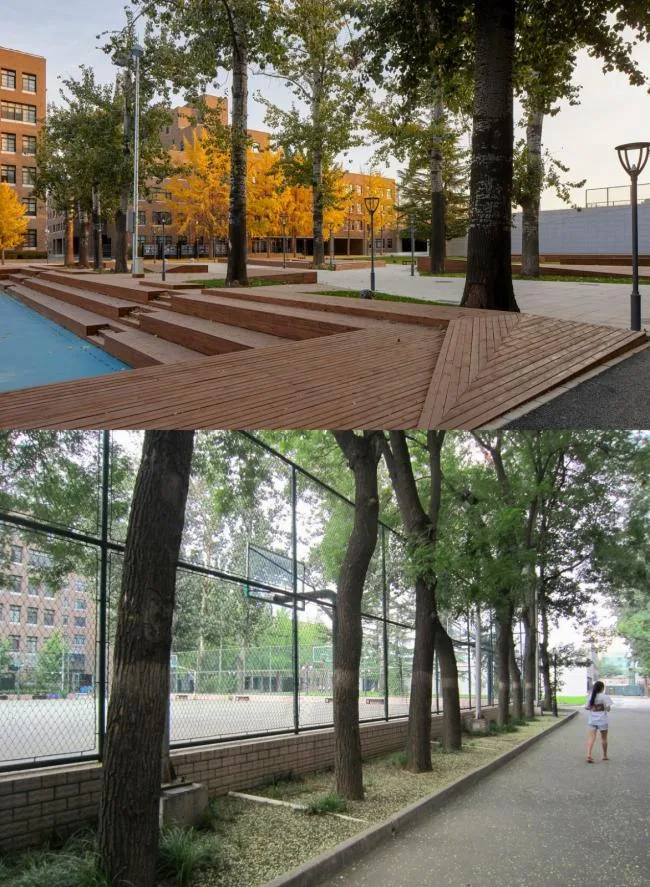
▲ Formerly closed spaces are now open and accessible
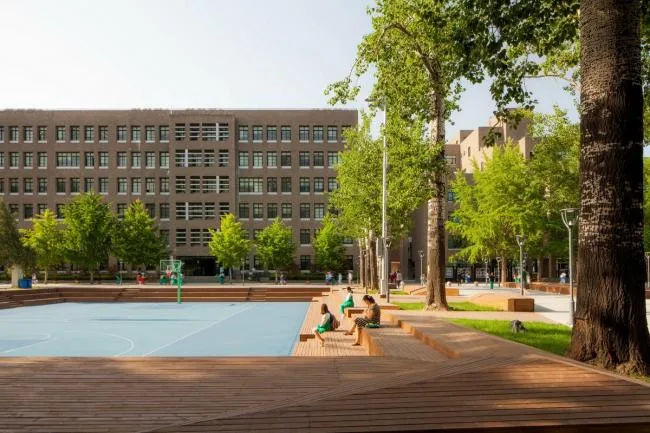
▲ Spectator seating doubles as a resting place
Although the large central lawn permits entry, few are comfortable sitting directly on the grass, leaving this vast space underused. To transform this, we introduced outdoor seating fixtures within the lawn and around roadside trees, creating an “outdoor classroom” or “living room” that invites spontaneous and comfortable interaction.
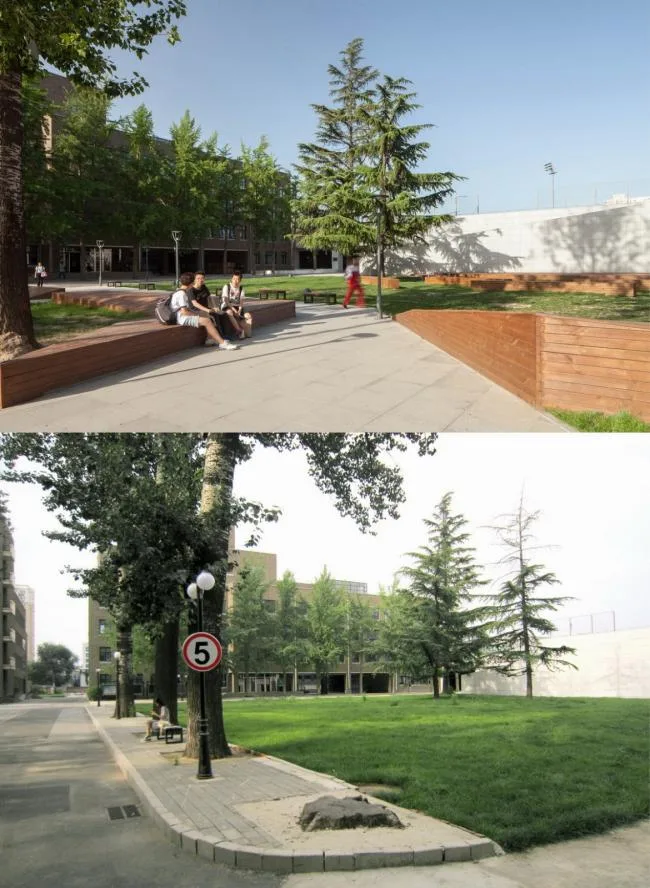
▲ Transformation of the large lawn into a social space
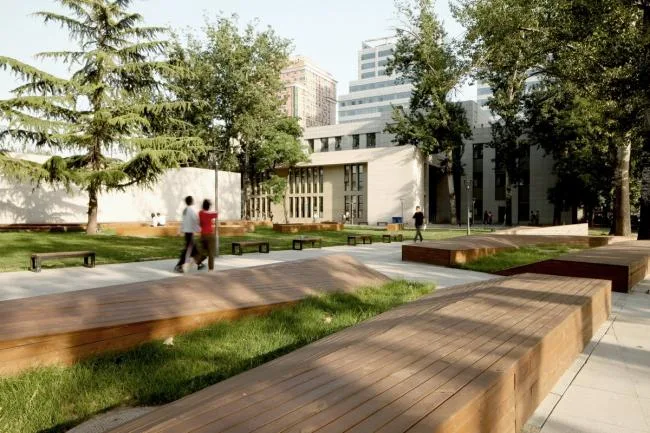
▲ Benches integrated with the lawn improve accessibility
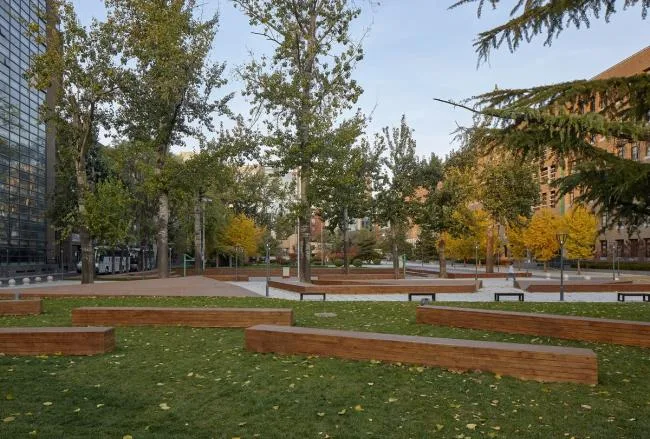
▲ Flexible seating arrangements
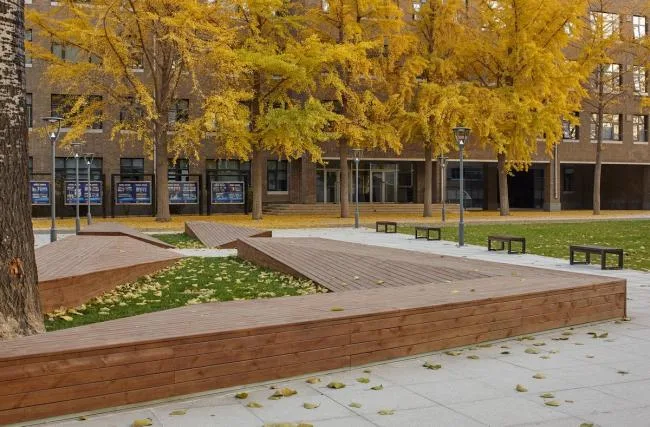
▲ An “outdoor living room” harmoniously integrated with greenery
We also revitalized a previously dark and underused inter-building fire escape by installing a running track and embedding functional elements like rest areas and bulletin boards along its walls. This 100-meter track has become one of the school’s most popular sports training venues.
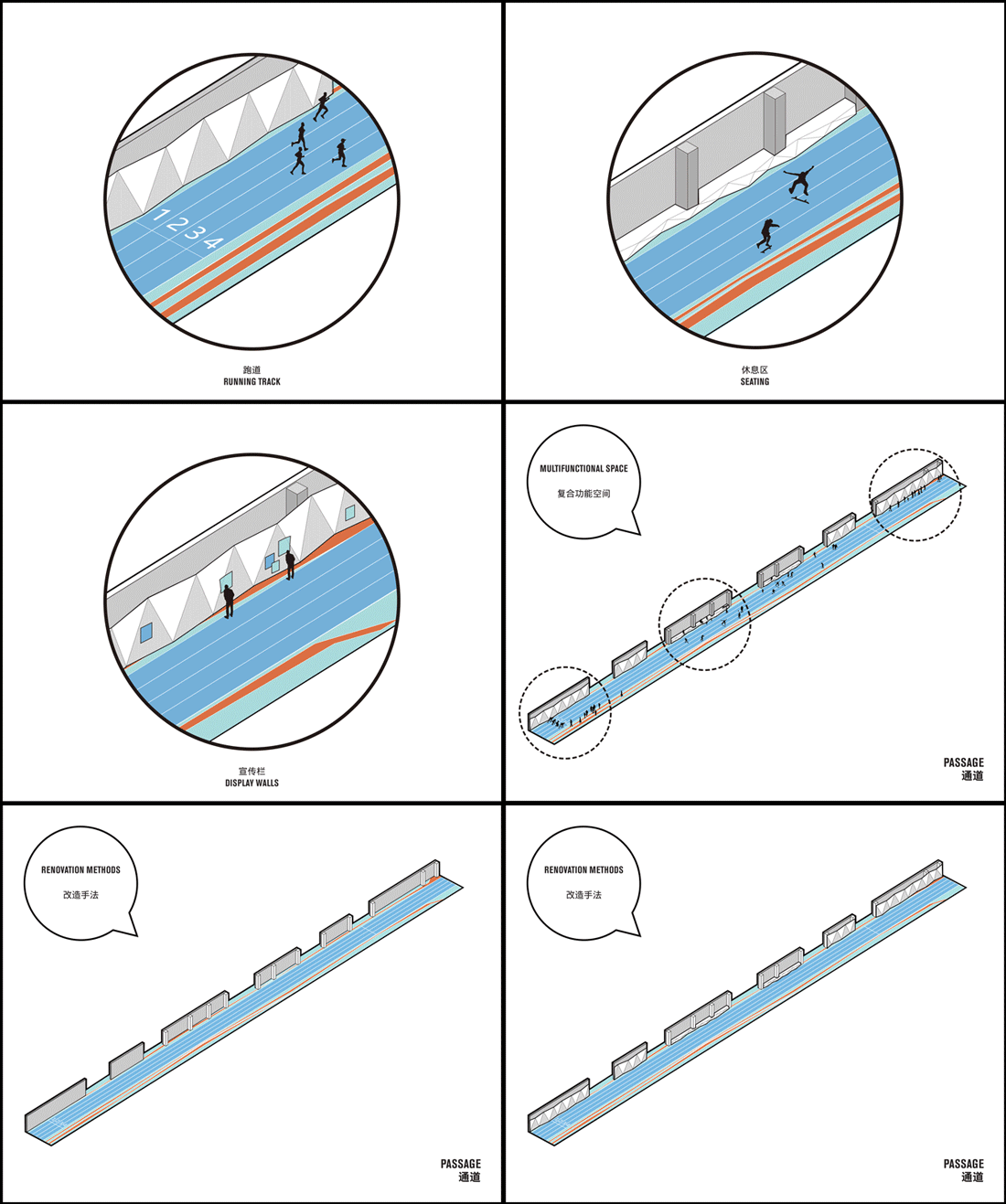
▲ Schematic diagram of the revitalized passage
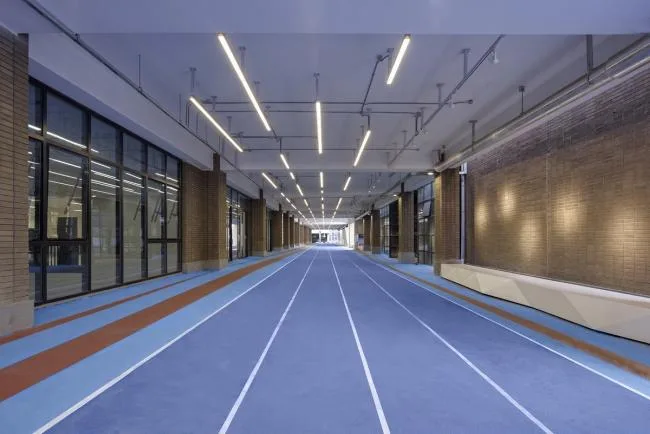
▲ Turning a neglected fire exit into an active sports area
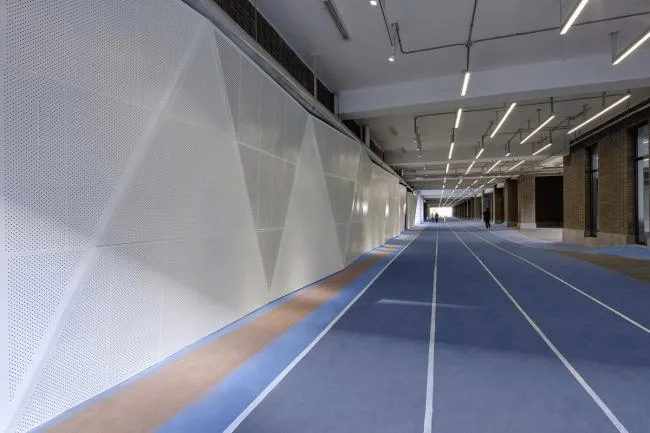
▲ Embedded functional elements
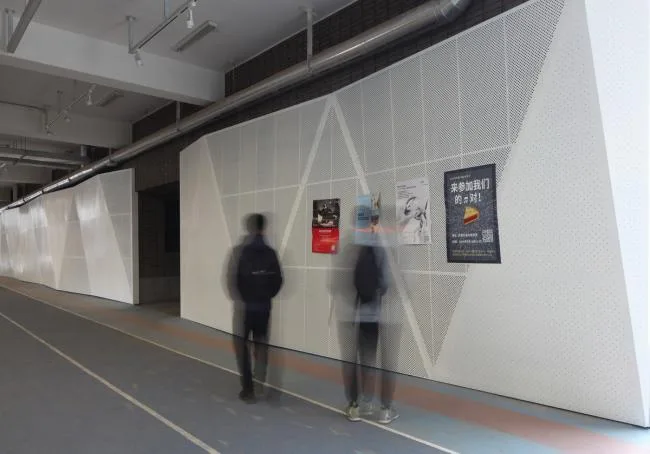
▲ Added bulletin boards for communication
Campus Story 2:
Chaoyang Future School — Holistic Design Spreading Education Throughout the Campus
The newly renovated Chaoyang Future School campus offered us greater creative freedom. Educators there embrace the idea that “education is everywhere,” so the campus should seamlessly extend indoor teaching spaces, sharing consistent values and an inseparable connection. Using an integrated design approach—from architecture to signage—we incorporated landscape considerations from the outset.
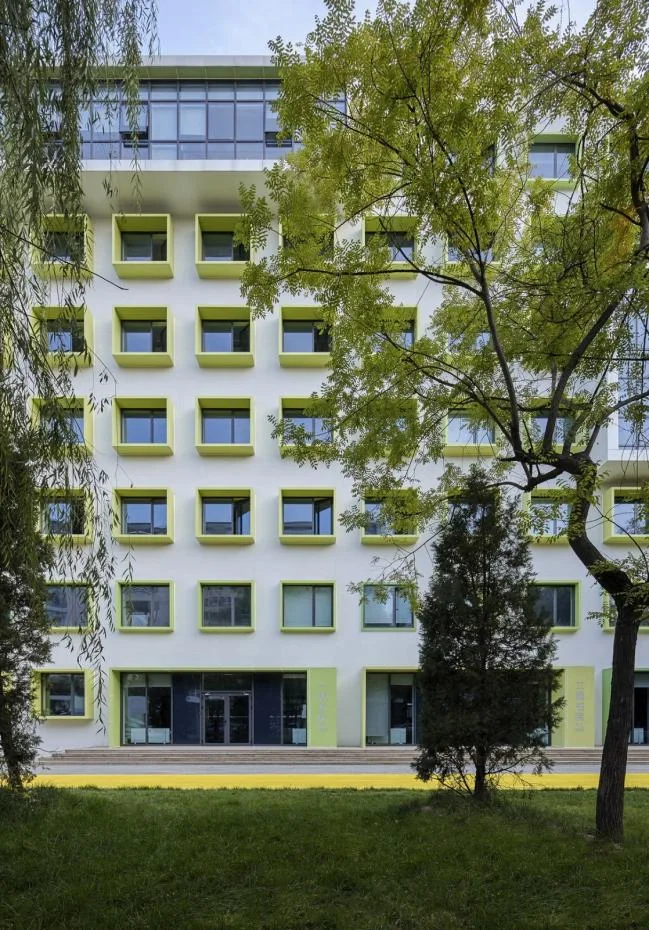
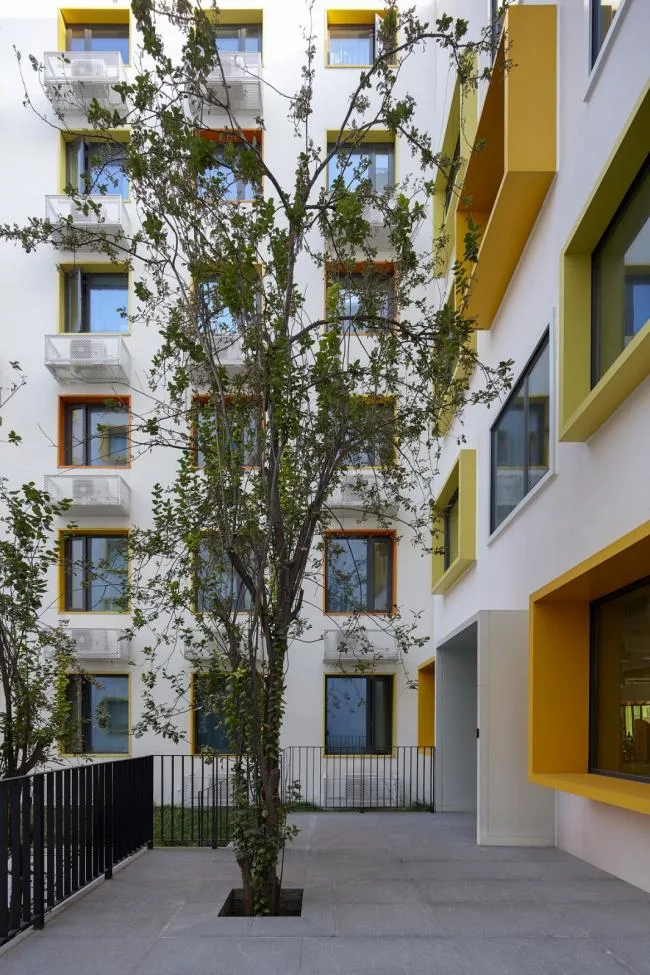
Landscape as an extension of space
More Than Just a Track
At Chaoyang Future School, we designed a slow running track with educational significance, embodying the harmony between landscape language and educational philosophy.
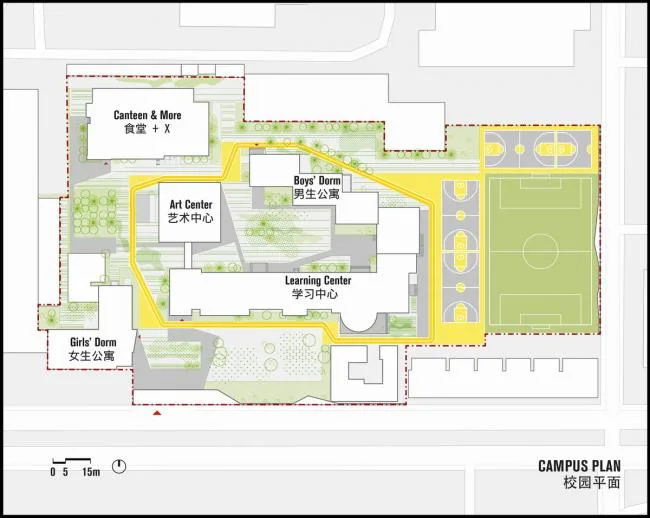
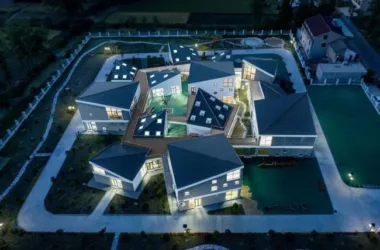
▲ Future School Campus Plan
This track not only supports physical education but also serves as a main pedestrian path, weaving freely through the campus and creating thoughtful relationships with surrounding buildings and sites. Its circular form represents the equal status of all campus spaces. The blossoming peach and plum trees speak for themselves, inviting curiosity. The track becomes an educator, encouraging students to independently choose their paths and actions.
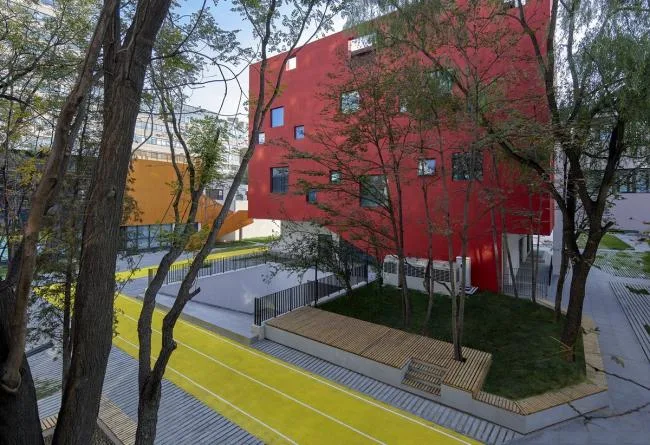
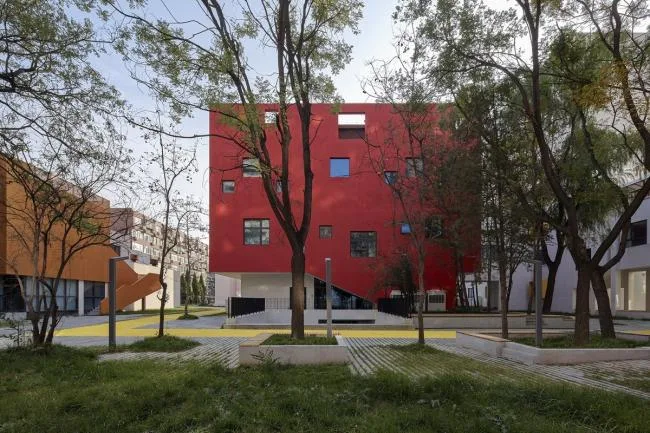
▲ Running track flowing through the campus
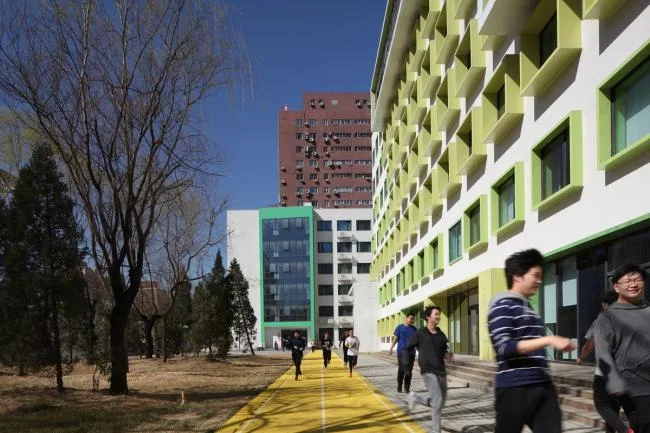
▲ Students running along the track
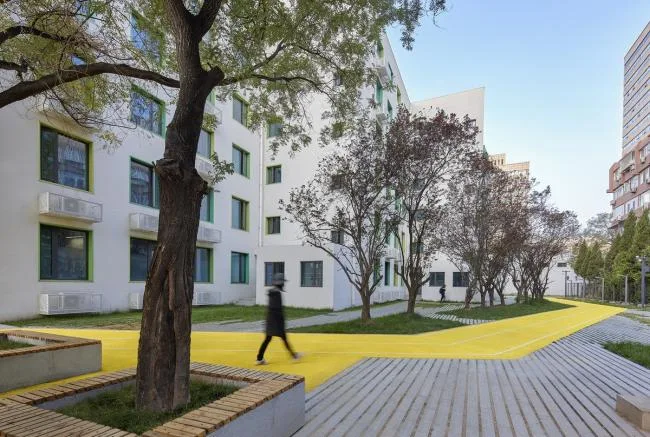
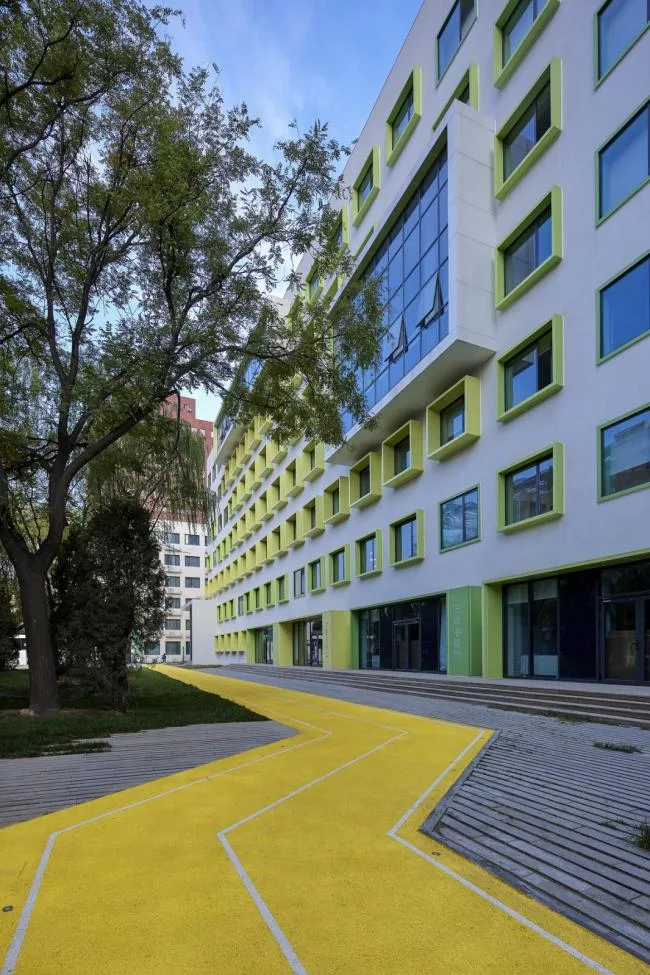
▲ The track’s relationship with surrounding spaces creates a balanced scale
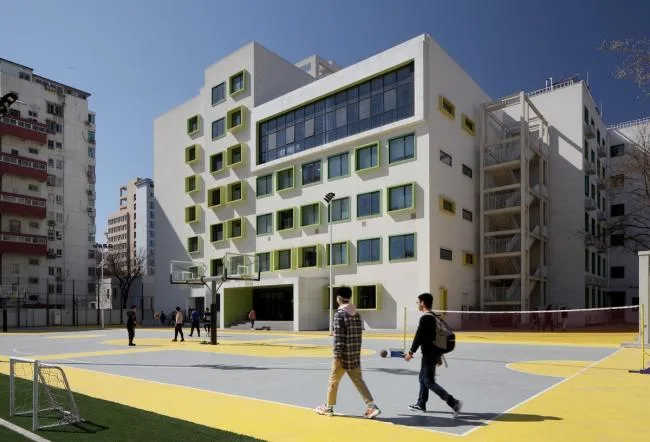
The Harmonious Relationship Between Sports Fields and Architecture
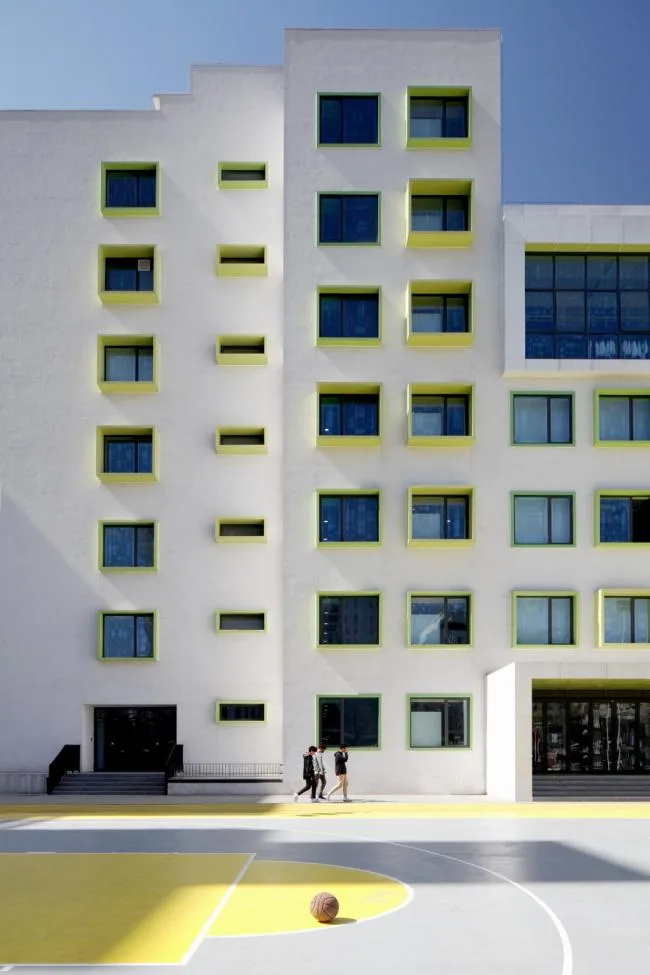
▲ Building facade
Positive Edges
Often, so-called “secondary” elements like campus walls receive little design attention and become negative spaces with minimal interaction. We aimed to change this.
Along the edge of Chaoyang Future School campus, instead of a wall, we created a “corridor fence” featuring a roof and built-in seating, maximizing transparency. This space offers an informal social area for the campus community and strengthens ties with the surrounding neighborhood, encouraging students to engage with the world beyond the school.
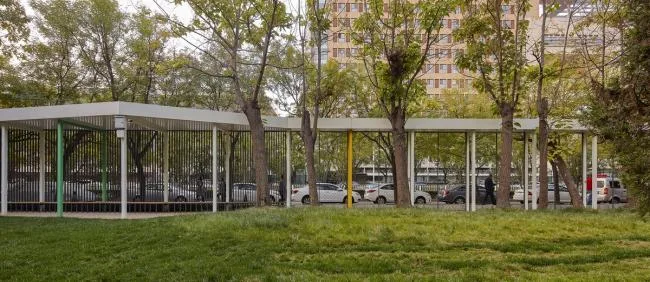
▲ Transparent corridor
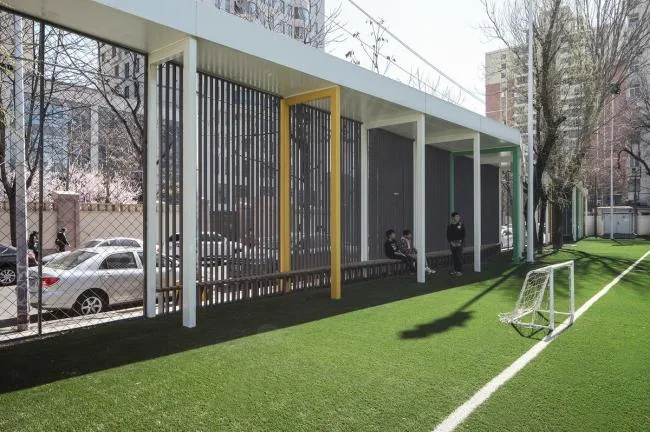
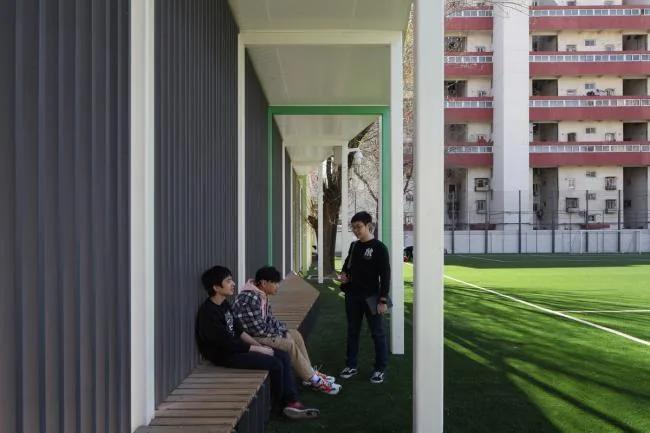
▲ Informal social space
Reflection: Does a Campus Need Landscape Design?
When many people hear “landscape,” they think it’s a minor detail. Indeed, in many public projects—including schools—landscape is often secondary, added later based on budget and schedule constraints. Often, once core teaching functions are met, some greenery is planted to meet regulations, and a few decorative elements are scattered across the campus.
But should campus landscape be regarded as mere decoration?
Today, the relationship between individuals, physical space, and cultural environment—and how students develop self-awareness and fulfillment—are central to modern educational exploration and to Crossboundaries’ design approach. These two renovated campuses gradually freed constrained free spaces imposed by traditional layouts, integrating them across different forms and scales while improving overall space efficiency.
This process reinforced our belief that the beauty of education often lies in the thoughtful details.
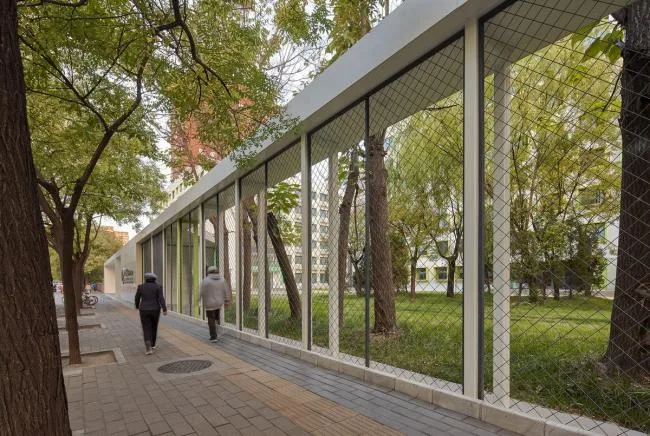
▲ Positive spaces encouraging interaction
Project Information: Peking University Affiliated High School
Location: Beijing, China
Client: Peking University Affiliated Middle School
Site area: 51,560 m²
Design period: March 2018 – May 2018
Construction period: July 2018 – September 2018
Completion: September 2018
Designer: Crossboundaries, Beijing
Partners: Binke Lenhardt, Dong Hao
Design team: Yu Zhaoxiong, Hou Jinghui, Hu Bingyu, Gao Yang, Hao Hongyi, Irene Sola, Tang Jiayin, Wang Xudong
Collaborators: Beijing Architectural Design and Research Institute Yuanjing Landscape Architecture Planning Studio, Beijing Architectural Design and Research Institute Fifth Architectural Design Institute
Photography: Yang Chaoying, Hao Hongyi
Project Information: Chaoyang Future School
Location: Beijing, China
Client: Beijing University Affiliated High School (BIM Architecture)
Site area: 25,916 m²
Design period: October 2015 – March 2018
Construction period: September 2017 – May 2018
Completion: May 2018
Designer: Crossboundaries, Beijing
Partners: Binke Lenhardt, Dong Hao
Design team: Gao Yang, Andra Ciocoiu, Natalie Bennett, Hao Hongyi, Wang Xudong
Collaborators: Beijing Architectural Design and Research Institute Yuanjing Landscape Architecture Planning Studio, Beijing Architectural Design and Research Institute Fifth Architectural Design Institute
Photography: Yang Chaoying, Hao Hongyi, Dong Hao












Must log in before commenting!
Sign Up