

Luhe Hospital is a comprehensive medical facility featuring a complex mechanical and electrical pipeline system. The project involves numerous new technologies and equipment, resulting in high construction difficulty, elevated cost risks, and a tight schedule.
Given these challenges, traditional construction management methods are no longer sufficient. Due to the separation of design and construction typical in China, the decision was made to adopt Building Information Modeling (BIM) technology to enhance construction management. The implementation utilizes mature software with secondary development, specifically expanding the BIM5D software developed by Guanglian Software Company.
Development of System Extension Functions
Based on BIM5D software, Guanglianda Software Company developed an extension module focused on labor efficiency analysis. The secondary development process included the following steps:
- Communicated with construction project professionals to gather specific issues and requirements.
- Organized the collected data to identify root causes and devised a development plan for the labor efficiency analysis function.
- Presented a prototype to project personnel for feedback, refining and improving the design accordingly.
- Upon finalizing the prototype, collaborated with software developers to build the extension module within the BIM5D system to implement labor efficiency analysis.
- Provided training to project professionals on system usage, who then validated the functionality against real on-site needs to ensure practical effectiveness.
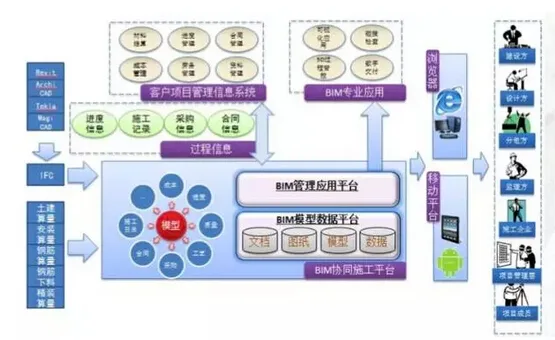
Project System Architecture
Preparation of Basic Data for System Application
The project utilizes Guanglian Da Civil Engineering BIM software (GCL) and Revit to create professional BIM models. These models are integrated into a 3D platform via the BIM5D software, with all models stored on a centralized model server to support a visual communication platform. The implementation process includes:
- Budget Data and Models for Civil Engineering:
Civil engineering quantities are calculated using Guanglian Da’s GCL software. After combining list and quota methods, models are exported to Guanglian Da’s pricing product (GBQ) for cost estimation. Quantity models, related quantities, and pricing data are imported into BIM5D through an internal data interface. - Models and Budget Data for Other Disciplines:
Revit is used for modeling other specialties. Models and quantities (including basic physical quantities and non-budget quantities) are exported in IFC format and imported into BIM5D for pricing. Revit components use extended cost codes integrated with construction discipline codes to group quantities and associate price information. - Schedule, Cost, and Resource Data Based on Integrated Models:
The BIM models from all disciplines are integrated with engineering quantities and project schedules. This enables detailed analysis of costs, labor, machinery, and resource consumption. The system provides real-time visibility into progress and resources, facilitating dynamic project management and serving as a solid data foundation.
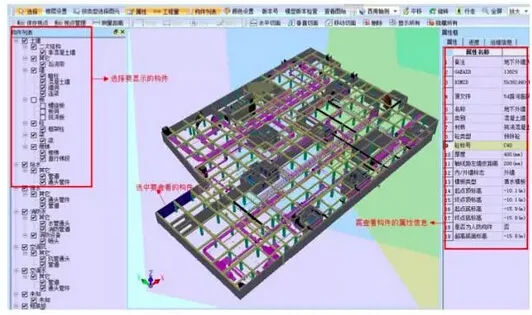
5D Application Interface
Collision Detection
The comprehensive scope of the Luhe Hospital project results in numerous mechanical and electrical pipelines concentrated in the basement, creating complex layouts. Detecting clashes and conflicts between different specialties is critical, and traditional 2D design methods struggle to address these issues.
By using multi-disciplinary integrated 5D BIM models, inter-specialty collaboration and clash detection are effectively facilitated. In practice, before construction begins, technical staff from the project department conduct inspections to identify conflicts in basement areas prone to clashes. Collision reports are analyzed to support design review and refinement, helping to prevent costly rework. The process includes:
- Integrating all professional models into the BIM5D system and performing systematic collision detection among civil, structural, and electromechanical models. The system automatically generates reports, which are sent to modeling teams for corrections.
- Modeling personnel adjust models in Revit and Guanglian Da software based on the collision reports, then update the BIM5D system for repeated detection until issues are resolved.
- The final collision-free model is submitted as the detailed construction plan. Early detection prevented common problems such as misplaced reserved openings, pipeline clashes, and insufficient construction space, reducing changes and rework significantly.
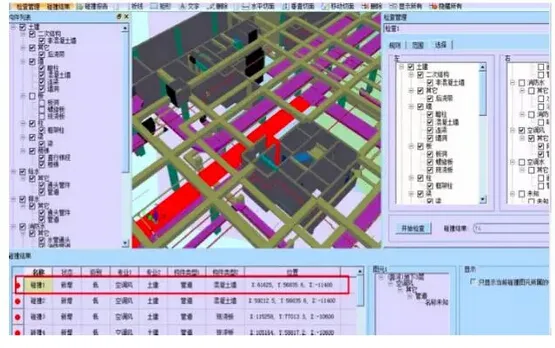
Collision Detection Interface
Schedule Management
Schedule management involves integrating BIM models with project timelines to verify schedule feasibility and enhance operability. Model-based schedule management reduces miscommunication and omissions, while enabling detailed stage management and optimization. Key activities include:
- Linking each BIM model component to bills of quantities and method lists within BIM5D through list imports. This enables automatic generation of component quantities and comprehensive unit prices. In this project, only the 08 list is attached, so only component quantities are viewable.
- Dividing the model into two zones, A and B, based on construction workflow sections.
- Connecting the model with the schedule managed in G-Project (Guanglian Da Schedule Management Software). Each schedule item is assigned building, floor, partition, workface, and component types, establishing a one-to-one link between model elements and schedule tasks. This foundation ensures smooth schedule management. Task assignments are given to responsible personnel to guarantee plan execution.
- Calculating labor requirements in BIM5D based on quantities, construction durations, and efficiency quotas per schedule item, then generating labor distribution curves. The BIM5D simulation function analyzes these curves to detect significant labor fluctuations, allowing schedule optimization.
- Tracking and inspecting progress during construction by monitoring daily logs and task completion. The BIM5D system automatically organizes and summarizes project data for efficient management. Project staff use progress analytics to make timely and informed schedule adjustments.
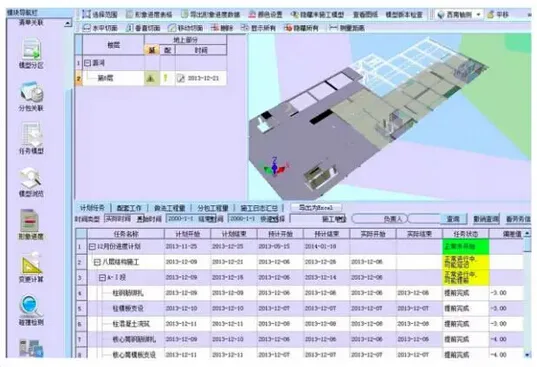
Project Progress Analysis Interface














Must log in before commenting!
Sign Up