
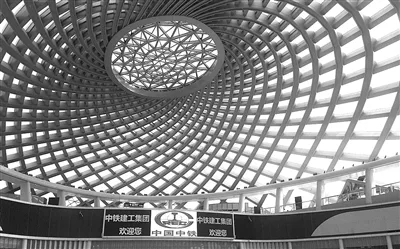
Yujiapu High Speed Railway Station: The World’s First Large-Span Single-Layer Dome
The recently completed Yujiapu High Speed Railway Station marks a milestone as China’s first high-speed intercity railway terminal for the Beijing-Tianjin intercity high-speed railway extension. It is currently the world’s largest and deepest fully underground high-speed railway station and also features the world’s first single-layer large-span dome steel structure. Facing unprecedented challenges with no prior examples to reference, the construction team relied on technological innovation to overcome obstacles such as deep foundation pits, difficult geological conditions, and abundant groundwater. This project not only filled the gap in China’s high-speed railway station construction but also introduced a series of world-class innovations.
Deepest Underground Continuous Wall Reaches 65 Meters
Unlike previous high-speed railway stations, 90% of Yujiapu Station’s main structure is underground, with only the dome visible above ground. Li Genxi, Chief Engineer of the Yujiapu Station Project Department at China Railway Construction Engineering Group, explained that building underground stations saves land, is environmentally friendly, and facilitates seamless integration with urban subway and highway transportation, enabling zero-transfer convenience.
However, the saline-alkali soil formed by alluvial deposits of the Haihe River over thousands of years presented significant challenges for underground construction. The complex geological conditions, including high permeability, increased the risk of geological disasters throughout the project.
The underground continuous wall at Yujiapu Station is exceptionally deep—reaching 60 meters underground with a maximum depth of 65 meters, comparable to the pile foundation depth of a 300-meter-tall skyscraper. These complex geological conditions made excavation and dewatering particularly challenging, posing serious difficulties for constructing the continuous walls and safely excavating the foundation pit.
To accurately translate design into reality, the steel reinforcement cages had to be placed with precision, maintaining an error margin within 0.1%. The project team held 13 expert demonstration meetings and employed BIM computer simulations for the construction of the connecting walls. By using high-precision guide walls and a three-grip groove construction technique, they ensured verticality and completed the demanding foundation pit support work. Protected by underground copper and iron walls, the risk of water leakage during subsequent construction was successfully mitigated.
Throughout this complex process, the project team developed and implemented advanced construction methods such as underground continuous wall construction, high-pressure rotary jet grouting pile construction, AM bored pile construction, and semi-parallel and semi-reverse deep foundation pit techniques. These innovations closed domestic gaps and ensured the project’s smooth progression.
4200-Ton Dome Without Internal Supports
Yujiapu Station’s unique design draws inspiration from maritime culture. Its transparent dome resembles a shell when viewed from the northwest and a blue whale from the southeast, earning the nickname “Shell.” This large-span dome is the first of its kind globally and has been highly praised by visitors.
“From a certain perspective, this structure resembles a bird’s nest,” said project manager Cao Jingquan. “While the Bird’s Nest is supported by concrete, ours is entirely steel.” The north-south length of the dome measures 143.9 meters, the east-west width is 80.9 meters, and its highest point rises 25.8 meters above ground. Weighing 4200 tons—about half the weight of the Eiffel Tower—the dome consists mainly of 36 regular spiral and 36 anti-spiral curved steel box girders that interlock without any central support, resting on 36 surrounding pedestals. This engineering feat is rare worldwide.
“The steel structure is highly complex, with over 1000 unique nodes and more than 2000 distinct members. Ensuring accuracy during high-altitude assembly is extremely challenging,” Cao Jingquan added. “The greatest difficulty lies in the sheer number of connection points, making it impossible to install components in a routine, programmatic manner as with regular buildings.”
“We held 83 rounds of discussions, and the design documents alone weighed 200 kilograms,” Li Genxi shared. “Ultimately, we adopted a partial reverse construction method and proposed a construction plan involving ground assembly, partial bulk assembly, and central lifting.” This approach enabled synchronized lifting of ultra-large components at extreme heights, creating yet another architectural marvel in China.
To balance lighting and structural load requirements for the underground station, the dome combines steel and membrane structures. The membrane uses ETFE film, the same innovative material as the Beijing Water Cube. ETFE offers exceptional tear resistance, tensile strength, moderate hardness, excellent impact resistance, long durability, and high transparency. It also features self-cleaning properties through natural rain and wind, and can automatically adjust tension via computer-controlled charging and discharging in response to temperature and humidity changes. This intelligent, low-carbon, and green design ensures the dome’s stability and sustainability.
“Besides incorporating various green materials and processes, Yujiapu Station is also the world’s first high-speed railway station equipped with a lifelong structural health monitoring system. Data is transmitted to the main control room every five minutes, ensuring station safety,” Cao Jingquan concluded.












Must log in before commenting!
Sign Up