
At the end of 2014, the group’s fifth company chose the third resettlement community project in Furong Ecological New City as an opportunity to create a demonstration and observation project in Changsha. BIM technology was introduced for the first time to optimize project management, implement standardized and lean construction, and ultimately deliver high-quality building products. The planned BIM applications included the following:
1. Three-Dimensional Construction Site Layout
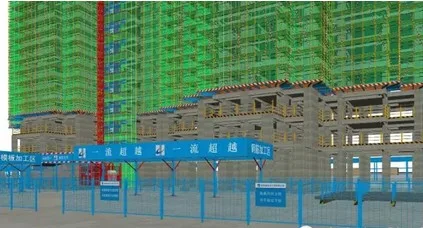
The total construction area of the third resettlement community project in Changsha Furong Ecological New City covers 108,528 square meters, with a total height of 98.1 meters. It includes one underground floor and 30 to 33 floors above ground, consisting of buildings 1#, 2#, 4#, and 5#. To ensure project quality, a dedicated BIM team was established to create a three-dimensional layout of the entire construction site. Using pre-built parametric components integrated with site conditions, the team strategically arranged living, office, and production facilities, providing an intuitive 3D planning scheme for on-site layout.
2. Technical Disclosure of Mobile Construction Process Samples for Planning and Quality Safety
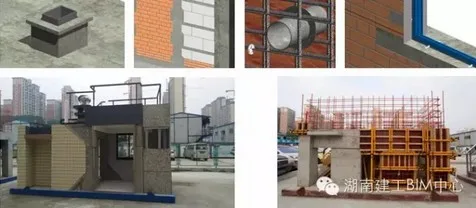
A mobile construction process template model was developed, covering finished products and processes for steel reinforcement, formwork, concrete, masonry, and mechanical and electrical embedment.
Additionally, a mobile decoration construction process model showcased finishing details for exterior wall decoration, interior wall plastering and insulation, stairs and railings, roof waterproofing, and mechanical and electrical installations. This comprehensive mobile template model for the Furong New Garden project included both structural and decorative electromechanical practices, as well as general engineering practices.
Before construction, Revit was used to generate key construction process points, while CAD provided detailed designs. Prevention and control exhibition boards were then created for on-site technical disclosure.
3. Production of Standardized Atlases for Safety, Civilized Management, and Construction Technology
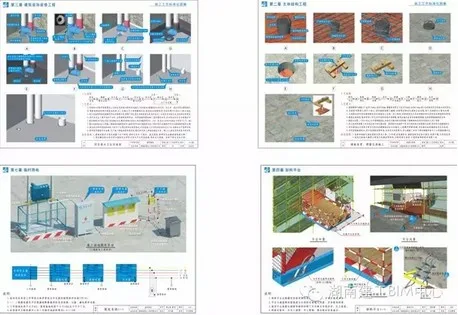
Using the enterprise parametric component model and addressing common project issues, a standardized atlas was developed focusing on safety, civilized construction practices, and construction technology. This atlas guided the BIM application goals toward standardized and lean construction on the project.
4. Collision Detection Across Multiple Disciplines
Hard collision checks were performed using Revit software, while soft collision checks utilized Navisworks. These checks covered various component types and disciplines, including civil engineering and mechanical and electrical engineering. By setting net height values in the software, components that did not meet design specifications were automatically identified, eliminating manual searches, saving time, and reducing errors.
Prior to floor masonry construction, the software simulated brick arrangements and generated detailed construction drawings. This process helped detect discrepancies in exterior walls, doors, windows, and the walls between windows, allowing for fine-tuning of door and window positioning and wall dimensions.
5. Adding Construction Information During the Building Process
The construction model in the software was linked to actual project progress, allowing timely input and review of construction information such as steel bar acceptance dates, formwork acceptance dates, concrete pouring dates, and steel bar inspection dates. Information from supervision and construction units was also recorded. This enabled the delivery of three-dimensional completion models during project acceptance, gradually replacing traditional paper completion drawings.
6. Quantity Calculation
After creating the engineering model, software functions were used to promptly calculate and compare net usage of output components against the budget, helping to identify calculation errors early. During construction, materials were managed based on construction section divisions and actual progress, providing valuable references for on-site material planning.
7. Application Experience
BIM technology at Hunan Fifth Engineering Co., Ltd. is still in its early stages. However, as experience grows and improvements are made, the company provides BIM training and promotes application of BIM management platforms on representative projects. The main goal is to integrate project quality, schedule, cost, safety, and civilized construction management through the BIM platform, enabling project management to operate efficiently and moving away from traditional extensive management models. Looking ahead, BIM technology will be broadly applied across projects and gradually align with the industrialization of construction.














Must log in before commenting!
Sign Up