
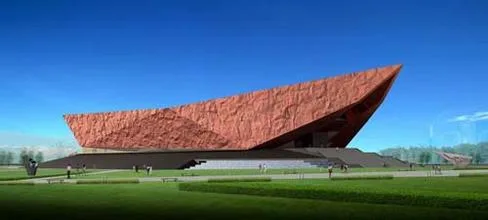
The Xinhai Revolution Museum spans four floors, including one underground level with a height of 5.4 meters. Above ground, there are three floors with heights of 7.2 meters, 7.2 meters, and 6.6 meters, respectively, bringing the total building height to 22.5 meters. The museum consists of one prologue, five main exhibition halls, and a multifunctional exhibition hall. It integrates exhibition display, cultural relic collection, education, publicity, and scientific research functions.
Among existing museums themed on the Xinhai Revolution, this museum stands out for its scale, advanced display technology, highly restored scenes, and comprehensive tour guide system. Architecturally, it is innovative, unique, and structurally complex. Throughout construction, continuous research and innovation were applied, including the use of BIM technology to overcome various challenges and achieve full architectural creativity.
Significant Social Impact
Construction began in August 2009 and was completed by September 2011. The museum opened to the public for free in October 2011 and has since attracted 1.36 million visitors. It has become a new cultural landmark in Shouyi Square and an important window through which both domestic and international audiences can appreciate Wuhan’s culture and charm.
The core exhibition, titled “The Foundation of the Republic,” is divided into five sections: Late Qing China, the Origin of the Revolution, the Wuchang Uprising, the Founding of the Republic, and the Centenary of the Xinhai Revolution. It features 428 historical relics, 694 photographs, 27 reconstructed scenes of major events, 12 artworks, and 20 multimedia presentations. This multi-perspective display deepens visitors’ understanding of the historical transformation brought about by the Xinhai Revolution and the founding of the Republic.
Enhancing the Urban Environment
Landscape Gallery and Triangular Composition
From the perspective of urban design and landscape, a landscape corridor forms an equilateral triangle with the Yellow Crane Tower and Snake Mountain Battery. This triangular composition symbolizes upward progress and aspiration, reflecting the spirit of the Xinhai Revolution.
Public Space and Openness
The northern facade facing the Red Chamber features a partial setback, forming a spatial enclosure with the Red Chamber’s U-shaped layout. This design creates a dialogue between the two structures, symbolizing a historical resonance from a century ago.
The design promotes accessible and open public spaces. The building’s layout extends and visually connects the north-south axis of the Shouyi Cultural District. Visitors ascend gentle sloped steps and pass through the museum, fostering a closer relationship between architecture and people, as well as between the building and the city.
Unified Building Structure
Form and Structure Integration
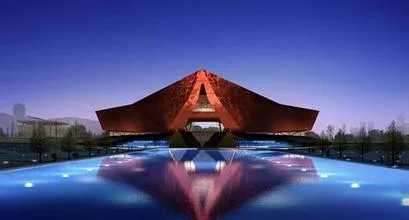
The museum’s structural system uses a folded plate spatial steel frame. Triangular inclined columns on the exterior serve both as the curtain wall support and the vertical floor support, enabling a column-free exhibition hall and public space. This integrated design achieves perfect harmony between architectural form and structural function.
Efficient Spatial Structure Design
The folded plate steel frame components were precisely positioned using control lines and detailed node drawings, reducing the steel structure production cycle by 45 days. All connections use intersecting welded joints, which cut production time and saved approximately 1.8 million yuan compared to cast steel joints.
Architecture Reflecting Regional Culture
Honoring the Spirit of Shouyi
The museum’s exterior uniquely blends traditional Chinese architectural elements with modern design. Features such as the elevated platform, large double-sloped roof, flying eaves, and upturned corners showcase classic Chinese architecture.
The upward geometric shapes on the exterior walls symbolize the pioneering spirit and innovation embodied by the Xinhai Revolution. The triangular architectural theme conveys progress and the triumph of Wuchang’s righteousness.
Creating a Historical Atmosphere
Sculptural forms produce a strong and upright visual presence. The exterior walls use natural carving and weathered textures, giving the impression that the building emerges organically from the ground. This artistic expression creates a solemn atmosphere of historical commemoration that harmonizes with the surrounding Snake Mountain, Red Mansion, and Wuchang Old Town landscapes.
Color Symbolism
The building’s exterior features red walls and a black base. This contrast not only reflects the revolutionary spirit—“Red” symbolizing revolution and “Black” representing darkness—but also echoes the color tones of the ancient State of Chu and harmonizes with the nearby Red Chamber.
Spatial Storytelling of Historical Events
Immersive Visitor Experience
The museum uses architectural narrative to guide visitors through the history of the Xinhai Revolution — its origins, development, climax, and conclusion.
Visitors enter the foyer from 5.4 meters below outdoor ground level, experiencing a transition from chaos to tranquility, evoking reflection on the oppressive rule and turmoil preceding the revolution. As visitors ascend to the second floor, the spiral upward design symbolizes the revolution’s arduous progress. Natural light floods the second-floor exhibition and outdoor areas, creating a sense of hope and renewal.
The third floor, the museum’s highest point, features a south-facing terrace offering panoramic views of South Square and Ziyang Lake, symbolizing the revolution’s climax. Throughout the visit, audiences engage both visually and emotionally, elevating their spiritual experience. The museum visit becomes a profound journey of historical and personal reflection.
Sculptural Wall Materials
To achieve a naturally sculpted texture, GRC (Glass Fiber Reinforced Concrete) cladding was used for both interior and exterior walls, covering 11,000 square meters. This large, continuous, and irregular surface texture—with maximum concavities and convexities of 25 cm—gives the exterior walls a strong sculptural quality, a first for China.
Compared to traditional natural stone, GRC offers large panel sizes and rich, adjustable colors while maintaining seamless irregular textures. This enhances the architectural spirit and artistic atmosphere of the museum.
Environmental Sustainability
GRC panels are environmentally friendly and made from recycled materials such as waste stone powder and slag, transforming waste into valuable resources. Their lightweight and high-strength properties significantly reduce concrete use.
Compared to traditional granite cladding, GRC panels allow for smaller structural components, saving approximately 300 cubic meters of concrete and 160 tons of steel, promoting a low-carbon and eco-friendly building approach.
Green and Energy-efficient Technologies
The museum employs green, environmentally conscious technologies suited to the local climate. The central air conditioning system uses a fully variable frequency integrated refrigeration station combining magnetic levitation and full frequency conversion—the first of its kind in China.
This system effectively cuts building energy consumption, reducing air conditioning energy use by 50% compared to energy-saving standards.
Advanced Digital Technology Integration
The building’s north-facing octagonal wall is an irregular polygon made up of multiple triangular folds of varying shapes and sizes. This complex geometry posed challenges for accurate positioning using traditional design methods.
By leveraging advanced 3D design software—including RHINO, REVIT, CATIA, NAVISWORKS, and TEKLA—and integrating BIM technology, precise 3D spatial positioning of every grid point was achieved. This 3D information model facilitated visualization and resolved complex spatial design challenges.












Must log in before commenting!
Sign Up