
In 2014, the long-standing collaboration between the Institute of Standards and Greenland Group achieved significant milestones. Greenland Group entrusted the Standards Institute with the general contracting of interior construction for the West Unit of Building 11 at the Shanghai Nanxiang Weilian Mansion project. This marked the Standards Institute’s first venture into industrialized interior construction general contracting. Throughout the project, the residential industrialization concept promoted by the Institute—focusing on the industrialization of the main structure and interior construction—was adopted, with BIM technology employed to monitor the entire process. As a pioneering effort in the industry, this innovative approach had a profound impact.
The interior construction general contracting project of Shanghai Greenland Nanxiang Weilian Mansion represents the latest advancement in technical innovation and business expansion for the Standards Institute. Many aspects of the project were unprecedented: new projects, new technologies, new management methods, and new teams all required a robust information platform. Consequently, BIM technology was introduced for the first time in the Institute’s interior construction projects. As the sole BIM resident, I was honored to participate throughout the entire project. Reflecting on six months of on-site work and life, I have been both a builder and a witness to this transformative process.
The Weilian Mansion project was like a blank canvas, and BIM technology served as the colored pens that brought it to life. Our objective was clear: to apply years of accumulated BIM expertise and standardized practices to the project, aligned with the project requirements. However, when I braved the cold last year and relocated all my work materials and daily essentials to Nanxiang, I was uncertain about the exact implementation plan. While I worked on the engineering front line, the department leaders and colleagues in the Beijing office provided unwavering support. Their continuous care and assistance kept me focused, enabling me to adapt project documentation methods based on on-site conditions without errors or omissions. Daily, I provided the modeling team with authentic and efficient project progress updates.
BIM Integration Throughout the Entire Process
The Shanghai Greenland Nanxiang Weilian Mansion project is recognized as China’s Centennial Residential Demonstration Project and stands as the first of its kind. As the first national standards institute to promote prefabricated industrialized residential buildings, the Institute not only challenged traditional concepts by adopting unique construction and contracting approaches but also integrated BIM technology throughout the project. This was especially important given the prefabricated construction techniques applied to century-old houses in Nanxiang.
BIM technology application in the Nanxiang project can be divided into three key engineering stages: bidding, construction, and completion & delivery (see Table 1).
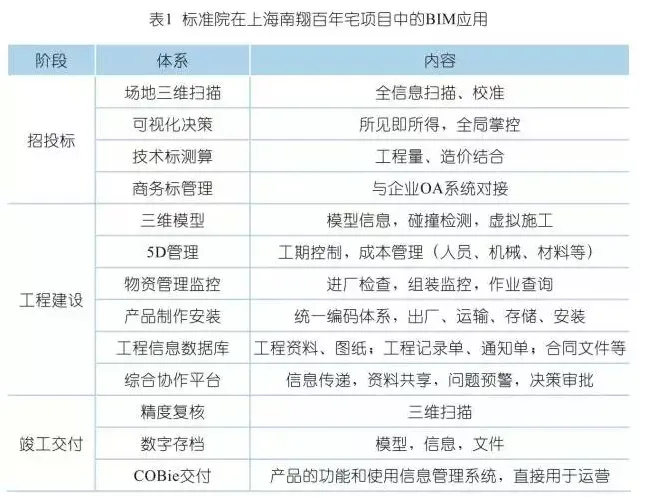
During the bidding stage, 3D scanning technology was used to create a precise digital map of the construction site, producing a detailed 3D model. Simultaneously, a preliminary BIM model based on engineering drawings was developed and compared against the 3D scan to detect discrepancies and promptly adjust budget estimates. For a typical residential unit of approximately 90 square meters, traditional layout methods require at least three to four working days and are often delayed by civil engineering quality issues. In contrast, a team of two to three technicians operating 3D scanning equipment could complete nearly 20 such units in a single day—over 40 times the efficiency of traditional methods. Moreover, the precise digital models enhanced the accuracy of technical specifications. The visualized model also facilitated decision-making and planning, significantly reducing uncertainties encountered after construction commenced.
During the construction phase, the Standards Institute built detailed BIM models and collected extensive engineering data from daily construction activities, including materials, labor, and construction methods. Integrating this data made the BIM models more dynamic and accurately reflective of real-time construction status, enabling advanced simulation and evaluation. Additionally, engineering records and documents generated throughout construction were centrally stored on a collaborative platform accessible to all project participants. This ensured that stakeholders had real-time access to the latest and most comprehensive project information, supporting informed and strategic decision-making. As the chief editor of the national BIM standard, the Institute incorporated data requirements from the “Delivery Standard for Building Engineering Design Information Model” and the “Classification and Coding Standard for Building Engineering Design Information Model” into the project. This approach not only facilitated the delivery of engineering information tailored to all parties’ needs but also classified and coded major building components specific to prefabricated residential buildings, enabling full traceability of products throughout the project.
In the completion and delivery phase, 3D scanning technology provided precise data to support project completion reviews and served as a reference for as-built drawings. The continuously refined BIM database now contains the most complete and accurate original project information, serving as a standardized reference for similar future projects and as a knowledge base for BIM technology application in engineering. Furthermore, the Standards Institute innovatively adopted the COBie framework from the United States, integrating engineering models, information, and data from earlier phases into unique standardized documents, which are then linked with subsequent operation and maintenance processes.
In summary, the Shanghai Greenland Nanxiang Weilian Mansion interior construction general contracting project exemplifies the innovative application of BIM technology to comprehensively manage the project lifecycle. This is demonstrated in four key areas: first, visual simulation and analysis during planning and design, including 3D modeling, schedule planning, collision detection, and construction simulation; second, control and inspection during construction, covering material and equipment management, cost and progress monitoring, and quality assurance; third, preparation of information for operation and maintenance, including engineering data and spatial positioning; and fourth, upgrading the enterprise engineering management system, encompassing process improvements, management models, technological innovation, and business integration. By adopting a BIM system tailored to the Standards Institute’s capabilities, the Century House project showcases new construction methods and processes through digitalization, generating significant social and economic benefits.














Must log in before commenting!
Sign Up