
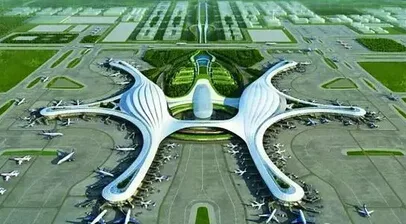
On June 1st, Sichuan Airport Group Co., Ltd. announced that the long-awaited Chengdu New Airport has completed a comprehensive planning and terminal design selection process. Six top-tier joint venture design proposals, representing global excellence in terminal design, integrated transportation planning, and airside layout, were presented in Chengdu. Among them, the joint venture consisting of China Southwest Architectural Design and Research Institute Co., Ltd., China Civil Aviation Airport Construction Group Co., Ltd., and a French company was unanimously endorsed by the expert panel and chosen by Sichuan Airport Group as the official plan for the overall airport layout and terminal building.
The six submitted proposals represent the forefront of international airport design, showcasing high-quality, comprehensive content that covers nearly every modular terminal model. This diversity allows for straightforward comparison across different design approaches. While each plan features a distinct terminal appearance, all successfully incorporate local Sichuan cultural elements, blending regional characteristics with modern aesthetics. The terminals boast simple yet elegant designs, functional completeness, and strong practicality. Additionally, the supporting hotels are thoughtfully integrated with the terminal facilities.
Inside the terminal, passenger flow has been carefully organized with a clear, layered layout that emphasizes human-centered design. Transfer processes are efficient and well-planned, ensuring a smooth experience for travelers. Operational efficiency and logical spatial arrangements have been enhanced in areas such as airside zone planning and comprehensive transportation integration.
Between May 18th and 19th, a review committee composed of 11 distinguished experts—including academicians from the Chinese Academy of Engineering, civil aviation design masters, and presidents of renowned universities specializing in planning, architecture, structural engineering, transportation, and airport operations—conducted a thorough evaluation. They assessed factors such as innovation, terminal process rationality, comprehensiveness of transportation systems, operational efficiency for aircraft movements, commercial layout completeness, phased construction feasibility, and cost-effectiveness. Ultimately, the Southwest Design Institute consortium’s proposal received unanimous recommendation from all experts on the panel.
















Must log in before commenting!
Sign Up