
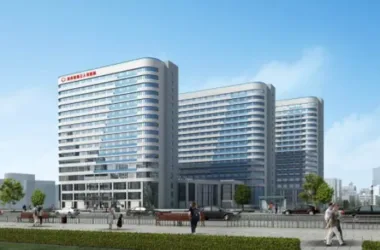
The Qingkong Human Settlements Technology Demonstration Building project implemented a BIM workflow platform during the construction drawing design phase to achieve comprehensive informatization throughout the entire process—from design to construction. In the early stages, the BIM team utilized Revit to develop a fully information-rich model, refined down to the component product level, allowing for highly detailed construction simulation. Later, NavisWorks was employed to enable visual simulation and information management during the construction phase.
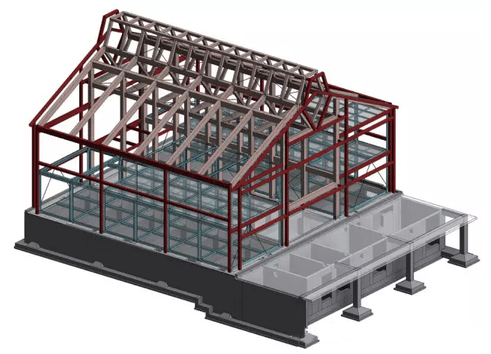
Differentiation of Various Structural Systems
Throughout the project, the BIM platform allowed all relevant stakeholders to collaborate using a shared 3D visualization model. This ensured accurate integration of information across different disciplines and maximized interdisciplinary cooperation. As a result, BIM technology supported informatization, interactivity, and simulation from the design phase through construction and into later operation stages. This approach holds significant importance for the Gui’an New Area Clear Control Human Settlements Technology Demonstration Building project, which prioritizes ecological characteristics throughout the building’s entire lifecycle as a key evaluation criterion.
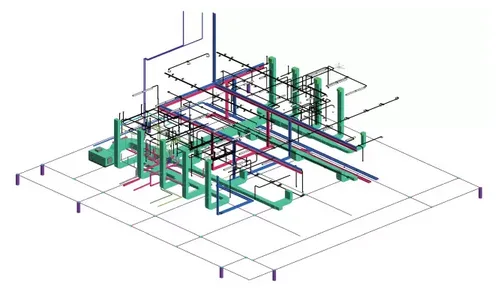
MEP Full Professional BIM Model
Through practical application of BIM workflow platforms such as Revit and NavisWorks, the BIM team has gained valuable experience in BIM processes—from initial information model creation and professional design coordination to the generation of report drawings and construction process simulation and management. BIM technology has demonstrated significant improvements in efficiency and error detection during design and construction phases. These advancements are especially meaningful for technology demonstration building projects that emphasize ecological considerations across the entire lifecycle.
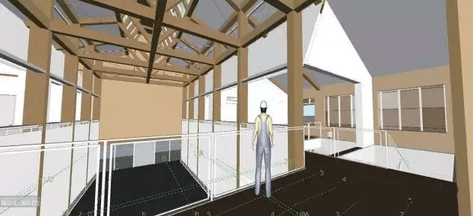
NavisWorks Reality Roaming
Unlike traditional design workflows, the core strength of BIM technology lies in creating and utilizing consistent, interoperable data across all architecture-related disciplines throughout the project lifecycle. Therefore, in this technology demonstration building project, BIM integration extends beyond design disciplines such as architecture, structural engineering, plumbing, electrical, and HVAC. It also encompasses the entire construction process, involving contractors, equipment suppliers, material manufacturers, and other related industries. This collaborative BIM approach fully leverages the powerful benefits of digital informatization, interactivity, and simulation.












Must log in before commenting!
Sign Up