
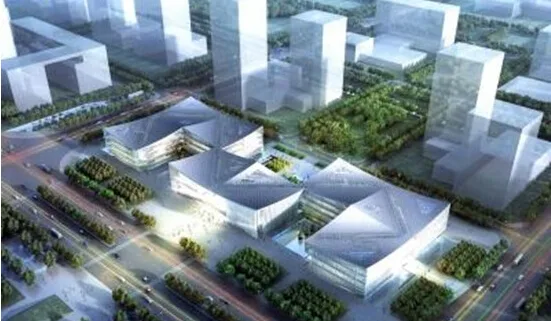
The main building of Guangling Cultural Center breaking ground and beginning to rise.
The Guangling Cultural Center in Jiangsu Province, also known as the Eastern Library, features two underground floors covering 48,000 square meters and four above-ground floors totaling 50,000 square meters, making up approximately 98,000 square meters in total building area. Construction is progressing rapidly, with the exterior facade unveiled on the city’s anniversary day.
The upper structure has started, and the facade facing Chengqing Front is now visible.
The Eastern District will soon have its own tall and sophisticated landmark. On June 10th, reporters observed at the north side of Civic Center Square that the library’s main building had broken ground and was emerging from the soil. The pile foundation construction is complete, and work on the first and second floors is underway.
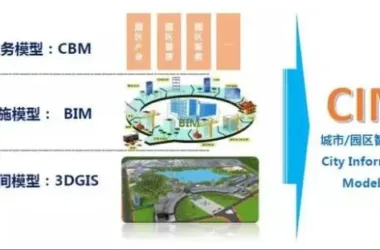
At the construction site, large concrete trucks are actively pouring concrete, and the site buzzes with activity. The overall project aims to be completed before the city’s anniversary in September, with the exterior facade fully presented. According to the project leader, over 1,000 workers are currently on-site, strictly following the schedule to meet construction milestones efficiently. The project also utilizes BIM technology, employing 3D models to anticipate and resolve construction challenges through virtual simulations.
“The underground section mainly serves as parking, while the four floors above ground house the library and cultural center, with part designated as an archive. The main structure on the ground floor has started, with plans to showcase the exterior facade by the end of August and complete the outdoor square before the city’s anniversary,” the project leader explained.
Convenience is a key focus.
1 million books and 1,200 reading seats
What functions will the future Eastern Library offer? The project leader described it as a comprehensive facility integrating culture, books, and archives, filling a cultural architecture gap in the Eastern District. The center consists of three structures arranged in two east-west sections forming an “L” shape, with a central building inspired by ancient bridge architecture.
“The library has two main functions: providing library services and acting as a cultural center. Visitors can read and borrow books, while the cultural center hosts cultural promotions and intangible heritage displays. The library will hold approximately one million books and offer 1,200 reading seats,” the leader added.
Distinctive design elements set the center apart.
Four landscaped areas inspired by private garden design
The Eastern Library’s design is tailored to the Eastern District, with a standout feature being the integration of the concept “Water, books, poetry, and scrolls.” This artistic approach uses the feeling of a garden to create an elegant, flowing water scene. A winding corridor offers reading spaces while immersing visitors in a cultural ambiance that changes step by step.
“The building incorporates four landscaped sections, inspired by Yangzhou’s private garden designs, representing spring, summer, autumn, and winter. The entire building acts as a landscaped area, much like a scenic spot. The garden is famous for its bamboo, which is reflected in the exterior design featuring clay tiles arranged to mimic bamboo joints. The facade resembles a bamboo forest, creating a tranquil bamboo grove atmosphere,” the project leader detailed.
The project site is surrounded by diverse urban structures: to the west lies the Bank of Communications Data Center, standing 100 meters tall, and to the east is the TEDA MSD Modern Service Industrial Park, with a maximum height of 120 meters. The cultural center, situated in the middle, rises to only 24 meters. This staggered arrangement enhances the architectural hierarchy along Wenchang Road and revitalizes the urban space.
Parking will be ample and convenient for visitors. The entire building is designed to accommodate 605 motor vehicle parking spaces — 550 underground and 55 above ground — plus 1,220 non-motorized vehicle spaces, sufficiently meeting the needs of the Eastern District’s residents.
On June 10th, the Guangling District Urban Construction Bureau announced plans to renovate the northern section of Guoqing Road (from Wenchang Middle Road to Yanfu East Road). The renovation is scheduled for completion before the city’s anniversary. The road width will remain mostly unchanged, with asphalt paving on the fast lane, stone paving on the east slow lane, and a combination of stone and green bricks on the west slow lane.
The northern section of Guoqing Road stretches over 700 meters, featuring an 8-meter-wide fast lane, an approximately 2-meter-wide slow lane on the east side, and about an 8-meter-wide slow lane on the west side. Currently, the roadbed is in poor condition, with combined rainwater and sewage pipelines underground and a dense network of overhead utility poles detracting from the ancient city’s image. Vehicles parked on the west-side slow lane also impede traffic flow. To improve conditions, Jiangsu City will renovate both the road surface and the building facades along this stretch, with construction running from the end of this month up to the city’s anniversary.
The renovation will separate underground rainwater and sewage pipelines beneath the utility poles. The fast lane will be paved with asphalt; the east slow lane with stone; and the west slow lane with a mix of stone and blue bricks. Existing bus stops will remain unchanged. Due to the narrow road width, no green median will be added, and parking on the west slow lane will be prohibited. Facade renovations on buildings along both sides of the road are under review by the city’s planning department and will be implemented following approval. Once completed, the road will offer smoother traffic flow and a more attractive streetscape, harmonizing with the nearby Dongguan Street, Caiyi Street, and Dongquan Gate areas.












Must log in before commenting!
Sign Up