
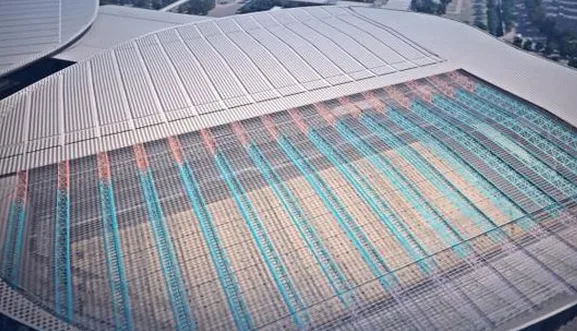
The National Exhibition and Convention Center, spanning a total area of 1.47 million square meters, completed its design to basic construction phase in less than two years.
Located in Qingpu District, Shanghai, the center’s distinctive four-leaf clover design has quickly become a new architectural landmark. On January 22nd, a representative from Shanghai Construction Engineering Group shared insights with The Paper (www.thepaper.cn) about the technological innovations behind this project.
“Spacecraft” Work Platforms Replace Traditional Scaffolding
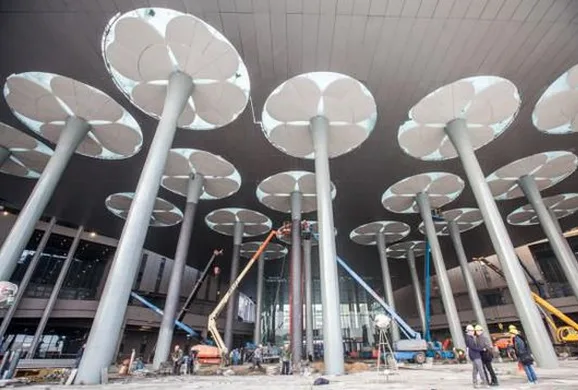
The construction of the National Exhibition Center features several remarkable highlights, including the world’s largest column-free exhibition hall. Among the 13 exhibition halls, one stands out with a building area of 28,000 square meters and a dome spanning 108 meters.
After lifting the roof, the conventional approach would be to erect scaffolding to continue construction. However, scaffolding would obstruct work at ground level. Given the heights involved—40 meters for single-layer halls and 16 meters for double-layer halls—the construction team innovatively employed a movable high-altitude work platform, nicknamed the “Spacecraft.”
The “Spacecraft” is suspended in the air by cables and secured with safety measures including lifting ropes, safety cables, and platform fences, ensuring worker safety at height without interfering with ongoing ground operations.
“This ‘Spacecraft’ provides a secure workspace for high-altitude workers while allowing uninterrupted work below. For instance, air conditioning and fire protection pipelines located in the upper trusses can be installed using the spacecraft, while pipelines in side walls and trenches are handled with traditional methods. This approach enables simultaneous work on three fronts, significantly boosting construction efficiency.”
3D Simulation Guarantees Subway Safety
The center’s E-building, part of the four-leaf clover design, is situated directly above Metro Line 2. Its basement is divided into north and south sections, both closely adjacent to the subway tunnel, with the above-ground structure similarly split. To prevent the building’s weight from pressing directly on the subway and to structurally connect the two halves, engineers decided to implement a large-span cantilevered steel structure above the subway. This structure supports a load capacity of 20,000 tons on both sides of the tunnel.
To assess the feasibility of this bold, unprecedented design, the construction team utilized Building Information Modeling (BIM) technology. BIM creates a detailed 3D model of the entire building structure, allowing for spatial and mechanical analysis before construction begins. Any design inconsistencies can be identified and corrected early, which greatly facilitates construction, ensures safety, and maintains uninterrupted operation of Metro Line 2 during the build.
“Triple Supply” of Cooling, Heating, and Electricity
The National Exhibition Center also applies advanced green, energy-saving, and eco-friendly technologies, transforming the venue into a smart, sustainable space.
The entire complex is powered by a distributed energy system using natural gas internal combustion units to provide cooling, heating, and electricity—known as the “Triple Supply.” Excess power generated is fed back into the grid, easing energy demands for large-scale exhibitions.
Furthermore, the center is the first in the industry to employ full LED lighting. Over 200 elevators utilize cutting-edge supercapacitor energy-saving technology, forming the world’s largest centralized demonstration area for such elevators. Additionally, the center features a closed vertical pipeline garbage collection system, a first for exhibition venues, which enhances waste recycling and improves environmental quality around the facility.












Must log in before commenting!
Sign Up