
Company: Huatai (Tianjin) Pharmaceutical Engineering Co., Ltd
Original Tianshili Group Engineering Technology Center
Author: Huang Guotao
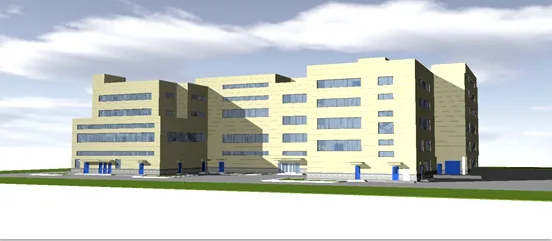
The Challenges of Traditional Design Methods:
In recent years, the engineering industry has widely embraced the concept of Building Information Modeling (BIM), which digitally simulates real building information. This innovative approach addresses several critical challenges:
First, communication difficulties arise due to multiple disciplines, low repetition, and lengthy project durations, making information prone to errors and omissions during transmission.
Second, existing management methods struggle to facilitate multidisciplinary collaboration. Limited coordination in 2D drawings often leads to increased interlayer space to avoid clashes between pipelines and air ducts, resulting in inefficient use of building space.
Third, design drawings frequently undergo numerous changes during construction. Variations from actual site conditions often require on-the-fly adjustments, hindering construction progress and jeopardizing project quality.
Since 2008, our company has gradually adopted BIM technology across multiple projects. Below is an overview of BIM’s fundamental role in EPCM projects:
Comprehensive BIM Application Across Project Lifecycles
BIM is utilized throughout the entire project lifecycle to enable multi-disciplinary information sharing. Unlike traditional project management models in China, BIM facilitates true collaborative management from design and procurement to construction, renovation, and expansion. Simply put, BIM ensures seamless information flow across all project phases.
3D Modeling for Enhanced Design Collaboration
BIM’s design phase revolves around 3D modeling, allowing experts from various fields to visualize and coordinate on drawings. This approach helps identify and prevent mistakes, conflicts, and omissions, enabling effective risk mitigation.
Traditional CAD-based designs are typically created independently by different disciplines and require multiple rounds of review for coordination. This method lacks the ability to analyze building functionality within specific environments. By establishing a 3D information model covering the entire project lifecycle, we can optimize and improve design solutions. This is currently one of BIM’s most significant contributions.
Meeting Property Owners’ Demands and Market Competitiveness
Pharmaceutical engineering projects are characterized by strong individuality, low repeatability, tight design schedules, complex pipeline layouts, and limited space. BIM aligns design closely with actual construction conditions, minimizing build time and reducing unnecessary rework. This accelerates product launch and indirectly lowers investment costs for owners.
Benefits of BIM Application:
Facing increasing project complexity, tight schedules, and strict budget controls, BIM demonstrates clear advantages in visualization, coordination, optimization, and simulation.
1. Visual Simulation
BIM’s 3D design offers a visual representation that matches what designers envision—“what you think is what you see; what you see is what you get.” It transforms traditional linear expressions into three-dimensional, physical object displays.
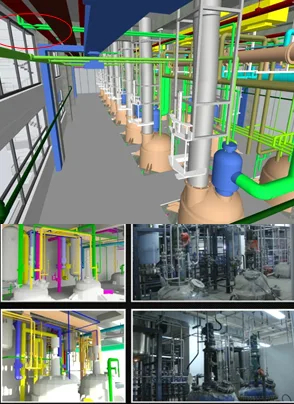
Input Data: spatial information, structural data, floor plans, equipment layouts, and equipment specifications
Output: 3D conceptual models of building spaces, structural frameworks, plumbing, electrical systems, and process equipment layouts
Project Applications:
- Providing owners with accurate process area models for easier design review and understanding
- Facilitating visual communication, discussion, and decision-making throughout design, construction, and operation phases, with precise spatial and building data
- Using a unified coordinate system during design to support future project integration, management simulation, clash detection, and coordinated design
Unlike typical 3D models, BIM produces accurate, actionable, and data-rich information models. During complex process design phases, complete information models are created based on floor plans, equipment models, and detailed parameters, ensuring precision.
However, uncertainties such as process equipment models often require using generic or alternative equipment models for initial 3D information modeling.
By managing multidisciplinary data visually, BIM allows stakeholders to predict project outcomes without requiring deep specialized knowledge.
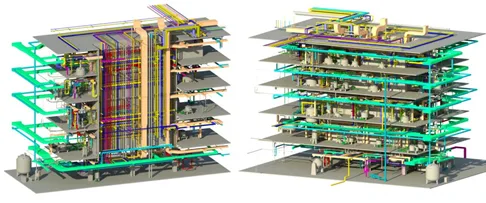
2. Coordination
Pharmaceutical projects, especially complex synthetic drug workshops, face significant design challenges in integrating various professional pipelines:
- Conflicts between equipment pipelines and structural elements like beams and columns
- Clashes among different professional pipelines
- Space limitations for equipment installation
Identifying and resolving these issues during construction typically requires coordinated efforts among professionals, followed by design changes and remedial measures.
Traditionally, 2D CAD pipeline synthesis involves multiple rounds of drawing reviews across architecture, structure, plumbing, HVAC, and process disciplines. Conflict detection often relies on visual inspection, calculations, or experience, with some problems only discovered on-site—leading to resource waste and escalating costs.
With 3D BIM design, architecture, structure, plumbing, electrical, and process models are integrated. BIM software modules can automatically detect and resolve basic clashes during design and management, effectively advancing review processes. This approach improves design accuracy, shortens design cycles, reduces costly errors, minimizes construction changes, and ensures true “build as designed.”
3. Simulation
3D BIM models enable simulations such as emergency evacuation, sunlight exposure, thermal energy analysis, fluid dynamics, and 4D construction scheduling. The technology allows dynamic observation of 3D models, generating realistic indoor and outdoor perspectives.
During construction, managers can use BIM models for on-site discussions, carefully inspecting project sequencing and reducing coordination errors among engineers.
4. Optimization
3D design combined with optimization tools uses information on geometry, physics, building rules, and change scenarios to refine complex projects. Design and construction become continuous improvement processes, helping designers optimize solutions effectively.
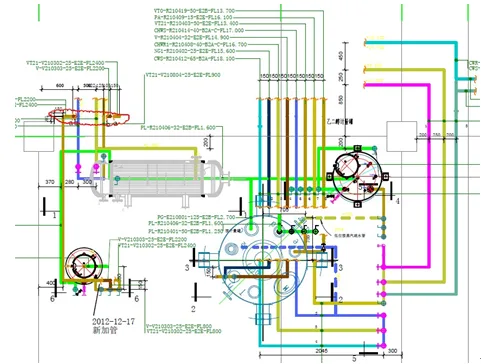
The collaborative nature of 3D design and centralized file management allows professionals to work together seamlessly on the same platform. The process culminates in practical construction documents, including comprehensive pipeline diagrams, clash detection reports, and suggested improvements.
Design Quality Control Achieved Through 3D Design:
- Multidisciplinary collaborative design enhances information sharing and efficiency
- Visual, realistic designs simplify owner reviews and comprehension
- “Build as designed” ensures construction matches design intent, demonstrating design value
- Rich, information-dense completion documentation facilitates post-construction factory management
Closing Remarks:
In the domestic pharmaceutical engineering sector, 3D applications remain relatively new. Both technical implementation and workflow changes present ongoing challenges.
This 3D design approach transforms design tools to make project completion, validation, and improvement easier, more efficient, and more accurate—ultimately boosting design and construction productivity.
In the long term, BIM represents a new engineering management model based on the entire project lifecycle.
Currently, technical challenges dominate, but future obstacles will involve changing mindsets. Much like the establishment of standard protocols between assembly languages in the 1990s, which enabled global collaboration across software, departments, and companies, BIM’s 3D technology still lacks standardized protocols for data exchange between platforms.
Once these standards mature, BIM will drive a comprehensive industry upgrade.
Full integration of supporting technologies, enterprise processes, and cultural shifts is essential to enhance production efficiency and quality in this field, a process that will require time.
















Must log in before commenting!
Sign Up