
Contributed by: Shanghai Vanke, Nanjing Zhenghua
Preface:
Recognizing the significance of BIM, Shanghai Vanke’s management launched an extensive BIM application plan in 2014 for both ongoing and commissioned projects. For this entrusted construction project, Vanke’s project management team engaged in multiple discussions with the owner, focusing on key BIM application aspects. Ultimately, the owner acknowledged the value of BIM, and its contributions during the subsequent five months were highly praised and appreciated.
Project Overview
Located in Wujing Town, Minhang District, Shanghai, the project site is bounded by Lianhua South Road to the west, Yongde Road to the north, Guihua 1st Road to the east, and Wumin Railway to the south. The development comprises five office buildings ranging from 10 to 19 floors (Buildings 1-5), five multi-story commercial buildings (Buildings 6-10), and a supporting underground garage, which doubles as a shelter for Level 6 second-class personnel and a Level 6 civil defense mobile power station during wartime. The project covers Phase II (Buildings 1, 2, 3, 9, and 10) and Phase III (Building 6 and basement subprojects).

(Aerial view of the project)
BIM Implementation Process
1. Pre-construction interaction (Design Phase) – Once the BIM design team completes the building, structural, and MEP (mechanical, electrical, and plumbing) models, these are shared with the project department, design departments, design institute, MEP consultants, and other stakeholders. Feedback is collected via email, consolidated, and then used by the BIM team to refine and optimize the models, with all changes recorded for traceability.
2. Post-construction interaction – The BIM design team shares models with the general contractors responsible for civil engineering, MEP, curtain walls, and decoration. These contractors can modify, deepen, and adjust the models based on field conditions, then provide results back to the BIM team. This collaboration ensures a comprehensive and accurate building information model.
3. Model Accuracy – Following the American Institute of Architects’ “AIA Document E202-2008” standard and Shanghai Vanke BIM Standard 1.0, Level of Development (LOD) 4 accuracy was selected to guarantee precision.
Core BIM Applications
The project’s complex functional spaces, intricate decoration designs, diverse structural forms, and tight mechanical and electrical pipeline spaces in the hypermarkets demanded BIM technology to optimize design, coordination, and communication. Each discipline created accurate BIM models from design drawings, enabling early clash detection and resolution through BIM’s intuitive inspection and collision detection features. Visual communication also significantly enhanced collaboration among all parties.
1. Intuitive Project Review and Design Briefings
BIM models greatly enhanced design visibility and communication during drawing reviews and design briefings. The BIM team utilized Autodesk Revit for 3D modeling of the building, structural, and MEP systems based on construction design drawings. This process helped identify and organize errors, omissions, and deficiencies in original designs, which were then communicated to the design unit.
The models also supported finalizing equipment layouts, pipeline arrangements, and mechanical and electrical completion standards for challenging construction areas. Furthermore, detailed system reviews and calculations were performed, leading to optimization proposals shared with the owner.
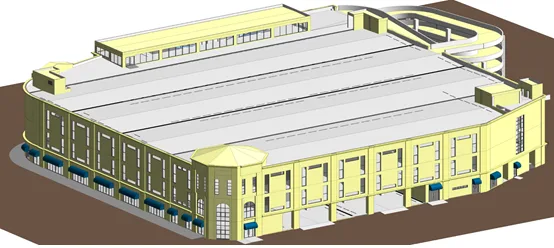
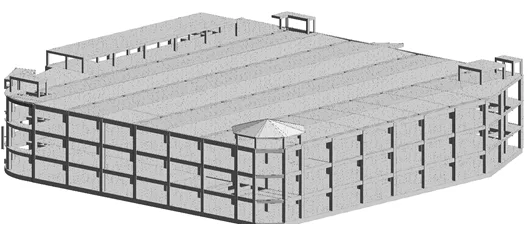
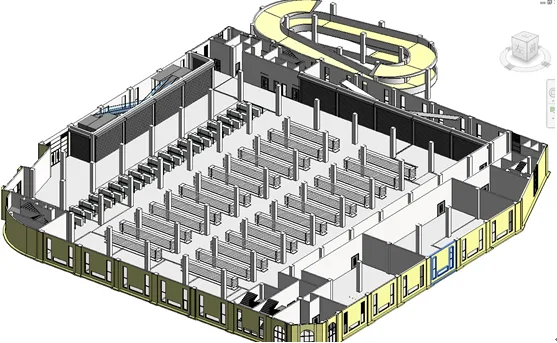
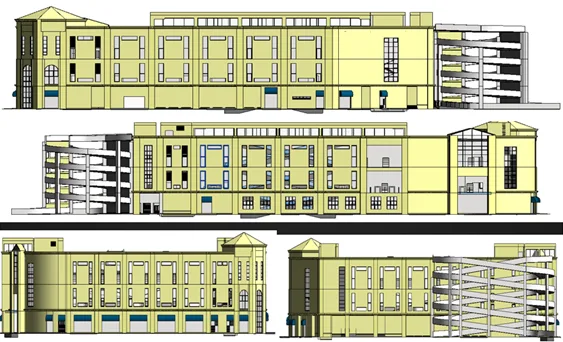
(BIM 3D Model Architecture)
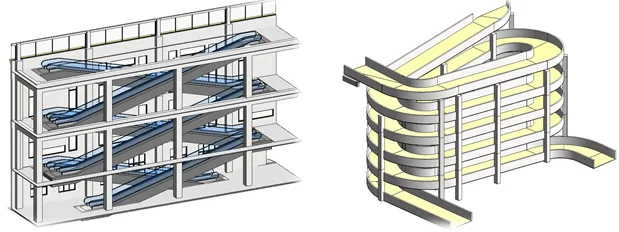
(Automatic escalator) (Outdoor circular ramp)
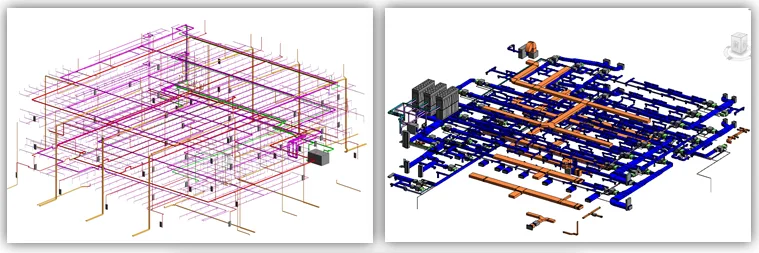
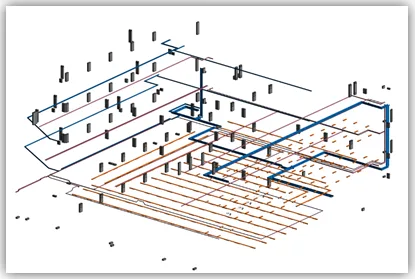
BIM 3D Model (Mechanical and Electrical Engineering)
2. Comprehensive Pipeline Inspection
Traditional 2D CAD overlays cannot fully detect hidden errors, omissions, or clashes in complex designs, which jeopardizes installation success rates. This project employed BIM’s 3D visualization to integrate architectural, structural, and MEP models in a 3D environment. These were imported into Autodesk Navisworks for thorough clash detection, followed by necessary adjustments based on findings.
This process not only resolved clashes efficiently but also enabled more logical and aesthetically pleasing pipeline layouts, significantly improving installation accuracy and minimizing rework.
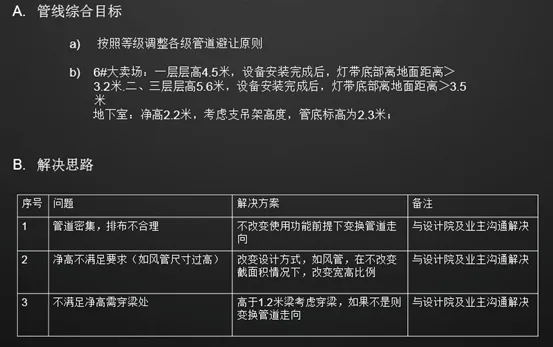
Examples of detected clashes:
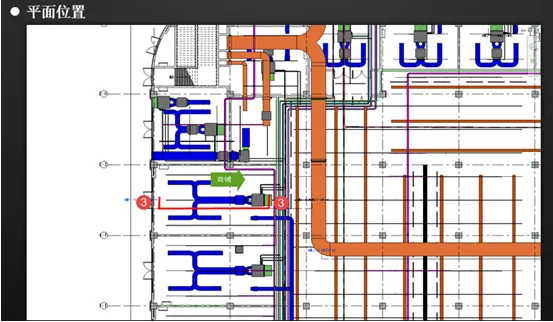
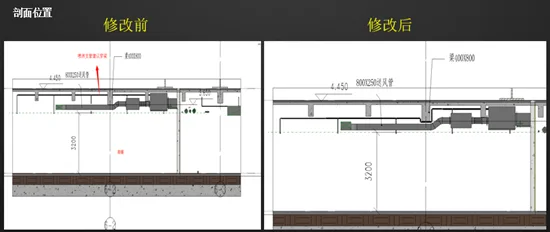
1) On the west side of the F1 floor, at axis 6-f, a spray nozzle conflicted with the main air supply pipe:
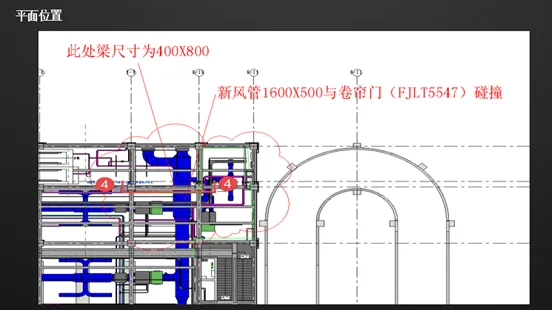
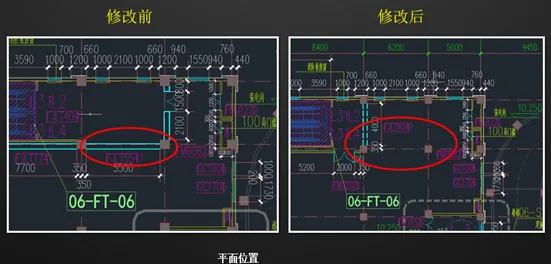
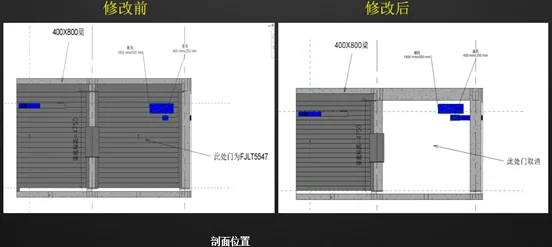
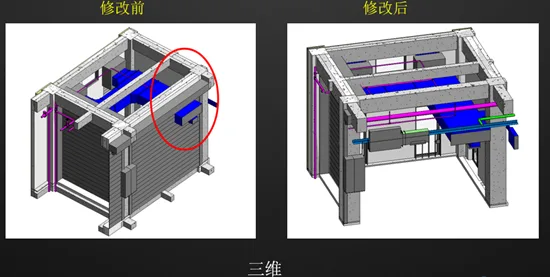
2) On the F3 floor, between axes 6-9/6-10 and 6-K, the FJLT5547 fireproof rolling shutter door clashed with a fresh air duct (1600×500):
3. Using BIM for Construction Management
With many general contractors involved, the construction management team requires comprehensive oversight of progress, technology, planning, materials, and costs. Given the project’s large scale and extended schedule, various factors during construction impact timelines.
To address this, the BIM team leveraged 4D and 5D BIM functionalities to assist in decision-making related to construction sequencing, material supply, and scheduling.
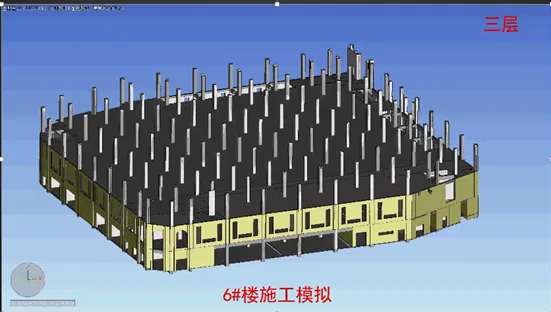
(5D BIM Construction Management)
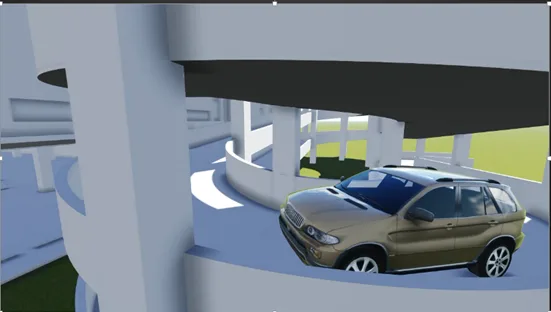
(Simulation test of circular ramp vehicle route)
Conclusion
Since 2012, the Nanjing Zhenghua BIM consulting team has been implementing BIM technology in Vanke’s commercial projects. The adoption of BIM is steadily growing across Vanke’s portfolio, with project teams gaining familiarity and expertise in BIM application methods. Shanghai Vanke has not only pioneered this technology but also actively promoted it to project owners.
In this project, BIM technology not only facilitated the owner’s understanding and acceptance but also earned high praise for Vanke’s proactive approach in adopting innovative technologies and delivering tangible results.














Must log in before commenting!
Sign Up