
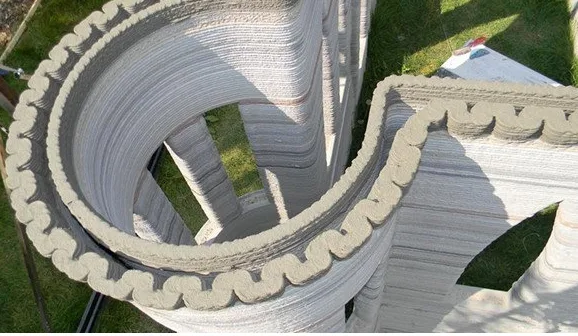
In recent years, with the support of national policies, residential industrialization has developed rapidly, and batches of industrialized residential buildings have sprung up. Residential industrialization has entered the fast lane of development, especially with the development of information technology, which is promoting the development of residential industrialization towards automation, integration, and intelligence. The emergence of 3D printed concrete buildings fully demonstrates the bright prospects of future residential industrialization development. The intelligent manufacturing of the construction industry is not a castle in the air. A construction company in Shanghai used 3D printers to build two buildings, one is a 1100 square meter villa in Shanghai, and the other is a 6-story residential building in Suzhou, which is currently the tallest 3D printed building in the world.
3D printing technology is an advanced manufacturing technology, and its unrestricted nature by product structure determines its sufficient application in many industries. From another perspective, 3D printing is just an advanced manufacturing technology and a tool. Its value as a product itself is not high, and it needs to be realized in industry applications, which is a process of gradually matching technological advantages and user needs. For 3D printed concrete buildings, cost, raw materials, and structural safety are key points for their future development.
Analysis of 3D printed concrete structures
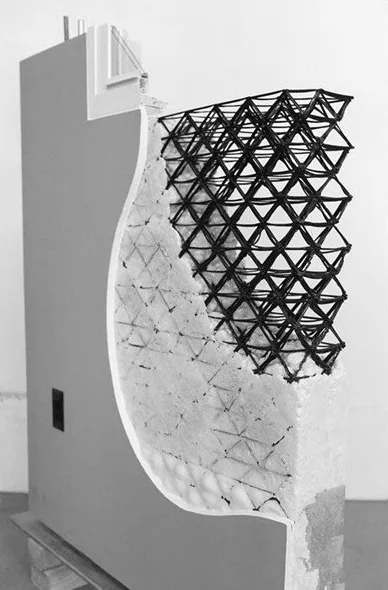
At present, 3D printing of concrete buildings involves modular design of the entire building, printing industrial modules using 3D printers, and finally transporting them to the construction site for assembly. Therefore, its production and construction process is basically the same as that of PC component industrial residential buildings. The difference is that in these 3D printed modules such as walls and panels, there are no steel bars. Instead, cement and fiberglass are used to enhance the tensile strength of the entire concrete structure, thus achieving the construction of a 6-story residential building using an unreinforced concrete structure.
At present, the industrial PC structure system for residential buildings in China can be divided into two categories: fully assembled structures and partially cast-in-place and partially assembled structures. The integrated residential structural system developed by Vanke is actually imported from Japan, and its beams, columns, and shear walls are all cast-in-place as load-bearing structures; The floor slab is a semi prefabricated combination of prefabricated floor slab and cast-in-place BIM layer; Only the exterior walls, stairs, and balconies are fully prefabricated components. The fifth generation integrated housing of Yuanda Residential Engineering is similar to this. Therefore, from the current situation in China, most of them adopt semi prefabricated structural systems, except for Yuanda’s sustainable buildings, which use fully assembled steel structure buildings, all connected by bolts, and can build 6 floors a day. Various new types of prefabricated building structural systems are constantly emerging.
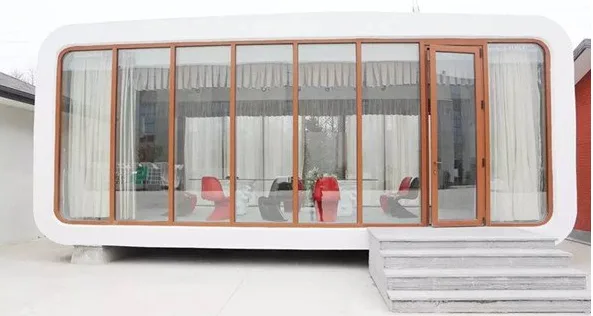
As the most cutting-edge and cutting-edge technology in residential industrialization, 3D printed concrete buildings need to break through the semi prefabricated structural system, adopt fully assembled structures, and even 3D printing throughout the entire process, in order to achieve the complete transformation of the construction industry from traditional construction to manufacturing. In addition to the basic parts, in the future, even the entire foundation will be 3D printed to achieve true intelligent manufacturing and utilize virtual assembly technology. Virtual assembly is the use of computer simulation and virtual reality technology to simulate assembly on a computer through simulation models, achieving optimal solutions for product process planning, manufacturing, and on-site assembly.
For 3D printed building modules, the use of non reinforced structures is not only for the convenience of printing, but also to achieve the advantages of lightweight, thin, and strong 3D printed concrete modules. More varieties of concrete are used to print building modules with different functions and structures. Therefore, the raw materials for 3D printed concrete have a wider range of sources and varieties, and the mechanisms of setting, hardening, and strength generation will also break through the theoretical scope of traditional concrete. The durability and safety also need to be studied and demonstrated.
With the continuous development of technology, there will even be giant 3D printers in the future, which can print the entire building on site. The main structure of the 3D printer, similar to the double dragon gate hanging style, can be raised and lowered like a tower crane. Several variable position beams are arranged on the top for BIM learning, and one print head is set on each beam. Depending on the area size, dozens to dozens of print heads are arranged. The vertical structure of the building can be directly printed layer by layer upwards, and the modular structural steel bars are lifted on site by cranes for welding and assembly. The printing head can use tools similar to ancient rammed earth walls to sandwich steel mesh and stack concrete layer by layer upwards. Once this giant printer appears, it will bring huge changes to the entire commodity concrete industry, and it is also a huge challenge for small and medium-sized commodity concrete enterprises. This concrete technology used for 3D printing is more complex and requires higher quality.
Analysis of raw materials for 3D printed concrete
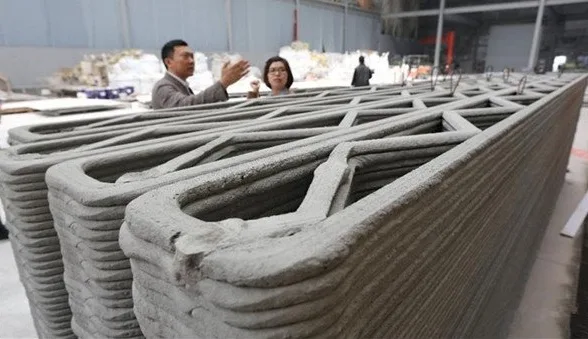
According to publicly available information, Shanghai’s 3D printed concrete buildings use glass fiber reinforced concrete, which is characterized by higher tensile, bending, and crack resistance than ordinary concrete, as well as improved toughness and impact resistance. Therefore, it is widely used in non load bearing components such as exterior walls, ceilings, and partition walls. For example, the white concrete grid on the exterior of the French Pavilion at the Shanghai World Expo is made of glass fiber concrete.
From the perspective of the development trend of the existing 3D printing concrete technology, the proportion of ordinary concrete in the 3D printing building raw materials will be significantly reduced in the future, and fiber concrete, foam concrete, lightweight aggregate concrete, cement resin based concrete, polymer concrete, water glass concrete and other types of concrete will be more widely used, and even new material concrete may appear.
3D printed concrete is different from traditional concrete. Due to the lack of templates in 3D printing, it not only needs to meet the requirements of rapid prototyping, that is, it quickly sets and flows around after coming out of the printing nozzle; 3D printed concrete components or buildings must be seamlessly integrated to ensure a tight connection between layers of concrete without creating cold joints; In addition, it is necessary to ensure that the concrete flows freely within the pipeline and nozzle without blocking them. These three points require 3D printed concrete to be different from traditional concrete in terms of raw materials and quality requirements.

From the perspective of cementitious materials, 3D printed concrete uses a wide range of cementitious materials, which are broadly defined as concrete and not ordinary cement concrete. In addition to cement, tree fingers, water glass, gypsum, geopolymer, etc. can all be used as cementitious materials for 3D printed concrete. Among them, geopolymer is more suitable for 3D printed concrete due to its fast hardening and early strength characteristics.
Aggregates are the largest proportion of materials in concrete, and 3D printed concrete has higher requirements for aggregates than traditional concrete. Aggregates with high strength, low density, and particle morphology close to spherical shape are the most suitable for 3D printed concrete. At the same time, 3D printed concrete buildings are stacked layer by layer of concrete, and each layer of concrete is relatively thin. In addition, the structure of the 3D printer nozzle is complex, so it is required that the particle size of the aggregate in the concrete be smaller than that in traditional concrete, and the maximum particle size of the aggregate should be below 10mm. The requirements for particle size distribution, mud content, harmful substance content and other indicators are more stringent. These are all determined by the particularity of 3D printed concrete.
Admixtures have the smallest proportion in the composition of concrete materials, but they significantly improve the performance of concrete. 3D printed concrete requires higher workability, excellent flowability in pipelines, and rapid solidification in the air after coming out of the nozzle. Therefore, admixtures must have multiple functions and must be a composite superplasticizer. In addition, the materials used for 3D printing concrete are complex and diverse, which requires its additives to have good adaptability and form a 3D printing specific material.
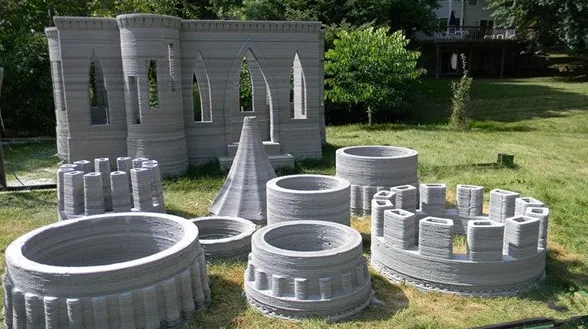
The industrialization of housing and the development of information technology have led to the emergence of new forms of construction, which is 3D printing architecture. 3D printing architecture is a very complex system engineering that inherits the ideas of manufacturing assembly line production and intelligent manufacturing, completely breaking the constraints of industrial production that cannot be used in construction, and providing unlimited possibilities for the development of building industrialization. The realization of 3D printed concrete buildings is an inevitable trend in the development of residential industrialization, a necessary requirement to adapt to the development of modern building technology, and an important way to improve the technological level and innovation of the entire construction industry.
The development of 3D printing concrete technology is both an opportunity and an unprecedented challenge for the commercial concrete industry. Only by adhering to technological innovation and keeping up with the development trend of construction technology can we win the initiative and achieve sustainable and healthy development in the future competition of commodity concrete market.
Article source: China 3D Printing Network












Must log in before commenting!
Sign Up