
How to Create Exploded Views of Model Components in Revit
Sometimes, it’s necessary to demonstrate the delivery and installation process of complex components or nodes. In Revit, you can achieve this efficiently by using the Create Parts and Displace/Displace Elements commands to generate detailed exploded views. Let’s walk through the process using a composite wall as an example.
First, draw any composite wall. Whether viewed in shading mode or realistic mode, the wall initially appears as a single, solid element without revealing its individual layers.
Next, select the wall and click on Create then choose the Create Parts command from the panel.
At this stage, you will notice that the wall’s multiple layers become visible. The original composite wall is now broken down into several smaller parts. Besides walls (excluding stacked walls and curtain walls), other layered elements such as floor slabs (except multi-story shape-edited slabs), roofs, and ceilings can also be converted into parts using this method.
To illustrate the relationship between each layer and the entire model, use the Displace/Displace Elements command to create an exploded view. Select the component you want to move, then click on View and choose Displace/Displace Element from the panel. This will display drag controls on the selected part, allowing you to move it along the X, Y, or Z axis and adjust its position freely.
After moving the part to the desired location, add a path to visually connect it back to its original position in the model.
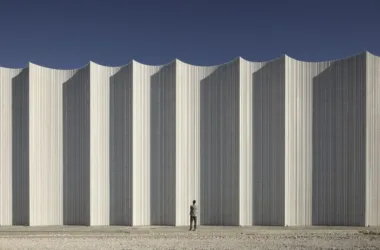
Repeat this process for other layers, dragging and adding paths as needed. The final effect will look similar to the exploded diagram shown in the image below.
This simple method enables the creation of clear and visually appealing exploded and decomposition diagrams for your models.
【 Related Skills Search 】
How to Create Explosion Analysis Diagrams in Revit
Drawing Wall Details with Detail Components in Revit














Must log in before commenting!
Sign Up