
—The Application of BIM in Commercial Real Estate
Chen Lei, Consultant, Shanghai Luban Enterprise Management Consulting Co., Ltd.
Challenges of Traditional Operations and Maintenance
The rapid expansion of commercial real estate brings significant challenges, especially regarding talent cultivation and retention. Operations teams are central to competitiveness, but the industry faces difficulties in recruiting and training qualified personnel, particularly for senior management. High demands for staff quantity and capability cannot be met quickly through internal training or external recruitment. Additionally, rising labor costs in China have made workforce expenses a major concern during operations and maintenance.
Key questions include: How can operational quality be enhanced without increasing staff numbers? How can the efficiency of current employees be improved? The answer lies in strengthening headquarters’ control capabilities. Operational efficiency in commercial real estate now depends on advanced information management systems rather than individual skill sets, forming the core competitiveness of these enterprises.
Low-Carbon Economy Pressures
In recent years, concepts like “low-carbon,” “environmental protection,” “energy conservation,” and “green” have become prominent social concerns. Buildings in China account for around 28% of the nation’s total energy consumption, with commercial real estate’s share being particularly substantial. For both business and society’s sustainable development, reducing energy consumption through technological and managerial innovations will become a key competitive advantage.
Risks of Passive Operations and Maintenance
Commercial real estate involves complex systems—lighting, ventilation, monitoring, elevators, communications, and more. Should these be addressed only after malfunction, or proactively maintained and replaced when needed? Any fault can disrupt business operations and even cause safety incidents. Timely discovery and prevention of potential hazards can significantly reduce losses.
Emergency Response and Handling
How should management respond to scenarios such as VIP visits, temporary events, conflicts, or fires—covering evacuation, security deployment, vehicle guidance, shutting down equipment, and activating fire protection systems? Poor handling of emergencies can result not only in financial losses but also damage to brand reputation.
Headquarters Management Challenges
With commercial real estate projects expanding nationwide, headquarters face increasing difficulty managing operations across regions. How can they quickly and accurately understand the performance of projects and provide tailored guidance? Leveraging talent and technology, headquarters should build a robust management and support platform that enables rapid identification of issues and efficient coordination across regions.
The Value of Integrating BIM and IoT for Operations and Maintenance
Remote Equipment Control
Using technologies like RFID, previously isolated devices within commercial real estate can be managed on a unified platform. This allows monitoring equipment status and enabling remote controls—for example, checking elevator functionality or remotely switching lighting systems.
Spatial Positioning of Systems and Equipment
BIM transforms traditional textual or numbered representations into three-dimensional graphic locations. This improves searchability and provides intuitive visualization. For example, RFID can track the location of security personnel. When a fire alarm is triggered, the BIM model quickly identifies its location and displays evacuation routes and key equipment nearby.
Visualization of Internal Facilities
Historically, facility information was limited to 2D drawings and manuals, requiring professionals to interpret and act. BIM enables a visual 3D model, consolidating all relevant data. For example, during renovations, the BIM model shows the location of pipelines and load-bearing walls, tenant spaces, and detailed information, making planning and management more efficient.
Data Accumulation and Analysis
Operational and maintenance data are valuable for management. They help analyze problems, identify hidden risks, and optimize operations. For example, RFID can track electricity meter readings over time and enable garage management by analyzing parking space availability.
BIM and IoT technologies are indispensable for modern operations and maintenance. Without IoT, management remains manual and fragmented. Without BIM, operations cannot be spatially associated with buildings or systematically evaluated. Together, they offer 3D visualization of information models and give building components and devices new intelligence, elevating operations to a new level of smart buildings. The combined use of BIM and IoT will drive a comprehensive information revolution in commercial real estate operations and maintenance.
System Architecture
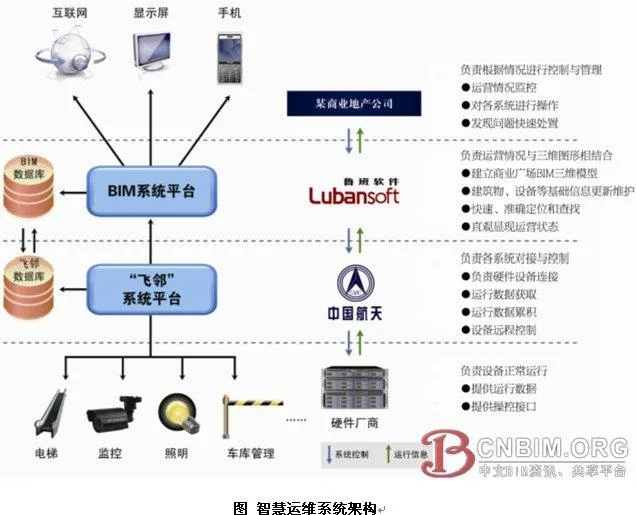
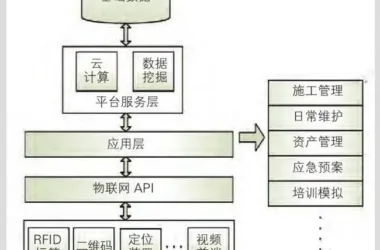
The foundation of the intelligent operations and maintenance system is built on Luban Software’s BIM platform and the “Flying Neighbor” system developed by China Aerospace. The system architecture is illustrated below:
Specific Applications of Intelligent Operations and Maintenance
Commercial real estate operations and maintenance involve multiple systems, such as equipment management, energy management, security, tenant management, and more.
Equipment Operation Monitoring
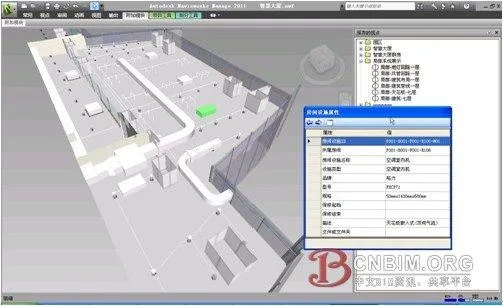
The management system integrates search, retrieval, and location functions for devices. By clicking on equipment within the BIM model, all relevant information can be viewed—supplier, expiration date, contact number, maintenance status, and location. The system manages device lifecycles, issuing timely warnings for parts nearing expiration, preventing accidents. Searching by device name or description quickly locates the equipment in the virtual building. Managers can use four-dimensional BIM models to browse building equipment in real time.
Equipment Operation and Control
Device operational status is visually displayed on the BIM model—green for normal, red for malfunction. Historical operating data can be queried, and devices can be controlled remotely, such as switching lighting systems in specific areas.
Hidden Project Management
On July 28, 2010, during the demolition of a waste plastic factory in Qixia District, Nanjing, an underground pipeline was accidentally excavated, causing a violent explosion. The lack of accessible information on these concealed pipelines was a critical factor. As buildings age and personnel change, such hazards become more prominent.
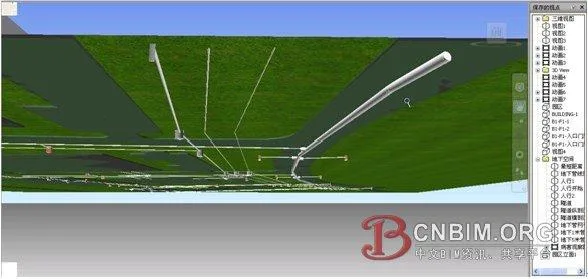
Smart operations and maintenance systems manage complex underground pipelines—sewage, drainage, network cables, wires, and related pipe wells—allowing their positions to be measured directly on the map. Renovations can avoid existing pipe networks, facilitating maintenance, replacement, and positioning. The same applies to concealed works indoors. All information is stored electronically, can be shared internally, and updated as needed to ensure completeness and accuracy.
Energy Operation Management
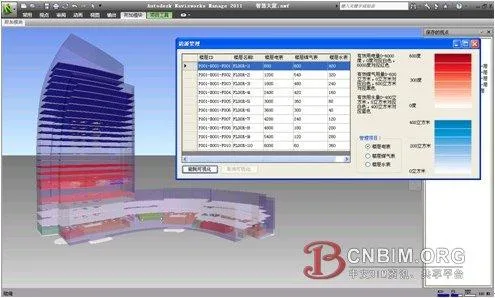
IoT technology makes daily energy management and monitoring more efficient. With smart electricity, water, and gas meters, energy usage is collected in real time. Through the energy management module, consumption can be analyzed by area and tenant, and abnormal usage can trigger warnings or labels.
Tenant Management
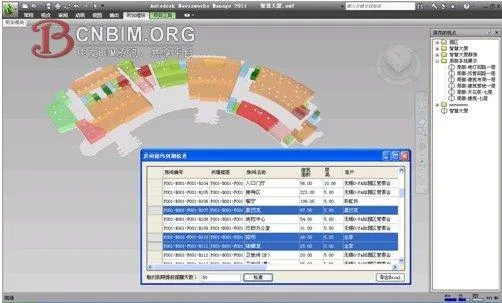
By searching and locating within the system, managers can easily find merchant spaces and access tenant information, such as customer name, building area, lease area, rent, and property management fees. The system offers customized functions, such as rent collection reminders. Data is updated in real time, forming a fast sharing platform.
Security Management
Video surveillance is now integrated with BIM-based visualization. Traditional systems provide many “eyes,” but BIM-based systems add “brains.” Camera and video management are part of the operations and maintenance control center. With a large monitoring screen, the video surveillance system can display all images for any selected floor. In emergencies, BIM-based video monitoring can integrate with other subsystems for coordinated response.
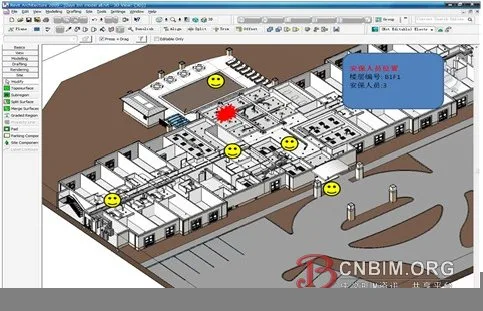
Security personnel can be tracked using wireless RF chips embedded in work cards, allowing for real-time location tracking. This is particularly valuable in large commercial properties with high foot traffic and frequent emergencies. When dangerous situations arise, management can efficiently direct security operations.
Garage Management
Traditional garage management systems only report the number of available parking spaces, not their specific locations, causing congestion and wasted resources. Wireless RFID technology places location identifiers on parking cards, automatically tracking occupancy. All occupied and vacant spaces are displayed at the garage entrance, and customers can easily locate their cars, improving navigation and reducing confusion.
Emergency Management
BIM technology enables comprehensive emergency management without blind spots. As commercial centers gather large crowds, rapid response is crucial. Traditional emergency management focused on response and rescue, whereas intelligent operations cover prevention, alerts, and handling.
For example, in the event of a fire, the management system can sense information through sprinkler sensors. A fire alarm is triggered in the BIM interface, immediately pinpointing the fire’s location in 3D. The control center can quickly review surrounding conditions, aiding timely evacuation and response.
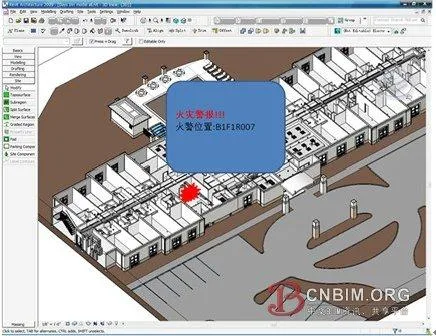
Other emergencies, such as water pipe or air duct bursts, can also be managed efficiently: the BIM system helps quickly locate control valves, avoiding time-consuming searches. Delays can lead to catastrophic incidents.
Outlook for Smart Operations and Maintenance
Recognizing the importance of BIM technology, China has supported research since the “15th Five-Year Plan” for scientific and technological breakthroughs. While BIM is widely used in design and construction, its application in facility maintenance is still developing. Experts agree that demand for BIM in operations and maintenance is high, especially for commercial real estate, where its value is clear. The rapid growth of IoT provides new opportunities for BIM’s application in this stage.
The “Internet of Things” is considered the third wave of global information industry, following computers and the internet. Experts believe IoT can improve efficiency, reduce costs, and drive economic recovery. Countries like the US, EU, and China are investing heavily in IoT research. China’s Ministry of Industry and Information Technology is actively researching next-generation information technology and forming supportive policies.
Source: New Luban














Must log in before commenting!
Sign Up