
Green buildings are structures designed to maximize the efficient use of resources—such as energy, land, water, and materials—while minimizing environmental impact and pollution throughout their entire lifecycle. These buildings aim to provide healthy, comfortable, and efficient spaces, fostering harmony with the natural environment. Importantly, the label “green” goes beyond marketing; it requires a comprehensive evaluation system to ensure that all relevant standards are genuinely met.
In China, developers primarily rely on LEED certification as the standard for assessing green buildings. LEED, or Leadership in Energy & Environmental Design, was established by the US Green Building Council in 1998 and is internationally recognized as the most influential and comprehensive framework for evaluating building sustainability and environmental performance. LEED evaluates projects across six core dimensions: sustainable site development, water efficiency, energy and environmental performance, materials and resources, indoor environmental quality, and innovative design. The criteria and their respective weights vary by building type, and are classified either as prerequisites (mandatory) or credits (optional, determining the level of certification).
LEED was introduced to the Chinese construction market in 2003, with the first projects registered in 2004 and certifications being awarded by 2005. As LEED has gained traction, the number of registered and certified projects has increased rapidly each year. As of August 10, 2011, China had 515 LEED-registered projects and 149 projects that had received LEED certification. These figures highlight that China’s green building industry is still in its early stages; while the overall market size is still limited, its growth rate is remarkable.
Bolstered by national policies such as the 12th Five-Year Plan, green buildings are widely seen as the future of China’s construction industry. The outlook for the sector is positive. The following analysis uses the BCG matrix to examine investment and growth strategies for companies in various competitive positions.
In 2010, the number of LEED-registered projects in China increased by 47% year-on-year, while in 2011, growth slowed to 32%. The number of LEED-certified projects rose by 275% in 2009 and by 117% in 2010, reflecting rapid expansion and strong market appeal. According to the Ministry of Housing and Urban-Rural Development, the output value of green buildings grew by more than 60% annually in both 2010 and 2011. Consequently, the BCG matrix uses 60% as the benchmark for industry growth rate.
Analysis of Enterprise Competitive Positions
China’s green building sector is currently in a phase of rapid growth with relatively moderate market competition. Companies in the sector differ in terms of starting points and capabilities. The market now consists of a leading group (the top three companies by market share) and a following group (other companies).
Investment Strategies for Comprehensive Development Enterprises
BCG Matrix Analysis for Green Buildings in China
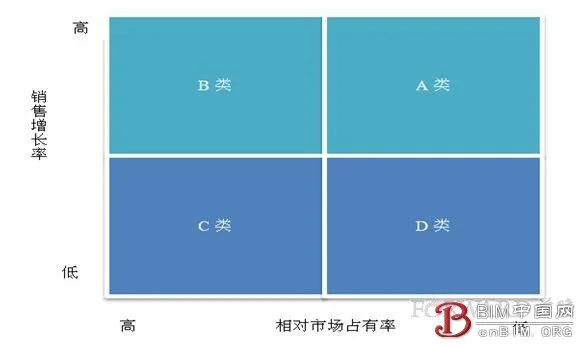
Source: Forward-looking Information Industry Research Institute
A-Class Business Types and Corresponding Strategies
A-Class companies operate in a fast-growing market (growth rate above 60%) but do not hold a leading position. This suggests there are significant market opportunities, but also challenges such as marketing, product quality, or other internal factors. Financially, these companies often face low profit margins, insufficient capital, and high debt ratios (with some variations). Typically, they are new entrants or have yet to establish market dominance. Recommended strategies include:
1. Assess internal resources (capital, talent, land) and capabilities (technology, management, experience) to identify areas for improvement.
2. If improvements are possible, formulate a long-term plan to build competitiveness, expand market share, and transform green building products into “star products.”
3. If improvement is unlikely or efforts do not close the gap with industry leaders, adopt a maintenance strategy and keep monitoring market trends.
B-Class Business Types and Corresponding Strategies
B-Class companies experience a growth rate above 60% and hold a leading market position. Their sales revenue from green building products is growing rapidly, requiring further investment to maintain momentum. The recommended strategy is:
Actively increase scale and market presence, pursue long-term returns, boost market share, and reinforce competitive leadership. The ultimate objective is to transition into a D-Class “Cash Cow” business, thereby establishing a strong profit center for the company.
C-Class Business Types and Corresponding Strategies
C-Class companies have growth rates below the industry average, are market followers, and see a shrinking market share. These businesses typically have low profits, break-even or negative financials, high debt ratios, and lack sustainable profitability. Recommended strategies are:
1. Reduce investment and gradually withdraw from or exit the market.
2. Redirect resources toward other products or projects.
3. Restructure product lines or consider mergers and acquisitions.
D-Class Business Types and Corresponding Strategies
D-Class companies have achieved maturity in green building products, possess a leading market position, and maintain stable market share. Currently, no company in China’s green building sector has reached this stage, as the industry is still developing and the competitive environment remains dynamic. Nevertheless, the “Cash Cow” business model is the ultimate goal for all companies and represents the future direction for the industry.
















Must log in before commenting!
Sign Up