
Preface
On October 18, 2007, the Construction Market Management Department of the former Ministry of Construction issued the “Implementation Opinions on the Qualification Management Regulations for Construction Enterprises” (Jian Shi [2007] No. 241). Annex 2 of this document, referred to as the “Informationization Evaluation Form for Special Qualification Standards of Construction General Contracting Enterprises” (hereafter, “Informationization Evaluation Form”), set forth detailed requirements for digital transformation in construction companies applying for special qualifications.
Leading construction firms today face a variety of management challenges and must leverage information technology to improve operational efficiency. For many construction enterprises with limited IT experience, there is an urgent need for effective IT solutions to build management information systems and progressively achieve digitalization.
The Institute of Building Engineering Software, China Academy of Building Research, has years of experience in developing and implementing IT solutions for large and medium-sized construction contracting companies. During the “15th Five-Year Plan,” the Institute partnered with China State Construction Corporation to complete the national project “Development of Information Technology Application Software for Construction Enterprises.” In 2006, the Institute delivered the “Engineering Project Management Information System for General Contracting Mode.” Since 2002, dozens of leading construction enterprises have benefited from these IT solutions, accumulating significant practical experience.
This article summarizes both the research findings and practical experiences, providing a comprehensive IT solution for general contracting enterprises with special qualifications. It also presents specific case studies to help guide these companies through their digital transformation journey.
2. Overall IT Solution Framework for Special Qualification General Contracting Enterprises
The “Informationization Evaluation Form” establishes assessment standards in six main categories and twenty-four subcategories, which are divided into two groups: foundational environment construction (including network hardware and management software) and application systems. Based on the current IT adoption status and practical needs of construction enterprises—as well as the Evaluation Form’s requirements—this article proposes a holistic IT solution framework tailored for special qualification general contracting enterprises.
2.1 Basic Environment Construction Plan
2.1.1 Network Equipment and Hardware Environment
The “Informationization Evaluation Form” requires companies to establish computer centers, purchase servers, and deploy internal networks at project sites. It also specifies the need for network security, antivirus solutions, and data backup to ensure information safety. The hardware requirements are similar to those in other industries and can be met with mainstream market solutions. Therefore, this article does not detail hardware solutions.
2.1.2 Management System Software Environment
The Evaluation Form mandates only “dedicated information management personnel” and “operational management systems for all included systems.” However, true digital transformation requires a robust information management system, going far beyond these minimum requirements. Building the IT software environment involves three main aspects: IT strategic planning, establishing and improving the IT organizational structure, and enhancing regulations and operational management systems for information systems.
(Source: BIM Building Network)
2.2 Application System Solution Framework
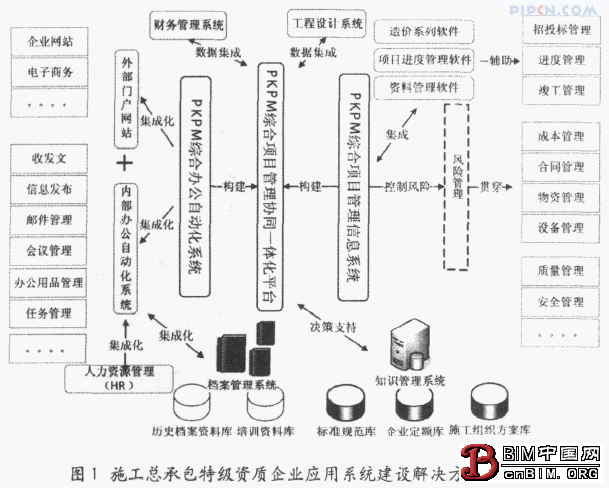
The “Informationization Evaluation Form” requires enterprises to build application systems such as portal websites, office automation (OA), comprehensive project management, human resources, archive management, financial management, e-commerce, and knowledge management. Integration among these systems is also required. All professional design work must use computer software, and companies should deploy bidding and quotation software, schedule management software, and completion data management software throughout the construction process.
Drawing on the research and practical achievements of the China Academy of Building Research, this article presents a solution framework for the required application systems, as shown in Figure 1 below. Many construction companies still lack effective application system solutions to support their digital transformation. This article therefore provides a comprehensive introduction in three parts: the comprehensive project management system, the integrated OA system solution (including portal, HR, archive, and office automation), and strategies for system integration.
3. Comprehensive Project Management System Solution
The comprehensive project management system organizes the ten sub-items under “Comprehensive Project Management” in the Evaluation Form into four main categories:
3.1 Bidding, Progress Management, and Completion Management
The Evaluation Form requires companies to use dedicated software tools for bidding, progress, and completion management. Most large construction enterprises already use such tools independently, thus meeting the Form’s requirements. This article recommends integrating these three core tools into a unified comprehensive project management system, which would serve as the central repository for all project management data.
(Source: BIM Building Network)
3.2 Core Business Systems
3.2.1 Contract Management
The contract management module classifies contracts into owner contracts, internal contracts, joint venture contracts, subcontracts, procurement contracts, and leasing contracts. The management workflow includes contract review, signing, disclosure, changes, claims, settlements, payments, and counterclaims.
Key business processes include:
- Contract basics: managing contract templates and drafts
- Contract review: process approval workflows
- Contract formation: overview registration and ledger queries
- Contract performance and control: disclosure, changes, claims, settlements, and financial management
- Comprehensive contract queries: evaluation and summary analysis
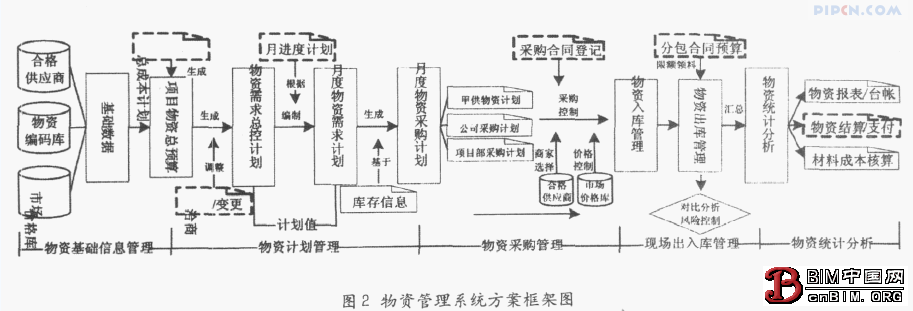
3.2.2 Material Management
The complete material management process is illustrated in Figure 2:
3.2.3 Cost Management
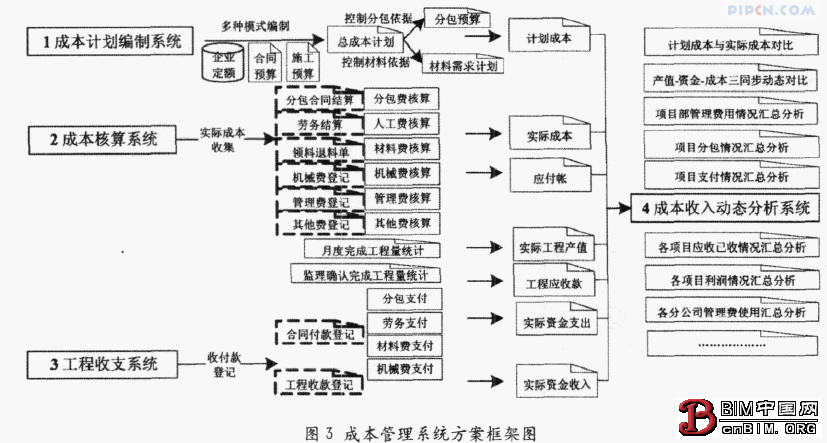
Cost management for construction projects covers forecasting and decision-making, planning, control, accounting, and analysis. The cost management system is composed of four subsystems: cost planning, cost accounting, project revenue and expenditure, and dynamic cost-income analysis. The structure is shown in Figure 3:
3.2.4 Mechanical Equipment Management
Mechanical equipment management consists of five areas:
- Basic information management: includes a qualified supplier database, equipment code database, inventory, and market price database
- Planning management: project departments submit equipment demand plans for company review and approval
- Supply management: supply mode (internal allocation, internal/external leasing, procurement) is determined based on demand and inventory
- On-site management: after delivery, project departments manage on-site equipment, including spare parts, maintenance, and repairs
- Statistical analysis: analyzing equipment status, cost accounting, and generating reports
3.3 Quality and Safety Management
3.3.1 Quality Management
The Evaluation Form’s quality management requirements are part of the enterprise-wide quality system, focusing on information management of engineering quality documents and technical data. This ensures project quality can be controlled at the company-wide level.
The quality management module includes:
- Quality objectives management: preparing project quality plans and targets, registering awards
- Quality personnel management: recording inspectors, training, and assignments
- Quality inspection: logging inspections, acceptance, and monthly reports
- Quality incident management: documenting incidents, handling, rectification, and monthly statistics
(Source: BIM Building Network)
3.3.2 Safety Management
The Evaluation Form’s safety management requirements are also incorporated at the enterprise level, covering all documentation related to company safety operations and management controls.
The safety management module covers:
- Personnel management: registering safety officers, special job roles, and assignments
- Safety education: planning, training registration, and promoting safety awareness
- Safety inspections: recording inspections, rectifications, and safety scores
- Safety incident management: accident records, investigations, and monthly statistics
- Assessment and rewards/punishments: tracking safety rewards, penalties, and summary reports
3.4 Risk Management
Risk management is integrated into all subsystems, including schedule, contracts, materials, costs, equipment, and quality/safety management. Rather than functioning as a standalone subsystem, risk management is embedded throughout all business processes.
4. Integrated OA Solution: Portal, HR, Archive, and Office Automation Systems
The “Informationization Evaluation Form” requires companies to establish external portal websites, HR management, archive management, office automation, and e-commerce systems. This article recommends implementing an integrated solution covering all of these systems, as shown in Figure 1. The proposed solution includes:
- An integrated external portal and internal OA system
- A comprehensive OA system that manages HR, archives, and e-commerce
Source: Institute of Building Engineering Software, China Academy of Building Research
Authors: Liang Bo, Chen Dailin
















Must log in before commenting!
Sign Up