
Research Objective: Engineering cost management is a core discipline within project management and plays a vital role in achieving project success. This paper explores strategies for controlling engineering costs using project management techniques, emphasizing the interconnectedness of all project elements. The aim is to improve cost control in engineering practices and help organizations attain true profitability.
Research Method: This study adopts principles and methods from scope management, time management, quality management, and cost management to analyze their respective impacts on project costs. Concepts such as value engineering and earned value are utilized to address the relationship between project duration, cost, and quality, thereby establishing a comprehensive framework for managing all project components.
Research Conclusion: Engineering cost management cannot be isolated from other aspects of project management. Focusing solely on costs while ignoring other factors will not achieve effective cost control. Successful management requires a holistic understanding and integration of scope, quality, time, and cost.
Project management was formalized as a structured methodology in the late 1950s. Its proven effectiveness led to widespread adoption across industries like aerospace, aviation, defense, construction, and finance from the 1960s onward. In China’s construction sector, integrating project management with local practices has yielded significant results. Landmark projects such as Xiaolangdi and the Three Gorges Dam demonstrate how project management enables companies to optimize resources, maximize benefits, and accelerate development.
It is widely recognized that successful project delivery depends on four key factors: scope, cost, schedule, and quality. Engineering cost management—sometimes referred to as general engineering cost management—is fundamental to project success and is one of the nine core knowledge areas in project management. However, all aspects are interconnected. Focusing on just one undermines overall project outcomes. Effective cost control requires integrating various project management techniques.
1. Application of Project Scope Management to Engineering Costs
1.1 Concept of Project Scope Management: A project is a unique endeavor aimed at delivering a specific product or service. Scope management encompasses two primary components: product scope (the features or functions of the deliverable) and project scope (the work required to deliver those features). Defining scope starts by identifying the final deliverable and its clear, measurable characteristics, which are communicated through documents, diagrams, or standards stakeholders can easily understand. Clarity is key—ambiguity must be avoided. Product scope determines project scope, and a scientific approach to defining project scope forms the foundation for cost management. Once the scope is established, preliminary cost estimates can be prepared according to relevant standards, providing a basis for cost control and future budgeting. In construction projects, initial bidding documents, tender materials, and engineering drawings are commonly used to define scope.
1.2 Methods of Project Scope Management and Their Impact on Cost Control: Scope management involves planning, definition, verification, and change control. Among these, scope definition and change control are most critical for cost management. The Work Breakdown Structure (WBS), the main outcome of scope definition, divides the project into manageable units, ensuring all necessary work is identified. WBS, as a hierarchical structure, forms the foundation for:
- Integration and coordination validation
- Schedule and timeline confirmation
- Risk assessment and decision-making
- Clarification of project organization
- Definition of cost structure
- Delineation of work package matrix
- Method selection and account preparation
- Establishing quality benchmarks
- Developing communication and procurement plans
All these elements are closely connected to total project cost, making WBS essential for cost control. Resource requirements—including labor, materials, equipment, subcontractors, travel, and logistics—are determined for each work package according to the WBS. Using these requirements and unit prices, cost estimates and management plans are created. Common estimation methods include analogy-based, parametric, and bottom-up approaches. The cost management plan details how cost deviations will be handled, reflecting the project’s financial scope and enabling indirect cost management through scope management. Both are interdependent and integral to the overall project plan.
After cost estimates are generated from the WBS, a cost budget is established, allocating the total project cost among work packages. Each package receives a Total Budgeted Cost (TBC), determined via either top-down or bottom-up methods. This cost budget forms the cost baseline plan, a key output for cost control. The plan distributes the budget over time, allowing cost performance to be measured and monitored using an S-curve (with time as the horizontal axis). The cost baseline supports earned value analysis, cost control, as well as schedule and scope control. Construction project managers often manage schedule, scope, and cost separately, neglecting their integration, and may overlook that cost management reflects scope and schedule deviations.
Scope change control is another essential process. It involves managing factors that influence scope changes, determining if changes have occurred, and controlling those changes. Managing scope changes not only impacts scope itself but can also trigger changes in objectives such as schedule, quality, and cost. While an ideal scope plan is desirable, changes are inevitable. Change is not inherently negative—the absence of standardized change management is. Scope changes may result from user requests, environmental factors, or design modifications. Performance monitoring and progress analysis are essential for anticipating and managing potential scope changes according to standardized procedures. By mastering scope change management, root causes affecting project objectives can be controlled, ensuring effective cost management. Cost changes resulting from scope changes must be tracked promptly for comprehensive cost control, rather than managing costs in isolation.
2. Application of Project Time Management to Engineering Costs
Project time management focuses on managing the project schedule and duration. Modern construction companies prioritize timely or early completion as a competitive advantage during bidding. However, project managers often overlook how abnormal or unrealistic timelines can significantly raise costs. Project cost and duration are fundamentally linked. In project management, “time is money”—both acceleration and delay can have major financial consequences. Cost management that ignores scheduling, or vice versa, is unscientific. Therefore, duration and cost must be managed together, considering their mutual impact during planning and execution.
Research in project management shows an S-curve relationship between project duration and cost. The US Department of Defense’s “Specification for Cost/Schedule Control Systems” introduced earned value management as an advanced method for integrated schedule and cost control. Professor Abba, a renowned project analyst, defines earned value as a measure comparing planned and actual values of completed and uncompleted tasks. The formula is: Earned Value (EV) = Actual completed task volume × Budgeted cost of completed tasks. According to PMBOK (2004), SV = EV – PV, where SV is schedule variance, EV is earned value (budgeted cost of completed work), and PV is planned value (budgeted cost of scheduled work). SV > 0 means the project is ahead of schedule; SV < 0 indicates a delay. Significant schedule variance calls for reviewing progress, assessing whether excessive acceleration has increased costs, and checking if costs have exceeded baseline and control thresholds. Cost and schedule change controls should be implemented, corrective actions taken, and project costs managed promptly. Cost reflects schedule, and cost deviations can be identified through schedule analysis. Thus, schedule and cost management must be integrated for effective cost control.
3. Application of Project Quality Management to Engineering Costs
3.1 Objectives of Project Quality Management and the Concept of Quality Cost
Project quality is a critical determinant of success. Ensuring quality is vital to a company’s reputation, but excessive requirements can result in unnecessary costs. According to PMBOK, quality management aims to satisfy regulatory and practical requirements—avoiding unnecessary “gold plating”—and fulfilling customer expectations. Both insufficient and excessive quality increase quality costs, which must be managed and optimized. Quality management consists of planning, assurance, and control, and introduces the concept of quality cost. Quality cost refers to the expenses incurred to ensure project quality and is divided into prevention costs, appraisal costs (for verifying quality and processes), and failure costs (for correcting deficiencies). Failure costs are further categorized as internal and external.
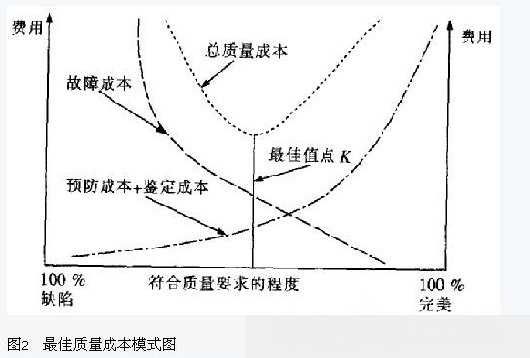
The diagram above illustrates that total quality cost is the sum of failure cost and prevention/appraisal cost curves. The lowest point K represents the optimal quality cost. The objective of quality cost management is to achieve the lowest combined value at point K. Prevention cost starts low but rises sharply as quality requirements increase. Appraisal cost is relatively stable but also increases with higher quality demands. Failure cost is high when quality is poor but declines as quality improves. The interaction among these costs leads to an optimal point K, which serves as the benchmark for controlling engineering costs.
Effectively managing the relationship among quality failure costs (internal and external), prevention costs, and appraisal costs is essential. Scientific and practical technical measures should be adopted to minimize project costs while ensuring construction quality meets design requirements. Excessive quality should be avoided, as it can increase costs without delivering proportional economic benefits, thus reducing competitiveness. The ultimate goal of project management techniques is to deliver appropriate products at reasonable costs that satisfy customer requirements.
3.2 Integrated Management of Project Quality and Engineering Cost
Integrated management of quality and cost is based on value analysis. By evaluating project output value, a unified quality and cost plan can be developed to maximize enterprise value. Value analysis uses the formula: V = F / C, where V is value, F is function (quality), and C is cost. Since quality generally equals function, value can be increased by enhancing function, reducing cost, or both. For example, decreasing both function and cost but with a greater reduction in cost, or increasing both but with a greater improvement in function than in cost. These methods raise project value and should be applied in comprehensive quality and cost control. By considering quality and cost together, sensible cost indicators aligned with quality requirements can be established.
Integrated Management of All Project Components
While scope, duration, and quality have been discussed in relation to cost control, managing these elements separately is ineffective. Scope, cost, schedule, and quality are directly interrelated and influence each other. Scope changes affect duration and cost; schedule advances or delays impact cost; quality affects cost; and cost, in turn, can affect both schedule and quality. Project management must integrate the management of scope, schedule, cost, and quality.
According to earned value principles: SV = EV – PV, and CV = EV – AC. Earned value (EV) represents the budgeted cost of completed work and serves as an indicator of deviations resulting from the interaction between schedule, quality, and cost. By analyzing the planned completion status of schedule, cost, and quality, it is possible to anticipate how current project status will affect future progress, enabling effective integrated control.
Conclusion
In conclusion, the distinct nature of projects requires a comprehensive and integrated management approach. However, current project management practices often lack cohesion among schedule, cost, and quality management. To enhance project performance and value and effectively control costs, it is crucial to understand the constraints and interrelationships among all project components. Managing costs alone will not achieve effective control. Only through integrated management methods, utilizing project management techniques and earned value principles, recognizing and understanding mutual impacts, developing corrective measures, and exercising effective project control, can the ultimate goal of project management be realized: delivering satisfactory and qualified products to customers at the lowest reasonable price and maximizing enterprise profit.














Must log in before commenting!
Sign Up