
The term “No Waste City” emerged as a new buzzword in the construction industry in 2019. Recently, the “Notice of the General Office of the State Council on Issuing the Pilot Work Plan for the Construction of ‘Waste Free Cities'” (hereafter referred to as the “Notice”) provided detailed explanations regarding standards and requirements. After careful review, it is clear that the construction industry plays a crucial role in achieving the goal of waste-free cities.
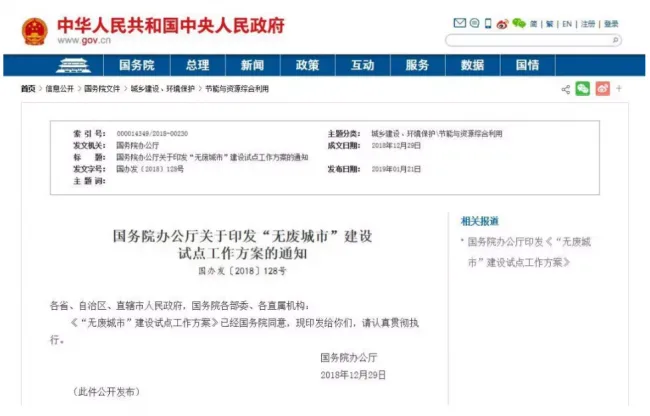
1. Multi-Ministry Leadership with Clear Responsibilities and Authority
The “Pilot Work Plan for the Construction of ‘Waste Free Cities'” outlines six main tasks, many directly linked to the construction sector.
(1) Strengthen top-level design guidance and utilize government’s macro-management role.
An indicator system for building a “waste free city” will be established to serve as a guiding framework. By June 2019, research was to develop a construction indicator system focusing on solid waste reduction and recycling rates. This system will integrate with green development and ecological civilization assessment frameworks. Moreover, a comprehensive solid waste statistics system will be created to unify data collection methods across industrial solid waste, agricultural waste, and construction waste.
This initiative is led by the Ministry of Ecology and Environment, with participation from several key ministries including the National Development and Reform Commission, Ministry of Industry and Information Technology, Ministry of Housing and Urban-Rural Development, Ministry of Agriculture and Rural Affairs, and the National Bureau of Statistics.
Policies will be integrated and innovated to enhance the systematic nature of pilot programs. Reforms under the Overall Plan for Ecological Civilization System Reform will be implemented, aligning circular economy, clean production, resource utilization, and rural revitalization policies toward building “waste free cities.” Pilot cities will develop tailored implementation plans that integrate urban construction and management with reform tasks to ensure coordinated and effective progress.
This effort is guided by a broad coalition of ministries, including Ecology and Environment, Development and Reform, Industry and Information Technology, Finance, Natural Resources, Housing and Urban-Rural Development, Agriculture and Rural Affairs, Commerce, the National Health Commission, and the National Bureau of Statistics.
Urban development will be coordinated with solid waste management and industrial layout optimization. Assessments will review regional solid waste utilization and disposal capacity. Construction and expansion of high-solid-waste-generating projects will be strictly controlled, especially where effective utilization or harmless disposal is challenging.
A multi-level circular utilization system for resources and energy across industry, agriculture, and daily life will be promoted. Material flow analysis will support building circular economy industrial chains within industrial parks, enterprises, and regions. Urban infrastructure planning will clearly define support capacities for waste classification, collection, and disposal—including household waste, sewage sludge, construction waste, tires, hazardous waste, agricultural waste, and scrapped vehicles—to ensure adequate facility land use.
This coordination is led by the National Development and Reform Commission, Ministry of Industry and Information Technology, Ministry of Natural Resources, Ministry of Ecology and Environment, Ministry of Housing and Urban-Rural Development, Ministry of Agriculture and Rural Affairs, and Ministry of Commerce.

(4) Promote green lifestyles and reduce household waste at the source.
Construction waste management will be enhanced to improve source reduction and resource utilization. The current status and trends of construction waste generation will be studied, and the entire lifecycle of construction waste will be managed more effectively.
Planning guidance will optimize the layout of transportation, storage, consumption, disposal, and recycling facilities for construction waste. Facility construction will be accelerated to meet urban development needs, while stockpiled waste sites that meet safety and stability standards will undergo ecological restoration.
Where conditions allow, resource utilization will be promoted, aiming to improve the quality of recycled construction waste products.
This task is led by the Ministry of Housing and Urban-Rural Development, National Development and Reform Commission, and Ministry of Industry and Information Technology.
(6) Stimulate market vitality and foster new industrial development models.
Incentive and regulatory mechanisms will be accelerated to encourage solid waste reduction, resource utilization, and harmless treatment. Government investments in public projects will prioritize comprehensive utilization products made from industrial solid waste and promote green building materials such as innovative wall products.
The plan also explores mandatory resource utilization systems for construction waste in prefabricated housing, clarifying product quality standards, usage scope, and required proportions.
This initiative is guided by the National Development and Reform Commission, Ministry of Industry and Information Technology, Ministry of Housing and Urban-Rural Development, and the State Administration for Market Regulation.
From the above, it is evident that the future will bring breakthroughs in the statistics, treatment, and supervision of construction waste, alongside advancements in its reuse and harmless disposal.
2. Green Construction Relies on Information Management
The Notice calls for the development of the “Internet plus” solid waste treatment industry. This includes promoting new recycling technologies and business models, encouraging collaboration between producers and distributors, optimizing reverse logistics for prefabricated housing materials, and supporting renewable resource enterprises in establishing online trading platforms.
Offline recycling outlets will be improved and integrated with online waste exchange platforms, creating a seamless connection between digital and physical recycling efforts.
Information exchange between government solid waste environmental platforms and market-oriented public trading platforms will be established. Technologies such as the Internet of Things (IoT) and GPS will be fully utilized to digitize and visualize the collection, transfer, and disposal of solid waste, enhancing supervision and management efficiency.
In the digital age, the solid waste treatment industry will evolve toward more scientific and orderly development, with enterprises distributed along the industrial chain. Effective waste management requires early intervention at the source to reduce downstream burdens and improve processing efficiency.
The Notice emphasizes implementing green design and building green supply chains to promote waste reduction and recycling. Green design will be vigorously advanced to improve product disassembly and recyclability, minimize the use of toxic materials, and cultivate leading green design enterprises.
Green supply chain management will leverage the influence of large enterprises and retailers to foster demonstration companies with low waste generation and high recycling rates.
3. Time is Crucial and Urgent
The Notice clarifies pilot objectives and scope. While it is difficult to predict the exact cooperation models, leading enterprises, or technologies that will emerge over the next two years, the construction industry is expected to move toward greener, more scientific, and cost-effective practices.
(1) Pilot Objectives. By 2020, an indicator system for “waste free city” construction will be established. A comprehensive management and technical system will be explored. Pilot cities will make significant progress in key areas of solid waste management, aiming for near-zero growth in bulk industrial solid waste storage and disposal.
Key goals include full utilization of major agricultural waste, improved household waste reduction and recycling, comprehensive hazardous waste safety controls, and zero incidents of illegal solid waste transfer or dumping. Several leading enterprises in solid waste resource utilization will be cultivated.
Through comprehensive management reforms in pilot cities, replicable and promotable “waste free city” demonstration models will be developed, laying a solid foundation for wider adoption of waste-free society construction.
(2) Pilot Scope. Approximately ten cities nationwide with suitable conditions, infrastructure, and scale will be selected for pilot projects to build “zero waste cities.”
Selection will consider regional diversity, development levels, industrial characteristics, and local government enthusiasm. Priority will be given to cities in provinces that qualify as national ecological civilization pilot zones, circular economy demonstration cities, industrial resource comprehensive utilization bases, or those with successful solid waste recycling and disposal pilot projects.
4. Early Preparation and Benchmark Alignment
As this pilot phase aims for completion by 2020, with the possibility of later expansion if targets are met, construction companies must prepare early. They should actively follow industry leaders, identify gaps, and introduce both “software” and “hardware” improvements.
By software, we mean green construction management systems, standards, cooperation frameworks, and related organizational content. Emphasis should be placed on effective construction waste management, focusing on recycling, reuse, and maximizing residual value.
Companies should establish strategic partnerships with solid waste treatment enterprises and proactively engage in construction waste management.
Hardware refers to green construction technologies. Current waste recycling technologies include steel bar, wood, and formwork recycling, alongside green construction methods based on the “four savings and one environmental protection” principle.
However, given the current industry level, many areas remain open for research and experimentation, such as “smart construction” and “Internet plus + big data supervision.” These approaches aim to reduce costs while achieving optimal results, effectively addressing environmental challenges and supporting sustainable business operations.
Article source: Architectural Technology Magazine















Must log in before commenting!
Sign Up