
This article examines contemporary ship design and manufacturing, focusing on the challenges brought by the rapid development of information technology. It highlights the necessity for parallel and collaborative design, especially through the adoption of Windchill collaborative design management software. By integrating 3D design software—most notably SolidWorks—with Windchill via an integrated platform, the article analyzes essential technologies and demonstrates practical applications through ship design case studies. The approach enables more efficient, parallel, and real-time management of the entire ship design process, particularly within a 3D Collaborative Design environment.
Introduction
In the 1990s, the emergence of information technology led to the development of Computer Integrated Manufacturing (CIM) systems in the shipbuilding industry. Since 2000, further advances in IT and network technologies have made parallel and collaborative ship design essential for reducing design and construction cycles. Modern ship design has fundamentally evolved—from computer-aided drafting to computer-aided design (CAD), from 2D and 3D geometric models to 3D Product Data Management (PDM) models. The focus in ship engineering has shifted from design-oriented to manufacturing-oriented processes, and from sequential (serial) engineering to parallel engineering.
Ship 3D design is a highly sophisticated process involving multiple disciplines and large-scale collaboration, requiring frequent interaction among different engineering domains. Traditional single-user CAD systems are no longer sufficient for the needs of designers. Continuous communication and information sharing throughout the design process are crucial to avoid data inconsistency and redundant work. This research integrates ship 3D CAD technology with PDM collaborative management, establishing a parallel collaborative ship design system on an integrated platform to improve design efficiency.
Currently, several collaborative design management software solutions are widely used worldwide, including Windchill (PTC), TeamCenter (EDS), e-Matrix (MatrixOne), SmartTeam (IBM), and mySAP (SAP). These represent the forefront of PDM technology. In China, as PDM adoption increases, local vendors have developed their own products, such as TiPAM3.6 and TiPLM from Yingtai (Tsinghua University), XTPDM3.5 from Exeter Software, INTEPDM from Huazhong University of Science and Technology, and TOPPDM from Sichuan.
Windchill stands out among these solutions, having been successfully implemented in both domestic and international shipbuilding enterprises, delivering impressive results. Its web-based features are advanced, offering comprehensive development tools and supporting distributed product data management for virtual enterprises. Windchill can integrate with other PDM software (such as Metaphase) and ERP systems (including BANN and Oracle Manufacturing) via its Info Engine interface. At present, Windchill offers seamless integration with Pro/E and tight linkage with CADDS5 (via OPtegra). Some Chinese design institutes already use CADDS5 for 3D ship design, enabling parallel collaborative management through Windchill. For CATIA, Windchill employs Workgroup Manager to enable collaborative design management across related companies. This article focuses on the integration of Windchill and SolidWorks for managing the 3D Collaborative Design process in shipbuilding.
Establishing an Integrated Platform Between SolidWorks and Windchill
SolidWorks is a Windows-based parametric, feature-driven modeling software that supports complex 3D part modeling, assemblies, and automatic generation of engineering drawings. There are two main approaches to secondary development in SolidWorks: creating standalone executables using the SolidWorks API, and developing add-ins (plugins) that are integrated directly into the SolidWorks environment. Add-ins operate within the same process as SolidWorks, providing high efficiency and seamless integration, with support for custom menus, toolbars, and property pages.
This article adopts the add-in approach to build a remote collaborative design platform for reverse engineering, integrating SolidWorks and Windchill. The Windchill PDMLink module provides the Workgroup Manager for SolidWorks middleware, enabling designers to check design models directly into Windchill from the SolidWorks interface. The platform is then customized for ship design needs.
To configure Workgroup Manager for SolidWorks, follow these steps:
1) Navigate to <WindchillInstall>/codebase and run:
windchill wt.tools.boot.MakeJar jar=wmSolidWorks_config.jar
2) Go to <WindchillInstall>/codebase/wmSolidWorks and run:
windchill com.icubed.legend.dmc.ui.DMCCreate
3) Change directory to <WindchillInstall>/codebase and run:
windchill com.icubed.setup.ServerUpdate
After configuration, a Windchill menu bar will be available in the SolidWorks interface.
Windchill Model Relationships
Windchill maintains the relationships between CAD objects, Windchill objects, and product structures. The Workgroup Manager for SolidWorks uses Windchill CAD documents and Windchill Enterprise Parts (WTParts).
A Windchill CAD document contains a design file (such as a 3D model) as its primary content. It may also include secondary content, such as visualizations or alternate representations.
Figure 1 illustrates the typical relationship between CAD documents and components.
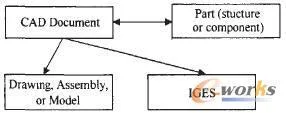
Figure 1. Schematic diagram of the relationship between a Windchill CAD document and a WTPart object model.
The 3D model import process works as follows: Open SolidWorks → Load the target assembly → Start the assembly relationship import process → Extract the assembly structure to generate drawings → Import the models into Windchill for management.
Case Study: Visual Management of 3D Ship Models in the Integrated System
For example, in the design of 145-180 segmented ships, the integrated platform combining SolidWorks and Windchill PDMLink is used for collaborative ship design.
1) Ship designers create 3D models using SolidWorks. Once completed, the models are checked into Windchill PDMLink via the Windchill menu in SolidWorks, as shown in Figure 2. At this step, the system verifies user permissions through a login interface, as depicted in Figure 3.
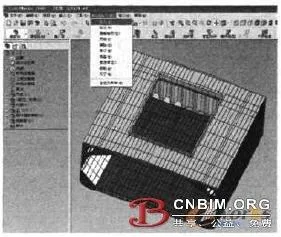
Figure 2. 3D model being checked into Windchill.
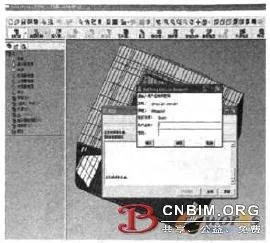
Figure 3. Designers logging into Windchill.
2) The hull structure is comprised of parts, components, sections, and the entire segment. For the 145-180 ship section, this includes hatch panels, transverse bulkheads, and decks. The hatch panel is constructed from profiles (e.g., hatch T profiles) and plates. After the model is checked into the integrated system, the chief engineer decomposes the design and creates a product structure tree in Windchill PDMLink, as shown in Figure 4, before initiating the approval process.
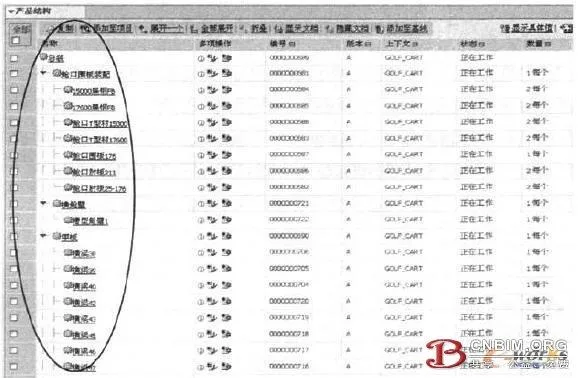
Figure 4. Structural decomposition of segments 145-180.
3) The review and approval process for ship 3D models is managed entirely on the Windchill platform. This process typically includes five stages: design, proofreading, review, standard inspection, and approval, after which the model is archived. The workflow is illustrated in Figure 5.
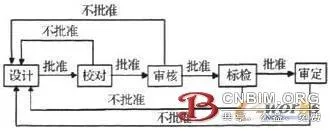
Figure 5. Document review and approval workflow.
In the approval workflow template, routing conditions for approval or rejection are defined using code, as illustrated below:
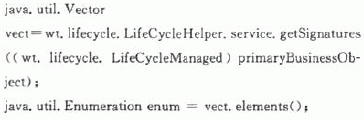
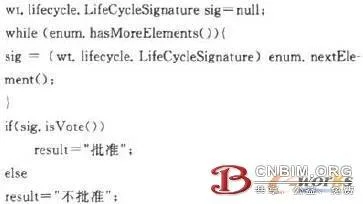
The flexible review and approval process operates as follows:
1) After designing segments 145-180, the designer submits the model to Windchill through SolidWorks, as shown in Figures 2 and 3.
2) The proofreader receives the review task, locates the relevant segments in ProductView (see Figure 6), and if no issues are found, selects “approve.” The document then moves to the review stage.
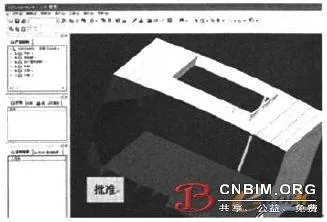
Reference: 3D model in Figure 6 ProductView.
3) If issues are found, the proofreader selects “not approved,” and the document enters a revision state. The designer receives the task, checks out the document, makes corrections in SolidWorks, and checks it back into Windchill. This cycle (design → proofreading → review → standard inspection → approval → archiving) repeats, with version updates (e.g., from A.1 to A.2), until the document is finally archived.
4) The subsequent stages (review, standard inspection, approval) follow the same process until the model is archived, marking the completion of the 3D model’s review and approval.
Conclusion
This article incorporates 3D ship model design into project management by establishing an electronic workflow for the review and approval of 3D models. Completed models are published on the Windchill PDM management platform, with visualized results linked to the product structure for custom model design processes. By utilizing advanced visualization tools on the management platform, potential conflicts during product design, construction, and maintenance can be identified and addressed promptly. This ensures parallel, dynamic, and real-time management throughout the ship design process.














Must log in before commenting!
Sign Up