
This project will leverage BIM technology to enable seamless and barrier-free communication of project information. The application of BIM will be structured across different levels, tailored to the project’s realities, owner requirements, and construction timelines. Key uses include pipeline clash detection, pipeline integration, system balance verification, prefabrication processing, rapid quantity aggregation, accurate cost evaluation, and effective progress control through 3D construction simulation combined with construction organization planning.
1. System Introduction
BIM (Building Information Modeling) is an advanced information management system increasingly adopted in the construction industry. It involves creating comprehensive building information models that integrate data from all participants—designers, constructors, project managers, and operators—into a unified database. This digital simulation replicates real building information, providing a platform for full lifecycle management.
Throughout the system’s operation, coordination among the owner, designers, supervisors, general contractors, subcontractors, and suppliers is essential. Daily maintenance and management are facilitated through an online collaborative file management platform.
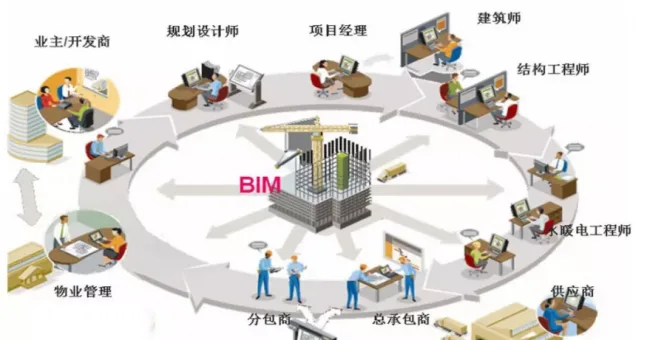
The core of BIM is the generation of engineering information models, capturing nearly all design-related data via 3D design. It continuously delivers comprehensive, reliable, and high-quality information on project scope, progress, and costs. This engineering information model enables:
- Accelerated delivery (time savings)
- Enhanced coordination (error reduction)
- Cost savings
- Improved productivity
- Better work quality
- Increased revenue and business opportunities
- Reduced communication time
During the three main phases of a construction project lifecycle—design, construction, and management—the BIM model provides complete access to key information:
- Design phase: Design, schedule, and budget data
- Construction phase: Quality, progress, and cost information
- Management phase: Performance, usage, and financial data
2. The Value of Parameterized 3D Models
BIM ensures coherence and consistency across planning, design (including preliminary, technical, and construction drawings), bidding, construction, operation, and management. This is achieved through parameterized 3D models that allow early-stage modifications, maintaining consistent information throughout the project lifecycle.
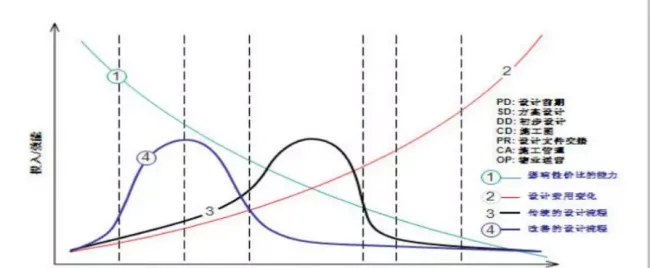
Key benefits include:
- Comprehensive information coverage: Immediate access to design, geometry, cost, and scheduling enables faster, more informed decision-making.
- Reduced workload and errors in design documentation: 3D models automatically coordinate and detect inconsistencies in 2D drawings, eliminating repetitive manual checks and improving quality, allowing teams to focus on critical project issues.
- Ease of modification and error reduction: Changes in the BIM model automatically propagate throughout the project, streamlining the creation of deliverables and enhancing overall work quality.
- Enhanced construction phase information: Synchronized building quality, progress, and cost data facilitate construction evaluation, planning, and communication, reducing impacts on operations and improving efficiency and cost savings.
- Value during management phase: BIM provides synchronized data on building performance, equipment status, time, and finances, supporting relocation, environmental and energy analysis, cost estimation, and update planning.
3. Advantages of BIM Technology
Large construction investments carry significant risk, and poor-quality projects lead to increased costs and operational disruptions. Delays generate substantial losses. Traditional design environments are often labor-intensive and prone to errors, delays, and budget overruns.
BIM technology integrates planning, design, and construction processes, offering opportunities to mitigate delays and cost overruns caused by incomplete documents, design changes, or inaccuracies. It enables stakeholders to experience the project virtually before physical construction and creates a functional database supporting the building’s entire lifecycle.
Main advantages include:
- Implementation: Gain full project understanding pre-construction, improving data reuse and refining design solutions. Accelerate communication and reviews involving extended teams to ensure timely delivery within budget.
- Communication: The 3D model enhances collaboration by making design intentions clear to designers, contractors, suppliers, and clients. This reduces communication time and improves mutual understanding.
- Inspection: Detect and resolve budget and design issues early via clash detection in BIM, preventing costly problems.
- Simulation: Simulate the entire construction process digitally, connecting time, cost, and data into an integrated network, ensuring smooth implementation and on-time delivery.
4. Significance of BIM Application in This Project
Visualization
BIM platforms predict building performance before construction, delivering intuitive 3D coordination renderings. Integrated data enhances time and space coordination, identifying design issues early. Accurate design standardization helps forecast building effectiveness. Below are BIM models of the 96th floor illustrating project content visually:
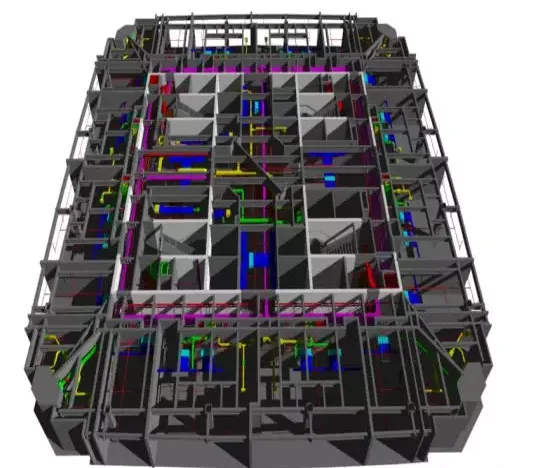
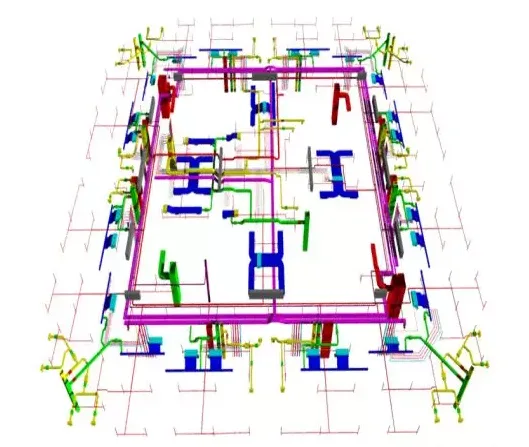
(1) Design Visualization
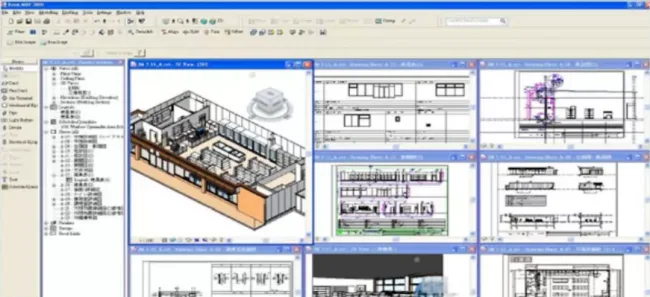
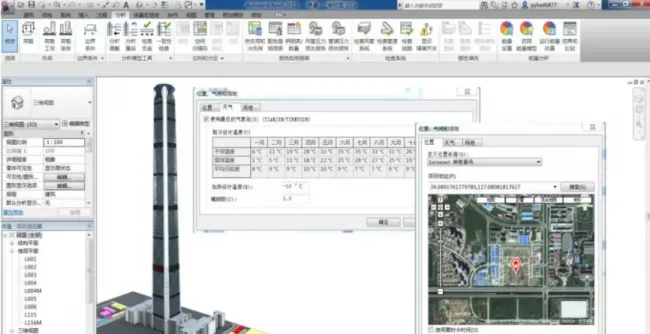
The advent of CAD and BIM modeling technologies has enabled computer-based visualization techniques such as shaded 3D views, photorealistic renderings, and animated walkthroughs. These methods effectively represent 3D designs, allow data reuse, and reduce time and costs associated with creating visualization models. They also support structural and energy consumption analyses, as demonstrated in the Tianjin 117 Building project where 3D visualization and 2D drawings interact bi-directionally.
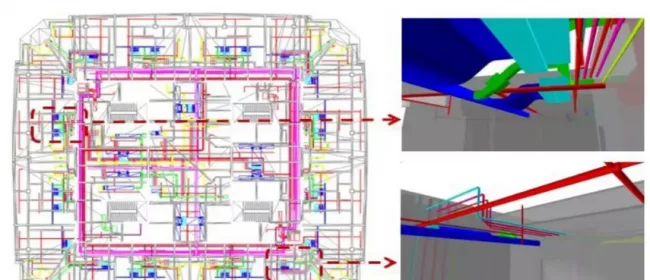
(2) Visualization and Clash Detection
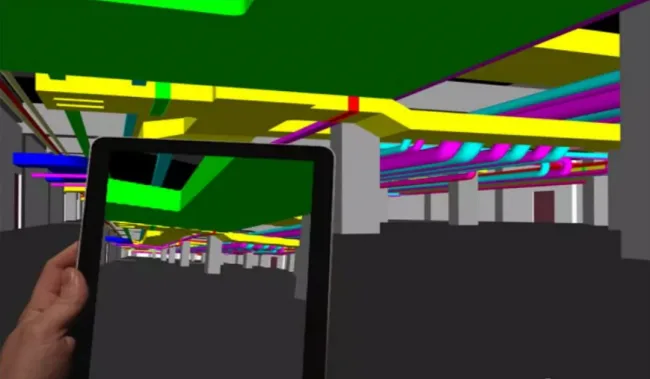
BIM visualizations also facilitate collision detection and pipeline integration. The BIM data model allows intelligent recognition of component properties, applying engineering rules to check project rationality. This helps identify errors such as omissions and clashes before construction, as shown below:
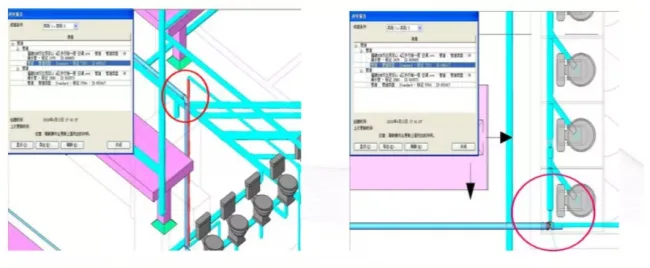
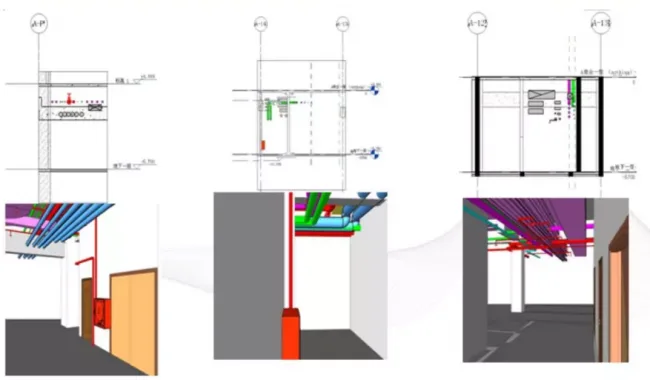
Cost Budgeting
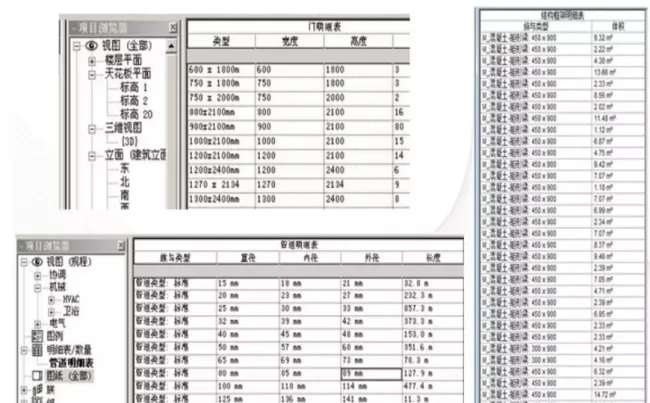
The BIM system contains computable building information, allowing the model to “understand” its components and their relationships. For example, walls “know” their properties and inclusion in schedules or quantity calculations. This supports structural analysis, MEP modeling, energy consumption analysis, regulatory compliance, and cost budgeting.
Typically, architects design buildings, while budget officers assess costs. BIM models directly generate material names, quantities, and dimensions, automatically updating construction documents and schedules after design changes. Budget officers can evaluate risks based on the updated models, as illustrated below.
Digital Construction
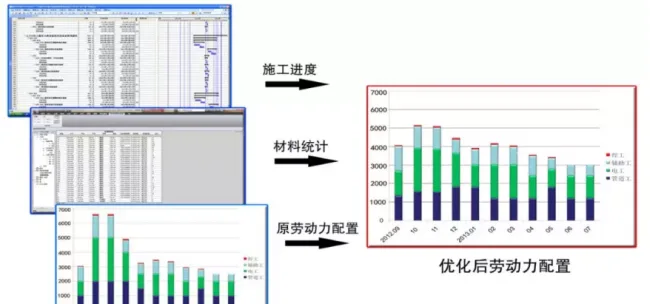
BIM supports end-to-end workflows, including structural manufacturing using platforms like Revit® Structure. By combining 4D simulation and construction simulation technologies, traditional Gantt charts evolve into 3D construction simulations, enabling pre-construction planning, progress optimization, early problem identification, and coordination. This improves safety management and multidisciplinary collaboration.
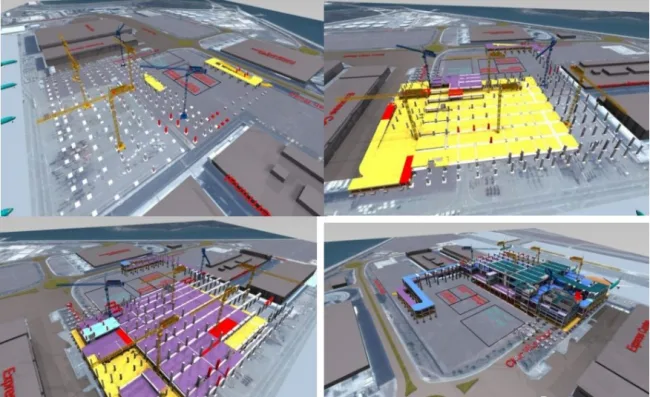
System Maintenance During Delivery and Operation
BIM integrates essential information for operation and maintenance phases—maintenance plans, inspection reports, work lists, equipment parameters, failure records, etc.—within the model. This enables seamless property management integration, ensuring the BIM completion model reflects actual building data.
BIM Assists Property Management
Based on BIM models, digital property management becomes possible:
- Interactive scene simulation: Tenants or clients can virtually tour the building through different entry points, exploring spaces like shops, lobbies, elevators, and restrooms.
- Rental and sales support: Clients can understand mechanical and electrical parameters (e.g., electrical load, HVAC) via BIM models and communicate specific requirements. Owners can then tailor changes accordingly.
BIM Supports System Maintenance
Maintenance staff can quickly access equipment data, pipeline layouts, and other building information through BIM. For instance, when a leak is detected, instead of inspecting the entire building, maintenance personnel can locate valves or equipment in the BIM system, retrieve specifications and part numbers, and resolve issues promptly.
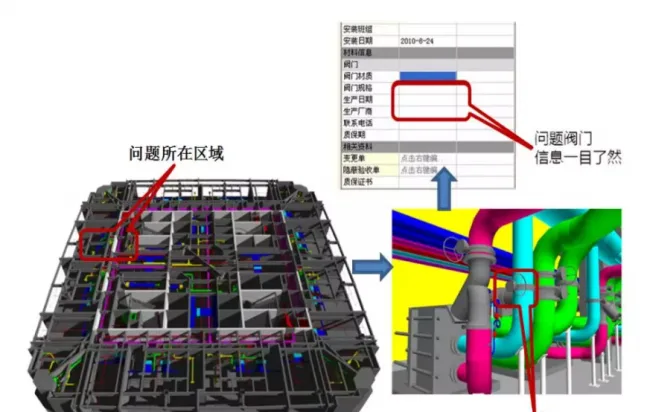
BIM for Emergency Management and Simulation
BIM enables digital emergency management and training simulations that are impractical on-site, such as fire evacuation, personnel evacuation, and power outage drills. This saves time and effort while preparing management personnel for emergencies.
4. BIM System Creation, Execution, and Implementation Plan
1. BIM System Service Objectives
To shorten project duration, reduce costs, and improve quality, the project will pursue these BIM goals during service:
| BIM Objectives | BIM Applications |
|---|---|
| Enhance coordination between design and construction | Comprehensive review and detailed design of construction drawings based on BIM |
| Reduce construction site collisions and conflicts | Collision detection |
| Optimize construction schedules and processes | 4D construction simulation |
| Quickly assess cost changes due to design changes | Automatic component statistics |
| Improve quality through factory manufacturing | Digital processing of prefabricated components |
| Manage prefabricated components via tracking | RFID-enabled tracking and management |
| Remote monitoring and management of construction sites | Buzzsaw and RFID technology integration |
| Provide accurate information for property operation | BIM completion model delivery via Buzzsaw and RFID |
2. Organizational Structure of BIM System
The general contracting project management department will appoint a BIM director to lead the BIM manager and team responsible for building, maintaining, and coordinating BIM models. A BIM center will be established with clear organizational structures and job responsibilities divided among design management, schedule management, and coordination management teams. The general contractor will submit the BIM center’s organizational chart to the owner within 30 days after contract signing.
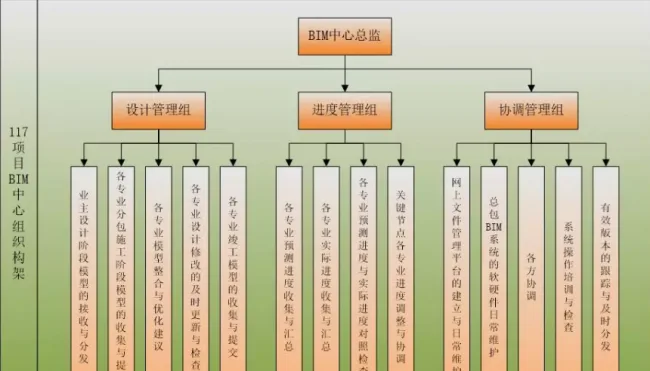
Responsibilities of BIM Center Director
Appointed personnel with a bachelor’s degree in architecture, over 10 years of construction and engineering experience, and BIM management expertise will oversee BIM planning and execution, ensure communication and coordination, and participate regularly in BIM meetings.
Responsibilities of BIM Design Management Team
This team manages architectural and structural models during design phases, distributes updated models to subcontractors, oversees professional design deepening, performs clash detection and optimization, collects BIM data during construction, and confirms design updates. The team leader must have architectural education, 4+ years of experience, and BIM management skills, supported by seven skilled team members.
Responsibilities of BIM Progress Management Team
Using software like Revit and Navisworks, this team creates 4D progress models based on predicted and actual schedules to optimize construction sequencing and control progress in real time. The leader and six team members meet the required qualifications and experience.
Responsibilities of BIM Coordination Management Team
This team coordinates all BIM stakeholders, maintains the online file collaboration platform, conducts training and inspections, manages software updates, and ensures smooth BIM operations. The team consists of a leader and six qualified members.
1) BIM System Work Plan
Based on owner requirements and construction timelines, a BIM implementation plan will be developed and submitted within 45 days after contract signing. Key milestones include:
| Task | Completion Time & Deliverables |
|---|---|
| BIM team formation | Core personnel gathered before contract signing; team formed within 10 days after contract |
| BIM execution plan | Completed within 45 days after contract signing |
| Design phase BIM verification & improvement | Initial construction phase model completed before contract signing |
| Construction phase BIM model creation & maintenance | Initial model within 120 days; updates within 14 days of change orders |
| BIM model coordination & integration | Complete before issuing completion certificate |
| Construction drawing review | Submit BIM model with drawings |
| Collision detection & resolution | Within one month before construction in respective areas |
| 4D construction simulation & schedule optimization | Within one month before construction in respective areas |
| Automatic component statistics | Within 14 days after change orders |
| Digitization of prefabricated components | Collaborate with steel structure design and fabrication |
| Real-time construction site monitoring | Within 40 days after contract signing |
2) BIM System Workflow
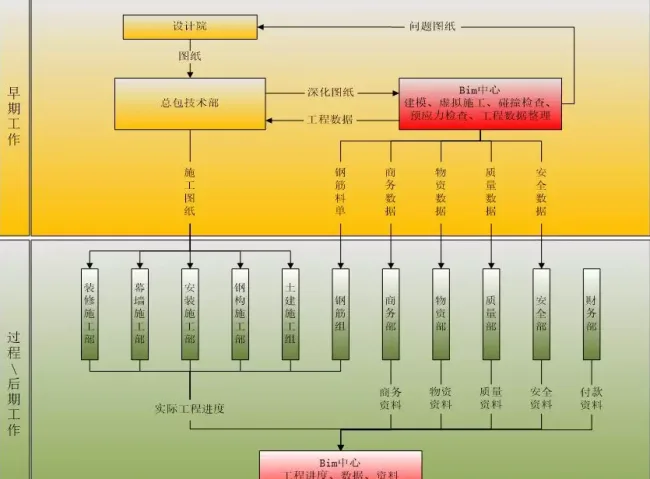
4. Creation and Maintenance of BIM Models
Design Phase Verification and Improvement
The general contractor is responsible for deepening and updating design drawings, ensuring accurate BIM data foundations. Tasks include:
- Receiving BIM materials and equipment info from designers
- Verifying BIM models and related materials
- Organizing handover meetings between design teams and owner representatives
- Improving BIM models based on received information
Construction Phase Verification and Improvement
The general contractor creates and maintains BIM models throughout construction, ensuring data accuracy and error-free information, including:
- Timely updates reflecting design changes and construction progress
- Submitting BIM models aligned with progress and design deepening for owner review
Coordination and Integration
Responsibilities among subcontractors for BIM model creation and maintenance are clearly defined. The general contractor coordinates, reviews, and integrates BIM models from various units, provides technical support and training, and validates the final BIM completion model, delivering complete and accurate BIM data to the owner and property managers.
Application Based on BIM Models
The general contractor uses BIM models to conduct comprehensive reviews and detailed designs for construction drawings, enhancing collaboration and coordination across disciplines:
- Complete comprehensive review of construction drawings
- Develop detailed civil engineering structural drawings (e.g., Comprehensive Structural Hole Drawing – CBWD)
- Prepare detailed mechanical and electrical installation drawings (e.g., Comprehensive Mechanical and Electrical Pipeline Diagram – CSD)
- Design steel structure production drawings
- Produce detailed decoration engineering drawings
Collision Detection and Spatial Coordination
Collision detection is performed across specialties using BIM models, with reports identifying collision points and recommended solutions. Applications include:
- Construction drawing review stage
- Detailed design stage, including CBWD and CSD drawings before final construction documents
- Pre-construction clash detection and spatial adjustments in complex, intersecting areas
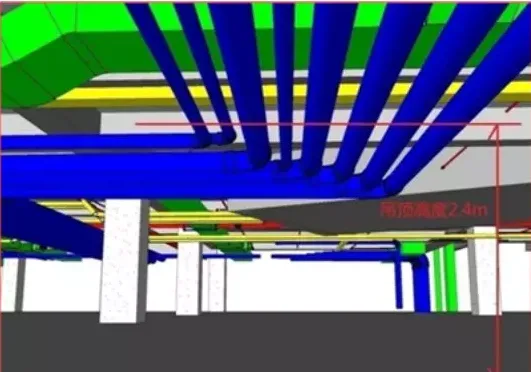
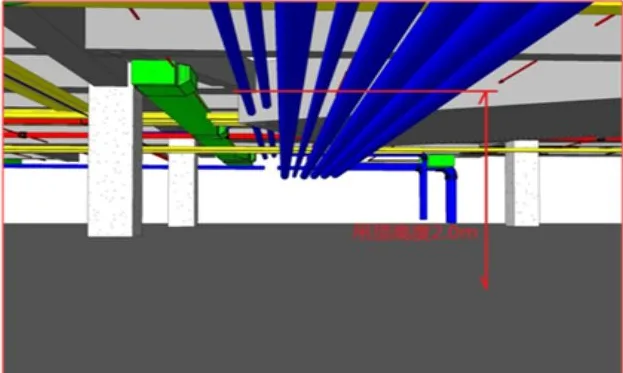
4D Construction Simulation
The general contractor will use BIM models combined with the overall construction plan to create 4D simulations, optimizing schedules and plans. This includes:
- Medium- and long-term simulations for overall schedule optimization
- Short-term, constructible simulations as per owner and management needs
- Simulations within one month prior to key or complex node construction
Automatic Component Statistics
The BIM model’s automatic statistics function enables rapid, accurate quantification of components, facilitating timely evaluation of material demand and cost changes resulting from design modifications.
Digital Processing of Prefabricated Components
BIM models and digital processing equipment will be used for precise fabrication of prefabricated components (e.g., steel structures, air ducts, water pipes), ensuring quality and minimizing schedule impacts.
Tracking and Management of Prefabricated Components
By integrating RFID technology, wireless mobile terminals, and web platforms, the entire lifecycle—from design and procurement to installation and use—of prefabricated parts will be tracked and managed visually via BIM models, preventing issues throughout the process.
On-site Monitoring and Management
Using the Autodesk 360 Access platform integrated with BIM models, RFID, wireless terminals, and web technologies, real-time tracking of construction progress against plans will be possible, with automated daily reporting and early delay detection.
Four all-weather cameras will be installed near the site, uploading images to the Buzzsaw system via wireless networks, enabling remote monitoring by owners and stakeholders.
RFID and wireless technologies integrated with Autodesk 360 and BIM models allow for component installation status collection on-site, forming 4D simulations linked to actual construction progress. Key and concealed work areas are documented through photos and records associated with BIM components, enhancing management insight.
Delivering BIM Completion Models Using RFID
Combining BIM models, RFID, wireless terminals, photography, video, and web technologies enables integration of concealed project records with BIM data. This ensures that during operation and maintenance, relevant construction information—including hidden works—is easily accessible through the BIM system.
Article source: Bean Construction













Must log in before commenting!
Sign Up