
BIM Software Tip: Understanding Volume Calculation at the Intersection of Revit Walls and Beams
It is well known that Revit offers a detailed schedule function, providing essential data for preliminary budgeting. However, these schedules rely on model-based statistics, and during modeling, overlapping areas often occur. For convenience, many users tend to ignore these overlaps and continue modeling without interruptions. But does the volume calculated in the schedule remain accurate under these circumstances? Let’s explore this through a verification.
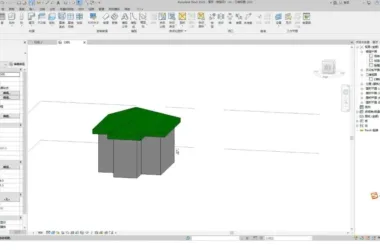
Consider a beam in the model with a cross-section of 400 x 800 mm and a total length of 4000 mm. Its total volume is calculated as 0.4 × 0.8 × 4 = 1.28 m³. However, there is a column measuring 500 x 450 mm intersecting the beam in the middle. The overlapping volume of the column must be deducted from the beam’s volume, calculated as 0.4 × 0.8 × 0.5 = 0.16 m³. Therefore, the correct volume of the beam is 1.28 – 0.16 = 1.12 m³, which matches exactly the volume reported in the detailed schedule.
This confirms that the overlapping volume is automatically accounted for and subtracted during the schedule calculations. As an additional example, consider a wall intersection, where the overlapping volume is not deducted in the schedule. Feel free to examine this case yourself.













Must log in before commenting!
Sign Up