
Zhang Xiqian, Chairman of the Construction Technology Professional Committee of China State Construction Engineering Corporation and Honorary Editorial Board Member of the Construction Technology Editorial Committee, brings over 50 years of experience in the construction industry. Having witnessed the tremendous evolution of China’s construction sector firsthand, Mr. Zhang presents in this issue several typical engineering cases, including the Ocean Artificial Island, the Underground Pipe Gallery of Xi’an Xingfu Forest Belt, and the Wuhan Greenland Center. These cases highlight innovative achievements and quality control measures in concrete technology for readers.
Underground Engineering on Islands and Reefs
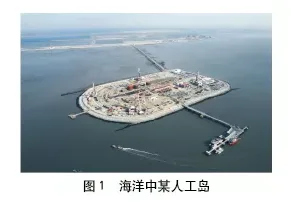
The concrete floor of an artificial island’s underground project in the ocean is constructed with C50 concrete, 2 meters thick (see Figure 1). Due to design, construction, and natural influences, tens of thousands of penetrating cracks appear in the underground concrete. To address this, structural waterproofing additives are incorporated to enable the concrete’s self-healing properties.
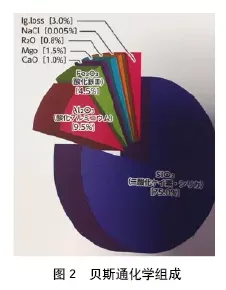
Beston is a premium waterproof additive for concrete structures, produced in Japan. It consists of natural volcanic ash rich in active silica. Its high activity and excellent waterproof properties compensate for the limitations of traditional cement components and significantly enhance cement performance (see Figure 2).
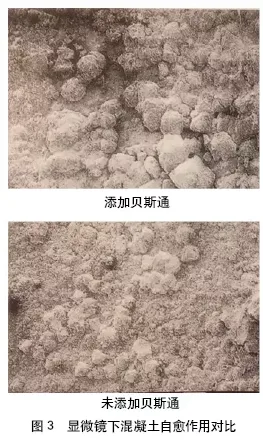
Since its market introduction, Beston has earned recognition for its outstanding waterproof performance, cost efficiency, and safety. It is widely used in large-scale civil engineering projects, including nuclear power plants. The waterproof mechanism involves the cement hardening reaction, where free calcium hydroxide produced during cement hydration is absorbed to generate calcium silicate gel. This gel prevents the calcium hydroxide from leaching out and expands to fill internal concrete voids, resulting in highly waterproof concrete.
It is important to note that Beston is not a waterproof material but a waterproof additive (see Figure 3). Concrete mixed with Beston exhibits the following characteristics: ① significant self-healing ability; ② maintained concrete strength; ③ resistance to weathering and neutralization; ④ minimized dew point condensation; ⑤ enables single-wall basement construction; ⑥ shortened work cycles and improved economic efficiency.
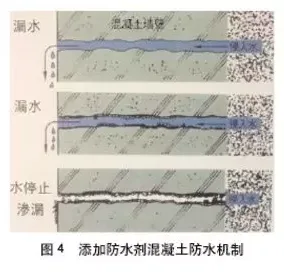
When groundwater seeps through cracks in the concrete, the reaction gel deposits and expands within the pores. Over tens of days, this gel effectively fills the pores, providing a waterproof barrier (see Figure 4).
Xi’an Happiness Forest Belt Underground Pipe Gallery
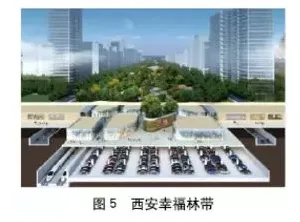
The Xingfu Forest Belt in Xi’an spans from Huaqing Road in the north to Xinxing South Road in the south, and from Xingfu Road in the east to Wanshou Road in the west. The forest belt stretches 5.85 km with an average width of 140 meters, covering a total land area of 1.17 million square meters. This is a comprehensive municipal engineering project integrating rail transit, an underground pipe gallery, underground space development and utilization, green landscaping, and municipal road renovation.
The concrete structures supporting the pipe gallery and subway are designed with a service life of 100 years, demanding high durability (see Figure 5).
The project presents several challenges: ① The pipe gallery and subway supporting structures are long, requiring strict shrinkage control; ② Tight schedules and large continuous concrete pours necessitate strict control over concrete workability; ③ As underground structures, high resistance to cracking and seepage is essential; ④ The concealed nature of the pipe gallery complicates structural details and demands superior waterproofing and durability.
To address these, key concrete crack control technologies include: ① optimal raw material selection; ② mix proportion optimization; ③ constraint condition optimization; ④ temperature control of concrete entering the mold; ⑤ concrete pouring plan optimization; ⑥ curing and secondary rolling; ⑦ steel reinforcement construction; ⑧ temperature monitoring and feedback.
2.1 Optimal Raw Material Selection
2.1.1 Cement
1) Cement storage temperature must not exceed 60 ℃. If it does, cooling below 60 ℃ is required before use.
2) Different cement brands must not be mixed and should be stored and used separately.
3) Any change in cement brand requires redesigning the mix proportion and conducting experimental verification.
4) Sampling and testing must follow national standards, with records and samples retained.
2.1.2 Fly Ash
1) The fly ash storage temperature must not exceed 60 ℃.
2) Initial inspections for fineness, acid dripping, flowability, and ammonia gas are mandatory before use.
3) Sampling and testing must comply with national standards, with records and samples kept.
2.1.3 Mineral Powder
Sampling and testing must follow national standards, with records and samples retained.
2.1.4 Sand and Stone
1) Incoming sand and stones must be free of water dripping, silt, mud clumps, roots, or debris. Sand particles should be dispersed without compaction; stone particles must be uniform without excessive needle-like or oversized particles.
2) Sand and stone must be stored neatly, avoiding mixing or contamination.
3) Sampling inspections should follow national standards, with records maintained.
2.1.5 Admixtures
1) Only admixtures that pass tests for water reduction rate, slump, time-dependent loss, and uniformity are used.
2) Sampling and testing must adhere to national standards, with records and samples kept.
2.2 Mix Proportion Optimization
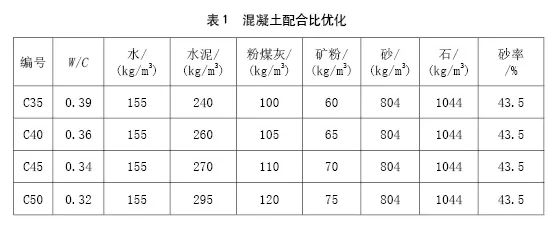
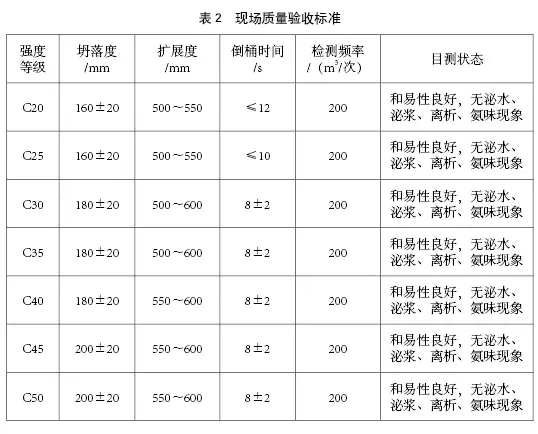
The optimized concrete mix proportions for different strength grades are shown in Table 1. This mix uses Jidong, Hailuo, and ecological P·O42.5 ordinary Portland cement, along with a polycarboxylate high-performance water reducer. Cement type, model, cementitious dosage, water reducer type, model, and water content must remain unchanged. The sand ratio can be adjusted within ±2% as needed; beyond this, re-verification is required before use. Common mix proportions require monthly integrated decoration tests, while full mix designs require quarterly verification. If significant changes occur affecting mechanical or durability performance, a redesign and demonstration must be organized with the Forest Belt company. On-site quality acceptance standards are detailed in Table 2.
Wuhan Greenland Project “5+10+30”
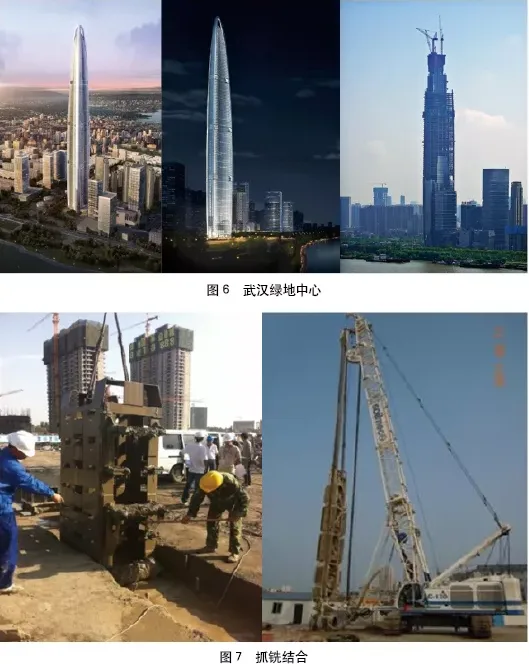
The Wuhan Greenland Center comprises a super high-rise main building, an office auxiliary building, an apartment auxiliary building, and a podium building, totaling a construction area of 728,600 square meters. The super high-rise main tower includes 6 underground floors and 120 above-ground floors, initially planned to reach 636 meters. Due to height restrictions, the current approved height is 455 meters (see Figure 6).
3.1 Project Overview
1) Extremely deep and large foundation pit
The foundation pit measures 300 meters in length and 120 meters in width, covering approximately 36,000 square meters. Excavation depth ranges from 23.1 to 30.4 meters, creating an underground space of 1 million cubic meters and underground building area of 200,000 square meters. This represents a super-large, ultra-deep foundation pit project.
2) Complex geological conditions
The site lies on Class I terrace landform on the south bank of the Yangtze River, featuring multiple geological strata. Silty clay mixed with silt exists above -14 meters, with fine sand layers between -14 and -44 meters. Being only 250 meters from the Yangtze River, the groundwater level is high, with stagnant water 0.2 to 1.8 meters deep. These conditions pose high construction risks.
3) Unique functional design
The architectural concept integrates “two rivers and three towns into one city,” featuring a Y-shaped core tube symmetrical on three sides. The complex exterior facade includes over 60,000 glass curtain walls with more than 10,000 unique shapes. Nine air vents located at triangular ends on floors 31-33, 60-62, and 94-96 minimize wind impact, replacing traditional dampers.
3.2 Innovative Technologies
3.2.1 Advanced construction techniques for ultra-deep, ultra-large foundation pits near the Yangtze River
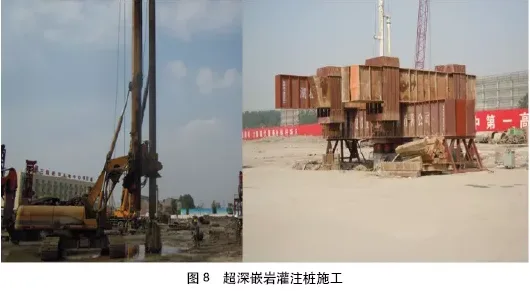
1) Construction of 56m deep rock-embedded underground continuous wall
The geological complexities include thick, dense sand layers at depth. The underground continuous wall must penetrate deep sand layers and reach moderately weathered fine sandstone or sandy mudstone, posing construction challenges. The “grab and milling combination” method is used, alternating between grab bucket groove forming machines and milling machines (see Figure 7).
2) Construction of high-bearing capacity ultra-deep rock socketed cast-in-place piles
The verticality tolerance for bearing piles is 1/250. The slightly weathered rock layer measures 1.2 meters. Pile foundations require high bearing capacity, with individual piles supporting 1500-1700 tons and test piles up to 4500 tons—the highest in building construction (see Figure 8).
3) High-pressure water control technology for multi-layered strata in Linjiang
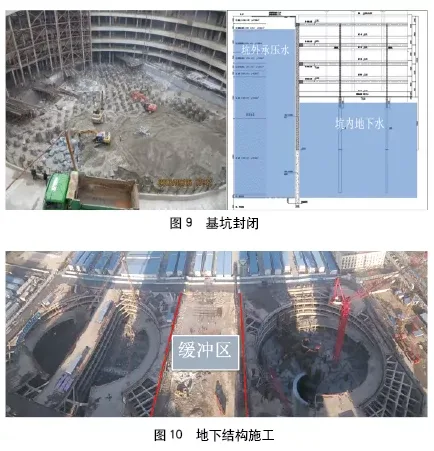
The Greenland Center employs foundation pit closure by embedding underground continuous walls into slightly weathered rock layers, fully isolating groundwater. This technique, designed to endure three flood seasons, cuts off hydraulic connections between the pit and the Yangtze River, ensuring complete pit closure (see Figure 9).
4) Wireless transmission-based underground structure construction technology
The excavation method “zone sequential construction + middle buffer zone post-construction” was designed (see Figure 10). By combining foundation pit deformation numerical simulation and wireless monitoring technology, appropriate excavation timing reduces spatial impact and prevents deformation in ultra-long foundation pits.
3.2.2 Self-built tower crane lifting formwork system
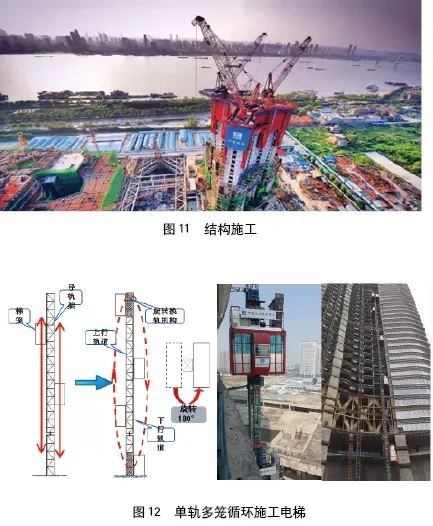
The top formwork system consists of a support and lifting system, steel platform, formwork hanging system, and ancillary facilities. A ZSL380 tower crane is integrated within the platform, lifting synchronously with it. This integration reduces tower crane equipment costs, saves time, and enhances safety (see Figure 11).
The initial platform covers about 1,200 square meters, supported by 12 points, weighing approximately 2,000 tons, with a maximum lifting capacity around 4,000 tons. After retracting the core cylinder on the 67th floor, the formwork is dismantled and modified at height. The remaining six 350-ton oil cylinders then lift the platform, enabling a maximum speed of four days per floor.
3.2.3 Monorail multi-cage cyclic construction elevator
This project’s monorail multi-cage cyclic construction elevator is the first of its kind. Stretching 600 meters—25 meters underground and 575 meters above ground—it includes eight elevator cages (see Figure 12). The basement serves as storage and maintenance for the cages, which can rotate at eight swivel joints strategically placed from basement levels to the tower top.
3.2.4 Virtual Reality and Digital Construction
A comprehensive BIM model is established, integrating key management information into a general contracting management platform. Current BIM functions include: ① scheme simulation for refined management; ② comprehensive pipeline layout and clash detection enhancing design quality; ③ detailed node deepening and process arrangement to overcome traditional construction shortcomings; ④ visualized process management; ⑤ business coordination for quantity and cost calculation; ⑥ support for new technologies such as pre-assembly of computer rooms, automated component processing, robotic measurement, and 3D scanning for acceptance; ⑦ evolving from information models to integrated platforms, leveraging digital information to improve general contracting efficiency.
3.2.5 Beidou Satellite Precise Positioning Technology
While traditional laser plumbmeters remain useful for control line projection, they face limitations such as reduced accuracy over long distances, large light spots, and interference from building sway or weather conditions. Satellite positioning overcomes these issues with no line-of-sight requirements, no cumulative error, and minimal weather impact.
It has been successfully used for measuring and controlling core tubes and outer frame columns. Correction coefficient studies have resolved normal vertical deviation issues, achieving millimeter-level accuracy consistent with traditional methods and re-verifications.
Article source: Construction Technology Information, September 2018. All images and text copyrights belong to the original author.














Must log in before commenting!
Sign Up