
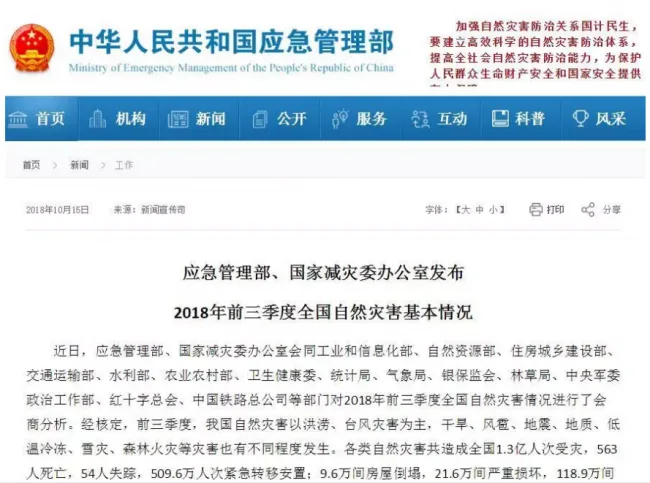
Recently, the Ministry of Emergency Management and the Office of the National Disaster Reduction Commission released data on natural disasters in China for the first three quarters of 2018. During this period, mainland China experienced 10 earthquakes with magnitudes of 5 or higher.
The most intense quake was a 5.9 magnitude earthquake in Mojiang County, Yunnan Province. It was the strongest and most severe earthquake in mainland China this year, causing over 2,000 houses to collapse and 34,000 buildings to sustain various degrees of damage.
Statistics show that earthquake disasters during these three quarters affected 316,000 people nationwide. Approximately 82,000 people were urgently relocated and resettled. More than 5,000 houses collapsed, 31,000 were severely damaged, and 91,000 sustained moderate damage. The direct economic losses amounted to 2.73 billion yuan.
Compared to the same period last year, the earthquake disaster situation has significantly improved: no fatalities were reported, and the number of collapsed houses and economic losses decreased by more than 60%.

When it comes to engineering construction, seismic resistance in prefabricated residential buildings is a complex and demanding challenge. Neglecting any stage of the process — including seismic planning, site surveys, design, or construction — can reduce the building’s seismic capacity. Therefore, seismic resistance requires thorough attention throughout construction.

Seismic Design and Verification of Buildings
01 Seismic Design of Buildings
1. Earthquake effects on structures vary greatly depending on geological conditions. Therefore, thorough geological surveys should be conducted beforehand to avoid unfavorable sites and select locations that enhance seismic resistance.
2. Quantitative constraint stirrups should be installed in plastic hinge zones to improve the ultimate strain capacity of structural components, thereby greatly enhancing their ductility and ensuring overall structural safety.
3. A seismic fortification system must be established with appropriate measures to strengthen both foundation and superstructure stiffness, improving the building’s overall safety performance.
02 Seismic Verification of Buildings
1. Buildings must undergo seismic resistance calculations based on seismic action, representative gravity, seismic influence coefficients, and combined seismic effects. This includes reviewing the design intensity and verifying that the building continues to meet its original functional requirements.
2. Buildings undergoing only seismic reinforcement or partial renovation do not require seismic deformation verification. However, if additional floors are added during renovation, seismic deformation verification is mandatory.
3. If changes in stiffness and gravity representative values of the reinforced structure are less than 10% and 5% respectively, changes in seismic action can be disregarded. However, if the original structural system is altered, a comprehensive seismic review must be conducted based on the post-reinforcement state.
4. For buildings with a design service life of no more than 25 years after reinforcement, a seismic adjustment coefficient of 0.85 times the value specified in the regulations can be applied for load-bearing capacity.
Seismic Assessment of Buildings
1. If a building is to continue usage beyond its designed service life or if its original function changes in ways that may affect seismic performance, a seismic performance evaluation is required.
2. Completed buildings lacking seismic fortification or those that do not meet current standards — and which are not scheduled for demolition or renovation — must undergo seismic appraisal if they fall into any of the following categories:
- Major construction projects;
- Projects that could cause severe secondary disasters or affect earthquake resistance, disaster relief, shelter, and evacuation;
- Projects that cannot be interrupted or require rapid restoration after earthquakes;
- Buildings with significant historical, scientific, artistic, or commemorative value;
- Public buildings with dense populations such as schools, hospitals, kindergartens, sports centers, theaters, exhibition halls, department stores, and office buildings.
3. The building owner must commission a qualified design unit to conduct the seismic appraisal. If testing is necessary, the design unit shall engage a qualified engineering quality testing institution.
4. The seismic appraisal results determine whether seismic reinforcement is required and identify any serious seismic safety hazards.

Evaluation of Building Seismic Resilience
In practice, seismic resilience evaluation should be conducted for both planned and existing buildings. This evaluation includes the following key points:
1. Collect comprehensive building information, including types, quantities, materials, and geometric dimensions of structural and non-structural components, as well as types, quantities, and installation methods of equipment.
2. Develop a structural model of the building. For existing buildings, conduct vibration testing and update the model accordingly. Perform elastic-plastic time history analysis at specified seismic levels.
3. Extract engineering requirement parameters from the elastic-plastic time history analysis results.
4. Assess the damage status of all components using the engineering parameters combined with a vulnerability database for structural and non-structural elements.
5. Based on component damage, evaluate repair time, costs, and personnel loss for a given seismic level.
6. Integrate repair time, cost, and personnel loss indicators to comprehensively assess the building’s seismic resilience.
Seismic Reinforcement Technologies for Buildings
01 Seismic Technologies
1. Energy Dissipation and Shock Absorption Technology: Primarily used in high-rise buildings, tall tower structures, large-span bridges, flexible pipelines (lifeline engineering), upgrading seismic or wind performance of existing buildings, and protecting cultural relics and commemorative structures.
2. Building Seismic Isolation Technology: Typically applied to vital buildings such as Class B structures and buildings with special usage requirements where traditional seismic methods fall short. It is also used for retrofitting existing buildings that do not meet seismic standards and for protecting cultural heritage sites.
02 Reinforcement Technologies
1. Structural Component Reinforcement: Commonly used methods include steel strand mesh with polymer mortar reinforcement and external steel wrapping.
(1) Steel strand mesh polymer mortar reinforcement involves placing steel mesh on the tension zones of components after surface treatment, then applying polymer mortar.
(2) External steel reinforcement wraps steel around reinforced concrete beams and columns and can be either dry or wet application. Each method differs in its effect on bearing capacity and construction convenience.
2. Steel strand mesh polymer mortar is suitable for reinforcing brick walls in masonry structures, as well as beams, slabs, columns, and nodes in reinforced concrete structures. External steel reinforcement is ideal for strengthening reinforced concrete beams and columns when increased cross-sectional bearing capacity and seismic resistance are needed.

Acceptance Procedures for Seismic Construction of Buildings
01 Foundation Trench Acceptance
Acceptance of the foundation trench requires participation from geological exploration units, design units, and quality supervision units. Construction can only proceed to the next stage after acceptance. Periodic acceptance also requires supervision involvement before approval.
02 Underground Section Acceptance
After each construction step is completed in accordance with design specifications and passes self-inspection, an acceptance application must be submitted to the project supervision department, quality supervision unit, and seismic office. The geological survey unit, design unit, and quality supervision unit must jointly participate in acceptance before above-ground construction begins.
03 Main Structure Acceptance
To ensure quality and schedule control, the project department may conduct secondary acceptance during structural construction. After passing self-inspection and confirmation by the project supervision department, acceptance applications shall be submitted to quality supervision, seismic office, and design institute. Only after approval can the next phase proceed.
04 Completion Acceptance
Upon completion of construction per design documents and satisfactory usage performance, self-inspection should be carried out. After passing, an initial inspection is organized by the project supervision department. Then, acceptance applications are submitted to the quality supervision unit, municipal seismic office, design institute, and related parties. The assembled R&D team must approve the project, confirming it meets structural and functional requirements before it is put into use.
05 Acceptance After Seismic Reinforcement
After seismic reinforcement completes, acceptance is mandatory. Once approved, signs indicating construction year, reinforcement date, maximum service life post-reinforcement, and other relevant information must be prominently displayed on the project.
(Some content sourced from official websites such as the Ministry of Emergency Management)
Article source: Architectural Technology Magazine














Must log in before commenting!
Sign Up