

The core application of BIM and Internet of Things (IoT) technology not only enables three-dimensional visualization and management of building information models, but also endows every component and device within a building with perception and responsiveness. This integration elevates building operations and maintenance to a new level of intelligence.
1. Challenges of Traditional Operations and Maintenance
Rapid Expansion and Talent Bottleneck:
The operations team is the core competitive advantage in commercial real estate. With rapid expansion, challenges in talent development and retention become inevitable, particularly concerning the selection and promotion of senior management. The high requirements for both the quantity and quality of personnel in commercial real estate cannot be quickly met through internal training or external recruitment.
Additionally, rising labor costs in China have made workforce expenses a major consideration in the operations and maintenance phase. How can commercial real estate improve operations and maintenance without increasing headcount? How can current staff work more efficiently? The answer lies in strengthening headquarters’ control. Operational efficiency now relies more on advanced information management systems rather than individual abilities; this is the key competitive edge for commercial real estate enterprises.
Pressure of a Low-Carbon Economy:
In recent years, topics such as “low carbon,” “environmental protection,” “energy saving,” and “green” have gained widespread attention. Building energy consumption in China accounts for about 28% of total national energy use, with commercial real estate being a significant contributor. For sustainable development, reducing energy consumption through technological and managerial innovation will be a major competitive advantage in the future.
Risks of Passive Maintenance:
Commercial real estate involves numerous systems—lighting, ventilation, monitoring, elevators, communications, and more—each with extensive equipment and pipelines. Should these be serviced only after failures occur, or proactively maintained or replaced as scheduled? Any malfunction can disrupt business operations or even cause safety accidents. Timely detection and prevention of these risks can significantly reduce losses.
Emergency Response:
Handling emergencies such as VIP visits, temporary events, conflicts, or fires involves swift personnel evacuation, security deployment, vehicle guidance, equipment shutdown, and activation of fire protection systems. Poor emergency management not only results in financial losses but can also seriously damage the brand.
Headquarters Management Pressure:
As commercial real estate projects expand nationwide, the complexity for headquarters to manage regional operations grows. How can headquarters quickly and accurately assess the status of regional projects and provide timely support? By leveraging talent and technology, headquarters should establish a robust management and support platform that enables rapid identification of issues and provides real-time guidance across regions.
2. The Value of Integrating BIM with IoT for Operations and Maintenance
Remote Equipment Control:
By using technologies like RFID, devices that previously operated independently in commercial real estate can now be managed on a unified platform. This enables real-time monitoring of equipment status and allows for remote control—such as checking if elevators are running normally or remotely turning lights on or off.
Spatial Positioning of Systems:
Systems and devices such as lighting and fire protection are now given 3D spatial information, replacing traditional text or numbering with graphical locations. This makes searching easier and provides intuitive visual references. For example, the location of security personnel can be tracked with RFID, and in the event of a fire alarm, the exact location can be identified in the BIM model along with evacuation routes and critical equipment.
Facility Visualization:
Traditionally, information about building facilities existed in 2D drawings and manuals, requiring experts to search and interpret. With BIM, a visual 3D model holds all relevant data, enabling instant access. During renovations, for example, pipelines and load-bearing walls are clearly marked in the BIM model, with detailed tenant area information available at a glance.
Data Accumulation and Analysis:
Operational and maintenance data are invaluable for management. Such data helps analyze current issues and risks, and optimize management practices. For instance, RFID can track electricity meter readings and aggregate energy usage over time; parking space availability data can be collected and analyzed for improved garage management.
BIM technology and IoT are indispensable for modern operations and maintenance. Without IoT, management remains reliant on manual processes and cannot achieve unified, efficient platforms. Without BIM, operations cannot be linked to the building, nor can spatial or environmental factors be systematically considered.
The integration of BIM and IoT not only achieves 3D visualization of building management but also brings perception and responsiveness to every component, raising building operations and maintenance to the level of smart buildings.
The synergy between BIM and IoT represents a comprehensive information revolution for commercial real estate operations and maintenance!
3. System Architecture
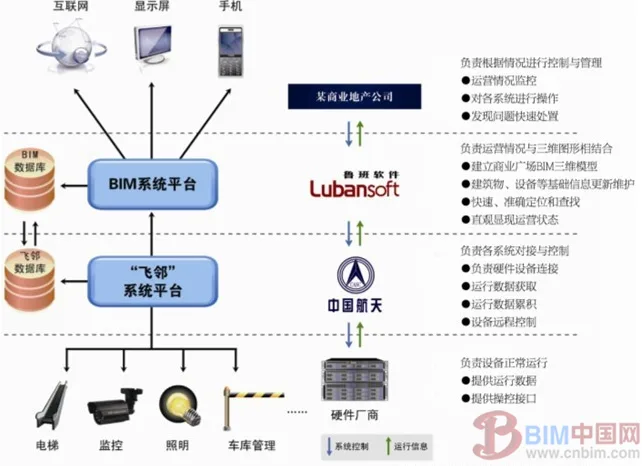
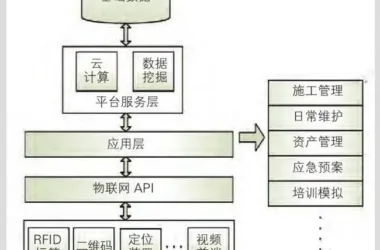
The foundation of the intelligent operation and maintenance system is built on Luban Software’s BIM platform and the “Flying Neighbor” system. The specific architecture is illustrated below:
4. Practical Applications of Intelligent Operation and Maintenance
Operations and maintenance in commercial real estate cover various tasks, including equipment management, energy management, security, tenant management, and more.
1. Equipment Operation Monitoring
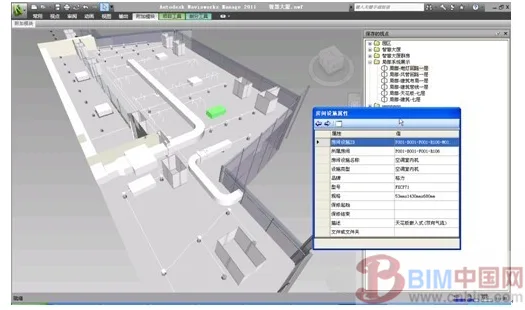
The system integrates search, retrieval, and location for all equipment. By selecting equipment in the BIM model, users can view details such as supplier, expiration date, contact information, maintenance status, and location. The system manages equipment lifecycles, issuing timely alerts for devices approaching the end of their lifespan to prevent accidents. Searching by name or description allows quick location of equipment within the virtual building, and managers can use 4D BIM models for real-time browsing.
Equipment status is visually represented in the BIM model—for example, green indicates normal operation while red signals faults. Historical operation data for each device is accessible, and devices can be remotely controlled, such as switching the lighting in designated areas.
2. Hidden Project Management
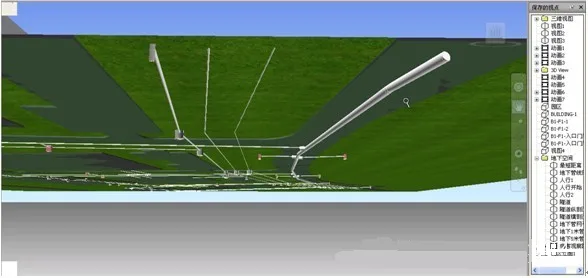
On July 28, 2010, during the demolition of a plastic factory in Nanjing’s Qixia District, an explosion occurred due to the excavation of an underground pipeline. The key issue was the lack of accessible information regarding concealed pipelines—data that may exist but is often obscure or known only to a few. As buildings age and staff change, such safety risks become more pronounced.
Smart operation and maintenance systems can manage complex underground networks—such as sewage, drainage, cables, and related wells—by mapping and measuring their spatial relationships. During renovations, this helps avoid damaging existing pipelines and supports efficient maintenance, equipment replacement, and accurate positioning. All information is stored electronically, accessible to internal staff, and can be updated to ensure completeness and accuracy.
3. Energy Operation Management
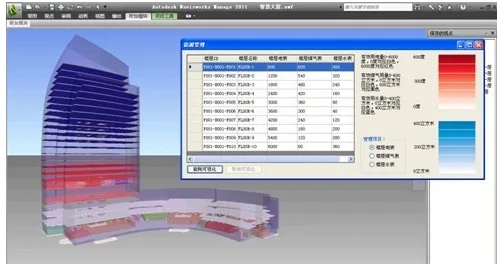
IoT applications have streamlined daily energy management and monitoring. With smart meters for electricity, water, and gas, all energy data is collected in real time within the management system. The energy management module analyzes consumption by day, week, area, and tenant, and issues warnings for abnormal usage.
4. Tenant Management
Searching and locating tenant spaces is easy, with access to information such as client name, building area, lease details, rent, and management fees. The system supports customized features like rent reminders and real-time data updates, forming a rapid information-sharing platform.
5. Security Management
Video surveillance in traditional systems is limited to camera feeds. BIM-based security integrates both “eyes” and a “brain,” as surveillance is part of the visualized BIM management center. With a large monitoring screen, selecting a building floor instantly displays all relevant camera feeds. In emergencies, BIM-based monitoring can be integrated with other subsystems for coordinated response.
For security personnel, wireless RF chips embedded in work cards enable real-time location tracking, which is particularly valuable for large, high-traffic commercial properties. In emergencies, management can efficiently direct security efforts using this system.
6. Garage Management
Traditional parking management systems count available spaces but do not specify their locations, leading to wasted time and congestion. With RFID, each parking card is tagged, instantly indicating whether a space is occupied. The system displays the status of all spaces at the garage entrance, and customers can locate their car using the parking card—an invaluable navigation feature for those prone to losing their way.
7. Emergency Management
BIM technology ensures there are no management blind spots. As commercial centers gather large crowds, emergency response capability is crucial. While traditional emergency management focuses on response and rescue, intelligent O&M includes prevention, alerts, and active handling. In the event of a fire, for instance, sensors trigger automatic alarms and provide 3D location data and room identification, allowing the control center to quickly access relevant information for evacuation and response.
For incidents like water or air pipe bursts, the BIM system allows rapid location of control valves, eliminating the need to search through stacks of blueprints. Prompt action prevents minor incidents from escalating into major disasters.
5. Outlook for Smart Operations and Maintenance
Recognizing the significance of BIM technology, China has included it in its “15th Five-Year” technology R&D plan. After years of development, BIM is widely applied in design and construction, but its application in facility maintenance remains limited. Nevertheless, experts unanimously agree on the great demand for BIM in operations and maintenance, especially in commercial real estate, where its value is clear. The rapid development of IoT in recent years provides a major opportunity for BIM application in this phase.
The “Internet of Things” is considered the third wave in information technology after computers and the Internet. Experts believe IoT can boost economic efficiency, reduce costs, and provide momentum for global economic recovery. Currently, the US, EU, China, and other countries are investing heavily in IoT research.
China is also paying close attention to IoT development. The Ministry of Industry and Information Technology, together with relevant agencies, is researching next-generation information technologies and formulating supportive policies for their advancement.














Must log in before commenting!
Sign Up