
Prefabricated structural buildings now utilize two cutting-edge technologies to keep pace with the rapid advancements in intelligent management, significantly enhancing installation accuracy. Their integration into building informatization and industrialization exemplifies the highest level of prefabricated assembly achieved in China.
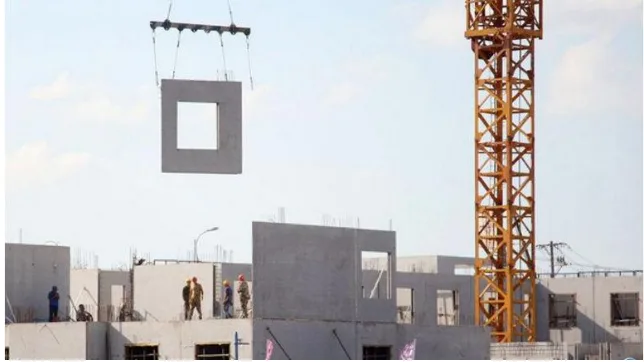
Shanghai has taken the lead in promoting prefabricated technology nationwide. Recently, the city introduced two pioneering technologies that accelerate and refine the development of prefabricated construction, successfully applying them on construction sites.
During the intense summer heat, the construction site of COFCO No.1 Mansion in Qiantan, Pudong, stands out distinctly. The building walls are supported by striking red “mechanical arms,” while every wall panel and beam carries an “ID card.” When scanned with a smart device, detailed information from production to installation appears on the screen, highlighting the project’s technological sophistication.

Rendering of Qiantan Residential Project
These innovative sites embody the application of building informatization and industrialization, representing China’s most advanced standards. Similarly, the Xinghewan Middle School construction site, promoted in the same year, was shortlisted for the “Ministry of Housing and Urban-Rural Development Prefabricated Building Technology Demonstration Project” and the “Shanghai Prefabricated Building Demonstration Project” for its pioneering approach.
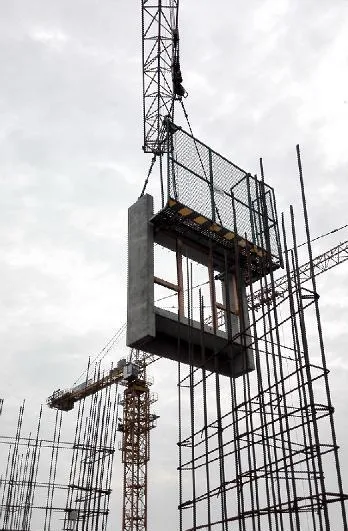
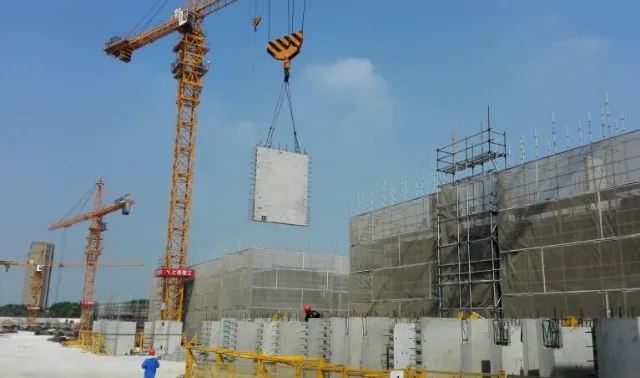
Construction site utilizing prefabricated technology
The ‘Robotic Arm’ Achieves Millimeter Precision in Just 30 Seconds
Implementing prefabricated construction in architecture is more complex than it appears. Factory-produced prefabricated components undergo standardized production and inspection, ensuring quality far superior to cast-in-place parts. These components boast exceptional flatness and straightness, but traditional wall installation relied on plumb bobs and visual checks, which were susceptible to human error and time-consuming, falling short of prefabricated assembly standards.
Inspired by automated production lines, engineers from Shanghai Construction Engineering Fifth Construction Group developed a high-precision adaptive slant support bracing system. The red “robotic arms” seen on-site are hydraulic mechanical rods from this system. When laser measuring equipment is mounted on the pole, wall angle data is transmitted to the robotic arm, which automatically adjusts accordingly. This process achieves perfect horizontal and vertical alignment within 15 to 30 seconds.
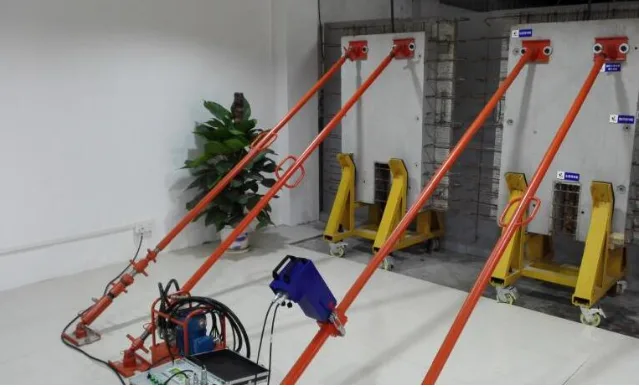
High precision adaptive support system
The robotic arm technology overcomes previous limitations, offering greater potential for the aesthetics of prefabricated buildings. Li Yan, Chief Engineer of Fifth Construction, noted that future prefabricated buildings will grow taller—potentially exceeding 100 meters—demanding higher precision for wall angles. Currently, accuracy standards are generally 1/100L, suitable for buildings between 20 to 30 meters high. The newly developed adaptive slant support system aims for a theoretical accuracy of 1/1000L, which could enable taller domestic prefabricated structures when scaled.
Additionally, as buildings become increasingly customized, exterior walls may not always be perfectly vertical. Manual tools only allow for 90° measurements, while laser measurement and control can precisely adjust to angles like 89° or 89.5°, adapting to complex building shapes.
Though the robotic arms entail higher initial costs compared to manual labor, Fifth Construction engineers are confident that automated measurement and control will reduce the workforce by 2 to 3 workers per team, cutting labor costs. Large-scale adoption will further decrease expenses.
Exclusive ‘ID Cards’ Enable Comprehensive Traceability
After erection, prefabricated buildings require meticulous management. The COFCO No.1 Mansion project features 6,000 prefabricated components, each tagged with a unique “ID card.” Embedded with RFID chips, these tags can be scanned with smart devices to access detailed production, storage, installation, and inspection records—from raw materials like stone and concrete to finished walls. This digital traceability forms a virtual assembly line, allowing quick accountability if issues arise.
Fifth Construction began exploring advanced BIM technology applications two years ago. They linked construction codes in the BIM architectural design model to individual RFID chips and used 13 colors in the BIM model to indicate the precise status of each component—whether ordered, transported, installed, and more—much like tracking logistics in e-commerce apps. This enables engineers to monitor progress clearly and efficiently.
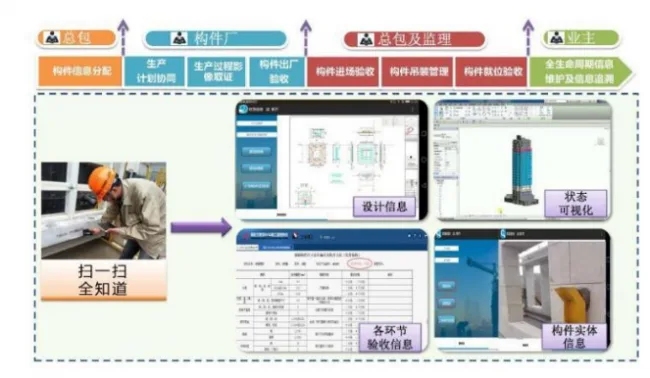
Lean construction visualization management platform for prefabricated projects
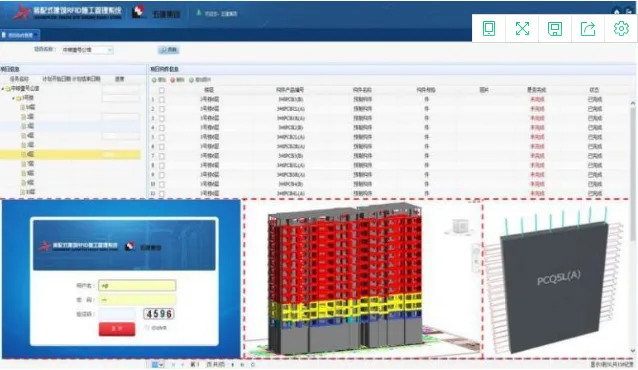
The visualization platform allows tracing of component information and tracking construction progress through color coding.
Prefabricated components with “ID cards” enhance refined management. Although many components appear identical, their designated assembly locations are fixed and cannot be swapped without compromising accuracy and efficiency. The RFID chips enable workers to easily distinguish these “identical twins” by simply scanning and placing them correctly.
As technology evolves, the component “ID cards” continue to improve. For instance, in the construction of Unit 06-01 of N12-1101 at Baoshan Gu Village this year, costly 30-yuan RFID chips were replaced with QR codes costing only 1 to 2 yuan each, significantly reducing expenses.
Prefabricated Technology Moves Toward Greater Precision
In recent years, Shanghai has seen a significant rise in both the prefabrication rate and the number of related enterprises. By 2016, 13.85 million square meters of prefabricated buildings had been constructed, doubling for two consecutive years. The city hosts 41 prefabricated component production companies with a combined capacity exceeding 12 million square meters. The quality of these components is top-tier, with some enterprises achieving world-class standards and exporting to countries like Japan, receiving widespread acclaim.
This year, the city’s prefabrication rate is expected to surpass 40%. Notably, the Xinghewan Middle School project achieved a 47% prefabrication rate, positioning it as a leader in the Shanghai region.
With ongoing technological refinement, prefabricated building methods in Shanghai and across China are set to reach new heights. The fusion of industrialization and informatization fosters healthy and sustainable industry growth while transforming management philosophies—from labor-intensive approaches to intelligent, precision-focused management, explained Liu Xunquan, Chairman of Shanghai Construction Fifth Construction Group.
Wujian Construction plans to incorporate VR and AR technologies for safety training on prefabricated building projects. Workers will use VR glasses to visualize safety warnings and technical points on-site, enabling faster and clearer understanding of often monotonous safety briefings, thereby enhancing construction safety.
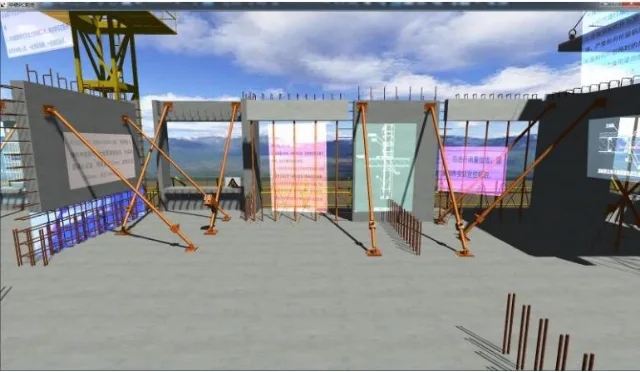
Visual technical safety briefing
While increasing prefabrication rates, economic factors must be considered. Li Yan pointed out that ten years ago, Wujian collaborated with real estate companies to produce buildings with 100% assembly rates, but costs were prohibitively high. Higher prefabrication rates introduce more assembly nodes and raise concerns about structural stability and earthquake resistance.
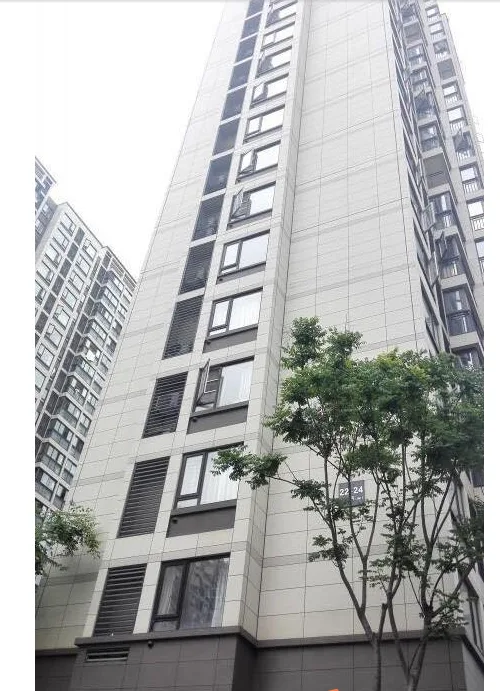
Completed prefabricated buildings
The reporter observed that the Pudong Qiantan residential project has a prefabrication rate of 30% despite using the same technology. Li Yan explained that prefabricated technology is better suited for frame-type public buildings like schools, which feature regular designs and high standardization. Residential buildings tend to be more personalized, with decorative facades and fewer prefabricated components. Research is ongoing to adapt prefabricated technology for more customized buildings.
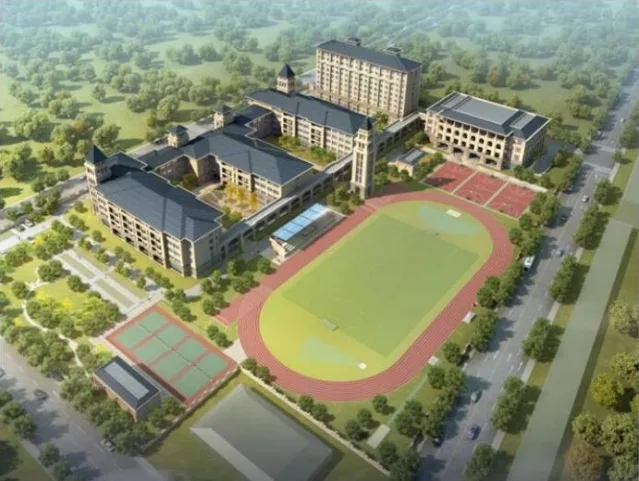
Rendering of Xinghewan Middle School
Article source: Prefabricated Building Industry Modernization Network












Must log in before commenting!
Sign Up