
Editor’s Note:
With strong government support, prefabricated construction is experiencing rapid growth across China.
The nationwide promotion of prefabricated buildings has become a key driver for transforming and upgrading the construction industry—from its previous focus on simple, extensive development to an emphasis on refinement, modularization, standardization, integration, and industrialization. Many companies and investors are actively investing in this sector, establishing numerous production lines and even introducing some of the world’s most advanced automated assembly lines.
In response to this trend, Mr. Guo Xueming cautions against a “supply-side Great Leap Forward.” He advocates learning from mature international experiences while adapting to China’s unique building structural systems. Instead of blindly pursuing high-end designs, he emphasizes selecting prefabrication processes that prioritize quality, cost-efficiency, and energy savings.
While Mr. Guo’s views represent only one perspective, a balanced understanding requires listening to diverse opinions. The healthy development of any industry depends on the constructive input and active participation of many practitioners. We believe this article offers timely insight to prevent irrational enthusiasm and misguided investment during the rapid expansion of prefabricated concrete buildings.
Why Japanese PC Factories Are Considered Unqualified in China
1. Japan leads the world in mature, advanced prefabricated concrete (PC) technology. Its prefabricated concrete buildings have proven seismic performance, tested by multiple major earthquakes. Japan boasts the largest number of super high-rise prefabricated concrete structures globally, including the world’s tallest PC building—a 208-meter tower constructed by Kashima Corporation. The first-class quality of Japanese PC factories is internationally recognized.
However, according to some Chinese managers and developers, relocating Japanese PC factories to China has resulted in their being deemed unqualified, often excluded from bidding opportunities. This issue extends beyond Japan: many PC factories from the US, Australia, Southeast Asia, and parts of Europe are similarly considered unqualified when brought to China.
Why is this the case?
Primarily, most PC factories in Japan, the US, and Australia use fixed formwork technology. Yet, many Chinese industry insiders view fixed formwork as an outdated, manual process that falls outside modern mainstream prefabrication. Instead, they insist that PC components must be produced via assembly line technology, which incorporates mechanization, automation, and intelligence to ensure consistent quality. Some local government officials consider the presence of assembly lines a prerequisite for supporting prefabricated concrete enterprises and influence developers’ choices of PC suppliers.
2. Personal experience and insights
I am one of the founders and the first chairman of Shenyang Zhaohuan Modern Architecture Industrial Park Co., Ltd. Since entering prefabricated construction in 2009, I have extensively studied the historical evolution and current state of global prefabricated construction. Over the years, I have visited around 50 countries, inspecting buildings and capturing tens of thousands of photos of prefabricated buildings and PC factories.
Through this research, I concluded that Japan’s prefabricated concrete technology is the most reliable, excellent, and closely aligned with China’s needs. Consequently, we introduced two leading Japanese firms—Kashima and LIXIL (both Fortune 500 companies)—to collaborate in Shenyang Zhaohuan Modern Architecture Industrial Park. We built a PC factory designed by experts from Kashima, LIXIL, and top Japanese PC factories, employing the widely used fixed mold stage process.
This factory produced components for Shenyang’s earliest high-assembly-rate, high-rise PC buildings, including Vanke Chunheli Apartment, An’an Building, Nanke Venture Capital Building, and Nanke Building. These projects have provided valuable experience for China’s prefabricated building development. Recently, I brought a client from Beijing to visit these sites and witnessed firsthand the impressive quality of the PC components at the still unrenovated Nanke Venture Capital Building, which received enthusiastic praise.
Yet, despite its contributions, this factory has been disqualified by many developers in recent years. Upon noticing the absence of an assembly line, visitors immediately dismiss it as unqualified to bid. This is despite the fact that buildings constructed with components from this factory are among the best quality models in China’s PC sector.
The inspectors, while knowledgeable, often lack a deep understanding of global concrete component production technologies and disregard our explanations. They overlook the outstanding results achieved through this approach, which is truly unfortunate.
3. Two main PC component manufacturing methods: fixed and flow
(1) Fixed method
The fixed method arranges molds in fixed positions and includes the fixed mold platform process, vertical mold process, and prestressing process. The fixed mold platform process is the most crucial for PC manufacturing.
The fixed mold platform is a steel structure with a highly flat surface serving as the base mold for PC components. Side molds are fixed onto it, forming a complete mold. In this process, molds remain stationary while operators and materials like steel bars and concrete move between molds. Steel bars, tied or welded, are transported by cranes to various fixed mold platforms, while concrete is delivered using trucks or buckets. Steam pipes connected to each platform control curing temperature and its rise and fall via computer. Components cure on-site until they reach strength, then are demolded and moved to storage by cranes.
The fixed mold stage process is currently the most widely adopted worldwide. Of over 50 PC component types used in prefabricated buildings, more than 40 can be produced via fixed formwork. Except for pre-tensioned components, most—columns, beams, floor slabs, wall panels, stairs, bay windows, balconies, corners, and post-tensioned components—are compatible with this method.
Its greatest advantages are its broad applicability, flexibility, convenience, adaptability, and relatively low startup costs. Iconic structures like the Sydney Opera House and the Kitahama Building in Osaka were built using fixed formwork technology. Additionally, the world’s leading PC wall panel manufacturer, Takahashi (Japan), uses fixed formwork in all its factories.
(2) Flow method (assembly line)
The flow method involves molds moving along an assembly line on rollers or tracks. This includes flow stage processes, semi-automatic, and fully automatic assembly lines.
The assembly line starts with mold creation in a modeling area, followed by placement of steel bars and embedded parts in the working section. It then moves to the pouring and vibrating platform for concrete pouring and vibration. Next, the molds go to curing kilns, then to demolding areas. Components are flipped, lifted, and transported to storage.
This method suits plate components that are uniform, lightly reinforced, and simple in surface decoration. Globally, assembly lines are essential for automation, intelligence, and efficiency in producing such panels. However, the investment is substantial and economically viable only when demand is high, stable, and labor costs are significant.
The applicable scope of fixed mold platforms, assembly lines, fully automated lines, and prestressing processes is illustrated in Figure 1.
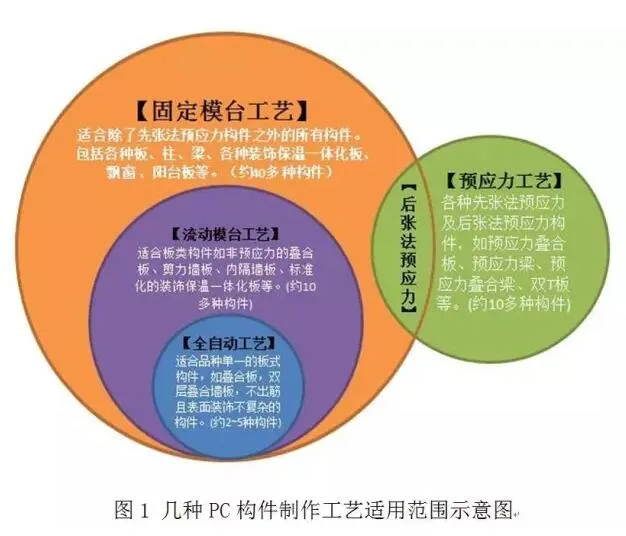
In China, public buildings primarily use frame, frame-shear, and tube structures. PC components typically include columns, beams, decorative exterior wall panels, and composite floor slabs. Except for laminated floor slabs, most components are unsuitable for assembly line production.
Residential buildings commonly rely on shear walls and frame-shear structures. Most shear wall panels have straight or circular bars on two or three sides, with sleeve or grout anchor holes on one side. External wall panels may require surface decoration or sandwich insulation layers, complicating production. Many engineering components are irregularly shaped—stairs, bay windows, balconies, eaves, corners, etc. Achieving automation and intelligence in component production lines for shear wall systems remains a distant goal worldwide, including in China.
Currently, domestic assembly lines for shear wall panels are essentially moving mold platforms without true automation or intelligence. Compared to fixed mold platforms, they lack technological or quality advantages and struggle to maintain uniform workflow. Any blockage in the line disrupts the entire process, and labor savings are minimal.
While assembly lines require heavy investment, their scope is limited. They cannot produce beams, columns, bay windows, corners, or irregular components. Assembly lines may be a future direction but are not essential during the early stages of industrialization. Only with standardized, normalized, specialized, uniform, and large-quantity components can assembly lines achieve true automation and intelligence. Japan uses automated lines mainly for ordinary laminated panels; Europe uses them for laminated panels, double-sided shear wall panels, and simple, lightly reinforced non-shear panels. Among prefabricated components widely used in China, only laminated floor slabs currently achieve automation and intelligence. However, labor savings do not offset the massive investment required.
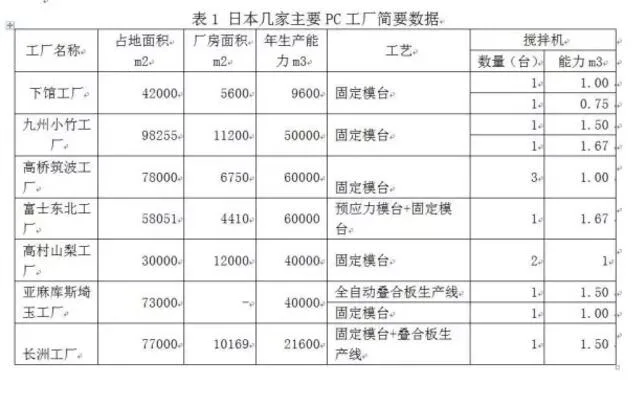
Table 1 summarizes key process data from several Japanese PC factories.
4. Prefabricated concrete construction has a history exceeding 60 years. Only a small fraction of the most advanced PC technology products worldwide achieve automation and intelligence, representing about 10% of all PC component types. Most such components are unsuitable for China’s typical structural systems and seismic requirements.
Currently, there is an uncritical pursuit of automation and intelligence in China’s prefabricated concrete sector. Assembly lines are treated as an industry threshold, leading to widespread and often inappropriate investment leaps on the supply side. This approach is unwise. Some industry players, driven by preference, profit motives, or lack of understanding, mislabel mobile molds as automated production lines, misleading the market and fueling a “Great Leap Forward” that harms industry development.
In my view, progress in prefabricated concrete construction should be measured by improvements in building quality, resource conservation, cost reduction, and shorter construction timelines—rather than by the scale of investment or how “high-end” a project appears.
Globally, prefabricated concrete buildings are not more expensive than cast-in-place concrete buildings and are often cheaper. In China, however, prefabricated buildings currently cost more and require strong government promotion. Various factors drive these high costs, which I will discuss separately. Notably, excessive competition in PC factory investments and premature assembly line expansions are significant contributors. The prefabricated construction era has yet to fully begin, but improper and inefficient supply-side practices are already widespread.
5. Practical examples of rapid, low-cost PC component production
Recently, I helped guide two micro-enterprises to quickly start PC component production with investments of only hundreds of thousands or less. Within just over a month, they produced high-quality PC components.
One company previously hesitated to enter the PC field, intimidated by the tens or hundreds of millions typically required to invest in PC factories. During training, I encouraged them: “Start the job now. If you start, I will teach you to ‘zero start’ production!” They secured a PC staircase order, and my team helped them produce excellent PC staircase boards in just over a month.
Of course, the initial investment was not literally zero—it involved tens of thousands—but compared to multimillion-dollar investments, it was effectively negligible.
We have many techniques for “zero start” production, but this is not our unique wisdom. Eight years ago, I witnessed a high-rise residential site in Omiya, Tokyo, where, due to restricted access for large vehicles, Kashima built a temporary open-air PC factory onsite (see Figure 2) to produce high-strength, finely crafted PC components. This experience profoundly inspired me: the real threshold for prefabricated concrete buildings is not investment or high-end equipment, but technology, management, and awareness.
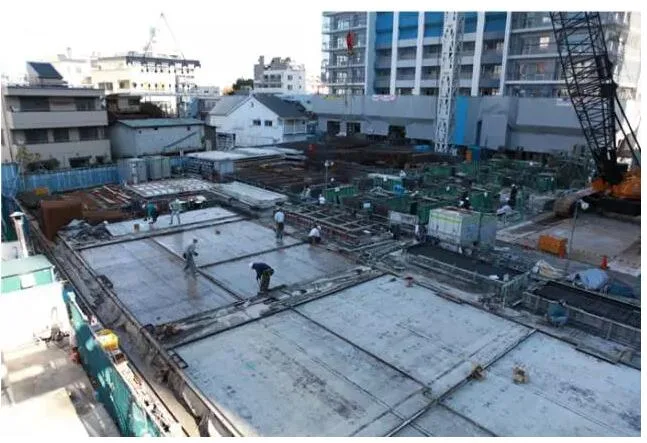
Figure 2: Temporary PC Factory at the Tokyo Omiya High-rise Prefabricated Residential Construction Site
I do not oppose assembly line methods. In recent years, I have explored adapting foreign automated production lines to better suit the production of standard PC components in China and improving domestic assembly line automation and intelligence. This article simply points out that most PC components needed for Chinese building structural systems currently lack suitable automated assembly lines. Existing flow mold processes fall short of basic automation and intelligence requirements and cannot replace—let alone eliminate—the world’s most important PC manufacturing process: the fixed mold method.













Must log in before commenting!
Sign Up