
(1) Walter Gropius
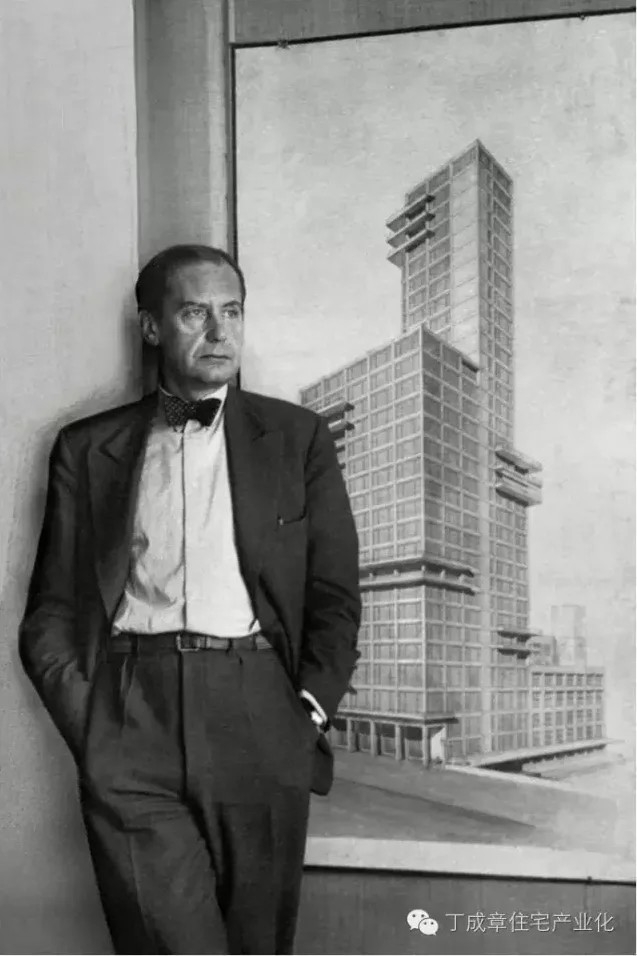
In March 1910, at the age of 26, Walter Gropius (Figure 2-1) submitted a memorandum to Emil Ratnow of the German General Electric Company (AEG) outlining the rational production of residential buildings. This document remains one of the most comprehensive analyses of the prerequisites for prefabrication, assembly, and distribution of standardized housing units. In 1923, Gropius’ book Industrialization of Housing was published as part of the Bauhaus Book Collection.
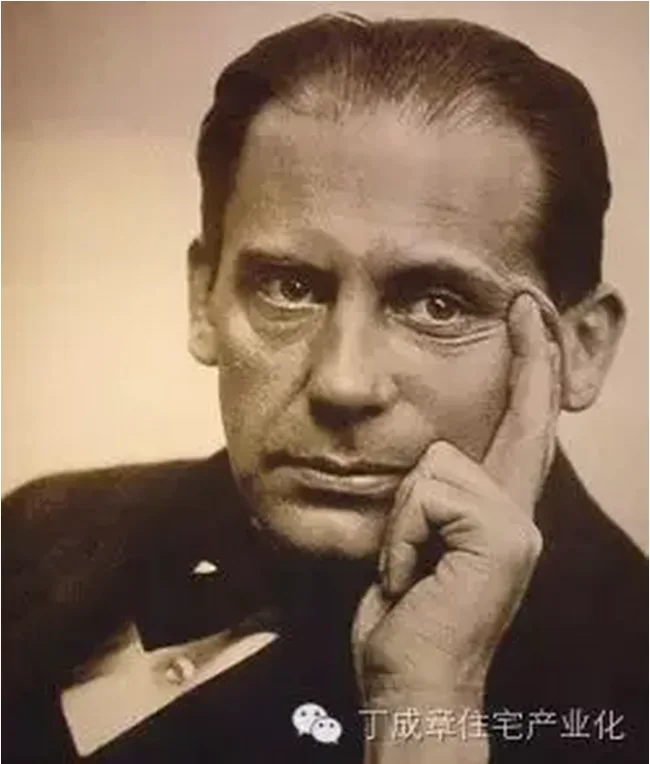
Figure 2-1
(2) Bauhaus
In 1915, Wilde recommended three candidates, including Gropius, for the principal position at the Weimar School of Arts and Crafts. The Weimar authorities appointed Gropius and promptly asked him to outline his vision for the school’s future development. In January 1916, Gropius submitted a detailed report analyzing local economic and social conditions. He proposed forging a partnership among artists, industrialists, and technical experts to organize the school in accordance with contemporary needs.
Gropius emphasized strengthening ties between students and industry, so that student assignments would serve as practical projects and products for businesses. After World War I, Germany faced the daunting task of reconstruction. The challenge of rebuilding a European power and revitalizing industry and trade became paramount for the government. Gropius’ educational reforms offered a promising approach to foster Germany’s comprehensive development.
Thanks to Gropius’ efforts and negotiations with the Weimar authorities, on April 1, 1919, he was appointed dean of the Academy of Fine Arts specializing in prefabricated structures. On April 12, he was tasked with merging the Academy of Fine Arts with the reopened Academy of Arts and Crafts. He named the new institution DeS Staatliches BauhauS, coining the term himself. The word “bau” derives from the German verb bauen (to build or house), evoking meanings related to construction and also, metaphorically, to sowing and nurturing. The term “Haus” refers to architecture but also symbolizes a new design system. Bauhaus was envisioned as a modern guild where craftsmen could collaborate to create buildings that perfectly unite art and craftsmanship.
Gropius had a profound impact on modern design. He firmly believed that design should serve society by solving real problems rather than indulging in mere formalism. He championed teamwork over individual supremacy and insisted on unity in form and function. His design philosophy opposed approaches that prioritized form over functionality or vice versa. Gropius advocated for modern materials, construction techniques, and standardized mass production, emphasizing that industrialization and urbanization are the foundation of modernism.
According to Gropius, the fundamental approach to city planning, building design, or furniture design is the same: to systematically study needs and problems, then solve them using modern materials and technologies. Functionality should be the guiding principle; form and popular style should not dictate design. This philosophy sometimes resulted in designs that appeared monotonous or lacked individuality.
Bauhaus operated in three locations in Germany: Weimar, Dessau, and Berlin. The first two buildings remain as museums today, while the third, an old factory building, was destroyed during the war. The Dessau building is the earliest significant Bauhaus structure, designed by Gropius and constructed by Bauhaus faculty and students. This architectural complex is a milestone in modern architectural history.
In the 1920s, only three buildings were considered the most important examples of modern architecture worldwide: Le Corbusier’s Villa Savoye near Paris, Ludwig Mies van der Rohe’s German Pavilion at the Barcelona World’s Fair, and the Bauhaus Dessau campus by Gropius (Figure 2-2). Some also include Finnish master Alvar Aalto’s Viborg Library and Paimio Sanatorium, but regardless of differing opinions, the Dessau Bauhaus building remains a cornerstone of modern design.

Figure 2-2a
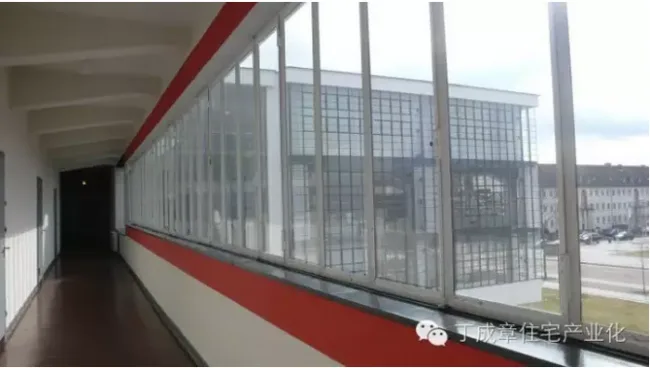
Figure 2-2b
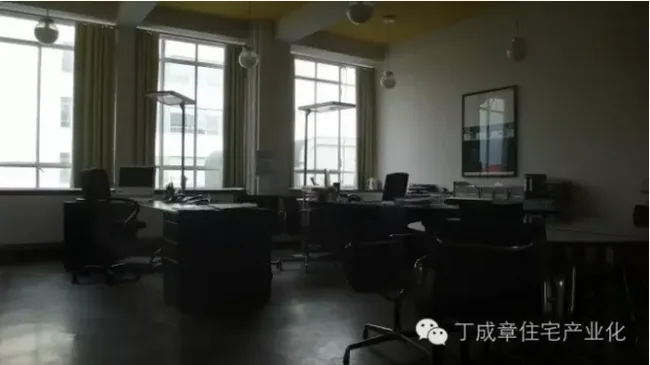
Figure 2-2c
In 1925, Gropius began designing the new Bauhaus school building, a comprehensive complex that included classrooms, studios, workshops, offices, 28 dormitory rooms, cafeterias, theaters (auditoriums), gyms, and a rooftop garden. The design featured simple forms, modern materials, and processing methods, with a strong emphasis on functionality.
The building’s height varied and it was asymmetrical, constructed entirely from prefabricated components. The workshop featured a glass curtain wall, and the entire structure was devoid of decoration. Functional areas were connected by pedestrian bridges, reflecting the pinnacle of modernist design at the time.
The building’s structure used reinforced concrete with floors supported on overhead steel frames and prefabricated panels. The flat roof incorporated a new waterproof coating, although it often leaked during rain. The interior design—including furniture and fixtures—followed the same principles as the architecture itself. This building became a masterpiece of 1920s modernist design.
Simultaneously, Gropius designed four dormitories for teachers on a quiet street near the school (Figure 2-3). These two-story residences, featuring reinforced concrete prefabricated components, emphasized functionalism and rationalism, without ornamentation. The staggered layouts provided comfortable living spaces. Gropius himself was the first to move in, stating, “Architecture can help shape a way of life.”
The designs offered excellent residential functions alongside productive working environments, boosting efficiency. Furniture inside was designed by Marcel Breuer, inventor of steel tube furniture, which perfectly complemented Gropius’ architectural style. The interiors were clean, minimal, and painted in pure white, reflecting the modernist ethos.
Each dormitory was assigned to different faculty members: one for Gropius, one for Nagi and Feininger, another for Kandinsky and Klee, and the last for Schlemmer and Munch. Some, like Kandinsky, criticized the lack of privacy and the monotonous, colorless interior design. Nevertheless, these buildings remain exemplary works of 20th-century modernist architecture.
The equipment, furniture, and other items within the Bauhaus Dessau building were designed by faculty and students and produced in the school’s factory, creating a highly unified aesthetic. The building included all necessary functions, fostering a strong community spirit. Teachers and students lived and worked together around the clock, promoting teamwork and cooperation.
Modernist pioneers believed architecture could influence human behavior; this complex provided a pioneering demonstration of that theory.
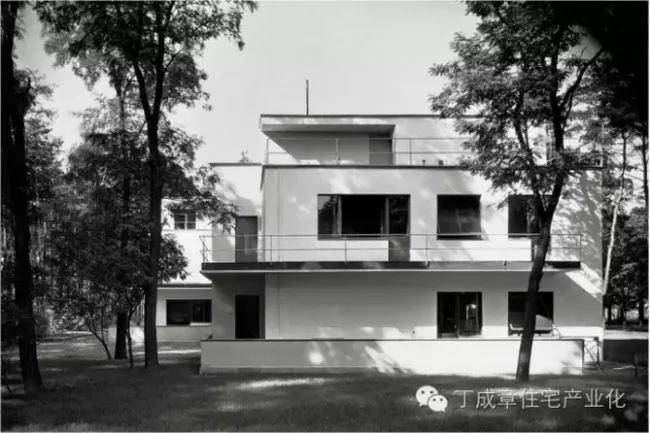
Figure 2-3
The Bauhaus atmosphere during the Dessau period was relaxed and lively. Frequent celebrations, such as Klee’s 50th birthday in 1929, became festive occasions for faculty and students alike. The school had its own band performing light and jazz music, accompanied by continuous dancing. Young Prince Anhalt of Liande Sao often joined these events. The school also hosted numerous sports competitions and active social activities, a stark contrast to the serious atmosphere during the Weimar period.
Living and working in a modern building with a close-knit community created a rich and vibrant life—the most accomplished and joyful chapter in Bauhaus history.
One of Gropius’ core ideas behind founding Bauhaus was his belief that art and craftsmanship were not opposites but two facets of the same endeavor. He aimed to harmonize these through educational reform, stressing the unity of craftsmanship, technology, and art. These ideals are clearly articulated in the Bauhaus Manifesto.
To achieve this integration, Gropius reformed the teaching system by using handicraft training as a foundation for artistic education. He sought to develop students’ visual sensitivity to a rational level, emphasizing scientific and technical understanding of materials, structures, textures, and colors over personal artistic expression.
His design education emphasized the integration of technical, logical methods with artistic creativity, centering on technical skills. Consequently, reforming the foundational courses became the core of Bauhaus’ early educational changes.
Bauhaus was shut down by Hitler in April 1933. From its founding in 1919 to closure, approximately 900 students—mostly Germans—and over 10 teachers studied and taught there. Although the school was small and short-lived, its influence was significant. Bauhaus pioneered the model of modern design education, which later spread to the United States and worldwide after World War II (Figure 2-4).
Many modern design schools consciously or unconsciously drew inspiration from Bauhaus’ teaching system, including its foundational courses, theoretical classes, and design projects. Techniques such as training in form and color, the integration of teaching and production, and the pure modernist style all trace back to Bauhaus. Despite its size and brief history, Bauhaus remains a central and unavoidable chapter in the story of modern design education.
















Must log in before commenting!
Sign Up