
1. Industrial Construction Technology Category
Prefabricated buildings represent a technological advancement, with the core being the industrialization and digitization of design, production, and construction processes. Compared to traditional methods, industrialized construction technology is more complex, covering a broader scope, with finer classifications and deeper research. Rather than a single breakthrough, it signifies a comprehensive industry upgrade across multiple dimensions, primarily encompassing design technology, manufacturing technology, final assembly technology, and information technology.
(1) Design Technology
Design technology serves as the leader, driving force, and overall framework for prefabricated buildings. Traditional design approaches are insufficient, requiring in-depth process design. This involves dividing a building into appropriate components based on rational principles and assembling them onsite to form a qualified structure. The significance of design technology lies in its control over the entire process, quality, and cost from the outset of prefabricated construction. Subsequent stages follow these design rules step-by-step, akin to a company’s strategic plan. Weak design technology can lead to high error rates and uncontrolled costs during construction.
(2) Manufacturing Technology
Manufacturing technology focuses on producing prefabricated concrete components in factories. Unlike other manufacturing sectors, this involves composite materials and the gradual curing of precast concrete, making coordination of timing and production rhythm challenging. Even with factory management personnel, knowledge of construction aspects like concrete performance is essential to avoid issues in strength, appearance, and other quality factors. Additionally, mold design and manufacturing for prefabricated concrete components must be project-specific, requiring redesign for each project. Poor mold design can increase processing difficulty, reduce efficiency, or limit mold versatility.
This technology integrates manufacturing and construction industry characteristics. As the saying goes, separated industries are like isolated mountains—integrating their technologies into a unified, coordinated system remains a challenge.
(3) Final Assembly Technology
Final assembly technology is relatively simpler but still differs significantly from traditional construction. First, planning is crucial. Traditional construction often adjusts schedules or adds workers to catch up, whereas prefabricated construction is constrained by resource availability, especially precast components. Delays in one component can impact the schedule by days, making meticulous planning vital. Second, construction organization must be highly scientific, including the selection, layout, and design of vertical transportation equipment. Incorrect equipment choice can cause safety issues, delays, or unnecessary costs due to overcapacity. Lastly, handling joints and seams requires advanced technology for seamless, precise fitting—critical for final assembly quality. Improper handling can result in serious leakage issues after handover. These points highlight key differences between prefabricated and traditional construction methods.
(4) Information Technology
Information technology presents the greatest challenge. Without IT support, construction industrialization remains basic and inefficient. Currently, no mature global IT system fully supports China’s construction industrialization. This vast market is under active development by several companies. Success would greatly advance China’s prefabricated construction industry. Zhongmin Zhuyou has made significant BIM breakthroughs, achieving “fast,” “compact,” and “integrated” outputs by miniaturizing IFC files. It is also the industry’s first to implement mobile applications. Their IT capabilities cover everything from micro-level operation interaction to macro-level display, proven through projects and market tests. This has produced a unique, advanced industrialization platform solution suitable for China’s complex structural systems.
2. Industrial Construction Technology System
Construction industrialization replaces traditional scattered, low-efficiency handicraft methods with modern manufacturing, transportation, installation, and scientific management techniques. Its main features include standardized architectural design, industrialized component production, mechanized construction, and scientific organizational management.
Structural systems: precast concrete (PC) structures, steel structures, modern wooden structures.
Industrialization categories: main structure, steel processing, building components, mechanical construction.
(1) Promoting Industrialization Technology
In prefabricated buildings, design and production are inseparable: design reduces production costs, while improved production processes enhance design flexibility. This symbiotic relationship is crucial. For smaller components like stairs and balconies, full prefabricated assembly should minimize onsite work.
Recently, China has widely adopted hydraulic climbing formwork for core tube sections in many high-rise projects, which is an effective industrial construction system for formwork.
Industrial construction of reinforced concrete (RC) frame structures typically starts with BIM training focusing on three-in-one prefabricated assembly of exterior wall panels, rapid support and formwork removal for shear walls using large templates, RC composite floor slabs, and prefabricated interior partition walls (or dry construction). Current RC construction combines prefabricated assembly with onsite pouring, emphasizing labor efficiency and mechanization.
In decoration and MEP (mechanical, electrical, plumbing) construction, efforts focus on eliminating or greatly reducing onsite wet work, minimizing manual labor like masonry and plastering, and maximizing factory prefabrication and onsite assembly.
All doors and windows are factory-produced and assembled, then transported for onsite installation. External doors and windows are also installed in prefabricated exterior wall panels before shipping.
Bathrooms and kitchens adopt standardized modular designs with standardized components and equipment. Ideally, toilet and kitchen box structures are factory assembled and transported for complete onsite installation.
Although decoration and MEP workloads are smaller than structural work, their complexity, frequent processes, and interconnections present challenges for factory prefabrication, requiring further exploration, as illustrated in Figure 1.28.
Figure 1.28 Industrial Technology Application
(2) The Three Key Points of Prefabricated Building Design
(1) Scientific Disassembly of Prefabricated Components
Architectural industrialization relies on production industrialization, with design standardization as its key. Establishing adaptable modules and coordination principles enables optimization of module sizes and types for universality and interchangeability. This ensures optimal building functionality, quality, technology, and economy, facilitating the shift from extensive to intensive construction methods.
Scientific disassembly affects building function, facade, structural stress, load-bearing capacity, and costs. Components are classified into vertical, horizontal, and non-load-bearing types. Vertical components mainly include prefabricated shear walls; horizontal components include floor slabs, balconies, staircases; non-load-bearing components cover PCF exterior panels and decorative elements enhancing aesthetics.
Component disassembly considers five factors: reasonable force distribution; production, transportation, and lifting requirements; reinforcement structure; connection and installation demands; and standardization design aimed at “fewer specifications, more combinations.”
For example, in Beijing’s Wuhe Vanke Changyang Tiandi project, prefabricated exterior wall panels are limited to six types, interior wall panels to three, and balcony panels to one through scientific splitting. Single wall panel weight is kept below six tons, and connecting nodes are standardized to reduce template variety.
(2) Processing of Connection Nodes
Designing and constructing connection nodes is critical and challenging. Node performance is vital to overall prefabricated structural integrity. Onsite assembly of nodes is prone to quality issues, making easy-to-construct, reliable node designs essential.
Vertical load-bearing steel bars are connected using grouting sleeve technology, widely adopted in earthquake-prone countries like the US and Japan. Extensive research by Chinese experts has validated its safety, now included in China’s “Technical Regulations for Prefabricated Concrete Structures.” This method uses cement-based grout to fill the sleeve gap, ensuring clear and efficient force transfer consistent with actual stress.
Architecturally, node treatments focus on external insulation and waterproofing. Sandwich-style exterior wall panels feature an inner concrete load-bearing layer, a middle insulation layer, and an outer concrete protective layer, connected by connectors to ensure stable insulation, heat transfer, and fire resistance. Waterproofing employs dual systems combining structural and material waterproofing at vertical and horizontal joints.
(3) BIM Full Industry Chain Application
Integrating BIM with industrialized residential systems improves project management, resource efficiency, cost reduction, and design and construction quality.
BIM software detects pipeline and structural conflicts, enabling designers to resolve clashes. Revit MEP optimizes pipeline tray design through data-driven modeling, minimizing collisions.
Design institutes should plan BIM applications across the entire industry chain and lifecycle, define BIM goals and standards, establish collaborative platforms, and maintain updates. BIM should support all phases: planning, design, component production, construction, and demolition, enabling owners to monitor quality, progress, and costs in real time.
(3) Structural System Analysis of Industrialized Buildings
Industrial buildings are factory-manufactured components assembled onsite via mechanized methods.
(1) Prefabricated Frame System
This modular system follows standardization, disassembling columns, beams, slabs, stairs, balconies, and exterior walls based on structural and building features. Factory prefabrication is combined with onsite installation using large equipment like tower cranes.
Prefabricated components: columns, composite beams, composite floor slabs, balconies, stairs, etc.
System characteristics: high industrialization, flexible interior space, exposed beams and columns indoors, high construction difficulty and cost.
Applicable height: up to 60 meters.
Applicable buildings: apartments, offices, hotels, schools, and similar.
(2) Prefabricated Shear Wall System
This system, a form of prefabricated concrete structure, mainly consists of load-bearing shear walls, beams, and slabs, partly or fully prefabricated. Assembly onsite uses vertical joints between wall panels, grout anchor connections for steel bars, and cast-in-place floor beams and slabs to create a unified structure. Construction methods include:
- a. Integral shear walls with precast bodies and cast-in-place edge components;
- b. Double-sided laminated shear walls with prefabrication on both sides and cast-in-place in the middle;
- c. Single-sided composite shear walls with precast outer sides and cast-in-place inner sides;
- d. Internal pouring with external hanging for non-load-bearing parts.
Prefabricated components: shear walls, composite floor slabs, composite beams, stairs, balconies, air conditioning panels, bay windows, partition walls, etc.
System characteristics: high industrialization, prefabrication ratio up to 70%, full room space without exposed beams or columns, easy construction, lowest cost comparable to cast-in-place, with partial or full prefabrication options and moderate spatial flexibility.
Applicable height: high-rise and super high-rise buildings.
Applicable buildings: affordable and commercial housing.
(3) Prefabricated Frame Shear Wall System
This combines frame and shear wall structures with three forms based on component locations: prefabricated frame with cast-in-place shear wall, prefabricated frame with cast-in-place core tube, and fully prefabricated frame shear wall. The flexible arrangement supports large spaces and tall buildings.
Prefabricated components: columns, shear walls, composite floor slabs, balconies, stairs, partition walls, etc.
System characteristics: high industrialization, complex construction, high cost, exposed indoor columns, with good internal space flexibility.
Applicable height: high-rise and super high-rise buildings.
Applicable buildings: commercial and affordable housing.
(4) Analysis of BIM Technology Application in Prefabricated Buildings
(1) BIM’s Value in the Design Stage
a. Enhancing Design Efficiency
Prefabricated building design requires extensive coordination due to embedded and reserved designs for components. BIM platforms allow multidisciplinary designers to share and modify designs synchronously, facilitating quick conflict detection and resolution. BIM’s collaborative functions enable real-time parameter sharing, easing adjustments and saving time and effort. Moreover, granting varying permissions allows technical and management experts to contribute, reducing design changes and improving owner satisfaction.
b. Standardizing Prefabricated Component Design
BIM enables open and shared design data. Designers upload schemes to cloud servers, creating “family” libraries of standardized components (e.g., doors, windows). Continuous accumulation refines standard shapes and module sizes, establishing universal design specifications. This accelerates layout design and adjustment, meeting diverse resident needs.
c. Reducing Design Errors
BIM allows precise design of structural components, minimizing assembly deviations during construction. Designers can visualize component fit in 3D and use collision detection to analyze connection reliability, preventing installation conflicts and reducing delays and material waste.
(2) BIM’s Value in Prefabricated Component Production
a. Optimizing Production Processes
Manufacturers retrieve geometric data directly from BIM models to plan production and update progress to construction units. RFID chips embedded during production contain component data, supporting logistics management and improving storage and transport efficiency.
b. Accelerating Trial Production
After design completion, BIM data is shared with manufacturers, enabling direct conversion of design parameters into production instructions via barcodes, enhancing automation and efficiency. 3D printing of BIM models accelerates trial production and validates design rationality.
(3) BIM’s Value in Construction Stage
a. Enhancing Inventory and Onsite Management
Classifying and storing prefabricated components is labor-intensive and error-prone. Combining BIM with RFID technology allows automated identification and tracking, reducing errors and saving time and costs. During installation, RFID aids in verifying correct placement and improves quality and efficiency.
b. Improving Construction Site Management
BIM simulations optimize hoisting and construction sequences, enhance safety planning by simulating emergencies, and improve site layout and vehicle routing. This reduces handling, increases machinery efficiency, and accelerates construction progress.
c. 5D Construction Simulation and Cost Planning
BIM integrates time and resource dimensions to form a 5D model, enabling dynamic construction planning. This supports visualization of technology, schedules, funding, and resource allocation, allowing optimization to avoid delays and cost overruns. Management gains intuitive insight into project timelines and budgets for real-time control.
(4) BIM’s Value in Operation and Maintenance
a. Enhancing Equipment Maintenance
BIM and RFID-based information platforms establish operational systems for prefabricated components. In emergencies like fires, responders access accurate building and material data for targeted action. Maintenance teams retrieve component models and manufacturer details from BIM, improving efficiency.
b. Strengthening Quality and Energy Management
BIM enables full lifecycle informatization. RFID chips trace component origins and responsibilities, aiding quality control. BIM software monitors energy consumption for green management, identifying high-usage areas and facilitating solutions. During demolition, BIM supports resource recycling, reducing waste.
(5) Prefabricated Decoration
Prefabricated decoration involves onsite green assembly of factory-made component systems by industrial workers following standardized procedures.
(1) Full Decoration
Full decoration completes fixed surface finishes and equipment installation, meeting basic building functionality and performance. Replacing traditional onsite decoration with prefabricated methods improves efficiency, cuts costs, and enhances living quality.
Factory decoration includes:
- Unified configuration of kitchens and key appliances (e.g., stoves, range hoods);
- Unified bathroom equipment and fixtures;
- Unified household storage systems;
- Factory prefabricated fixed furniture;
- Unified floor and door component configuration and assembly;
- Pre-positioned mechanical and electrical points in component drawings.
With common issues like roof leaks, poor door/window sealing, and insulation cracks, full decoration significantly improves quality, energy efficiency, and environmental protection, providing better living environments.
Pre-designed style packages allow homeowners to select decoration options during initial design, accommodating diverse needs.
Full decoration emphasizes critical elements such as equipment, piping, structure, and waterproofing, while owners maintain autonomy over soft decoration.
(2) Eight Major Systems in Prefabricated Decoration
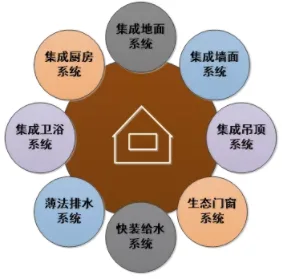
Figure 1.29: Eight Major Systems
(3) Core Concepts of Prefabricated Decoration
- Separation of pipelines and structures to eliminate wet operations;
- Reducing reliance on traditional crafts;
- Emphasizing energy-saving and environmental protection;
- Facilitating easier post-maintenance and renovation.
3. Technical Analysis
For detailed analysis of industrial construction technology, refer to Table 1.11.
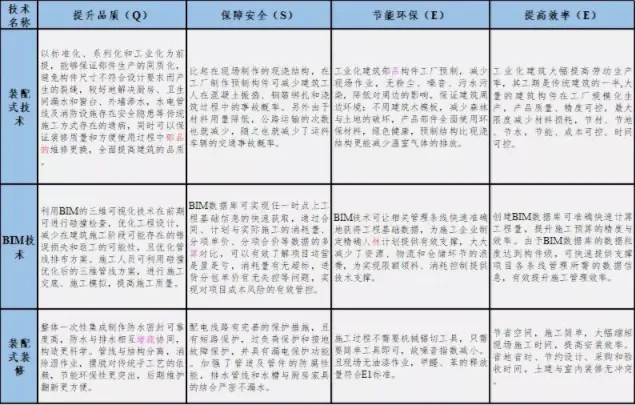
Table 1.11: Industrial Construction Technology Analysis
Across history, China has set development goals to promote new construction methods, transform the industry, and improve quality. From industrialization in the 1950s to housing modernization in the 1990s, the current construction industrialization vision integrates standardized design, componentization, and mechanized construction into a comprehensive, efficient, and quality-driven process. This approach merges industrialization with informatization to maximize energy savings, environmental protection, and full lifecycle value, marking a major shift from traditional construction methods.
As a representative of new construction methods, industrialized architecture deserves focused research. Key points include recognizing assembly as inherent to construction, with modern prefabrication as a natural result of specialization and scale. Assembly requires collaboration, empowered by information technology, to improve product quality, enhance workers’ lives, and reduce environmental impact. Prefabricated engineering general contracting optimizes resource management and collaboration, raising contractor performance.
The development of industrialized buildings represents a transformative construction production mode, supporting supply-side reforms and new urbanization. Benefits include resource and energy savings, reduced pollution, improved labor productivity and safety, deeper integration of construction and IT, cultivation of new industries, and resolution of overcapacity issues.
Authors: Mao Zhibing, Li Yungui, Guo Haishan, et al.
Source: “New Construction Methods in Construction Engineering”














Must log in before commenting!
Sign Up