
In today’s expanding decoration market, rising labor costs, increasing demand for environmental protection, and stricter policies and regulations are putting pressure on industry reform. The key focus is to reduce craftsmanship and manual labor, minimize their impact on the industry, enhance production efficiency, and prioritize environmental sustainability. While industries like automotive and mobile phones have entered the Industry 4.0 era, the decoration industry still lags behind, remaining stuck in a more traditional, manual era.
This article covers two main topics: first, what is prefabricated interior decoration? And second, what value does it bring?
To understand prefabricated decoration, we must first clarify what prefabricated buildings are. Currently, prefabricated construction mainly refers to prefabricated structural elements, to which prefabricated decoration can be added. Compared to traditional construction, the difference is like the contrast between kneading clay and assembling LEGO bricks. Clay is highly malleable but requires skilled hands for shaping; without expertise, the results can be unsatisfactory. Prefabricated decoration, on the other hand, is like assembling LEGO blocks—components are factory-made and fixed. Before design begins, every component and its effects must be well understood. Construction then becomes a modular assembly process, combining various parts systematically.
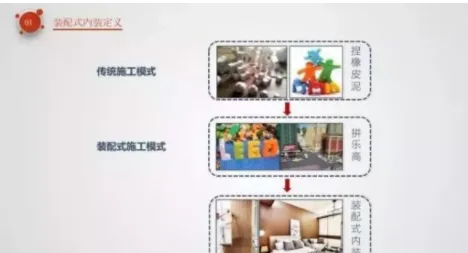
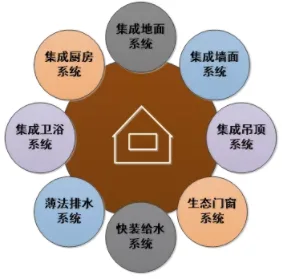
By this definition, many traditional decoration systems already incorporate some degree of prefabrication. Examples include integrated ceilings, interior wooden doors, flooring, and integrated bathrooms—all of which are assembly systems. Although parts of the decoration industry have scaled industrially, fully assembled interiors remain rare in today’s market.
Currently, the development of prefabricated decoration in our country is relatively underdeveloped for several reasons. Primarily, many properties are delivered as unfinished or semi-finished units, whereas in many foreign countries, homes are delivered fully finished, making their prefabrication technology much more mature.
Why are developers increasingly interested in prefabrication? Let’s analyze the current market situation.
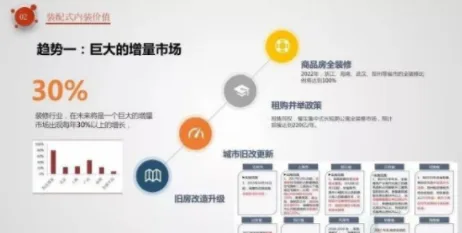
Several factors contribute to the rapid growth of the decoration market:
First, the full decoration of commercial housing has been implemented nationwide. Since 2015, provinces have successively issued policies mandating fully decorated residential properties. By 2020, the proportion of fully decorated homes in these regions will reach 100%, representing a massive market.
Second, the 19th National Congress introduced policies promoting both rental and purchase options with equal rights. This has fueled a booming long-term rental apartment market, which is now a primary customer segment.
Third, urban redevelopment is accelerating, with many cities undergoing extensive renovation of urban villages.
These factors combined have driven substantial growth across the entire decoration industry.
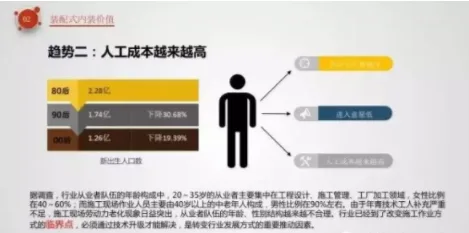
Labor costs are also rising due to several demographic and social factors. Official data shows that birth rates among the post-80s, post-90s, and post-00s generations are declining sharply. If this trend continues, the current ratio of 900 million workers supporting 600 million dependents will invert, with fewer workers supporting more dependents. This shrinkage of the labor force is evident. It is increasingly difficult to find young workers willing to work in decoration, partly due to the demanding nature and poor working conditions of the job. Many older workers discourage their children from entering the industry. As a result, skilled craftsmen are becoming scarce, directly pushing labor costs higher.

Additionally, environmental regulations have become increasingly stringent since 2013, with policies aimed at reducing air pollution to protect blue skies. Public awareness about environmental protection has also grown, driving demand for higher-quality, eco-friendly decoration solutions.

Given these trends—expanding market demand, rising labor costs, increased environmental awareness, and stricter policies—the entire decoration industry is under pressure to reform. The core challenge is to reduce reliance on manual craftsmanship, improve production efficiency, and enhance environmental sustainability. While many other industries have embraced Industry 4.0, the decoration sector remains stuck in an outdated, labor-intensive era.
In response, many decoration companies and cross-industry enterprises are exploring ways to innovate. Several approaches have emerged:
First, platform innovation: creating vertical e-commerce or shopping platforms that connect customers, designers, and sometimes foremen, streamlining communication and improving efficiency.
Second, productization innovation: companies develop standardized productized decoration offerings, capturing significant market share.
Third, design platforms: websites where designers create proposals that customers can select from, often featuring advanced tools to display renderings and manipulate real materials and furniture, facilitating better client-designer communication.
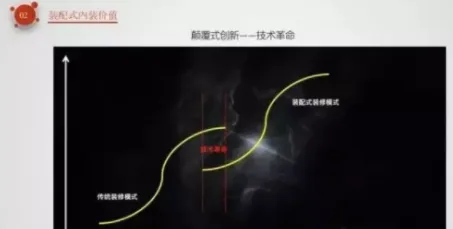
However, none of these approaches solves the fundamental problem: labor and craftsmanship have not been reduced, nor has environmental efficiency significantly improved. This has led to another, more revolutionary innovation in the industry—prefabricated decoration.
Key characteristics of prefabricated decoration include:
1. Speed: Ordinary residential and office buildings can be installed within 15 days. Using a BIM design platform with a rich component library and modular schemes, design adjustments can be completed instantly.
2. Environmental protection and health: Developers, offices, and apartments can be occupied immediately after decoration. Prefabricated decoration uses light steel keel structures, formaldehyde-free substrates, factory quality control, and dry and wet operations. It produces no noise or on-site waste, eliminates pollution sources, and ensures a completely non-toxic, formaldehyde-free, safe indoor environment.
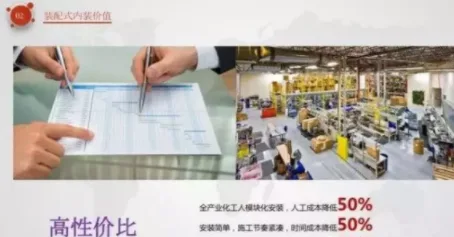
3. High cost-effectiveness: Factory-based modular production and compact on-site installation significantly reduce labor and time costs.
4. Safety and durability: Using the SI system, the building’s structural and decorative elements are separated. This minimizes structural impact throughout the decoration process.
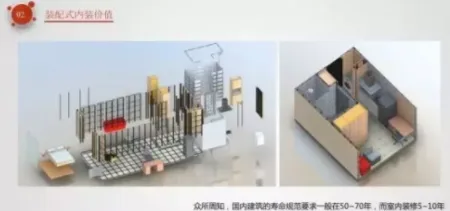
5. Convenient maintenance: Prefabricated interiors consist of modular components, such as wall panels assembled into blocks and connected with accessories. If a panel is damaged, it can be easily removed and replaced. This is especially beneficial for apartment management, where traditional renovations occur every five years and require complete overhauls. Prefabricated decoration allows for partial repairs and lowers long-term maintenance costs.
Overall, prefabricated interior decoration offers speed, environmental friendliness, safety, durability, maintainability, and convenience—benefits difficult to achieve with traditional decoration methods.
Of course, prefabricated decoration differs from traditional methods in various ways. It represents a new value network covering design, procurement, and construction, creating a completely new system. For example, all designs are now software-based, since prefabricated decoration requires components to be integrated into graphic libraries that are continuously referenced during the design process, ensuring accuracy and completeness.














Must log in before commenting!
Sign Up