
Modern Architectural Methods and Trends (Part 1)
1. What is Industrialization?
Industrial manufacturing across various industries involves the large-scale use of machines and replication methods. Industrialized manufacturing replaces traditional craft-based production with standardized, machine-driven processes. This shift improves efficiency and delivers high-quality products at lower costs.
There is a common saying: “Engineers are the natural enemies of craftsmen.” Engineers aim to dismantle traditional craftsmanship by breaking it down into standardized processes, enabling industrial manufacturing of products.
Modern history recognizes four major industrial revolutions:
The First Industrial Revolution took place from the late 17th to early 18th centuries. It featured significant advances in agricultural industrialization, the invention of the steam engine, and England’s leadership in the textile industry. This era replaced manual labor with mechanical production, marking the Industry 1.0 era. It also coincided with important scientific and political revolutions, often called the “Three Revolutions.”
The Second Industrial Revolution occurred in the late 19th and early 20th centuries. It introduced new technologies such as steel manufacturing, chemical engineering, electronics, aviation, and automobiles. The United States emerged as a leader in many industries during this era, which enabled large-scale replicated production, known as the Industry 2.0 era.
The Third Industrial Revolution unfolded in the mid-20th century. Advances in automatic control technology enabled automation of production lines—the hallmark of Industry 3.0. While China missed out on the first two revolutions, it embraced the third and became a global manufacturing powerhouse.
The Fourth Industrial Revolution is currently underway. It marks the industrialization of construction, driven by rapid developments in information technology, the Internet of Things, and artificial intelligence. This era, Industry 4.0, enables mass customization in industries like automotive, home appliances, clothing, and footwear. The housing industry is expected to catch up and benefit from these advances.
(1) Industrialization of Automobiles
In 1907, Ford revolutionized production by inventing the assembly line, enabling standardized mass production. Before this, cars were handcrafted by artisans using street-vendor techniques such as manual knocking and welding.
Following Ford’s innovation, cars were produced continuously on assembly lines developed by engineers who designed efficient manufacturing processes.
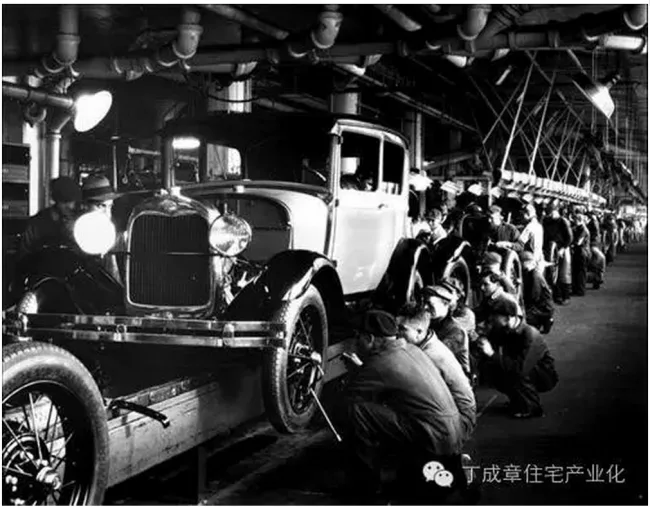
The assembly line mass production method has dominated globally for over a century and greatly contributed to industrial society. However, economic and social developments have exposed its limitations, leading to its gradual decline.
While mass production still applies in certain fields, its historical role as the mainstream method has diminished. A new approach—mass customization—has emerged, better suited to today’s market demands.
(2) What is Residential Industrialization?
(1) A Brief History of Building Industrialization
Construction industrialization is not new:
- Ancient Roman military engineering;
- Industrial Revolution’s Crystal Palace (1851);
- High-rise steel structures like the Empire State Building (1930).
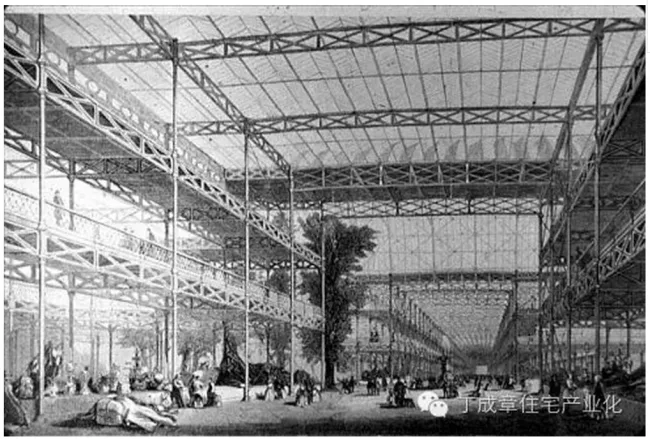
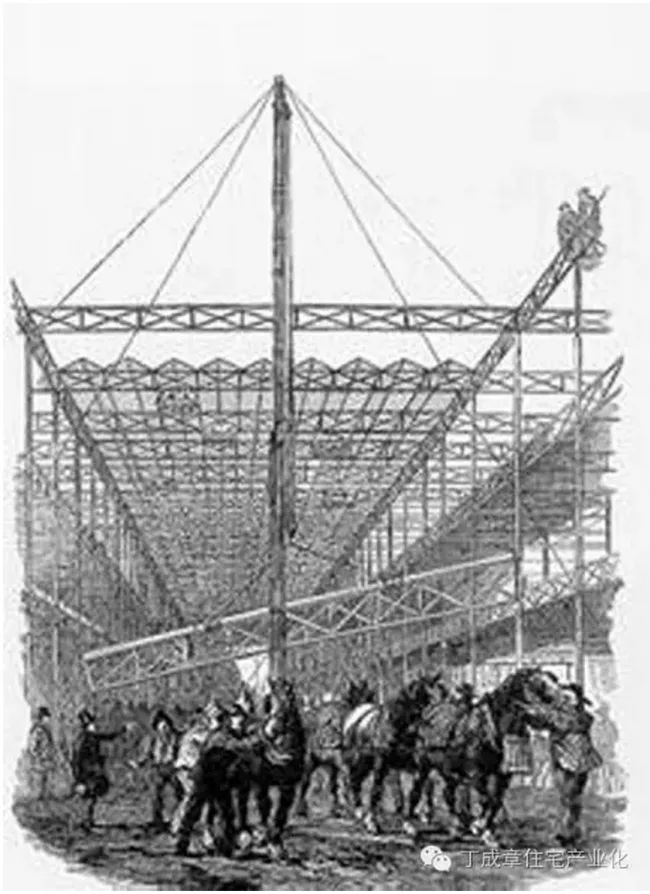
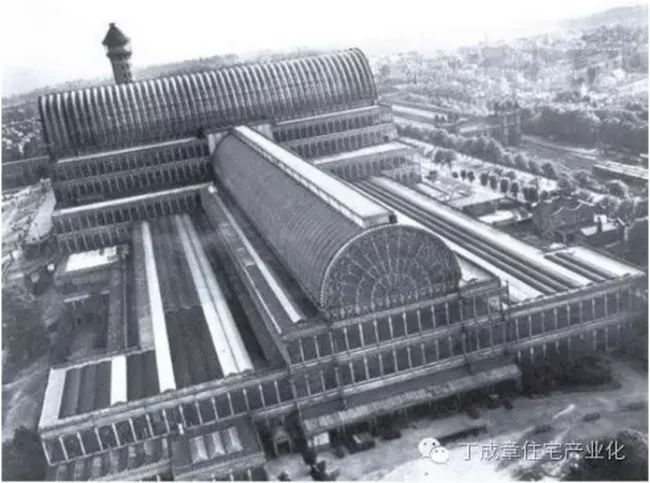
In 1851, during Britain’s Industrial Revolution peak, the first World’s Fair was held at the invitation of the English Queen. Joseph Paxton leveraged modern industrial technology’s speed, precision, and economy to pioneer continuous production of unit components. He designed and built the Crystal Palace, a prefabricated structure that hosted the London Expo.
In just six months, the Crystal Palace covered approximately 90,000 square meters, stretching 563 meters long, 124 meters wide, with a maximum 22-meter span and 33-meter ceiling height. This project encompassed design, production, transportation, construction, and demolition as a complete prefabricated system. It was a landmark in 19th-century cast iron technology.
Though reliant on horse-drawn transport, it pioneered factory-prefabricated components and on-site assembly, laying the foundation for modern architecture with steel frames and glass curtain walls.
Empire State Building (1930)
- Height: 381 meters, 102 floors;
- Construction time: 1 year and 45 days;
- Built a floor every day—a record never surpassed;
- Modular assembly: steel frames prefabricated in factories, transported to the city center, and lifted into place.
(2) A History of Residential Industrialization
Residential industrialization has evolved over more than a century, driven by numerous pioneers devoted to its theory and practice.
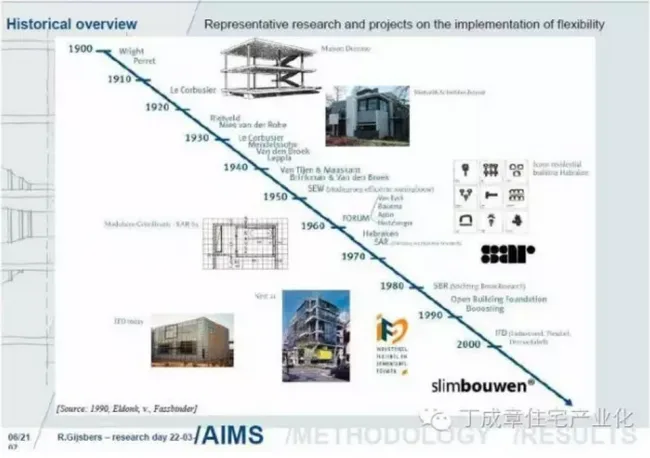
In March 1910, Walter Gropius submitted a memorandum to Emil Ratnow of the German General Electric Company (AEG) outlining rational production of residential buildings. At 26 years old, Gropius provided one of the most comprehensive discussions on prefabrication, assembly, and distribution of standardized residential units. His book, Industrialization of Housing, was published in 1923 as part of the Bauhaus Book Collection.

Interest in industrialized architecture remained strong throughout the 20th century. The Lhasa Raz Declaration, adopted at the first International Congress of Modern Architecture (CIAM) in 1928, emphasized the necessity of industrialization in architecture. It stated that architectural quality depends not on craftsmen’s skills but on widespread adoption of rational production methods. The declaration called for standardization in size and effective production methods as prerequisites for construction industrialization.
As early as 1910, Gropius articulated the core principles of housing industrialization:
- Continuous replication and production of independent components;
- Machine manufacturing of standardized components;
- Provision of interchangeable parts.
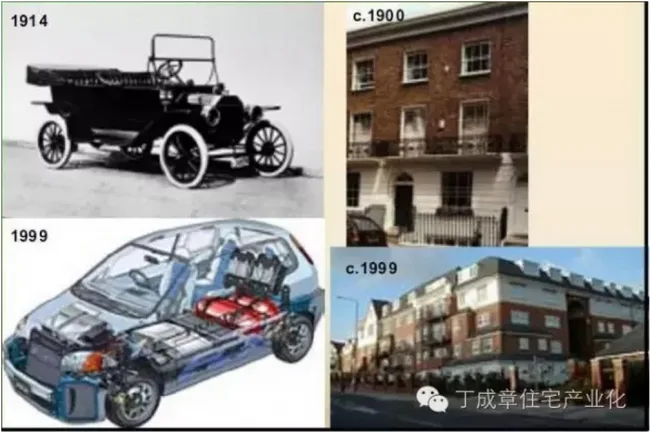
Whether Gropius was influenced by Ford’s Model T or vice versa is unclear, but both concepts emerged almost simultaneously. Over the past century, automobile industrialization has advanced rapidly, while housing industrialization has made limited progress.
(3) Definition of Residential Industrialization
While definitions vary, the core principle of residential industrialization remains consistent:
It is the construction of residential buildings using industrialized production methods. This shift is essential to upgrade low-mechanization, labor-intensive production methods, enhance labor productivity, improve overall building quality, reduce costs, and lower material and energy consumption.
The United Nations has proposed six standards for housing industrialization:
- Continuity of production;
- Product standardization;
- Integration of production processes;
- Standardization of construction management;
- Mechanization of production;
- Integration of technology, production, and scientific research.
To emphasize, Gropius’ three key points from 1910 still perfectly encapsulate the concept of housing industrialization:
- Continuous replication and production of independent components;
- Machine manufacturing of standardized components;
- Interchangeable parts.
These principles not only defined housing industrialization a century ago but also underpin the broader concept of industrialization in manufacturing.
3. What is Modern Construction Method?
(1) From “Batch Replication” to “Batch Customization”
The first three industrial revolutions enabled only mass replication, not mass customization. This limited the ability to meet individual consumer preferences for housing. For over 100 years, housing industrialization faced challenges because people desire unique homes, not identical replicas.
Mass customization has become a reality only in the 21st century. Few in China’s manufacturing industry recognize this concept; the Chinese construction sector still largely practices mass replication—”building houses like cars.” While architectural differences have always been acknowledged, customer customization conflicts with the mass replication goals of the 20th century, making housing industrialization difficult.
Mass customization blends mass production with customer-specific customization and is only achievable in the Industry 4.0 era. It introduces new construction processes that leverage automated production technologies while differentiating each product. The ability to deliver personalized buildings tailored to site conditions, functions, and owner needs is critical to mass customization’s success. This challenge stumped previous generations.
Today, information management tools enable visual control of off-site manufacturing for mass customization. Advances in lightweight, high-strength, and high-performance building materials, alongside efficient transportation and material reuse, support sustainable construction. Architects, builders, and property owners all stand to benefit.
(2) Definition of Modern Construction Methods
Modern construction methods encompass various architectural techniques that differ from traditional brick-and-block approaches.
Prefabricated residential construction can be classified as:
- Factory manufacturing of 3D (box-type) modules;
- Factory manufacturing of 2D (panel) modules;
- Hybrid factory manufacturing combining 3D, 2D modules and binding rods;
- Factory manufacturing of pre-assembled components;
- Modern construction methods applied on construction sites.
Other classifications of prefabricated housing methods include:
- Factory manufacturing and assembly;
- Industrialized manufacturing;
- Innovative system construction on site;
- Factory assembly and construction;
- Modular construction;
- Prefabricated construction;
- System architecture.
(3) Key Technical Features of Modern Construction Methods
Modern construction methods primarily refer to prefabricated modular buildings, characterized by but not limited to the following features:
- Prefabrication: essential for industrializing residential or construction processes;
- Safety: mandatory for construction and usage;
- Insulation: important for energy conservation, environmental protection, and sustainability;
- Lightweight: beneficial for prefabricated modular buildings (note: precast concrete slabs are not lightweight);
- Aesthetics: important for architectural appeal (precast concrete slabs often require additional finishing);
- Cost-effectiveness: critical for market adoption (precast concrete slabs may not be cheap).
(4) Benefits of Factory Manufacturing
1. Time (Speed)
Construction site:
Unpredictable weather and other factors often cause delays.
Factory manufacturing:
- Allows continuous work across three shifts, 24/7;
- Reduces on-site construction time since components are factory-made;
- Minimizes wet work on-site;
- Schedules completion dates accurately without weather disruptions.
2. Cost
Construction site:
Uncontrollable weather delays increase costs.
Factory manufacturing:
Although initial development costs may be higher, factory manufacturing saves money by:
- Controlling manufacturing processes to prevent cost overruns;
- Clarifying costs and reducing risks;
- Reducing errors and defective products;
- Lowering on-site management expenses;
- Improving quality, reducing maintenance costs;
- Shortening construction time and enabling earlier occupancy;
- Minimizing lifecycle costs.
3. Quality
Construction site:
- Often relies on temporary workers;
- Weather variability compromises quality.
Factory manufacturing:
- Employs well-trained, skilled workers in controlled environments;
- Uses specialized workshops and equipment;
- Reduces damage from on-site handling and storage;
- Minimizes transportation damage through enclosed 3D module units.
4. Health and Safety
Construction site:
- Risks from high-altitude work;
- Hazards from falling objects.
Factory manufacturing:
- Reduces risks by minimizing on-site personnel;
- Eliminates many high-altitude operations;
- Ensures better employee health and safety;
- Factory manufacturing is over six times safer than traditional construction.
5. Sustainability
Construction site:
Produces large amounts of waste requiring disposal, causing environmental and cost issues.
Factory manufacturing:
- Prefabricated panels arrive ready to install, generating minimal site waste;
- Factory waste is reduced through coordinated operations;
- Supports sustainable development by lowering waste, packaging, and environmental impact;
- Minimizes disruption to surrounding areas.
6. On-site Logistics
Construction site:
Frequent scaffolding rentals increase costs, space demands, and site complexity.
Factory manufacturing:
- Prefabricated panels are transported by flatbed trucks and installed with cranes;
- Reduces on-site workload, noise, dust, pollution, and damage;
- Minimizes high-altitude risks and falling object hazards;
- Requires minimal storage space on-site;
- Decreases the number of shipments needed.













Must log in before commenting!
Sign Up