
The design of prefabricated concrete buildings must adhere to national policies, regulations, and local standards. While meeting the building’s functional and performance requirements, it is essential to adopt modular, standardized, and integrated design approaches. The guiding principle of “fewer specifications, more combinations” promotes the modular combination and standardization of various components, parts, and structural connections. This approach establishes a reliable and practical universal building technology system and facilitates efficient assembly construction.
Modular coordination principles should be followed to ensure compatibility between buildings and their components, enabling modular design at all levels. Different modules are integrated under this principle: using standardized design, building component modules are organized into standard units based on function, and standardized interfaces connect component parts to form a hierarchical functional module system. Integrated design intensively coordinates the main structural system, envelope system, equipment and piping systems, and interior finishes. This integration enhances quality, precision, and construction efficiency, allowing buildings to be completed in a single assembly process that satisfies prefabricated building design requirements.
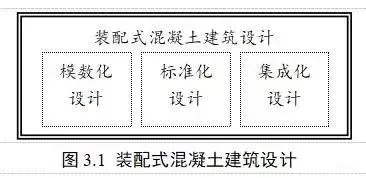
Modular Design
Standardized design in prefabricated buildings is fundamentally based on modular design. This approach uses basic, expanded, and sub-modules to achieve dimensional coordination among the main structure, interior finishes, and building components. Modules are defined by basic units or functional spaces and must comply with the national “Building Modular Coordination Standard” GB/T 50002.
By applying modular coordination principles that integrate dimensions such as openings and depths, diverse architectural layouts emerge through combinations of basic spatial modules. Horizontal expansions in modular design typically follow sequences of 2nM and 3nM (where n is a natural number), enabling dimensional consistency in design, manufacturing, and assembly.
Building floor heights and door/window opening heights are determined based on prefabricated component sizes. Facade designs must follow modular coordination to establish reasonable design parameters, ideally using vertical modular sequences (nM) to facilitate component production and installation.
The modular coordination method defines the dimensions of components and connection nodes, ensuring that all parts fit together cohesively. Vertical dimensions for beams, columns, and walls should follow the vertical modular sequence nM, while interface dimensions use subdivisions such as nM/2, nM/5, and nM/10. Positioning should combine center positioning for horizontal alignment and interface positioning for vertical and component part placement.
Standardized Design
The standardized design of prefabricated concrete buildings emphasizes modularity, serialization, and the “fewer specifications, more combinations” principle. This approach targets high repetition, fewer specifications, and diverse combinations of building units, connection structures, components, parts, and equipment pipelines.
Architectural modules are diversified and combined through standardized interfaces to create multi-level building combinations, resulting in replicable and scalable building units. For residential buildings, modules such as kitchens, bathrooms, living rooms, and balconies form modular units, while corridors and core tubes combine into standard floor modules. This systematic approach leads to repeatable modular constructions.
Standardized interfaces are critical for achieving coordination and fit between modules, enabling seamless assembly of building module combinations.
Integrated Design
Integration is the cornerstone of prefabricated concrete building design. It goes beyond traditional production methods and simple assembly; true prefabrication integrates the main structure, enclosure, and interior components into a unified system. This results in high quality, reduced labor, minimized waste, and enhanced efficiency.
Design must involve comprehensive planning that coordinates all phases—planning, component production, construction, and operation. Technical standards and system selections should be established early to prevent conflicts. During technical design, architectural, structural, mechanical, electrical, and interior systems must be integrated to avoid overlapping schedules and ensure smooth construction.
More integrated technologies within prefabricated components ease subsequent construction processes, representing the future direction for prefabricated systems.
Systematic integration covers:
- Main structural system integration: building structure technology, component assembly, installation, and equipment preconditions.
- Envelope system integration: combining building aesthetics with load-bearing, insulation, and exterior finish technologies.
- Equipment and pipeline system integration: applying efficient and compact energy technologies.
- Interior decoration integration: adopting dry construction techniques and modular systems for fast installation, maintenance, and environmental performance.
Integrated technology is essential for advancing prefabricated buildings, improving quality and efficiency. A core prerequisite for integrated design is cross-disciplinary and process-wide technical coordination.
1. Prefabricated Concrete Architectural Graphic Design
Graphic design of prefabricated concrete buildings should meet functional requirements while supporting efficient prefabrication, adhering to the “fewer specifications, more combinations” principle. Architectural plans must be standardized and modularized, establishing component and spatial modules that maximize reuse and improve quality, efficiency, and cost control.
(1) General Layout Design
The overall layout must comply with urban planning, national regulations, and construction standards. Early planning should define project goals, technical approaches, cost control, and efficiency targets. Considerations include component production, assembly capacity, onsite transportation, and lifting conditions. Coordination among disciplines is crucial to optimize technical routes, locations, and scale based on production and transport capabilities. Site plans must account for transportation channels, lifting equipment, and storage yards.
Three key layout considerations for prefabricated construction:
- External transportation: Ensure road widths, load capacities, turning radii, and clearance heights support component transport. If restrictions exist, consider alternative routes, temporary reinforcements, or component dimension adjustments.
- Internal storage space: Components are typically stored briefly on-site or lifted immediately. Storage locations should optimize construction sequencing, crane reach, and capacity while avoiding excavation zones.
- Internal installation flow: Installation requires precise coordination of construction processes. Layout must reserve adequate space for component movement, stacking, and lifting, and integrate tower crane and construction needs.
(2) Architectural Graphic Design
Graphic design must balance building functionality with prefabrication requirements, embracing holistic design. It should consider spatial usability over the building’s lifecycle to accommodate changing needs. Key design aspects include:
Large Space Structural Form: Designing large structural spaces reduces component variety, boosting production and construction efficiency while lowering labor and costs. Public and residential unit spaces should be planned as unified structural spaces, with prefabricated component dimensions based on structural stress and modular coordination principles.
Lightweight partition walls (e.g., steel frame gypsum boards, lightweight panels, furniture-style partitions) should be used to separate indoor spaces flexibly. These partitions can house equipment pipelines, facilitate maintenance, save space, and contribute to sustainable building development.
Planar Shape: The building’s shape and component arrangement significantly impact seismic performance and must comply with the national “Code for Seismic Design of Buildings” (GB50011). Designs should favor regular, symmetrical forms to ensure structural safety and economic rationality, avoiding irregular layouts. Large spatial layouts using structural units as functional modules are preferred. Columns, walls, and core tubes should be strategically placed, with centralized vertical pipelines to support flexible space usage.
The Technical Specification for Prefabricated Concrete Structures (JGJ 1) recommends:
- Simple, regular, symmetrical floor plans with uniform mass and stiffness distribution—irregular layouts should be avoided.
- Plan dimensions should not be excessively elongated, with aspect ratios adhering to specified limits.
- Protruding parts on plans should be controlled in length and width as per standards.
- Plans should avoid overlapping corners or slim waist shapes.
Vertical structural components like load-bearing walls and columns should be continuous and uniformly arranged to prevent sudden changes in lateral stiffness and bearing capacity, ensuring seismic resilience.
Standardized Design Method
Designs should adopt standardized, modular, and serialized approaches that meet the principle of “fewer specifications, more combinations” to maximize repetition and minimize the variety of building units, connection structures, components, parts, and equipment pipelines.
Plan dimensions should follow unified modular size series, optimizing sizes for combination. The reuse rate of units and components reflects standardization level. For complex or large components, typically no more than three specifications dominate the quantity. Simple components may be limited to a single specification.
The Evaluation Standards for Industrialized Buildings (GB/T 51129) outline requirements for standardized design, including modular coordination, unit reuse, functional layout, connection nodes, and component repetition rates, with specific scoring criteria.
Residential Modular Design
Prefabricated concrete residential buildings rely on combining basic units or sets as modules. Modular design diversifies optimized suite and core tube module combinations.
Nested modules divide into independent yet interconnected functional modules, each defined by interface, function, logic, and status attributes. Modules must be combinable, decomposable, and replaceable, with unified interfaces to maintain serialization and logical relationships.
Typical residential unit modules include living rooms, bedrooms, foyers, dining rooms, kitchens, bathrooms, and balconies. Spatial scales should suit residential needs while maintaining structural integrity.
Nested modules combine standard modules (fixed dimensions, e.g., living room-bedroom sets) and variable modules (flexible dimensions, customizable to project needs, e.g., kitchen-foyer combos), creating adaptable suite modules.
Key functional modules include:
- Living room: Designed for daily living, entertainment, and reception. Door positioning and wall integrity should facilitate functional layouts.
- Bedroom: Types include double, single, or combined bedroom-living room modules, ensuring sleep function and spatial diversity.
- Dining area: Includes separate or combined dining spaces; additional refrigerator and appliance storage may be incorporated based on kitchen space.
- Foyer: Includes storage, makeup, and decorative functions, designed according to living habits with integrated storage components.
- Kitchen: Facilities such as washing, cooking, storage, and appliances are arranged efficiently. Pipelines should be centralized for maintenance. Kitchen design follows modular coordination for factory production and onsite assembly, prioritizing integrated kitchens.
- Bathroom: Functions include toileting, washing, bathing, laundry, and storage. Modular coordination standards guide design to enable factory production and dry onsite construction, with preference for integrated bathrooms with same-floor drainage.
The core tube module must meet functional and regulatory needs, including stairwells, elevator shafts, corridors, equipment shafts, and air supply ducts. Design considerations include:
- Compliance with regulations, safety, transport convenience, comfort, and economy.
- Elevator quantity, size, and arrangement affecting building usability.
- Stair design for evacuation, location, quantity, and space efficiency, enabling factory prefabrication and assembly.
- Well-lit and ventilated front rooms, elevator halls, and corridors for user comfort.
- Centralized mechanical and electrical pipe wells with appropriate layout to separate strong and weak electrical ducts, avoid adjacency of electrical and plumbing ducts, and optimize exhaust and restroom locations.
2. Prefabricated Concrete Architectural Facade and Section Design
Facade design should apply standardized methods to achieve personalized, diverse building appearances through modular coordination. Prefabricated component types for facades should be minimized.
Using repetition, rotation, symmetry of standardized components, and variations in texture and color, facades can achieve both regularity and rhythmic individuality consistent with prefabricated construction.
(1) Facade Design
Prefabricated facades integrate standardized components and structural fittings into a unified assembly. Design should maximize prefabricated component use and minimize facade component variety, following the principle of “fewer specifications, more combinations.”
Facade surfaces should be smooth and uniform, with consistent openings, minimal decorative elements, and reduced complexity. Residential or public building units should be standardized to enable high repetition and modular assembly, producing facades that are rhythmic, neat, concise, and characteristic of prefabricated architecture.
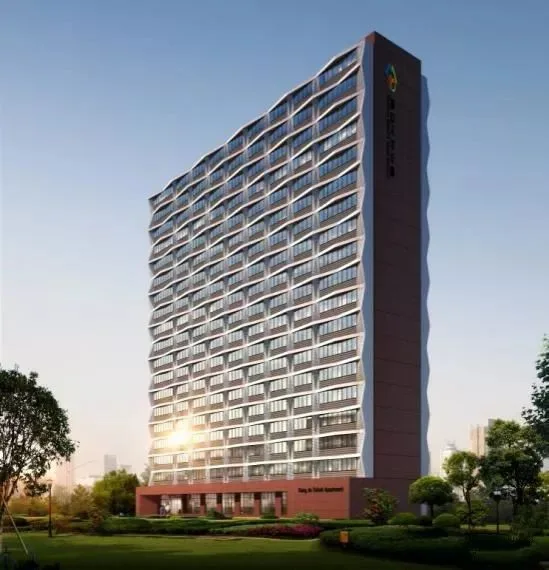

Figure 3.4 Facade Design of Prefabricated Buildings
Vertical building dimensions—including floor heights, door and window openings, and facade divisions—should be standardized and coordinated. Openings must align vertically and meet structural and prefabrication requirements. Doors and windows should use standardized components securely connected to walls via sub-frames or embedded methods. Sun shading integration and industrialized, standardized products are recommended for building envelopes, balconies, and air conditioning panels.
(2) Building Height and Floor Height
Maximum building height varies with structural type, as specified in structural design guidelines.
Floor height requirements for prefabricated buildings align with those for cast-in-place concrete and depend on building type and function. Considerations include required net height, beam and slab thickness, and ceiling height.
Traditional flooring embeds electrical and piping systems in concrete slabs and ground cushions, while the prefabricated SI system separates structure from interior pipelines, using open installation combined with suspended ceilings and lightweight walls.
Architectural floor height design must coordinate with structural, mechanical, electrical, and interior disciplines to optimize beam heights, slab thicknesses, and pipeline layout, minimizing space usage while meeting functional needs.
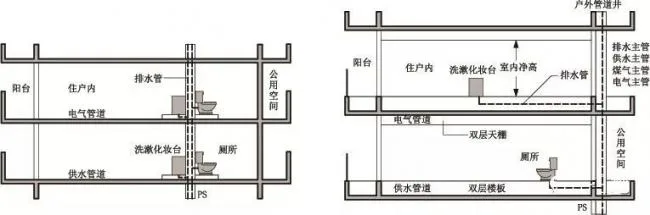
(a) Traditional architectural practices (b) Prefabricated building SI interior system practices
Figure 3.5 Comparison of Floor Height Design for SI Interior System of Prefabricated Buildings
(3) External Wall Facade Division and Decorative Materials
Facade divisions must align with component joints to unify building appearance and structural logic.
Design should reflect prefab factory production capabilities, structural stress points, and external wall panel requirements. Suitable facade materials and panel combinations should be selected to reduce decorative elements, especially those with shorter lifespans than the building, enhancing sustainability and resource efficiency.
Prefabricated wall panels typically come as full or strip panels, sized according to bay lengths and floor heights. Panels can be rectangular or shaped, assembled on site. Vertical grid divisions should consider openings, balconies, air conditioning panels, and decorations. Daughter wall panels use similar modular methods as base panels.
Exterior wall finishes must consider prefab characteristics, economics, and green building standards. Factory-produced finishes ensure better quality, durability, environmental protection, and efficiency compared to on-site finishing.
Recommended materials include concrete, weather-resistant coatings, face bricks, and stone, with options for colored, plain, exposed aggregate, and patterned concrete. Coatings offer uniformity and ease of maintenance; brick and stone veneers provide durability and texture. Integrated production techniques like reverse printing reduce on-site work and improve longevity.














Must log in before commenting!
Sign Up