
1. Concept of Prefabricated Shear Wall Structure
Prefabricated concrete, commonly referred to as PC, primarily consists of prefabricated shear walls, composite beams, and composite slabs that serve as the main load-bearing elements. These prefabricated components are effectively connected to form a reinforced concrete shear wall structure, also known as a prefabricated shear wall structure.
2. General Guidelines for Mold Design of Precast Concrete Components
The molds used for precast concrete components are mainly steel molds, with Q235 steel plates as the primary material for the panels. The supporting structures can be made of steel or steel plates, with specifications selected based on the mold type. The molds must satisfy the following requirements:
- Molds should provide adequate bearing capacity, stiffness, and stability to reliably withstand the weight, lateral pressure, and working loads during concrete pouring.
- Molds must be easy to support and dismantle, facilitating the installation of steel reinforcement as well as concrete pouring and curing.
- All mold components should be firmly connected, and embedded parts within the prefabricated components require secure fixing measures.
3. Design System for Prefabricated Concrete Component Molds
Current mold systems are categorized into independent molds and large bottom molds (where only the side molds are processed, and the bottom mold is shared). Independent molds demand more steel and are suitable for projects with a single component type and high repetition. Large bottom molds only require side molds to be produced, allowing the bottom mold to be reused across projects. This article focuses primarily on the large bottom mold system.
Main mold types include: large bottom molds (platforms), laminated floor molds, balcony panel molds, staircase molds, interior wall panel molds, and exterior wall panel molds.
Key Aspects of Bottom Mold Design: The panel should be constructed from a single steel plate tailored to the floor height and component length. Each large bottom formwork should accommodate no more than three components, with its length and width determined by the building height. For less critical surfaces, spliced steel plates may be used, with special care given to joint treatment. The support structure typically consists of I-beams or channel steel. To prevent welding deformation, it is ideal to design the large bottom formwork as a one-way plate, usually made of 10mm steel. The formwork must be fixed on a flat foundation, ensuring its operating height after positioning does not exceed 500mm.
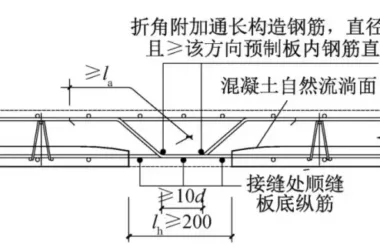
Key Points for Laminated Floor Slab Mold Design: Side molds are selected based on the laminated floor slab height, typically using angle irons. When chamfers are present on all four sides, bent steel plates can be welded onto the angle irons. Due to multiple notches on the edge mold formed by angle irons, longitudinal stiffness is limited. Therefore, the side mold should be divided into sections of 1.5–2.5 meters along its length, reinforced with ribs spaced every 400–500mm.
Key Points for Balcony Panel Mold Design: To achieve the building’s facade effect, balcony panels in residential buildings are designed as opposite-sex components with reverse edges on all four sides. This design prevents the use of large bottom molds. Instead, independent molds are used, with mold materials chosen based on component quantity. Demolding slopes of approximately 1/10 can be incorporated without affecting functionality to facilitate demolding. For taller components, special attention must be paid to the positioning and stiffness of the side formwork.
Key Points for Stair Mold Design: Stair molds are categorized into horizontal and vertical types. Horizontal molds require more space and frequent flipping of components, so vertical molds are preferred. The main challenge lies in shaping the stair treads, which have a wavy profile. Steel plates must be bent and spliced, with joints placed where they do not compromise component integrity and allow easy operation. Welding or cold splicing methods can be used for joints, but sealing must be meticulous to prevent grout leakage.
Key Points for Interior Wall Panel Mold Design: Interior wall panels are solid concrete walls and generally lack complex shapes. In Beijing public rental housing projects, prefabricated interior wall panels are typically 200mm thick. For ease of fabrication, 20# channel steel is used as edge molds. Since reinforcement is externally exposed on three sides with numerous notches cut out, the side molds tend to lack rigidity and deform easily during handling. Adding rib plates strengthens the side mold structure.
Key Points for Exterior Wall Panel Mold Design: Exterior wall panels in Beijing usually feature a sandwich structure composed of a structural layer (200mm), insulation layer (50mm), and protective layer (60mm). These panels can be produced using direct or reverse printing techniques. High flatness is required for exterior panels. Direct printing, whether manual or machine-applied plastering, often fails to meet flatness standards, complicating subsequent construction. However, direct printing simplifies embedded part positioning and streamlines operations. Process selection depends on project needs. This article mainly discusses molds using reverse printing technology.
The mold is divided into two layers according to the pouring sequence: the first layer includes the protective and insulation layers, while the second layer is the structural layer. The first layer mold serves as the base for the second layer and requires reinforcement at the connection. The structural layer mold resembles the interior wall panel mold, but with fewer positioning bolts, making tie rod positioning necessary to prevent mold expansion.
Leak-Proof Design for Exterior and Interior Wall Panel Molds: Since exposed steel bars are present on three sides of the components, numerous corresponding notches must be made in the side molds, complicating removal. To ease dismantling, openings are made larger, and materials such as rubber are used to separate the concrete from the edge formwork, significantly reducing removal difficulty.
Edge Mold Positioning Method Requirements: The edge mold connects to the large bottom mold using bolts. For quick disassembly, M12 coarse-thread bolts are recommended. Each side mold should have 3–4 positioning pins for precise alignment, with bolt spacing between 500–600mm and positioning pin spacing not exceeding 1500mm.
Embedded Part Positioning Design: Prefabricated concrete components contain numerous embedded parts requiring high precision. Some are positioned on the large bottom mold, while others, not in contact with the bottom mold, must be positioned via suspended molds supported by side molds. Suspended molds must allow easy disassembly and have unique positioning to avoid misuse.
Mold Reinforcement Design: Given the required number of mold uses, certain parts need reinforcement, typically using rib plates. When floor slabs lack sufficient stiffness, rib plates can be interconnected to improve overall rigidity.
Mold Acceptance Criteria: In addition to assessing external dimensions and flatness, the mold’s connection and positioning systems must be thoroughly inspected.
Economic Analysis of Molds: Based on the quantity and scheduling of prefabricated components in a project, a reasonable number of molds should be allocated. Costs are amortized per component, often measured by the amount of steel used per cubic meter of concrete, serving as part of the project quotation.
4. Requirements for Using Precast Concrete Component Molds
Numbering: Due to the fragmented nature of mold sets, uniform numbering is essential to prevent misuse.
Assembly: Connecting bolts and locating pins on side molds must be intact and securely tightened. Leak-proof components must be properly installed to aid side mold disassembly during demolding.
Dismantling Suspended Formwork and Fixtures: Suspended formwork and leak-proof components should be removed before the prefabricated concrete components are fully cured. This timing facilitates easier dismantling, reduces space usage on the assembly line, and lowers the height of steam curing kilns. At this stage, concrete strength is minimal, and grout leak prevention components can be removed without difficulty. If removed after concrete strength reaches approximately 20 MPa, these components adhere tightly, making removal extremely challenging.
Demolding Requirements: When demolding, all bolts and locating pins on the edge mold must be removed first. To protect mold longevity, use of large hammers is prohibited; instead, leather hammers, sheep horn hammers, small pry bars, and similar tools should be employed.
Mold Maintenance: When molds are temporarily unused, applying a layer of engine oil helps prevent corrosion.
5. Conclusion
Driven by strong governmental support, prefabricated shear wall structures have rapidly developed in China in recent years. Prefabricated buildings offer short construction periods and high installation accuracy, with component tolerances within 2mm, necessitating high-precision molds. Success requires a willingness to innovate, effective communication, and dedication to producing high-quality products.
References:
Code for Construction and Quality Acceptance of Prefabricated Concrete Structures DB11~1030-2013
Quality Inspection Standard for Precast Concrete Components DB11! T~968-2013














Must log in before commenting!
Sign Up