
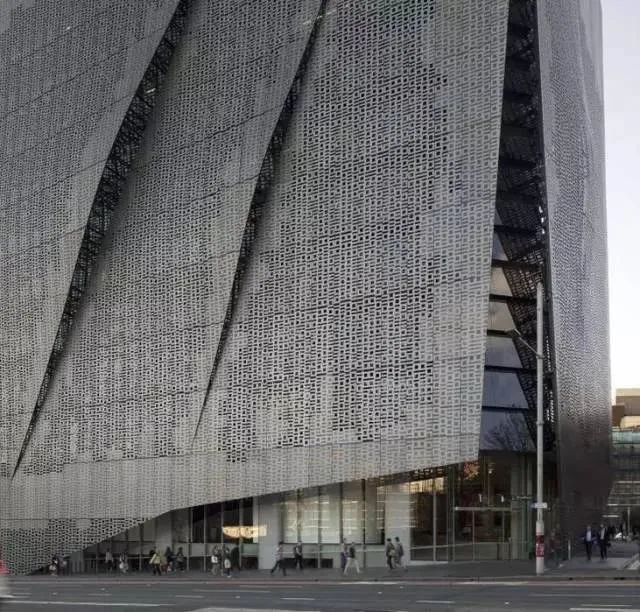
Definition of Building Surface
▽
The term “building skin” did not exist in ancient Chinese architectural terminology; it is a direct translation from English. Originally, the concept of building skin stems from biology, emphasizing architecture’s protective role. In this analogy, a building resembles a living organism, with the skin as its outer envelope, bones as its structure, and space as its soul. Another perspective defines the skin as an interface — the connection point between one system and another, whether solid or virtual (Chen Long, 2003).
Within this framework, architectural skin aligns closely with the “concrete skin of architecture.” Architectural design primarily focuses on the physical characteristics of the skin, highlighting material details and texture. The “concrete skin” reflects various architectural styles and schools through material expression, acting as a spatial partition on both interior and exterior façades or non-planar interfaces, fulfilling structural and functional roles.
Contemporary architects have diverse interpretations of building skin. Some emphasize its biological function, viewing it as a protective and regulating layer similar to animal skin — managing indoor temperature, air exchange, and adapting to external changes. Others see building skin beyond a mere maintenance system with clear separation; instead, it is a developing concept defined by spatial location, thickness, and material medium. Though seemingly vague, building skin possesses a distinct surface meaning (Feng Lu, 2004).
Introduction of the Term ‘Nonlinear’
▽
According to the Encyclopedia Britannica, linear and nonlinear systems differ fundamentally: a linear system responds proportionally to forces without chaotic amplification, while nonlinear systems exhibit variable, multifaceted behaviors that resist simple mathematical description. Only with advances in supercomputing has the nature of nonlinear systems and common chaos become better understood.
Nonlinear science studies complex, intriguing nonlinear phenomena, bridging determinism and probability theory. Crucially, it influences abstract thinking, marking a scientific leap from linear to nonlinear understanding and from quantitative to qualitative insights.
Nonlinear Building Surface
▽
Nonlinear building skin arises from nonlinear science principles, characterized by dynamic, complex forms. There are two types: the skin of nonlinear buildings and nonlinear elements within otherwise linear buildings.
Since the 1960s, rapid technological progress has spurred complexity science, integrating with architecture. Architects like the Blue Sky Group, Eisenman, Gehry, Zaha Hadid, Hardy, Koolhaas, Libeskind, and Qumi have embraced nonlinear architectural theories in their designs.
Design Methods for Nonlinear Building Surface
▽
1. Chaos Theory as a Foundation for Nonlinear Architectural Skin Design
Chaos theory, a core aspect of nonlinear theory, asserts that long-term predictions are impossible. It suggests architectural creation should align with natural laws and human perception. Chaos manifests everywhere — in clouds, mountains, rivers — illustrating the universe’s interconnected, chaotic nature. This theory encourages examining phenomena deeply to uncover their essence.
Design Based on Natural Forms as Prototypes
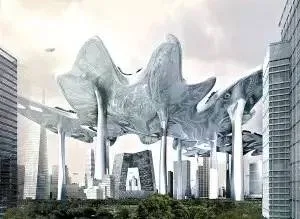
Floating Island – Ma Yansong
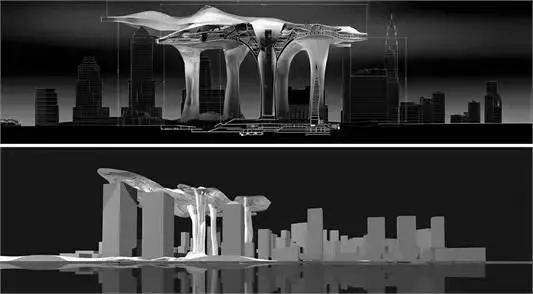
Floating Island – Ma Yansong
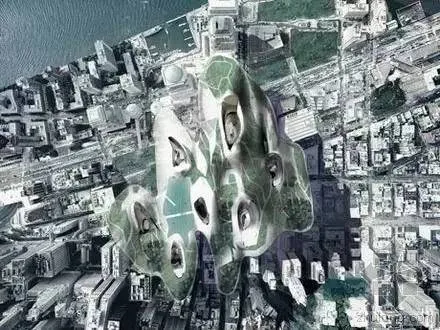
Top view of Floating Island – Ma Yansong
Ma Yansong’s “Floating Island” features a building surface that mimics the free form of plant leaves, as if enormous leaves drape over traditional urban buildings. This design challenges conventional “machine aesthetics” and the concept of the “vertical city” through a new urban organizational principle.
Concrete Imitation
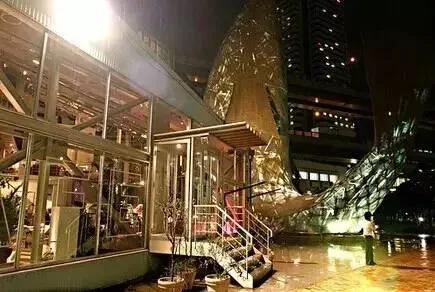
Fish Dance Restaurant – Frank Gehry
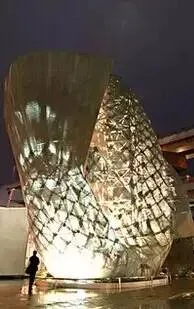
Fish Dance Restaurant – Frank Gehry
Frank Gehry’s design philosophy is unpredictable, blending reason with surprise. His Fish Dance Restaurant in Kobe, Japan, adjacent to a highway, features a massive carp sculpture that leaps 19.8 meters high. Although not a traditional building, it embodies nonlinear skin characteristics and serves as a Kobe city symbol. The fish’s form and fluidity create a magical sense of movement; dining inside feels like being submerged in an underwater world through the blue glass.
2. Design Based on Curves as Fundamental Elements
Beauty often arises from chaos, and nature’s allure stems from nonlinear complexity. Curves, a key nonlinear form, encapsulate natural shapes loved for their softness, complexity, and dynamism, aligning well with diverse building skin forms. It is natural that architecture extensively incorporates curves (Cristina Bechtler, 1999).
Dynamic Forms
Architectural pursuit of dynamic form dates back to ancient times, often expressed through the building skin. Nonlinear skins, inspired by chaos theory, feature dynamic curves. Recently, many architects focus on complex, fluid forms, transitioning from modernist mechanical skins to nonlinear designs. This shift involves moving from flat to deep, from closed to open, and from clear to blurred surfaces, emphasizing contemporary fluidity.
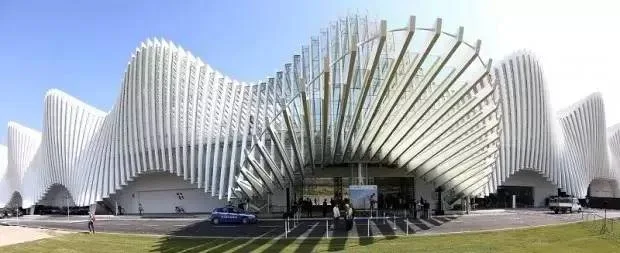
Italy RE High Speed Railway Station – Calatrava
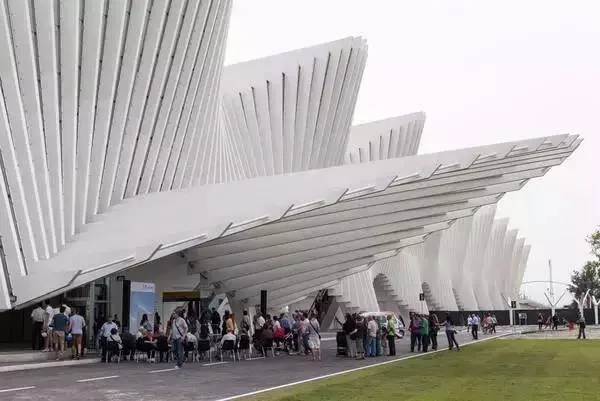
Italy RE High Speed Railway Station – Calatrava
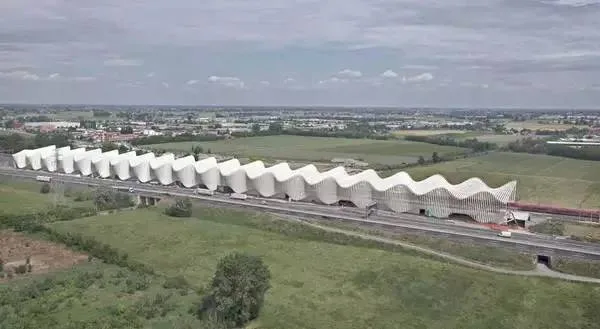
Italy RE High Speed Railway Station – Calatrava
Designed by Calatrava, the Italian RE High-Speed Railway Station comprises 19 modules, each made of 25 steel components spaced 1 meter apart. The building abandons traditional linear systems, embracing nonlinear form as the focal point. Walls seamlessly merge into the roof, and the 483-meter-long structure weighs 14,000 tons of steel. The flowing curves redefine traditional structural forms, dissolving interfaces to create fluid, dynamic shapes. This approach challenges Corbusier’s “plan, volume, and surface” standards and revolutionizes Mies van der Rohe’s architectural philosophy.
Continuous Free-Form Surfaces
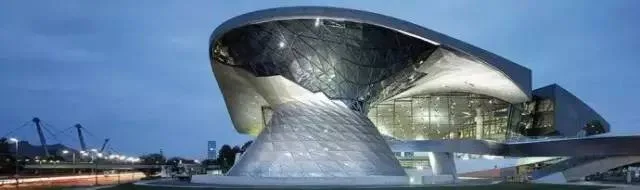
BMW World – Blue Sky Group
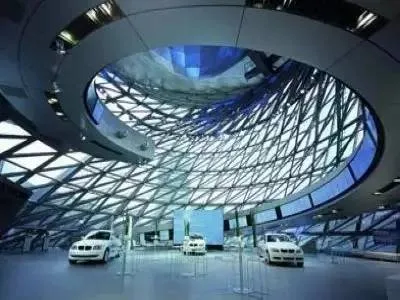
BMW World Interior – Blue Sky Group
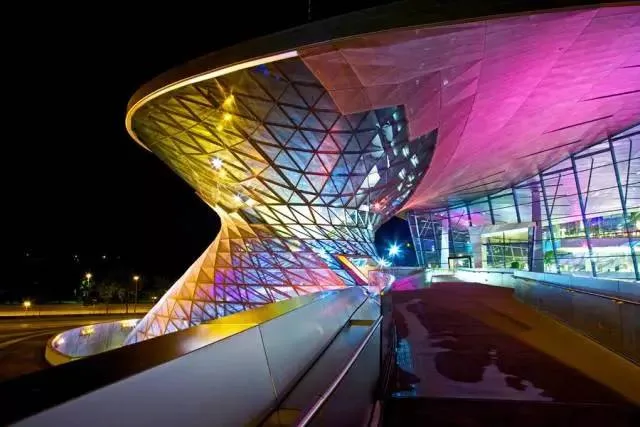
BMW World Night View – Blue Sky Group
The 2007 BMW World by the Blue Sky Group integrates multiple functions including a new car delivery center, technology and design studio, gallery, youth center, and bar, all covered by a vast glass shell resembling a cloud. Supported by a double spiral structure, the building reflects inclusiveness of diverse elements. The dual spiral cones move in opposite directions, with a freely changing lower ceiling, enhancing the roof’s floating sensation and softening the building’s overall form.
3. Folding and Forming Techniques
The renowned French philosopher Gilles Deleuze significantly influenced nonlinear architecture with his concept of folds. In his 1986 work “The Fold: Leibniz and the Baroque,” Deleuze described a world created through folding, unfolding, and refolding matter, where bending is the fundamental element of folds, regarded as “pure events of lines or points.”
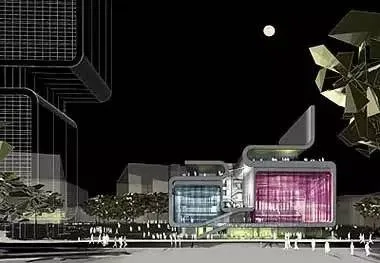
BBC Music Box Solution Effect
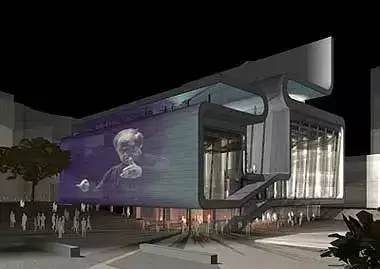
BBC Music Box Solution Effect
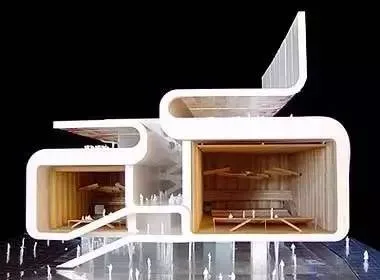
BBC Music Box Solution Effect
The BBC Music Box design integrates the building’s façade with the floor, creating a unified spatial system. The skin features symmetrical folds of varying scales, forming a continuous surface that blurs the boundaries between interior and exterior, as well as between façade and plane.
II. Geometric Logic in Skin Design
Regardless of how nonlinear skins evolve, geometry remains fundamental. Though modern geometry has transformed significantly compared to traditional methods, it continues to profoundly influence nonlinear architectural skin design, reshaping conventional concepts of building envelopes.
1. Fractal Extension Method for Skin Forms
In “Fractal Geometry in Architecture and Design,” Carl Bovill explains that fractal geometry impacts architecture mainly in two ways: it challenges the traditional notion that humans are the universal scale, emphasizing the relationship between local and global building aspects, and it provides principles like self-similarity and self-affinity to express nonlinear complexity.
Fractal systems are composed of multiple subsystems that mirror the composition and structure of the whole, exhibiting self-similarity.
Self-Similarity
Self-similarity means fractal shapes at different scales resemble each other, forming a cohesive whole.
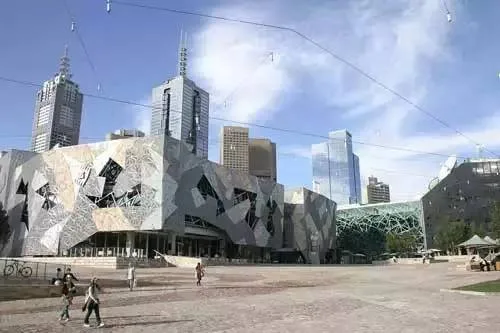
Melbourne Federation Square – Peter Davidson
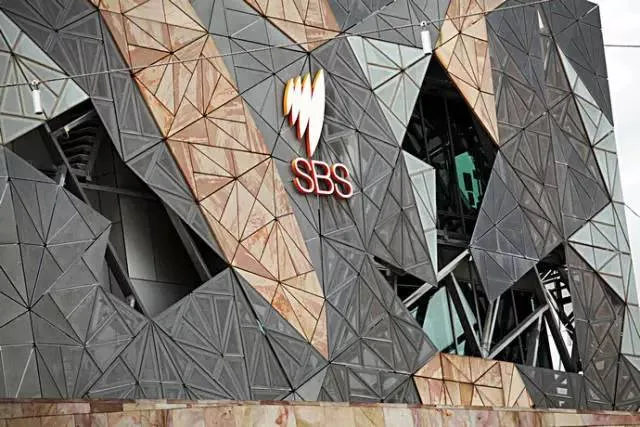
Melbourne Federation Square Skin Details – Peter Davidson
Contemporary architects, like Peter Eisenman, have applied fractal theory in designs, especially residential ones. Increasingly, designers use fractal self-similarity in building skins. For example, Peter Davidson’s Melbourne Federation Square employs a three-dimensional fractal geometry, combining right-angled triangles and rectangles in repetitive patterns to form a complex, infinite architectural texture with self-similar skin.
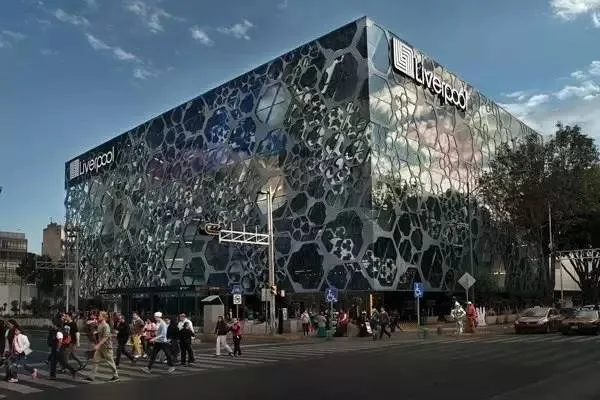
Liverpool Department Store in Mexico – Rojkind Arquitectos
The Liverpool Department Store in Mexico by Rojkind Arquitectos features an extended floating frame on its façade, creating a buffer between inside and outside. The nearly 3-meter deep layered hexagonal grid combines fiberglass, steel, aluminum, and glass. Its smooth, flowing forms resemble futuristic turbine blades, adding vitality and dynamism to the dynamic façade.
Geometric Weaving Method
Inspired by fractal geometry, weaving has evolved from two-dimensional to three-dimensional, with one-dimensional lines overlapping surfaces to add spatial depth. This method increases skin complexity, and many modern buildings feature woven façades influenced by fractal theory.
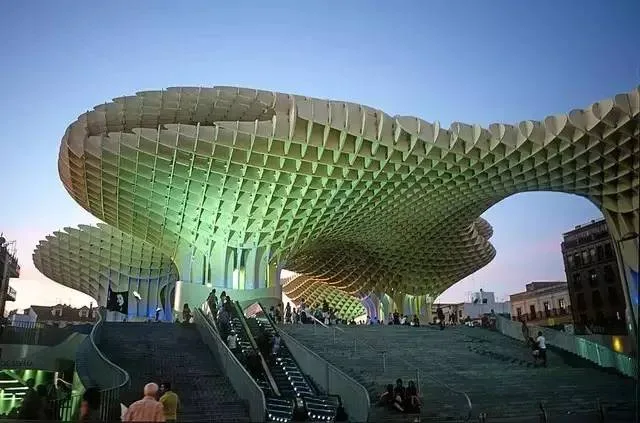
Metropol Parasol
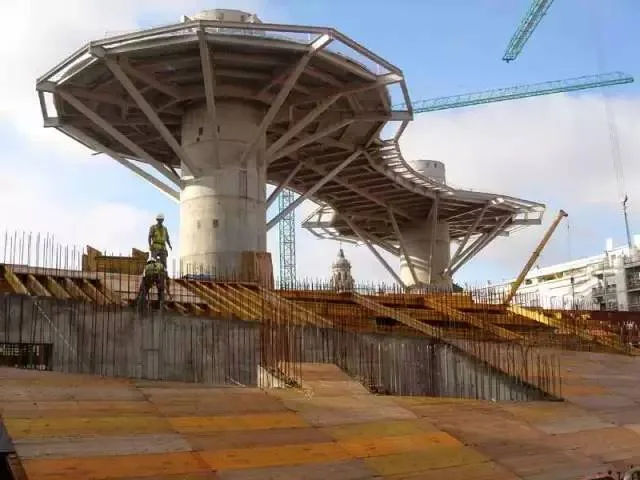
Metropol Parasol Construction Process
The Metropol Parasol in Seville, Spain, is the world’s largest wooden structure, covering nearly 5,000 square meters and standing 28.5 meters tall. Despite its futuristic design, it uses simple materials: a concrete base, wooden structure, and a honeycomb ceiling resembling a mushroom cloud. Using weaving techniques, quadrilateral units are repeated and interwoven to form a fractal geometric skin texture at different scales.
2. Topological Deformation Method in Skin Forms
Topology studies flexible transformations, differing from traditional Euclidean geometry which preserves shape invariance during motion (Chen Zhiyi, 2005). Topology focuses on how points move relative to each other without altering qualitative properties.
In our digital era, topology offers valuable insights for nonlinear skin design. Architects now favor nonlinear uncertainty and fluidity over fixed geometric forms. Using curves to express topological deformation, skin shapes flow and transform continuously. Even irregular skin surfaces can be subdivided and reassembled into consistent areas, reflecting design intent and offering effective strategies.
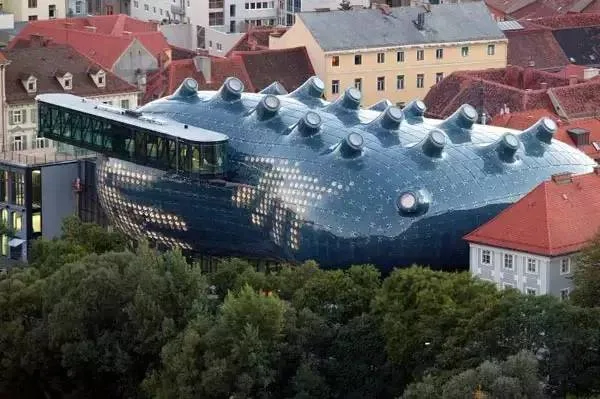
The Graz Art Museum by Peter Cook
The Graz Art Museum in Austria features a radical topological skin with eccentric protruding “nozzles” serving as skylights. These forms result from local topological stretching of the curved surface, creating unique, biomimetic architectural features that extend outward from the smooth façade.
III. Diversity of Information Reflected in Design Purpose
1. Unstable Skin Mutations
Mutation can be likened to dismantling a wall. Different dismantling approaches produce varied results: a gradual top-down removal changes stability slowly, while bottom-up dismantling can cause sudden collapse. This instability is called mutation.
Guided by nonlinear thinking, architectural design embraces contradictions while seeking optimal balance. The displacement technique corresponding to mutation theory helps achieve this balance.
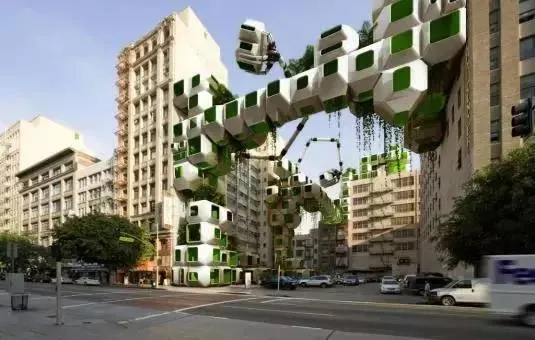
Ecological Pod – Howeler+Yoon Architecture and Squared Design Lab
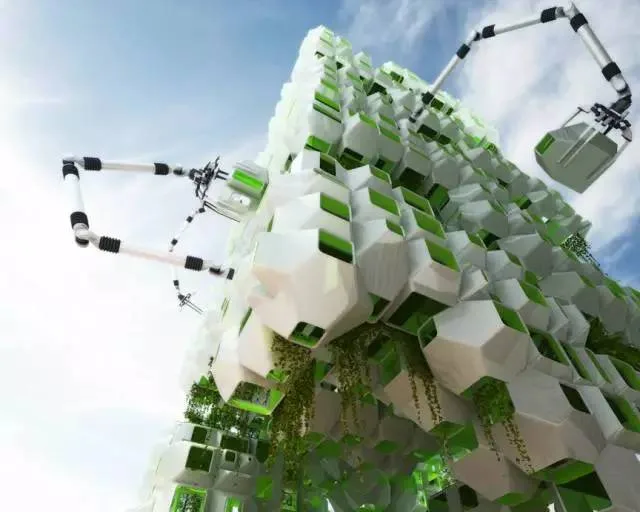
Ecological Pod – Howeler+Yoon Architecture and Squared Design Lab
The Ecological Pod in downtown Boston is a temporary vertical algae bioreactor designed by Howeler+Yoon Architecture and Squared Design Lab. Serving as a biofuel source and micro incubator, it features an open, reconfigurable structure attached to a building’s surface. On-site robotic arms reconfigure modules for optimal algae growth, causing the skin to continuously change with algae conditions. This flexible, adaptable design achieves a new unstable equilibrium, demonstrating a balance within contradictions.
2. Skin as a Carrier of Information
In the digital age, buildings embed digital information in their surfaces via flowing electricity and flexible digital displays. Visual media and computer networks have become primary channels for information exchange. This has transformed how we visually perceive architecture, as building skins transmit information symbols, reflecting the media era’s zeitgeist.
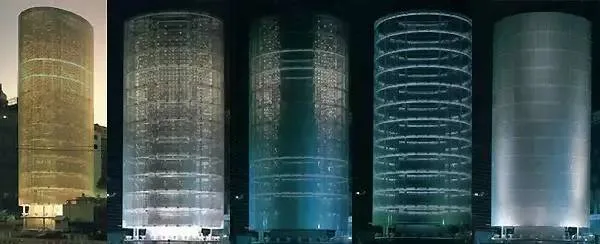
Wind Tower Skin Transformation – Toyo Ito
Toyo Ito treats architecture like fashion, transforming buildings into popular art. His research uses information processing to poetically express consumer society’s changing nature. For example, his “Tower of Wind” is a simple cylindrical exterior that acts as a giant screen, displaying color changes through lighting technology to convey information. This dynamic façade adapts to its environment, creating a lively, watchable musical experience.
Nonlinear building skins are increasingly valued by architects. As nonlinear theory deepens its application in architecture, building skins exhibit diverse characteristics. Nonlinear science topics are widely researched today, shaping a new worldview that influences contemporary architectural thinking. This perspective encourages macro and micro-level observations, enriching our understanding of the real world. Combining nonlinear thinking with building skin research offers fresh insights into architectural design.
References:
Art and Architecture in Discussion by Cristina Bechtler
Research on Nonlinear 3D Forms of Architecture in the Information Age by Chen Zhiyi
The Historical Perspective of Skin by Feng Lu
Interpretation of the Epidermis by Chen Long
Contemporary Nonlinear Skin Design Research by He Xiaobin














Must log in before commenting!
Sign Up