
Shen Zuyan, an academician of the Chinese Academy of Engineering (CAE) and a professor at Tongji University, recently highlighted the excellent seismic performance of steel-structured buildings. He emphasized that such buildings can significantly reduce earthquake damage while providing a comfortable and healthy living environment.
Advantages of Steel Structure Buildings
Shen Zuyan identified “greening, industrialization, and informatization” as the three primary directions for the construction industry’s development. Achieving coordinated progress in these areas requires embracing the concept of integration, ensuring harmony and unity throughout the process.
Green buildings aim to maximize resource conservation—including energy, land, water, and materials—while protecting the environment and reducing pollution. They provide healthy, efficient, and suitable spaces for occupants and coexist harmoniously with nature throughout their entire life cycle. In other words, green buildings conserve resources, minimize environmental impact, and meet user needs sustainably.
According to Shen, steel structure buildings offer numerous benefits, with two standing out most prominently:
First, well-designed steel structures are characterized as “light, fast, good, and economical” compared to other materials. Their lightweight nature means less material is needed for the same load-bearing capacity. The high degree of industrialization in steel construction saves energy, water, and land while reducing pollution. Steel also performs well structurally, is safe, and supports lightweight designs. Additionally, steel can be recycled and reused, aligning with sustainable development and green environmental protection goals.
Second, steel structures exhibit excellent seismic performance. This quality helps minimize losses caused by earthquakes and ensures a safe, comfortable, and healthy living environment. Steel buildings can harmoniously coexist with nature, embodying a balanced relationship between humans, buildings, and the environment.
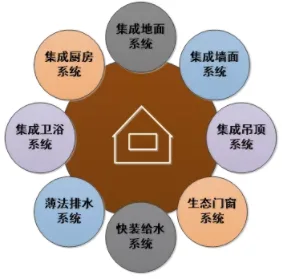
Building on the “light, fast, good, and economical” attributes of steel structures, new industrial construction methods can be adopted to meet green building standards. Shen Zuyan believes that integrated decoration in steel structure buildings represents the optimal structural approach to achieving green building objectives.
Steel Structure Construction and Industrialization
Building industrialization refers to a construction approach that emphasizes standardized design, factory production, assembly on-site, integrated decoration, and information management throughout the building’s lifecycle.
Shen Zuyan notes that in the information age, architectural industrialization should evolve by integrating information technology. This includes:
- Highly automated construction systems controlled by digital information technology, moving toward intelligent automation capable of autonomous operation.
- Transitioning from large-scale batch production to highly customized mass construction.
- Fulfilling the “nine modernizations” across the building’s nine lifecycle stages—ranging from architectural design and structural design to manufacturing, assembly, operation, and eventual demolition. These modernizations cover personalized design, modular components, intelligent manufacturing, and resource-efficient demolition, among others.
- Implementing menu-based ordering systems that cater to personalized requirements.
These “nine stages and nine transformations” require collaboration among registered architects, equipment engineers, structural engineers, and civil engineers at various phases.
Shen emphasizes that industrializing new construction inevitably leads to:
- High efficiency: Automation and informatization greatly enhance production speed.
- High quality: Large-scale production on automated assembly lines improves product quality and performance.
- High technology: Continuous innovation boosts energy conservation, emission reduction, and sustainable development.
- High economic benefits: Efficient resource utilization and mass production reduce costs.
Currently, steel structure buildings have largely achieved prefabricated assembly construction and intelligent automated manufacturing. Several system buildings meeting industrial manufacturing standards have been developed, alongside commercial production of various building components. The industrial construction of multiple system buildings has been explored.
Steel Structures: The Optimal Form for Green Buildings
Shen Zuyan asserts that steel structure buildings are best positioned to lead the industrialization of new construction and serve as a model for others. They represent the ideal structural form for achieving green building goals. Moreover, steel buildings best demonstrate the critical role of Building Information Modeling (BIM) shared information platforms in advancing new construction industrialization.
He advocates for a coordinated development strategy that integrates greening, industrialization, and informatization within the construction industry.
Shen hopes the industry will use steel structure buildings as a foundation to promote the synchronized advancement of green, industrialized, and information-driven construction. He calls on the National Development and Reform Commission, alongside the Ministry of Housing and Urban-Rural Development and related departments, to develop and release guiding policies such as the Action Plan for Achieving Green, Industrial, and Information Integrated Coordinated Development of Steel Structure Buildings to support industrial growth.













Must log in before commenting!
Sign Up