
What is DBB Mode?
The Design-Bid-Build (DBB) model is one of the most widely used and earliest internationally adopted contracting methods for engineering projects. In this model, the owner commissions an architect or consulting engineer to conduct preliminary tasks such as opportunity research and feasibility studies. After project evaluation and approval, the design phase begins, during which construction bidding documents are prepared. Contractors are then selected through bidding processes. Subcontracting of specific tasks, as well as procurement of equipment and materials, are typically handled through separate contracts between contractors, subcontractors, and suppliers.
Throughout the project implementation phase, engineers provide construction management services to the owner. A key characteristic of this model is its strict sequential process: Design, then Bid, then Build (D-B-B). Each stage must be fully completed before the next begins.
Advantages: The DBB model boasts broad applicability and has been widely implemented worldwide for many years. Its management practices are mature, and all parties involved are familiar with the standard procedures. It allows owners the freedom to select consulting, design, and supervision parties independently. Additionally, the use of standardized contract documents benefits contract management, risk mitigation, and cost control.
Disadvantages: The requirement to complete planning, design, and construction sequentially leads to longer project timelines. Owners bear relatively high management costs and significant upfront investment. Furthermore, project changes often result in numerous claims. Despite these limitations, the DBB model remains widely accepted and practiced in China.
The adoption of BIM technology in some Chinese engineering projects has been less successful due to factors such as unclear BIM goals, immature application technologies, incomplete team knowledge, and separation between BIM implementation and engineering execution. A significant reason is the lack of an appropriate BIM application management model for the project.

DBB Model Overview:
The Design-Bid-Build approach emphasizes a strict D-B-B sequence with low integration between stages, which poses challenges for effective BIM technology application.
Research into suitable BIM application management models within this framework is crucial to achieving overall project optimization.
Design General Contractor Led Management Mode
In this mode, the owner assigns a design general contractor to define BIM application requirements through a BIM contract. The design team or its commissioned BIM consultants not only handle BIM processes during the design phase but also represent the owner in organizing, managing, and controlling BIM activities for all stakeholders involved in construction and operation phases.
Meanwhile, construction and operation teams complete their BIM responsibilities independently within their respective scopes.
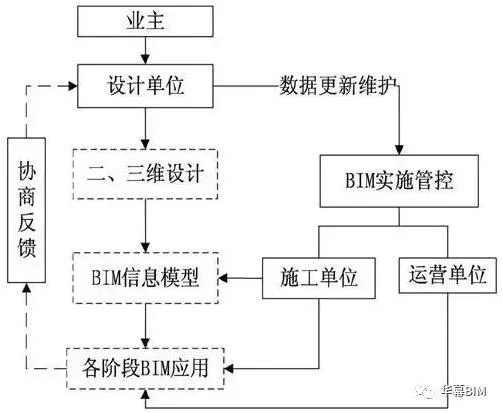
Schematic diagram illustrating the Design General Contractor Led management mode operation.
Advantages: In China, BIM-related costs are often excluded from initial project budgets, making it easier for owners to delegate BIM management to the design party during contract negotiations. Design teams typically have earlier exposure to BIM technology and stronger BIM capabilities, allowing the benefits of BIM to be realized more effectively during early project stages.
Many projects have demonstrated that this mode yields significant benefits in BIM application during the design phase and helps improve design quality. However, successful BIM integration across construction and operation phases remains rare in this mode.

Construction General Contractor Led Management Mode
Here, the owner entrusts the construction general contractor to organize, manage, and control BIM implementation among all project participants, in addition to managing BIM applications within their own scope as specified in contracts.
After the project enters the construction phase, the construction general contractor oversees coordination with design teams, subcontractors, suppliers, and operation and maintenance units regarding BIM implementation.
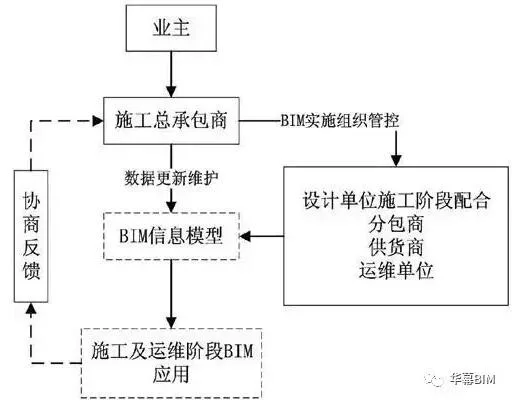
Schematic diagram illustrating the Construction General Contractor Led management mode operation.
Advantages: Construction general contractors’ strong on-site control capabilities enable effective integration of data and information across all parties, facilitating smooth project progress.
However, as the project nears completion, the construction party’s motivation to drive BIM application often diminishes. This can hinder the development of accurate and detailed BIM models necessary for operation and maintenance, complicating project close-out and data handover. Consequently, BIM’s value in lifecycle management may be compromised.

Project Management Led Management Mode
In this approach, the project management team leads by establishing a dedicated BIM team—either by appointing a full-time BIM manager or hiring professional BIM consultants—to plan and control BIM implementation throughout the project.
Advantages: As a key participant, project management oversees the entire project lifecycle through planning, organizing, implementing, and controlling. This holistic perspective ensures BIM implementation aligns with overall project goals. Project managers also possess strong contractual and financial control, enabling effective enforcement of BIM requirements among all stakeholders.
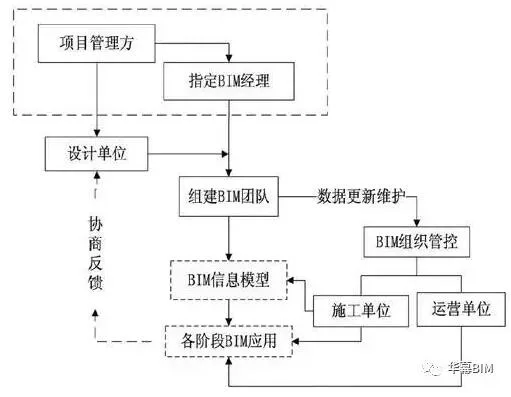
Schematic diagram illustrating the Project Management Led management mode operation.
BIM serves as the data backbone for digital project construction and operation management. Therefore, all departments within a project management enterprise—including technology, engineering, contracts, procurement, and cost control—should be familiar with the BIM environment and possess relevant BIM skills. Future project management teams should aim to implement “full staff BIM” to maximize project efficiency.
Comparative Analysis
Based on the discussion above, the characteristics of the three BIM application management modes are analyzed from the owner’s perspective. The key features and applicability of each mode are summarized.
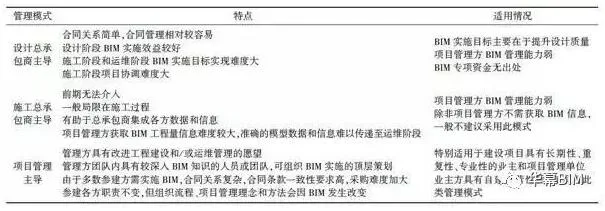
Characteristics and applicability of three BIM application management modes
The comparison considers seven dimensions: initial BIM implementation investment, organizational coordination difficulty, application scalability, operational support level, BIM management capability requirements, overall BIM implementation benefits, and current application maturity. Differences between the three modes are clearly identified.
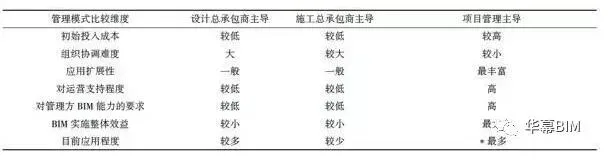
Comparison of differences among the three BIM application management modes
Each management mode has its own strengths, weaknesses, and best-fit scenarios. There is no one-size-fits-all solution. Project stakeholders should carefully evaluate their specific project characteristics, capabilities, and needs to select a BIM application management mode that balances BIM usage requirements, implementation risks, and investment costs.

Selection of BIM Application Mode for Railway Projects
For projects with long-term, repetitive, and operational demands—such as conventional railways, high-speed railways, and urban transit—even if initial investment costs are high, the project management led BIM application mode is recommended. This approach can deliver clear economic and social benefits for future projects.
Given that BIM adoption is still in its early stages and personnel and technical capabilities remain limited, BIM application management should be implemented in phases.
Initial Application Stage: Employ professional BIM consulting firms to assist with overall BIM technology management. Provide necessary BIM training and guidance to support the owner’s future operation and maintenance activities, maximizing asset lifecycle benefits.
Mid to Late Application Stage: Establish a dedicated BIM team within the owner’s organization to independently manage BIM applications. Owners should require all construction participants to actively engage in BIM, encouraging design and construction teams to adopt appropriate BIM depth levels to support ongoing BIM management and later operation and maintenance.

BIM technology offers an integrated platform for project information exchange, significantly enhancing collaboration efficiency. Although the DBB model faces challenges with information integration among participants, BIM implementation should still follow structured rules. Different BIM management modes led by design, construction, or project management parties each have specific applications, and the choice of management mode should be made thoughtfully based on project needs.
















Must log in before commenting!
Sign Up