
1. Introduction
Prefabricated buildings are constructed by assembling factory-produced components on construction sites. This approach features standardized design, factory manufacturing, mechanized assembly, and scientific management. The benefits include faster construction, higher quality, labor savings, reduced climate impact, and conservation of water, materials, electricity, and land, facilitating a transformation in production methods.
In China, the research and application of prefabricated buildings remain in the exploratory phase. A major obstacle to their development is the higher cost compared to traditional cast-in-place buildings. Most existing studies focus on analyzing cost drivers and control measures, while research on price compensation mechanisms for prefabricated buildings is limited.
Due to factors like scale, economics, and technology, prefabricated buildings cost approximately 200-400 yuan per square meter more than cast-in-place buildings, which restricts their market potential. In response, local governments have introduced incentives to encourage their growth. However, current price compensation mechanisms are imperfect and have yet to effectively promote the sector. Therefore, further systematic research on price compensation is necessary.
This article draws on economic principles of product externalities and relevant literature to analyze the rationale for price compensation, establish principles and standards, and design compensation methods aimed at expanding the development of prefabricated buildings.
2. Basis and Method for Determining Price Compensation Standards
1. External Benefits as the Foundation for Compensation Standards
Prefabricated buildings function as a public good with significant welfare and external effects. Developers’ activities generate substantial societal benefits by providing consumers with more comfortable living environments. However, cost savings alone do not sufficiently motivate consumers to choose prefabricated buildings, which are more expensive to build. Developers, driven by economic returns, do not capture these external benefits under current market conditions.
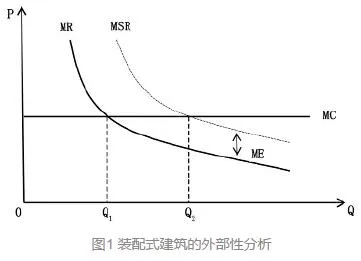
The relationship between development volume and price for prefabricated buildings is illustrated in Figure 1. The marginal cost (MC), private marginal benefit (MR), and social marginal benefit (MSR) are shown. Developers maximize private interests at quantity Q1, while social benefits peak at Q2. The external economy is represented by the vertical gap between MR and MSR, labeled ME.
2. Methods for Determining Price Compensation Standards
Considering the current development status and trends in the construction industry, compensation standards should be based on cost and other relevant factors, defining targets, amounts, periods, and ratios.
Based on direct investment and opportunity costs of prefabricated construction enterprises
Component factories require substantial investments—from land acquisition and construction to equipment procurement and technology development. Compensation standards must reflect the human, financial, and material resources invested during production and operation. For developers, economic externalities of prefabricated buildings must be considered to establish reasonable standards.
Based on profits gained by external economic beneficiaries
Prefabricated buildings provide strong environmental and social benefits, which can be monetized and used as a reference for calculating compensation.
Based on cost differences compared to traditional construction
Since prefabricated buildings are more expensive than traditional models, government incentive policies should account for these cost differentials as a key factor in determining compensation.
Each approach has advantages and drawbacks. Given the difficulty in quantifying economic externalities precisely, comparing prefabricated buildings with traditional cast-in-place structures offers a practical basis for compensation. Moreover, price compensation should be dynamic, adjusted in response to market conditions and industry development.
3. Analysis of Price Compensation Mechanism for Prefabricated Buildings
Prefabricated buildings face higher costs and lack economic advantages compared to traditional buildings, leading to insufficient internal motivation for development and limiting their potential to deliver environmental and social benefits. Without internal and external drivers, development stagnates.
1. Lack of Internal Motivation: The Core Reason for Price Compensation
Market dynamics are driven by interest and competition. Interest fuels market operations, which are inherently competitive. Prefabricated buildings are less competitive cost-wise than traditional buildings. According to survival-of-the-fittest principles, prefabricated buildings must improve competitiveness to survive; otherwise, they risk elimination.
The fundamental issue is the higher construction cost of prefabricated buildings, resulting in higher prices. Consumers tend to prefer lower-priced traditional buildings, and lowering prices reduces developer profits. Consequently, developers lack motivation to promote prefabricated buildings, treating them as mere gimmicks. Government incentives are essential to make prefabricated buildings economically attractive.
2. Lack of External Support: A Key Aspect of Compensation Mechanism Design
The market has failed to regulate prefabricated building development effectively, necessitating external intervention. The government plays a vital role in adjusting market incentives based on different building models.
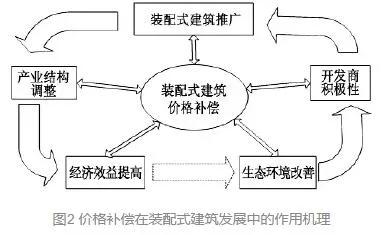
Establishing a comprehensive price compensation mechanism with reasonable standards can fully engage developers in prefabricated construction. This fosters industry adjustment, boosts economic and environmental benefits, and through competition, favors prefabricated buildings that are low-cost, functional, and high-quality. As the market matures, government compensation decreases, creating a virtuous cycle (see Figure 2).
Despite their environmental and energy-saving advantages, the high price remains a major barrier to prefabricated building adoption. Achieving cost parity or lower costs compared to traditional buildings requires collaborative efforts. The government must establish a sound incentive framework to guide development.
4. Designing a Price Compensation Mechanism for Prefabricated Buildings
The main barrier to prefabricated building growth is the absence of an effective price compensation mechanism, reflected in two contradictions: between long-term social benefits and developers’ immediate interests, and between external economic benefits and developers’ internal economic gains. To foster sustainable growth, a scientific, reasonable compensation mechanism and practical policies must be developed.
1. Principles for Designing the Price Compensation Mechanism
Polluter Pays Principle
Environmental degradation results from enterprises polluting the environment. If such polluters were forced to cease operations, environmental conditions would improve but the economy could suffer. Therefore, polluters should pay fees based on standardized rates. These funds can then support businesses that benefit from environmental improvements.
Government-led with Whole Society Participation
Prefabricated buildings offer “four savings and one environmental protection,” benefiting all humans, residents, enterprises, social groups, and individuals. The government bears the responsibility to establish and enforce an ecological compensation system on behalf of society. Concurrently, enterprises and groups benefiting from ecosystem protection should actively participate.
Balance Between Rewards and Penalties
Incentives for environmentally beneficial enterprises like those promoting prefabricated buildings should be balanced with pollution fees levied on polluters, ensuring the sustainability of the compensation capital flow.
2. Methods of Price Compensation
The government guides the compensation mechanism, using price compensation as an external driver to enhance market efficiency. Compensation methods must ensure policy enforceability, fairness, efficiency, and transparency.
Policy Compensation
The government provides preferential policies and financial support to prefabricated construction enterprises, granting them priority that helps economically weaker businesses leverage institutional and policy resources.
Monetary Compensation
Financial subsidies to developers and consumers address the higher prices of prefabricated buildings compared to traditional ones, encouraging consumer purchases and motivating developer participation.
Physical Compensation
Component factories benefit from land, technology, and guidance support to boost production capacity and component quality, underpinning the promotion of prefabricated buildings.
3. Operation and Implementation of the Compensation Mechanism
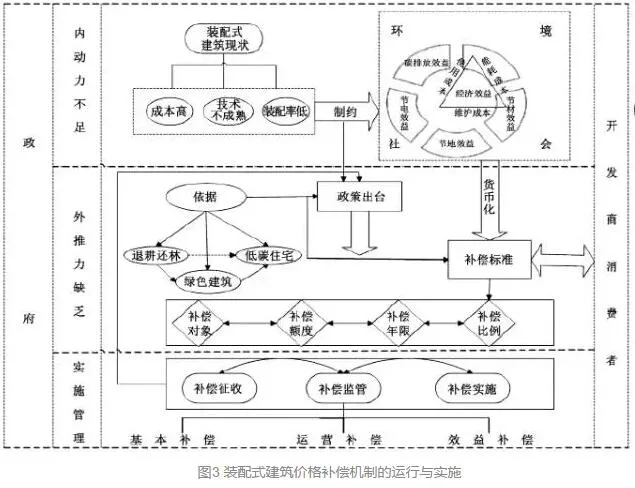
Price compensation implementation risks issues such as “rent-seeking.” Therefore, a dedicated agency should oversee fund collection and management, monitoring financing and application processes in real time to ensure efficiency, transparency, fairness, and to stimulate rapid industry growth. Feedback mechanisms should inform policymakers for ongoing improvements.
The compensation mechanism is illustrated in Figure 3. Critical factors include the scientific validity of policies, reasonable compensation standards, and an effective distribution network to ensure proper allocation and execution of funds.
5. Specific Suggestions for Price Compensation in Prefabricated Buildings
1. Determine Reasonable Compensation Amounts
The government should conduct thorough research across the prefabricated building industry chain, evaluating quality and environmental and social benefits. Compensation should vary by building level to prevent fund misuse and enforce strict quality control.
2. Focus on Consumer Compensation
Consumers are the end users of prefabricated buildings. Given the high development and construction costs, prefabricated buildings are common in affordable housing and should gradually expand into commercial housing. Consumer reluctance to pay higher prices limits development. Alongside promoting environmental and energy-saving benefits, the government can stimulate demand by reducing deed and property taxes, adjusting the supply-demand balance.
3. Ensure Reasonable and Efficient Compensation Throughout Stages
Compensation should align with the construction industry’s development stages and associated costs, divided into basic, operational, and benefit compensations targeting different stakeholders. Early-stage compensation supports factory land acquisition and investment, adjusting flexibly to supply and demand. Production and installation stages warrant compensation for costs incurred, while consumer compensation addresses price differences during sales.
6. Conclusion
This article analyzes the price compensation mechanism for prefabricated buildings, explaining the need for subsidies, constructing a compensation framework, and offering practical recommendations. However, simple subsidies alone are insufficient. Comprehensive regulations and standards, alongside cultivating an industrialized construction model encompassing the entire supply chain, are essential for unlocking the full potential of prefabricated construction.















Must log in before commenting!
Sign Up