
As a whole, design institutes are undoubtedly among the earliest stakeholders in China’s construction industry to research and practice BIM. To put it simply, this trend is indisputable. Over the ten years since 2003, the value and realization path of BIM have become increasingly clear and practical for owners and construction companies. However, design institutes now find themselves the most perplexed among the three main project participants: owners, designers, and constructors. Whether they can maintain their leadership and dominance in the industry—much like they did during the era of CAD popularization—has become a major question.
The confusion faced by design institutes stems from the reality that achieving improved drawing quality with BIM is easier than achieving improved drawing efficiency with CAD. However, the advantages of better drawing quality tend to be slow or indirect, while the benefits of increased drawing efficiency are fast and direct. The term “easy” here refers to relatively lower investment, quicker results, and less impact overall. It is important to note that the discussion pertains to drawing quality and efficiency, not design quality and efficiency, which are much broader and more complex concepts.
Currently, the use of BIM for drawing is one of the main points of contention in the decision-making process regarding BIM implementation routes in domestic design institutes.
When exploring the confusion surrounding BIM application within design institutes and seeking a successful BIM implementation path, another prerequisite must be clarified: owners will no longer pay additional fees for BIM application in design institutes beyond the standard design fee. Once additional fees are involved, this confusion would cease to exist—or at least be postponed. Therefore, the real challenge for design institutes is to determine where to begin BIM implementation when only the normal design fee is available (meaning the owner does not pay specifically for BIM usage, and the design institute only fulfills its design business responsibilities, without extending into additional business).
After defining this prerequisite, the main factors influencing the selection of BIM implementation routes for design institutes can be illustrated by the following diagram:
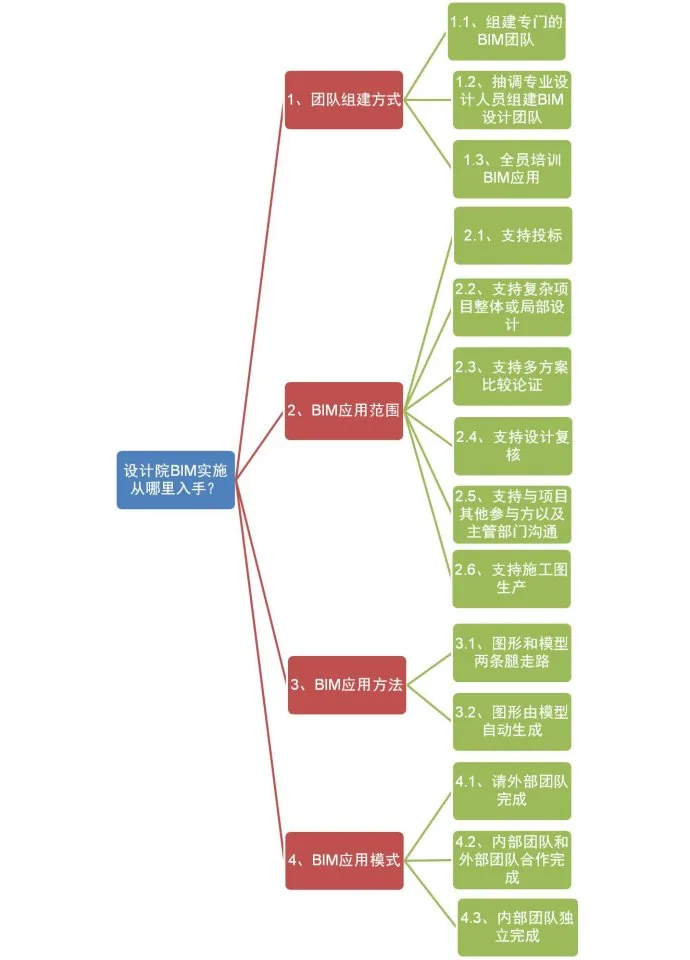
Below, we will analyze the factors that need to be considered when selecting a BIM implementation route for design institutes, based on the aspects shown in the diagram above.
1. Team Building Method
BIM teams in design institutes can be formed and trained in various ways, but fundamentally, these methods fall into three categories:
- 1.1 Establishing a dedicated BIM team
- 1.2 Selecting professional designers to form a BIM design team
- 1.3 Training all staff in BIM applications
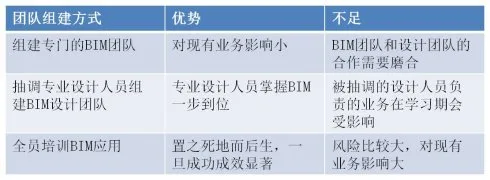
Category 1.3 is straightforward. The difference between 1.1 and 1.2 is that in 1.1, design tasks require collaboration between specialized BIM teams and traditional design teams, while in 1.2, BIM design teams can independently complete design tasks. Clearly, 1.2 is a partial pilot of 1.3, and having all staff master and apply BIM (not just BIM) is the ultimate goal. Meanwhile, 1.1 is another approach, which can also serve as a practice for 1.2 and an exploration towards achieving 1.3. The advantages and disadvantages of different team-building methods are as follows:
2. Scope of BIM Application
There are numerous materials introducing BIM applications during the design phase, which can generally be summarized into the six types shown in the diagram above. Notably, the author has added the term “support” to each of the six BIM applications. This indicates that BIM should work alongside other information technologies in the construction industry to help designers accomplish various design tasks, rather than relying solely on BIM technology.
3. BIM Application Methods
Ultimately, there are only two main methods for BIM application:
- 3.1 Using graphics and models in tandem (“walking on two legs”)
- 3.2 Automatically generating graphics from models
For further details, please refer to “BIM Introspection (V): Insights from the Manufacturing Industry”.
4. BIM Application Modes
There are three primary modes:
- Outsourcing to external teams
- Collaboration
- Independent implementation
The diagram above lists and analyzes three typical team-building methods, six BIM application scopes, two BIM application methods, and three BIM application modes. However, as everyone knows, the actual situation is much more complex. In such a complicated context, where should design institutes begin implementing BIM? From a market economy perspective, the answer is straightforward: choose an implementation route with low risk and high investment returns.
BIM technology and software products available to different design institutes at any given time are usually similar. However, each design institute has unique core capabilities, profit models, project characteristics, personnel composition, regional traits, customer types, and so on. Therefore, each must select the appropriate team-building method, BIM application scope, application methods, and application modes based on its own characteristics. This serves as the entry point for BIM implementation and as the focus at different stages of development, allowing the institute to fully leverage BIM as a new information technology in the construction industry to improve design quality and efficiency and enhance overall competitiveness.
In conclusion, the starting point and developmental path for BIM implementation in design institutes are not primarily technical issues; rather, they are strategic and economic ones. The so-called economic aspect refers to immediate benefits, while the strategic aspect concerns future gains.















Must log in before commenting!
Sign Up