
Tianjin 117 Building, also known as Gaoyin Financial 117 Building, is situated in Tianjin Binhai High-tech Industrial Park. The project boasts a total investment of 18 billion yuan and is a massive super high-rise structure combining the central business district, supporting residential areas, Tianjin Huanya International Polo Sports Theme Park, and other facilities.
Standing at 596.5 meters tall with 117 floors above ground—the origin of its name—the building covers a total construction area of 847,000 square meters, setting a record for the largest single residential building area. Construction began in 2008, and the main structure was topped out in September 2015, making it the second tallest building in the world and the tallest under construction in China at that time.
The construction period lasted seven years, reflecting the project’s high standards, challenging construction techniques, multiple collaborators, and complex management requirements. The vast amount of business information generated at every stage—including progress reports, costs, contracts, and drawings—made it difficult to complete the project on schedule using traditional project management methods with limited personnel support.
To address these challenges, the construction team integrated Building Information Modeling (BIM) technology with project management, achieving precise and digital technical and economic control, ultimately ensuring the project stayed on track.
Managing Massive Information Efficiently
As the Tianjin 117 project progressed, the project department accumulated a vast amount of drawings and documents, making collaborative work on project drawings and files critically important. These materials included construction drawings, design schemes, contracts, correspondence, meeting minutes, emails, multimedia files, electronic documents, and paper documents, all of which increased the complexity of project management and collaboration.
The actual application process involved large and complex datasets such as model data, collision reports, simulation videos, calculation results, and drawings related to seven major specialties of the project. Ensuring unified and centralized management of these graphical materials was essential to improve team efficiency, reduce costs, enforce proper access control, track document usage, enable full-featured retrieval, and manage document versions.
Integration of BIM and Project Management Systems
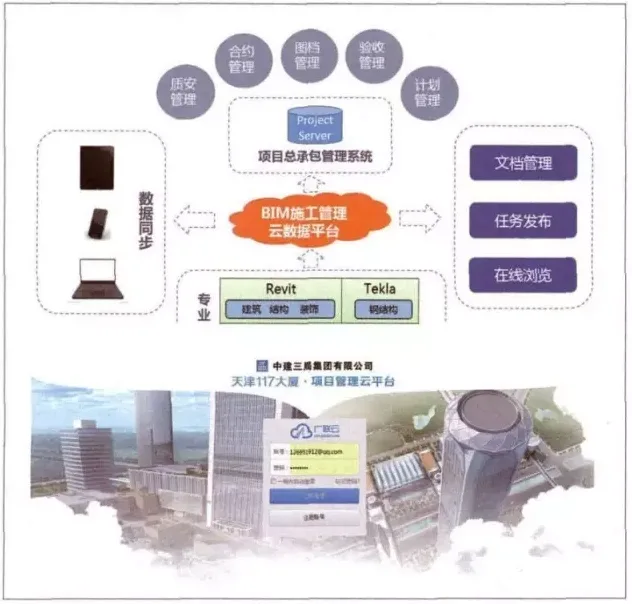
The Tianjin 117 project developed an application platform called the “Project General Contracting Management System” to integrate BIM with the project management system.
This cloud data platform serves as the core for BIM team data management, task publishing, and information sharing. It collects data generated in real time during project operations, enabling cloud storage, online file browsing, 3D model visualization, document management, and team collaboration. These functions significantly enhance information resource management, office efficiency, and cooperative work capabilities.
During data integration, models created using various software—including architectural, structural, decorative, steel structure, and electromechanical models—are combined on the same platform through open interfaces. Business information such as contract management, drawing management, acceptance management, plan management, and quality and safety management is also integrated, providing a comprehensive data foundation for future system applications.
The system allows project personnel to use 3D visualizations of BIM integrated models on web and mobile devices for data input, queries, browsing, statistics, analysis, and reporting. It supports extensive applications involving engineering quantities, budgets, schedules, and material cost accounting.
Building the BIM Cloud Platform
The Tianjin 117 project focused on four key areas during implementation:
- Creating a collaborative project space based on cloud data;
- Classifying and efficiently distributing project information;
- Establishing complete permission allocation and security controls;
- Automating workflows to improve efficiency, standardize business processes, and monitor approval procedures.
1. Collaborative Project Space on the Cloud
The project department leased 100GB of cloud storage and invited key members involved in frequent collaboration to join the project space. This virtual environment allowed all parties to create, share, and manage information throughout the project lifecycle, enabling seamless task collaboration.
2. Classified and Efficient Information Distribution
To facilitate transparent and efficient information exchange within the general contracting department, the project categorized and organized information by department and subcontractor. Documents and data were grouped by professional classification, with clear distinctions made between publicly available and confidential information.
3. Permission Allocation and Security Control
Information was divided into two main categories: public and non-public. Public data was accessible across departments on the cloud platform, while confidential information was restricted to internal use only, with access granted solely to authorized personnel.
4. Workflow Automation and Efficiency Improvement
The cloud platform enabled full automation and standardization of business processes and approval workflows. Project management tasks, approval processes, correspondence, work requests, and reports were all handled online. Workflow monitoring allowed supervisors to track progress in real time, while management personnel could follow up on task status through flow tracking. This process control minimized human error and ensured accuracy and efficiency.
Data and Business Integration Applications
Data integration involved creating detailed BIM design models and linking these models with business information. Through standardized association rules, models were automatically connected with vast datasets such as progress tracking, workface details, drawings, lists, and contract terms.
On the business side, various management applications were integrated based on this data foundation, including schedule management, contract management, drawing management, and quality and safety management.
Integrated Schedule Management
By combining BIM with schedule management, project managers gained powerful tools to simulate construction plans and evaluate schedule feasibility through virtual modeling. Progress tracking was visualized using BIM models, covering stages like scheme approval, detailed design, bidding, and procurement. This enabled managers to access comprehensive site information, objectively assess progress, and optimize scheduling. Additionally, BIM provided engineering quantity data for material preparation and labor allocation, supporting efficient progress control.
Integrated Contract Management
BIM integration in contract management addressed the issue of dispersed information. The system managed contract planning, ledgers, registration, and clause warnings in one platform. Deviations in contract completion, quantities, or approvals triggered timely alerts. By correlating model data with actual progress, the system extracted quantities for approval and tracked contract completion in real time, facilitating funding and resource planning based on contract performance.
Integrated Quality and Safety Management
BIM integration improved quality and safety control by identifying critical checkpoints through dynamic walkthroughs, technical simulations, and progress modeling. Quality and safety requirements were incorporated into models, allowing continuous solution optimization. On-site issues were tracked and rectified by comparing actual execution against the model and plan.
Integrated Drawing Management
The project linked drawing information to BIM models, enabling users to view corresponding construction drawings through the models. This included querying and downloading various drawing versions along with related attachments such as modification forms and design change records.
Impact of the Integrated Project Management Platform
The fusion of BIM and project management systems delivered significant value to the Tianjin 117 project. Managing over 10,000 engineering documents and supporting collaboration among nearly 10 different project units, the platform enhanced communication and efficiency.
Using BIM models to visually and accurately display construction progress, key milestones, and on-site issues reduced the need for 53 specialized disclosure meetings, greatly improving communication efficiency.
Data from BIM models supported business tasks like measurement, quantity reporting, and change management. This integration bridged the gap between design models and business management, fulfilling both technical and business needs within a single modeling framework. As a result, business calculation efficiency improved by over 30%, with accuracy errors reduced to less than 2%.
The project department also developed a comprehensive process for managing construction and detailed design drawings during construction. They designed workflows tailored to the owner’s requirements, ensuring smooth transmission of design information and drawings, avoiding conflicts among disciplines, and delivering high-quality construction documents. This process helped control the project’s schedule, quality, and cost effectively.
Through version control, check-in/check-out procedures, publishing, and status management, historical data remained traceable. This saved significant time for project personnel, improving drawing query efficiency by 70%. Additionally, managing drawing versions and submission status enhanced subcontractor coordination and communication.
The successful integration of BIM with project management systems in the Tianjin 117 project marks a key milestone, evolving BIM from purely technical use to a comprehensive tool supporting multi-dimensional project management. It provides valuable theoretical and practical experience for construction enterprises aiming to achieve lean construction through BIM and project management system integration.














Must log in before commenting!
Sign Up