
BIM (Building Information Modeling) originated in the architectural sector, and most existing BIM standards primarily target the civil construction industry. However, there are no dedicated standards for the railway sector, which presents significant challenges to the widespread application of BIM in railway engineering. As part of the overall information technology plan for railway construction, BIM is identified as a key technological direction to advance informatization in railway projects. Consequently, China Railway Corporation has actively promoted research and application of BIM technology in railway engineering.
By studying existing domestic and international BIM standards, analyzing their suitability for the railway sector, and proposing a framework for Chinese railway BIM standards, a foundation has been established for BIM applications in China’s railway industry. Research shows BIM technology holds great potential and value for railway construction, though significant challenges remain.
Preliminary investigations reveal that while countries such as the United States, the United Kingdom, Japan, and Singapore have developed BIM standards—and China’s Ministry of Housing and Urban-Rural Development began BIM standard development in 2012—these standards mainly cover civil buildings. Given the broader scope of professional fields in railway engineering and the ongoing evolution of BIM technology, it is essential to develop railway-specific BIM standard systems alongside pilot projects. This ensures unified guidance and standardized professional BIM applications at scale.
China Railway Corporation initiated BIM-related research in 2012, including studies like “Research on BIM-based Delivery Standards for Railway Tunnel Construction Drawings,” and plans to continue expanding BIM applications across railway specialties. In 2013, preliminary work on the Chinese railway BIM standard system framework began, with full-scale research launched in 2014.
1. Current Status of BIM Standards Internationally and Domestically
1.1 International BIM Standards
United States National BIM Standard (NBIMS)
The U.S. National Institute of Building Sciences released the first edition of the National BIM Standard (Part 1: Overview, Principles, and Methods) in 2007, followed by the second edition (NBIMS-US V2) in 2012. These standards aim to unify the entire lifecycle information processes in construction by referencing existing standards and developing data exchange protocols.
The initial NBIMS edition introduced BIM’s core concepts and principles for establishing a BIM system but did not define a specific BIM standard framework. Its goal was to create a standardized, machine-readable information model for each facility, encompassing all relevant data for use throughout the lifecycle—from planning and design to construction, operation, and maintenance.
The second edition refined this framework, defining categories such as reference standards, data exchange standards, and practical BIM implementation documents. Reference standards include internationally recognized models like IFC (Industry Foundation Classes), XML, OmniClass, and the International Data Dictionary Framework. Data exchange standards specify protocols for data management and reliability, tailored to scenarios like facility management (COBie), spatial analysis (SPV), energy consumption (BEA), and cost estimation (QTO). Practical implementation documents guide AEC (Architecture, Engineering, and Construction) professionals on BIM project execution, covering maturity models, project execution plans, and spatial coordination.
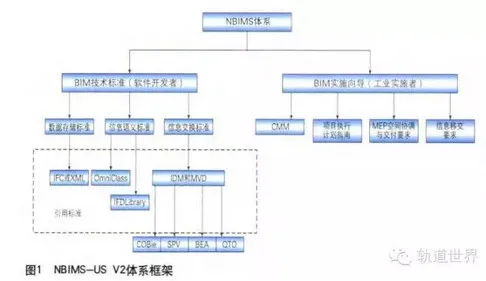
Figure 1
The third edition of NBIMS (NBIMS-US V3) was under development and scheduled for release in fall 2014.
United Kingdom BIM Standards
The UK introduced the AEC (UK) CAD standard in 2000 to improve design information management. Over time, this evolved into the AEC (UK) BIM Standard, with editions released in 2009 and 2012. Unlike NBIMS, the UK BIM standard focuses mainly on information exchange within the design environment, with limited coverage of BIM software technology or industrial implementation.
Japan BIM Standard
In July 2012, the Japan Institute of Architects (JIA) published the Japan BIM Guidelines, offering guidance on BIM team formation, data processing, design workflows, and BIM applications for budgeting and simulation. Japan’s software industry supports BIM through a domestic alliance of BIM software vendors, emphasizing interoperability and data integration with international standards like those from IAI Japan Branch.
Singapore BIM Guide
The Building and Construction Authority (BCA) of Singapore released BIM Guide versions 1.0 and 2.0 in 2012 and 2013, respectively. These guides define roles and responsibilities at various project stages and serve as references for developing BIM Execution Plans, including manuals, models, and collaboration processes.
South Korea BIM Standards
South Korea’s Public Procurement Service (PPS) issued the “BIM Application Guide for Facility Management” and a BIM Application Roadmap in 2010. The Ministry of Land, Infrastructure, Transport and Marine Affairs also released BIM application guidelines that year, offering detailed instructions for developers, architects, and engineers across government departments and public institutions.
1.2 Domestic BIM Standards in China
BIM standard research in China began relatively recently. In November 2010, Tsinghua University published the “Research Report on China’s BIM Standard Framework System.” By January 2012, China’s Ministry of Housing and Urban-Rural Development initiated five national BIM standard projects.
China Building Information Modeling Standard Framework (CBIMS)
Released officially in December 2011 by Tsinghua University’s BIM research team, CBIMS resembles NBIMS in architecture, dividing standards into two categories: technical standards for BIM software development and implementation standards for construction practitioners (see Figure 2).
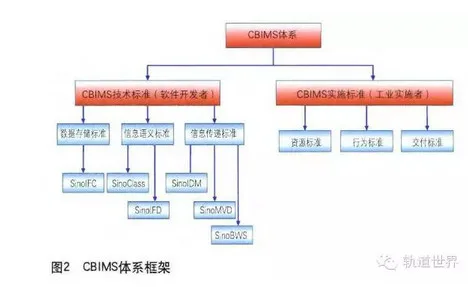
Figure 2
Chinese National BIM Standards
In January 2012, the Ministry issued document No. AI_S_SC_0-5, listing five BIM standards as national development projects. These standards are organized into three levels (see Figure 3):
- Level 1: Unified standard for building engineering information modeling applications (highest level).
- Level 2: Basic data standards, including classification, coding, and storage standards for building information models.
- Level 3: Execution standards, such as delivery standards for architectural and manufacturing engineering design information models.
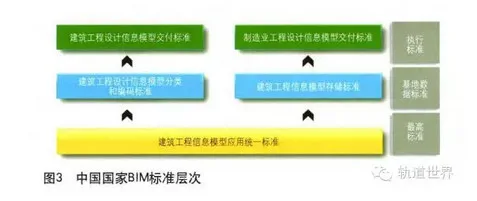
Figure 3
Beijing Local BIM Standard
The “Basic Design Standards for Civil Building Information Modeling (BIM)” serves as a general and fundamental BIM application standard for civil building design in Beijing. It covers principles, terminology, basic regulations, resource requirements, model depth, and delivery criteria.
1.3 Analysis of BIM Standards Domestically and Internationally
Currently, international BIM standards fall into two main categories:
- National or industry-level standards: Such as NBIMS in the US, providing guidance for both software technology and industrial implementation.
- Platform-specific implementation guidelines: Like those in the UK and Singapore, focusing on standardizing project BIM processes based on particular software.
Domestic BIM standards in China generally fit into three groups:
- CBIMS Framework: A theoretical and methodological framework that aligns with NBIMS and serves as the foundation for national BIM standards development.
- Chinese National BIM Standards: Led by the Ministry of Housing and Urban-Rural Development, these standards incorporate international experience and domestic regulatory requirements.
- Local BIM Standards: Regional regulations for BIM applications, such as Beijing’s civil building BIM design standards.
2. Adaptability of Existing BIM Standards to Railway Engineering
2.1 Existing BIM Standards Do Not Address Railway-Specific Needs
Current BIM standards globally focus on construction sectors, mainly architecture, structure, HVAC, electrical, equipment, construction management, and property management.
They do not cover specialized railway disciplines such as geographic information, engineering geology, track systems, roadbeds, bridges, tunnels, stations, signals, locomotives, or electrification. Railway BIM standards must include these unique fields with tailored information model definitions.
2.2 Railway BIM Standards Require a Comprehensive Standard System
Chinese railway BIM standards must support both software development and engineering applications, necessitating a complete system comprising technical and implementation standards. Technical standards cover data storage, semantic information, and data transmission. Implementation standards guide planning, design, construction, management, and operations within the railway sector.
The scope of railway BIM standards vastly exceeds that of existing construction BIM standards, making a comprehensive system essential for standardized application.
2.3 Challenges and Workload in Developing Railway BIM Standards
Basic standards referenced in construction BIM standards (like IFC, IFD, OmniClass) do not cover railway-specific fields, requiring expansion and definition within the railway BIM system. This is a complex, labor-intensive task demanding expert technical research and international standard benchmarking.
Railway engineering differs from construction in its linear nature, close integration with terrain, and broad geographic scope, requiring BIM standards to incorporate GIS (Geographic Information Systems) integration—a significant technical challenge.
2.4 Importance of BIM Software Support for Standards
Developing professional BIM software and ensuring its compliance with standards is critical. Currently, BIM software focuses on architecture and equipment, with many railway specialties lacking dedicated BIM tools. Furthermore, dominant software vendors often do not prioritize open standards or support for railway-specific applications, hindering standard adoption and implementation.
2.5 Chinese Railway BIM Standards Must Align with National Conditions
BIM standards are shaped by legal frameworks, government oversight, construction management practices, and market conditions. Chinese railway BIM standards must reflect China’s unique context rather than simply adopting foreign systems. Tailoring BIM standards to China’s railway environment ensures they effectively regulate and standardize BIM use in railway engineering.
3. Framework of the China Railway BIM Standard System
3.1 BIM Standard Hierarchy in Chinese Railways
The Chinese railway BIM standard system is structured in three levels:
- Industry-Level Standards: These railway-specific standards comply with national BIM standards and may contain provisions with mandatory or guiding significance for other industries.
- Enterprise-Level Standards: Railway design, construction, management, and operation firms develop internal manuals or protocols to implement BIM projects within the framework of national and local standards.
- Project Team Standards: Specific BIM working principles are created to address the unique needs of individual construction projects.
The relationship among Chinese railway BIM standards, national BIM standards, local standards, and related industries is illustrated below.
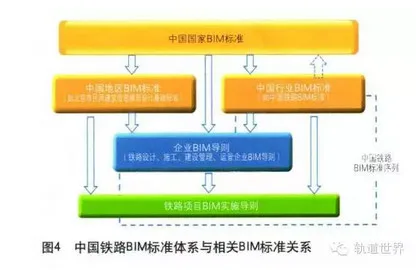
Figure 4
3.2 Structure of the China Railway BIM Standard System
The Chinese railway BIM standard system consists of two main components: technical standards and implementation standards (see Figure 5).
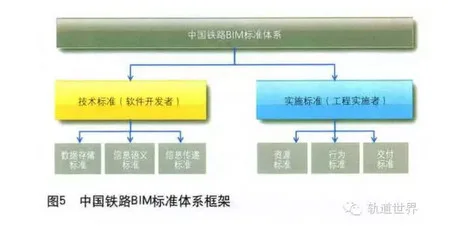
Figure 5
Technical Standards focus on enabling interoperability among diverse stakeholders and heterogeneous information systems throughout the railway project lifecycle. They guide BIM software development and are categorized into:
- Data storage standards
- Information semantic standards
- Information transmission standards
Implementation Standards regulate planning, design, construction, management, and operation in the railway industry, covering resources, behaviors, and deliverables to enforce BIM standards effectively.
Technical Standards in Detail
Technical standards provide the foundation for software development and BIM interoperability, divided as follows (see Figure 6):
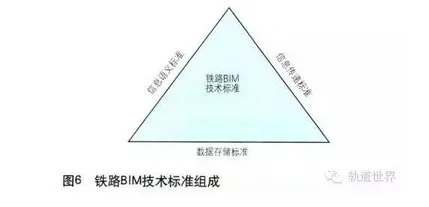
Figure 6
- Data Storage Standards: These cover BIM model data formats, semantic extensions, data access methods, and consistency testing. A practical approach is to extend the IFC (Industry Foundation Classes) standard commonly used in construction. This involves using IFC’s logical and physical organization of geometric and non-geometric information as a base, supplemented by semantic associations specific to railway BIM data. This method minimizes IFC expansion and maintains compatibility with existing BIM software (see Figure 7).
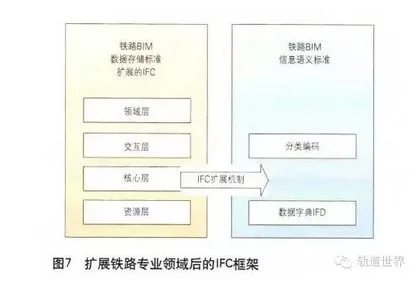
Figure 7
- Information Semantic Standards: Comprising a classification coding system and a data dictionary.
The classification coding system is based on ISO 12006-2 (“Organization of Construction Engineering Information Part 2: Information Classification Framework”) and tailored to China’s railway sector. It provides lifecycle-wide, surface-level classification, coordinated with railway construction management, quota systems, and national BIM standards.
The data dictionary follows ISO 12006-3 (“Organization of Construction Engineering Information Part 3: Object Oriented Information Framework”). It standardizes industry semantic concepts with clear names, definitions, and notes. Each concept has a unique global identifier (UID).
- Information Transmission Standards: These govern the process, rules, and scenarios of information exchange throughout the railway project lifecycle, including delivery standards, information security, and intellectual property rights.
Information Transmission: Defines workflows and rules for data exchange across planning, design, construction, and operation stages, involving owners, designers, contractors, operators, and various specialties (see Figure 8).

Figure 8
Delivery Standards: Define accuracy requirements for geometric and non-geometric data at key project milestones such as pre-feasibility, feasibility, preliminary design, construction drawings, and completion acceptance, based on Chinese railway construction management regulations.
Information Security: Railway BIM models contain sensitive national security data (e.g., geographic and geological information). Research focuses on maximizing BIM benefits while ensuring data security during information exchange.
Intellectual Property Rights: BIM model libraries require significant resources to develop and maintain. Protecting intellectual property rights is essential for encouraging BIM software and content development. Rules governing these rights require further study.
Implementation Standards
Implementation standards translate technical standards into practical usage norms, helping enterprises standardize workflows, management models, resource allocation, environment setup, and deliverables. They generally cover three aspects:
- Resource Standards: Define conditions and environments needed for BIM applications at different stages, including software, hardware, network, and component libraries.
- Behavioral Standards: Regulate personnel activities and processes such as modeling, mapping, and collaboration.
- Delivery Standards: Specify requirements for the outputs generated by BIM implementation and management.
4. Outlook
4.1 Potential for Elevation to National and International Standards
Current BIM standards domestically and abroad mostly focus on architecture. The proposed Chinese railway BIM standard is a pioneering effort. Once mature, it could be elevated to national standard status and, aligned with China’s global high-speed rail initiatives, potentially promoted as an international standard.
4.2 Focus on BIM Software Development
BIM’s 3D, data-intensive, and collaborative nature requires robust software support to succeed. No single software handles all BIM tasks; instead, a suite of specialized tools is necessary. Currently, few BIM software solutions exist for railway specialties worldwide, and many railway fields lack dedicated BIM tools.
Without adequate software support, railway BIM standards cannot be effectively implemented. Therefore, BIM software development and BIM standard system advancement should be strategically coordinated and promoted simultaneously.
Authors: Li Hualiang, Yang Xukun, Wang Changjin, Wang Zhaohu, Wei Yinghong, Han Zujie













Must log in before commenting!
Sign Up