
Creating Architectural Designs
Before diving into workflow examples, it’s important to understand some fundamental limitations when working with building shapes and components:
Geometry imported from other software cannot be manipulated directly within Revit. Imported shapes and components lack parametric control over geometric dimensions, meaning you cannot adjust size or shape through parameters like you can with native door and window families. Additionally, some metadata may not transfer.
To ensure smooth integration, it’s best to optimize geometry before exporting from Rhino to Revit:
First, in Rhino, unify the unit system and establish the project’s coordinate origin. This makes referencing linked files much easier.
Second, if you create your architectural design in Rhino or Grasshopper, remember that Grasshopper creations need to be baked before export. For designs composed of multiple surfaces, it’s advisable to join them before exporting. Closed, joined surfaces are recognized as single entities after export.
Once your design is ready, export it using the ACIS SAT format.
At this stage, you can link the SAT geometry into your Revit project by navigating to: Built-in Volume > Link to SAT. The advantage of this method is that if you modify the Rhino model, you can overwrite the original SAT file, allowing multiple design options to be reviewed within Revit. Alternatively, you can export Rhino models and import them into a loadable mass family.
After linking the SAT geometry, Revit users have two main approaches to create building components:
- Use Revit’s panel tools to create a curtain wall on the imported surface.
- Apply volume walls on the surface.
Both methods have their pros and cons. Note that the imported geometry retains UV mapping, but the UV divisions may not align with your design intent. You might need to disable the UV grid and instead use Revit’s Intersection Tool to divide faces appropriately.
Using the imported geometry, Revit users can also create mass floor slabs at specified elevations. This looks effective, but how can we compare different styling options?
Continuing the workflow from above, you can modify the shape in Rhino or Grasshopper and export again. If you save the SAT file with the same name, the linked file in Revit will update automatically.
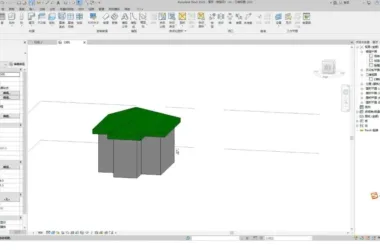
In Revit, the image on the left shows the original shape, while the following image displays the updated shape after reloading the linked file.
Additionally, volume floors and schedules update automatically to reflect the newly linked geometry.
This example illustrates how to leverage two different methods during both the schematic design phase and the design development phase.













Must log in before commenting!
Sign Up