
The wave of information technology is sweeping across the globe. In architecture, various 3D digital design software play an increasingly vital role in the creative process, enabling architects to expand their imagination and transform virtual concepts into reality. Some pioneering architects, both domestically and internationally, have successfully blended software with human intelligence to create unprecedented architectural forms and spatial experiences.
However, traditional social concepts, industry systems, design methods, and construction techniques continue to limit architectural exploration, especially in the design and construction of large-scale buildings. With the support of the Shanghai Autodesk China Research Institute, Autodesk Revit 2010 beta software was successfully applied to the construction drawing design of the Mogao Grottoes of Dunhuang Tourist Center, offering architects a fresh experience. The insights gained during this project are valuable and worth sharing.
Situated on the edge of the Gobi Desert and facing the vast sands, the Mogao Grottoes Tourist Center emerges from the earth like wind sweeping across dunes—flowing up and down, free and unrestrained. Multiple sets of free-form roofs intertwine, twist, and separate, some perforated with openings, resembling hourglass shapes as they descend. The main indoor public space exposes curved, cross-shaped beams reminiscent of coffered grids found in caves. The facade windows draw inspiration from the cave openings on cliff walls, featuring arc-shaped chamfered niches on double-layered walls. These complex forms give the building a unique appearance but also present significant challenges in construction drawing design.
Given cost constraints and local construction capabilities, cast-in-place reinforced concrete was chosen over steel as the primary structural material. Consequently, accurately positioning three-dimensional curved concrete elements became a core challenge. Questions such as how to model, locate, section, detail, and ensure practical guidance for construction diluted initial creative enthusiasm and had to be tackled systematically.
3D Modeling
3D modeling was the most critical task in the construction drawing process. We aimed to use Revit to accurately represent three-dimensional shapes and spaces and translate them into two-dimensional drawings for precise positioning. Leveraging BIM advantages, we sought to improve efficiency, facilitate modifications, and reduce workload.
Our approach began by breaking down complex tasks into manageable work packages structured logically. This hierarchical “pyramid” method refined medium-difficulty packages into simpler tasks with standardized procedures to ensure quality. Results were then combined step-by-step according to the logical framework to form the complete solution.
Specifically, we first adopted a 2m × 2m grid axis based on typical concrete formwork sizes as the foundational positioning scale for the entire building plan and space. All positioning referenced this grid. Next, we separated vertical walls from curved roofs and assigned two team members to handle these parts respectively. Finally, the curved roofs were further segmented by specific rules, modeled individually, and then reassembled to complete the full model.
Curved Roofs and Three-Dimensional Curved Beams
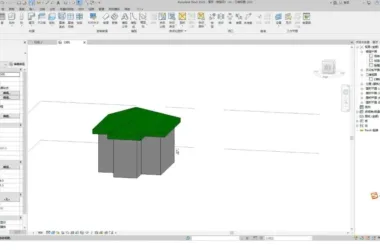
We began by decomposing the model. The longer roof was split into two zones—east and west—based on structural deformation joints. These zones were further broken down into individual curved roofs according to shape variations, and each roof was disassembled into basic structural components: main beams, secondary beams, slabs, parapet walls, and overhead roof panels. This process reduced the complex surface model into numerous fundamental units.
After decomposition, each component was defined, numbered, and assigned to zones. This numbering system, built upon the grid logic, ensured the uniqueness and spatial precision of every basic element, facilitating future inspections and modifications. We compiled a comprehensive table listing each component’s responsible person, completion status, location, and difficulty level. Each modeler received a partitioned combination map—essentially a task map—to track workload distribution, module integration, progress, missing elements, issues, and time estimates.
This task division helped mitigate the daunting complexity of the overall form by focusing attention on discrete components of varying difficulty. Complex units that could not be further subdivided—such as cross beams and funnels—were escalated to Autodesk’s technical team, and if necessary, to their US headquarters. This approach also enabled outsourcing work when needed.
Next, basic components were created following the partition map. Due to time constraints, after a brief training with Autodesk technicians, our team learned on the job. The key steps included: cutting and tracing cross-sections from the conceptual model; producing component surfaces one by one based on these sections; importing surfaces into the project environment and aligning them to the coordinate grid; assigning properties to components (beams, slabs, columns) and attaching walls to roofs. This repetitive process was labor-intensive, especially since the building’s freeform nature meant few repetitive components and a high quantity of basic parts.
We faced significant challenges during modeling. The three most difficult elements were the cross-shaped beam on the reception hall roof, the courtyard’s funnel-like structure, and the spatial curved beams. For the cross-shaped beam, we invested considerable effort to resolve torn surfaces, maintain curvature continuity at joints, apply UV mapping for grid adjustment, and create family files for surface application. Similarly, funnel production required careful decomposition, surface creation with varying curvatures, and smooth connection of family module files. Spatial curved beams were relatively easier, as they aligned with the curved roofs. We extracted roof components, identified beam centerlines on the plan, used column midpoints as beam endpoints, projected these spatially, connected points to form polylines, and extruded them vertically to create the beam’s cross-section, which was then imported into Revit and assigned thickness.
Revit handled walls, stairs, and windows with ease for regular geometries, thanks to its rich component library. Vertical walls could be parameterized for height and thickness, with extension and chamfer functionalities. Stairs were detailed parametrically, allowing rapid construction of steps, railings, and handrails. The main challenge was replicating cave-inspired niches and curved chamfered windows, which required custom family files. Once created, these families could be inserted at various wall positions and heights, with adjustable dimensions and proportions—greatly enhancing convenience.
Positioning
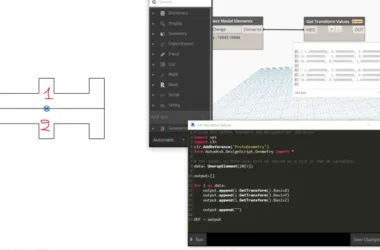
Revit alone could not solve the spatial positioning of curved roof panels, curved beams, and arbitrary cross-sections. We relied on Rhino combined with Grasshopper scripts to finalize spatial positioning. The key was Grasshopper’s ability to use custom scripts tailored to each structural component type for calculating 3D positions.
The positioning workflow involved: exporting structural components from Revit to CAD files; importing CAD files into Rhino; using Grasshopper scripts to calculate spatial positioning heights; exporting the results back to CAD; organizing and submitting them to the structural engineering team.
All planar positioning was based on the 2m × 2m grid. The spatial coordinates formed a 2m × 2m × 2m grid covering the entire building, into which all structural elements—irregular roof panels, curved beams, etc.—were placed. Coordinates were expressed as (x, y, z), with 2m spacing in x and y directions and z heights calculated via Grasshopper.
Positioning accuracy depended on grid size: smaller grid units yielded higher precision. For complex shapes, more positioning points facilitated construction and ensured that the final result met design expectations.
Generation of 2D Drawings
Traditional 2D design involves drawing plans, elevations, and sections separately. Sections require rotating and vertically aligning plans, which can be confusing and error-prone, especially with complex spaces and multiple floors. Changes to plans near project completion often necessitate extensive realignment and modification of sections, annotations, text, and node details, causing cascading adjustments and delays.
In Revit, all views—plans, elevations, sections, details, and dimensions—are linked to the 3D model. Any modification in one view automatically updates all related drawings, saving time, boosting efficiency, and reducing the risk of missed updates. For this project, with the curved roof’s continuous shape variations and unpredictable section locations, this associativity was invaluable. Once set up, we could confidently modify the model, knowing that drawings would reflect changes in real time.
However, differences in component properties (e.g., roof panels vs. walls) prevented smooth chamfering and intersection in Revit, resulting in profiles that did not meet drawing standards. Additionally, the software’s localization was insufficient to match traditional Chinese drafting conventions. Consequently, final drawings had to be exported to CAD for reorganization and output.
Advantages and Disadvantages of Revit Software
Revit offers powerful functionality, an intuitive interface, and supports collaborative design. It provides a platform for multidisciplinary teams to work together on 3D models, which holds great promise. However, due to gaps between its design features and the Chinese market’s requirements, currently only the architectural discipline can fully utilize it; other professions must forgo use as some fundamental needs remain unmet.
Revit was created by Autodesk with BIM as its core purpose, revolutionizing traditional 2D design. It consolidates all building information—architecture, structure, plumbing, heating, and electrical—into a single continuously updated document usable throughout design, construction, and operation phases. This integration eliminates separate blueprints and negotiation documents, streamlining renovations by relying on the latest drawing versions without tedious rechecking. This advantage benefits all related industries.
However, achieving this vision requires comprehensive BIM models with contributions from all disciplines. Any construction negotiation changes must be reflected within the same model.
For construction drawing design, 3D models linked to all plans, elevations, and sections prevent overlooked modifications common in traditional workflows and greatly improve drawing efficiency. Revit excels in curve modeling and can generate complex forms through method exploration, though surface modeling still needs refinement. Parametric design capabilities allow easy dimension changes and local component control via family files, performing well for buildings with simple geometries.
In this project, a fundamental challenge arose in converting 3D models into 2D drawings tailored to the Chinese market. Compliance with national standards and alignment with engineers’ established drawing practices are essential. Traditional drafting standards have been used for years, so Revit as an external software requires substantial redevelopment to meet local needs. We strongly recommend that Autodesk China Research Institute invest significant effort in addressing these issues in the next development phase.













Must log in before commenting!
Sign Up