
Creating Families for Revit Using Rhino
Rhino allows us to quickly create and assemble families for Revit. We can import geometry directly into Revit family files to use in a project. There are several reasons to take this approach:
1. The project team includes skilled Rhino users who can efficiently create various components;
2. The components do not require geometric parameterization;
3. Components have unique shapes that might be difficult to model directly in Revit;
4. The component design is finalized and does not need further modifications;
Although file formats can be imported and exported between the two platforms, cross-platform data exchange demands extra effort and time, which increases management costs. It also requires strict version control during the exchange process. Careful planning and implementation are essential to ensure smooth workflow.
Note: When importing from Rhino to Revit, be careful to avoid inserting points that deviate from the elevation direction. This can be controlled through object style settings.
Step 1: Set the unit system and origin in Rhino, then create a shape—such as a table.
Once the component shape is ready, export it using the ACIS Export Type set to Default.
Step 3: In Revit, create a new family. For this example, choose the furniture family, as we need to track furniture quantities within the project.
Revit assigns properties to components based on its OmniClass Number for each object. When importing geometry, this classification determines whether the object is furniture, a door, a window, or another category. This attribute affects quantity takeoffs, visibility, view representation, and other related functions. Autodesk’s AEC Exchange application also relies on this mechanism. Although the coding system still requires refinement, it has successfully established the foundation for Revit and its family system.
Step 4: Use Insert > Import CAD and select the SAT file for import.
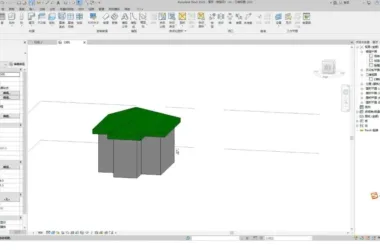
Step 5: Now you can load the family of the table into your Revit project. This example demonstrates how to create Revit families using Rhino.













Must log in before commenting!
Sign Up