
BIM Software Tip: Using Revit Adaptive Families
Adaptive components are designed to flexibly adjust, such as curtain wall panels adapting based on fill patterns. This functionality is ideal for situations where components must respond to various unique conceptual conditions. For example, adaptive components are often used in repetitive systems created by arranging multiple components that adhere to user-defined constraints.
Adaptive points are created by modifying reference points. When you draw geometric shapes by capturing these flexible points, you generate flexible components. You can also assign a category to adaptive components. Note: Adaptive components are limited to pattern panel families and adaptive component templates. Adaptive points cannot be used within mass families; however, families containing adaptive points can be placed into masses. Additionally, adaptive component templates cannot be loaded directly into the project environment but can be placed within the built-in family editor.
How to Place Adaptive Components:
- The adaptive model can be inserted into other adaptive components, conceptual masses, curtain wall panels, and interior masses. Begin by opening a new adaptive component and designing a model using adaptive points as references.
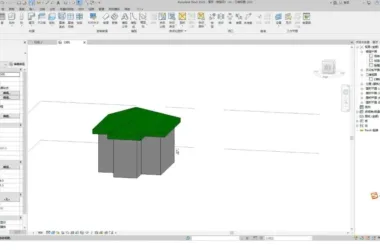
- Load these adaptive components into design components or volumes. For example, the figure below illustrates a conventional model with four adaptive points.
- In your design, drag the component family from the Project Browser into the drawing area. This component family is listed under “Conventional Model.” Note that the shape of the model will appear attached to your cursor.
- Place the adaptive points of the model within the conceptual design. You can press the Esc key at any time to finalize the model placement based on the currently placed adaptive points. For example, if your model has five adaptive points and you press Esc after placing two, the model will be placed according to those two points. The order in which you place adaptive points is important; if the component is designed to stretch, placing points counterclockwise will flip the stretch direction.
If needed, you can place multiple copies of the model. To manually arrange several instances, select a model, hold down the Ctrl key, and drag to position additional copies.













Must log in before commenting!
Sign Up