
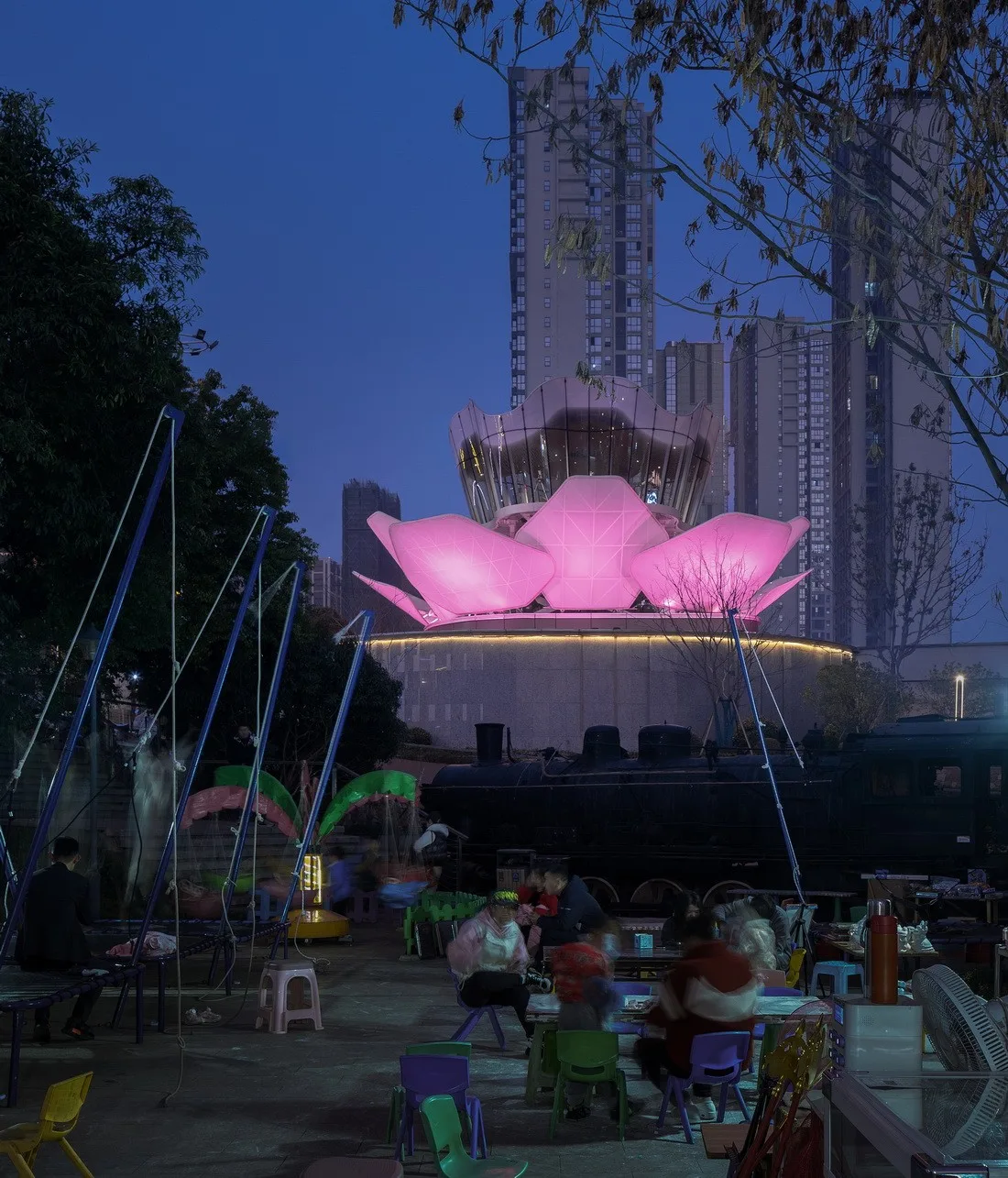
New technologies continuously push the boundaries of traditional architecture, transforming building production and ultimately creating a new spatial consensus. Future buildings may no longer be “frozen music” but instead active, dynamic environments. — Zhu Peidong
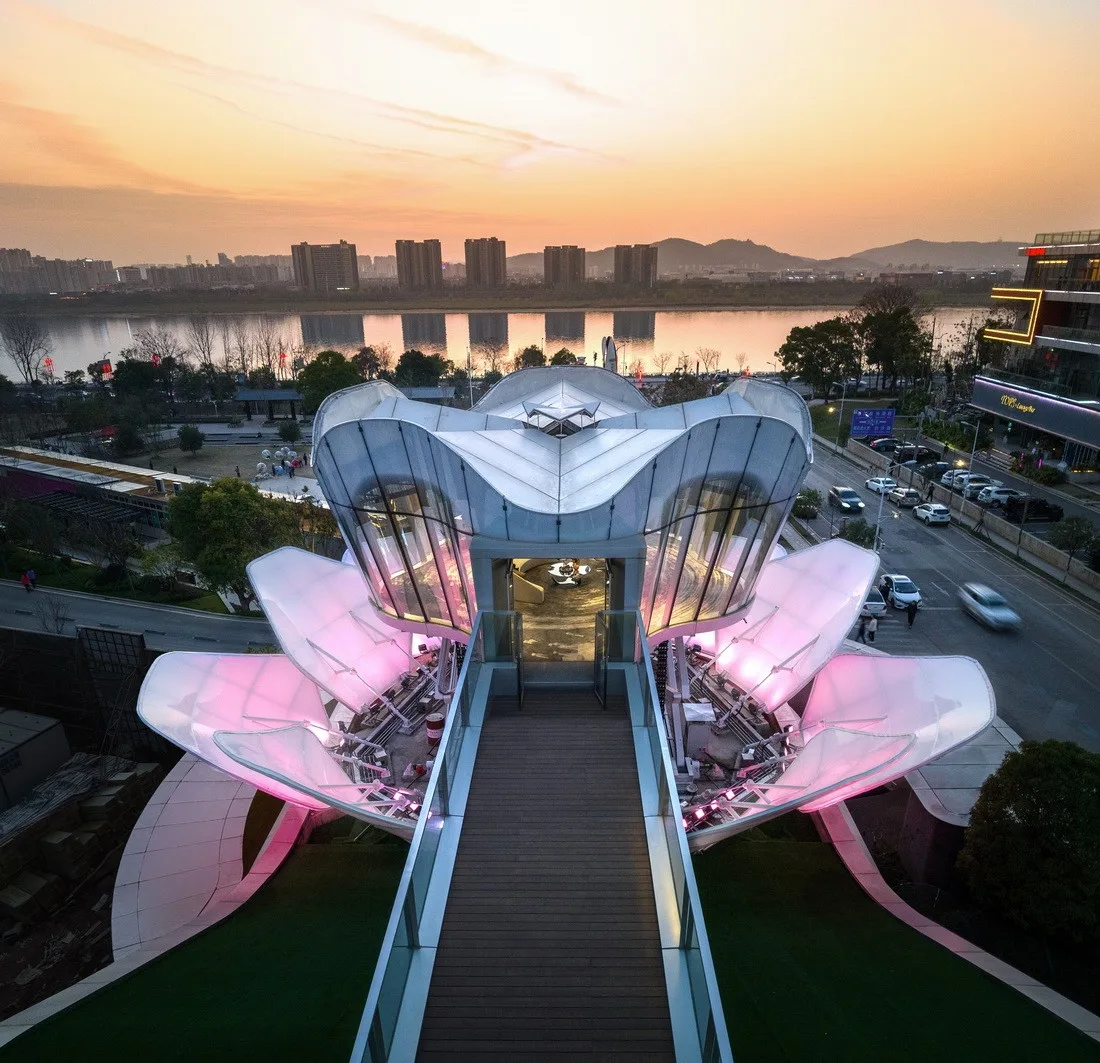
Zhu Peidong, co-founder and lead architect of Line+ Architecture Firm, led a team in collaboration with Dajie Intelligent Manufacturing to develop China’s first movable dynamic building — the “Eye of the Xiangjiang” in Changsha. This innovative project integrates multiple disciplines to adapt to changing environments, exploring new technological boundaries and expanding architectural possibilities for diverse future spatial scenarios.
△ Video production: Xingzhi Image – Li Yi
01 Responding to Site Conditions and Exploring Technological Boundaries
A New Approach to Spatial Production
Situated on the banks of the Xiangjiang River in Changsha, the “Eye of the Xiangjiang River” serves as a city reception hall, combining the functions of urban sightseeing and regional landmark.
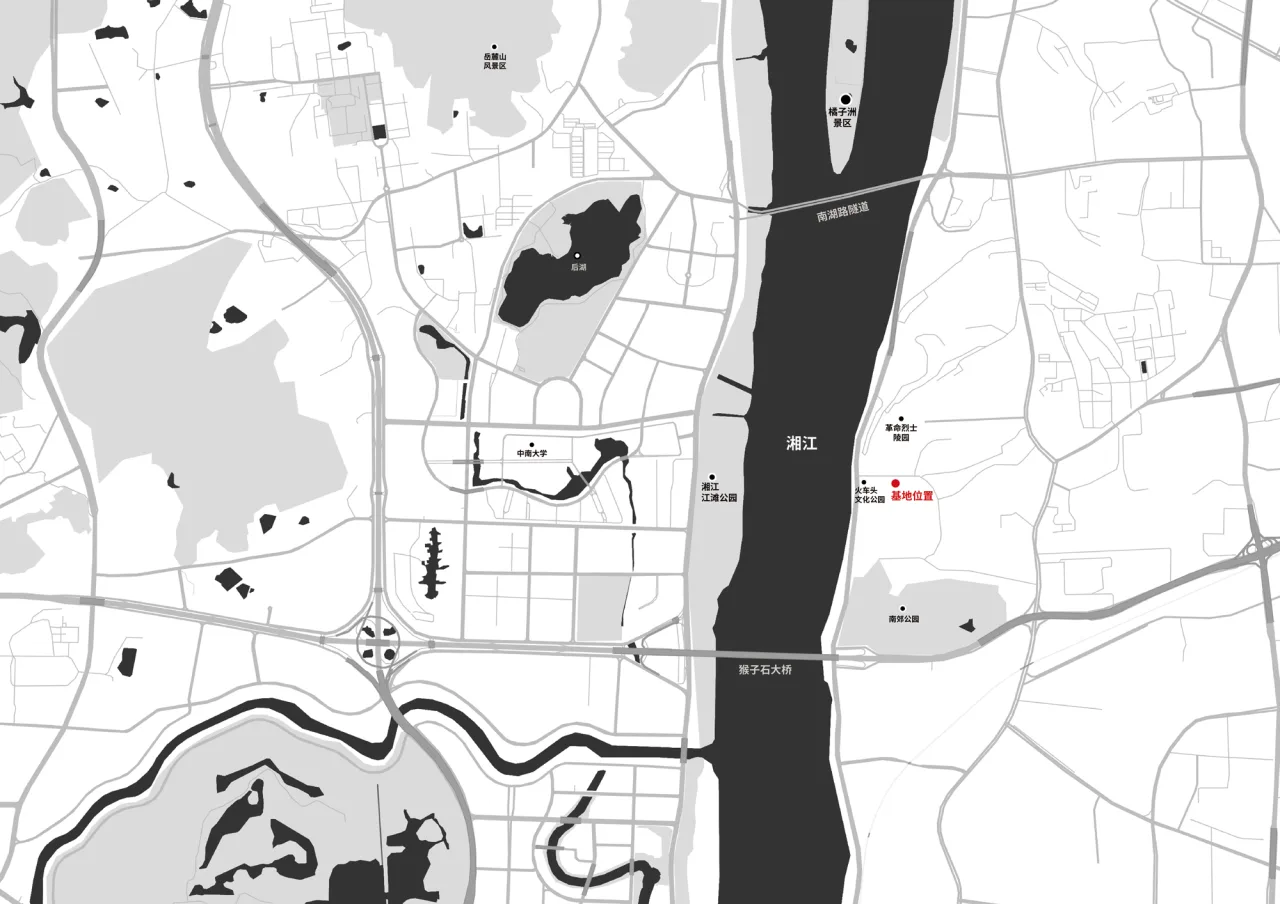
△ Location Map
Due to vegetation obstructing views along the riverbank, the building must reach sufficient height to fulfill its roles as a viewing platform and landmark. However, simply increasing height could block views from surrounding buildings and reduce the commercial value of the Jiangjing Community. Internally, the space must adapt to varying privacy and openness requirements for different events. These seemingly conflicting constraints ultimately emphasize the need for dynamic, adaptable spatial solutions.
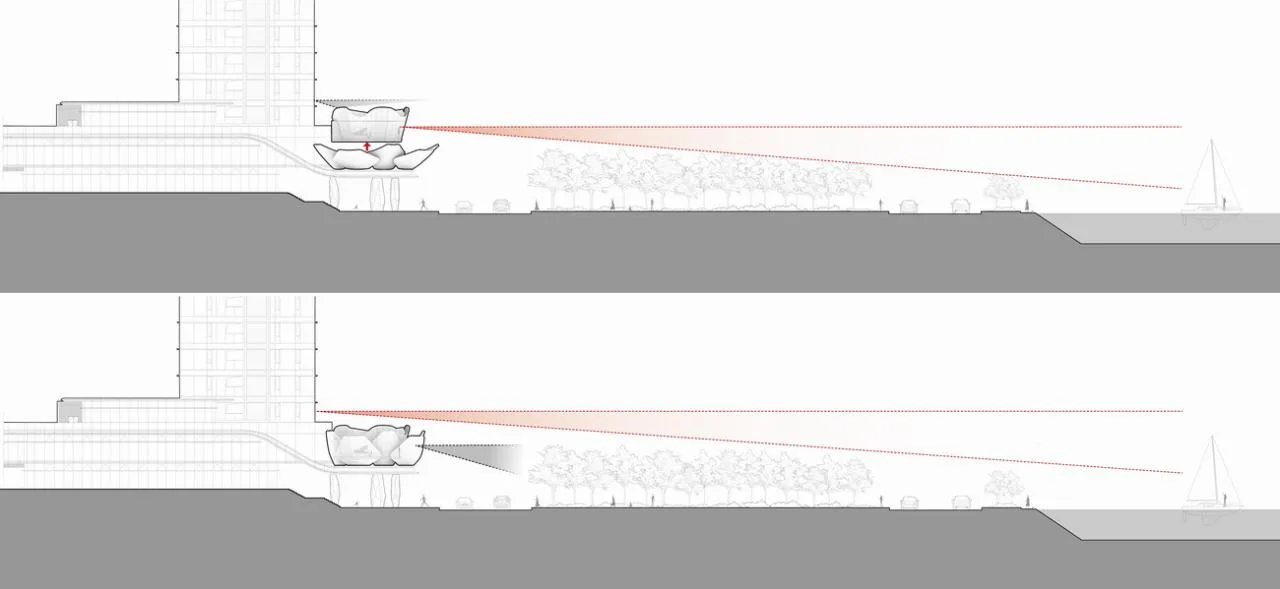
△ Visual Analysis
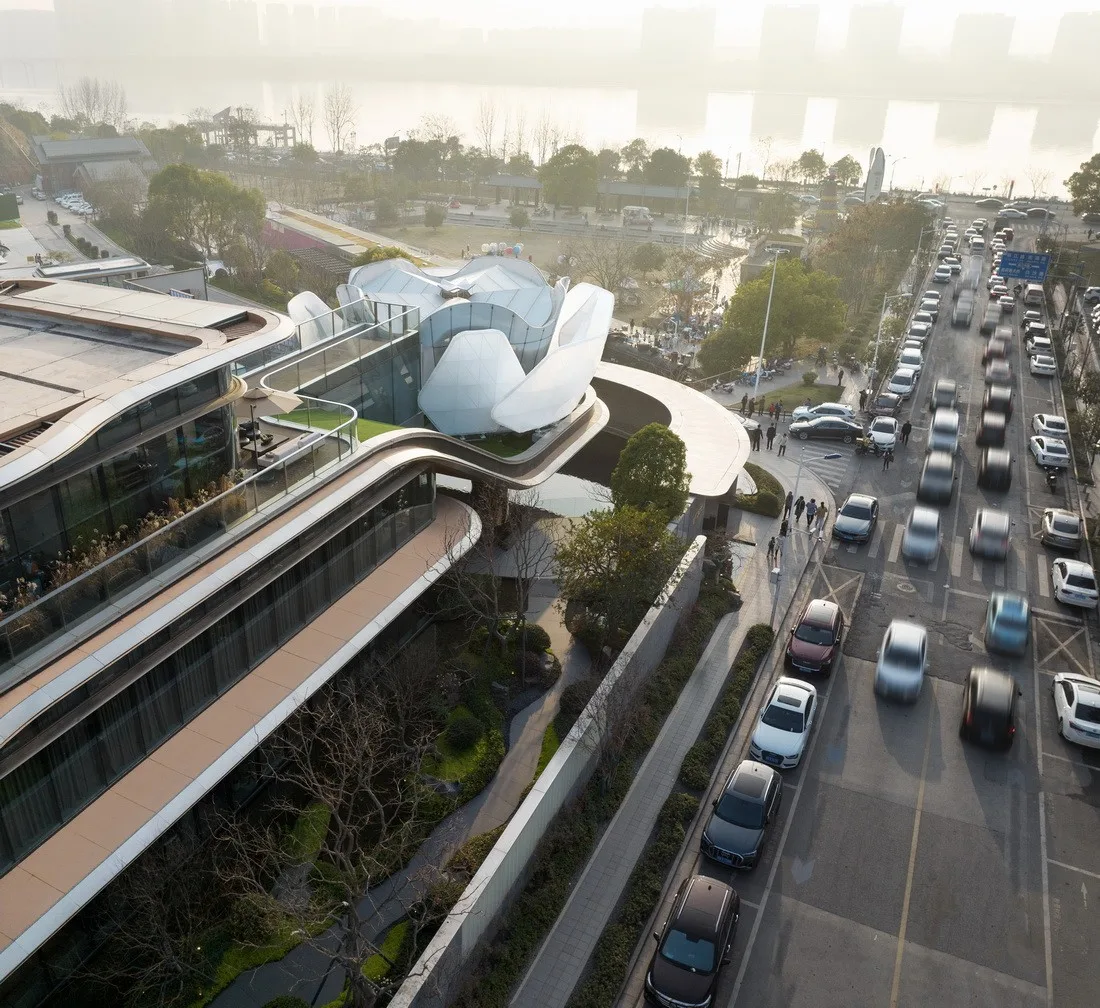
As times change, the uncertainty of spatial use continues to rise. Breaking away from the traditional one-way progression of “environment demands space technology,” dynamic architecture emerges as a promising breakthrough. This project embraces dynamic responses to varying spatial states required for different activities, creating an interactive system that links human activity, events, building, and environment.
By carefully analyzing internal and external project demands, the design dynamically adjusts spatial elevation and modulates surface transparency and privacy. Raising and lowering the main space, combined with opening and closing the outer facade, allows flexible adaptation to the environment and user needs. This creates a multidimensional integration of structure, landscape interface, and spatial experience.
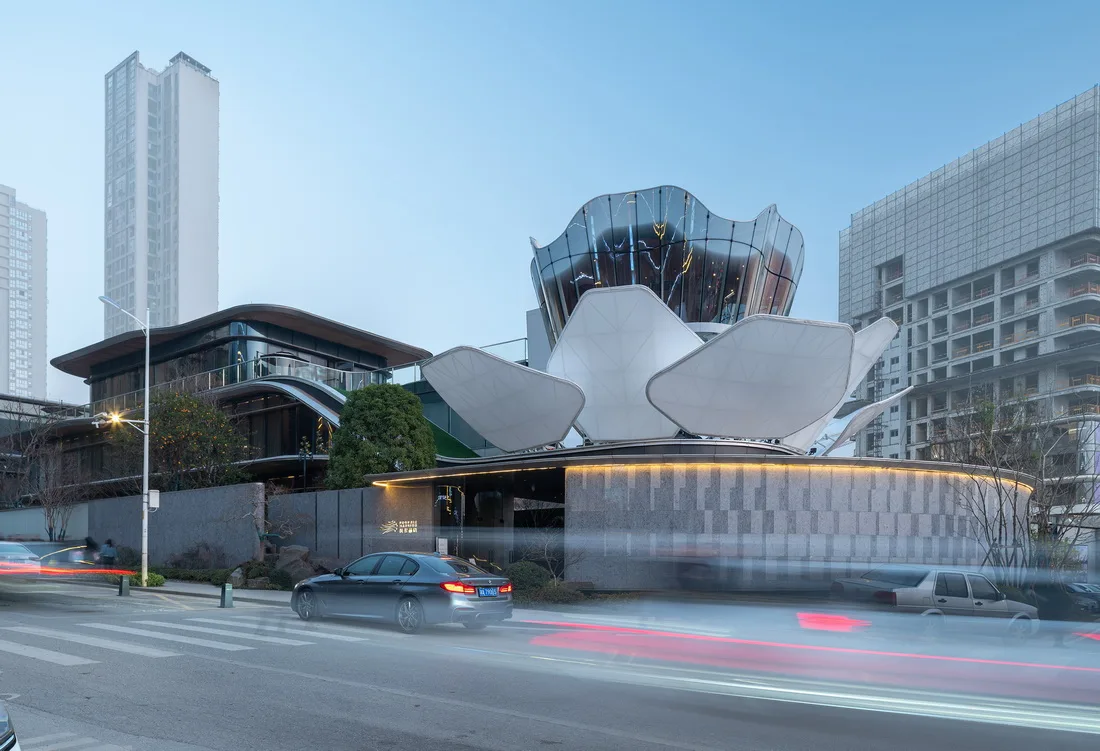
While many industries have seen transformative technological progress in recent years, architecture has experienced relatively few breakthroughs. Existing attempts often focus on limited variability, such as retractable curtain walls or adaptable interior walls. However, this project envisions buildings as dynamic, organic spaces that actively respond to environmental changes and diverse human needs.
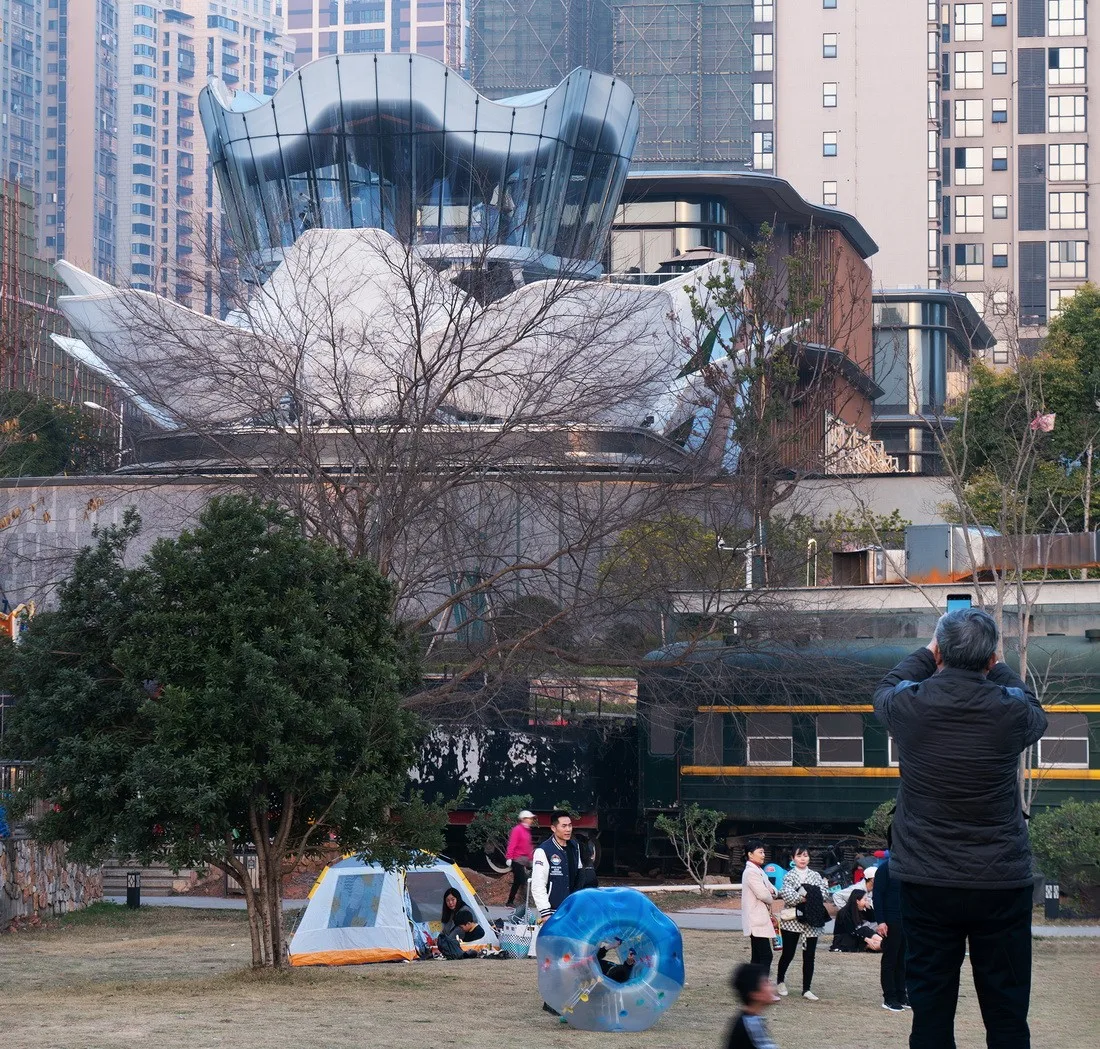
02 Blooming Form
Dynamically Variable Spatial Shape
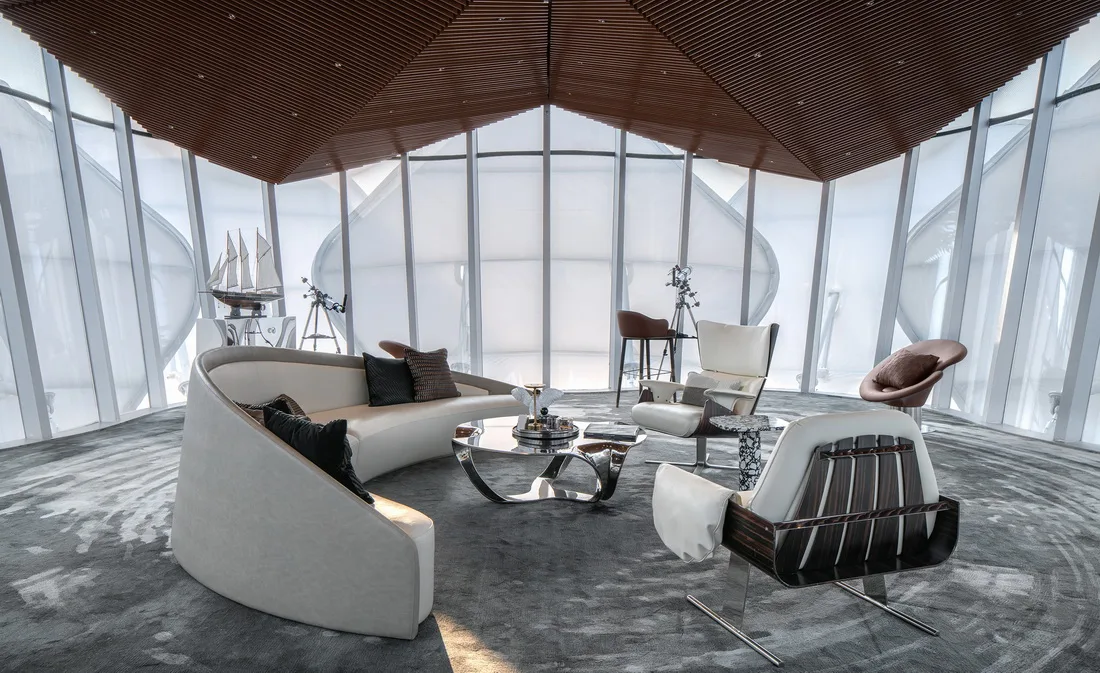
The architectural concept addresses two primary functions — viewing and meeting — alongside two forms — display and concealment — through the vertical movement of the main space. The building operates as an integrated responsive system inspired by industrial equipment design. The main structure comprises the central space and movable mechanical components, which alter connections to the east building’s floors through vertical displacement, enabling flow line switching.
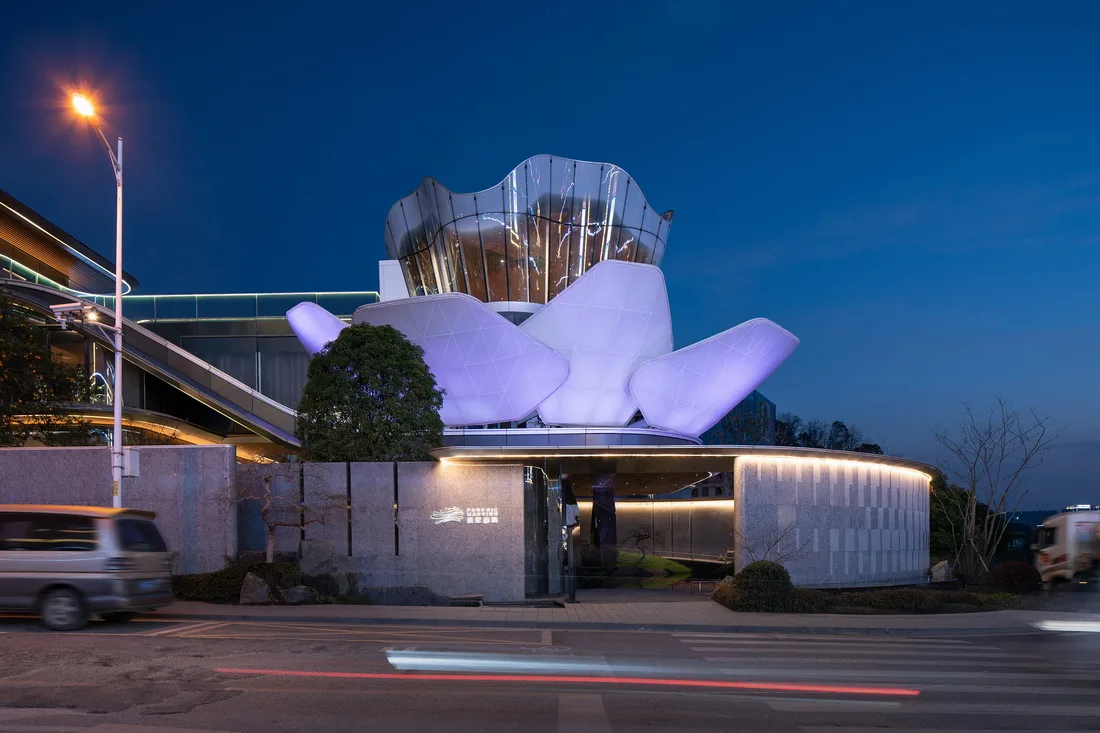
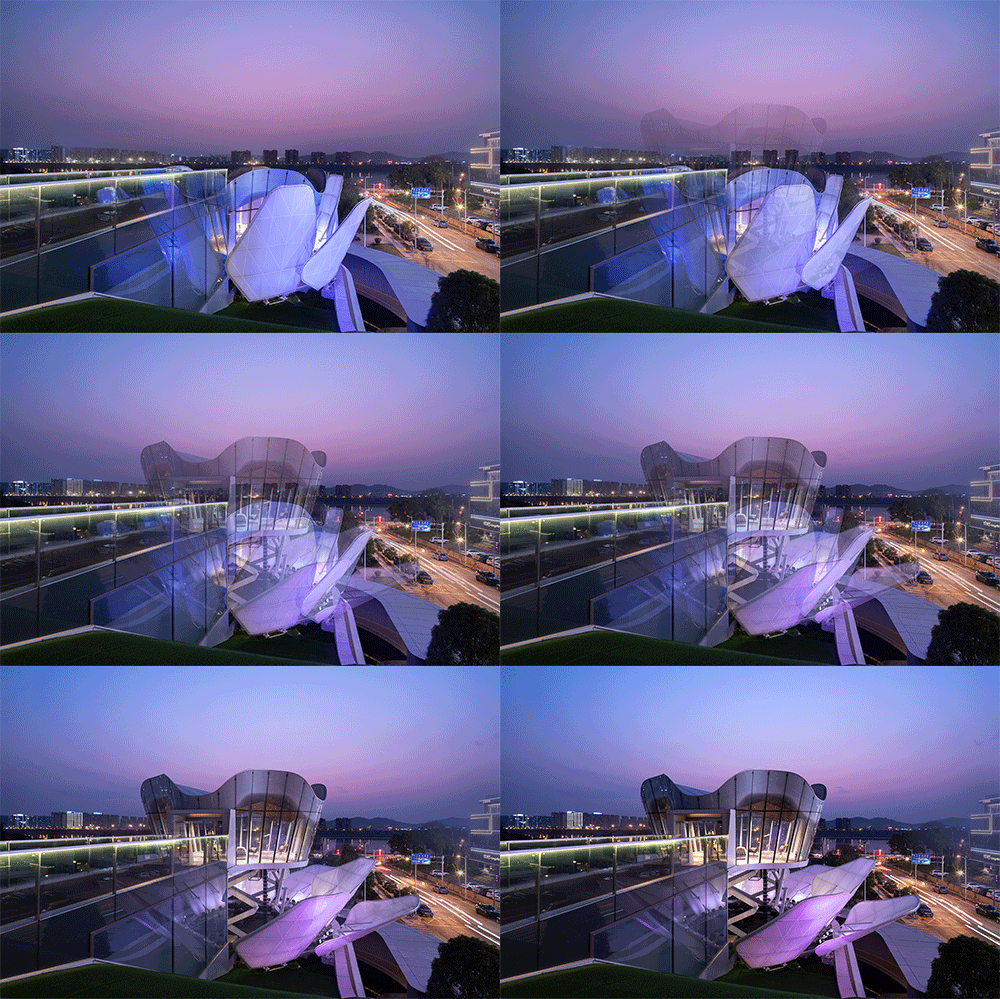
△ Transition from closed to blooming and rising
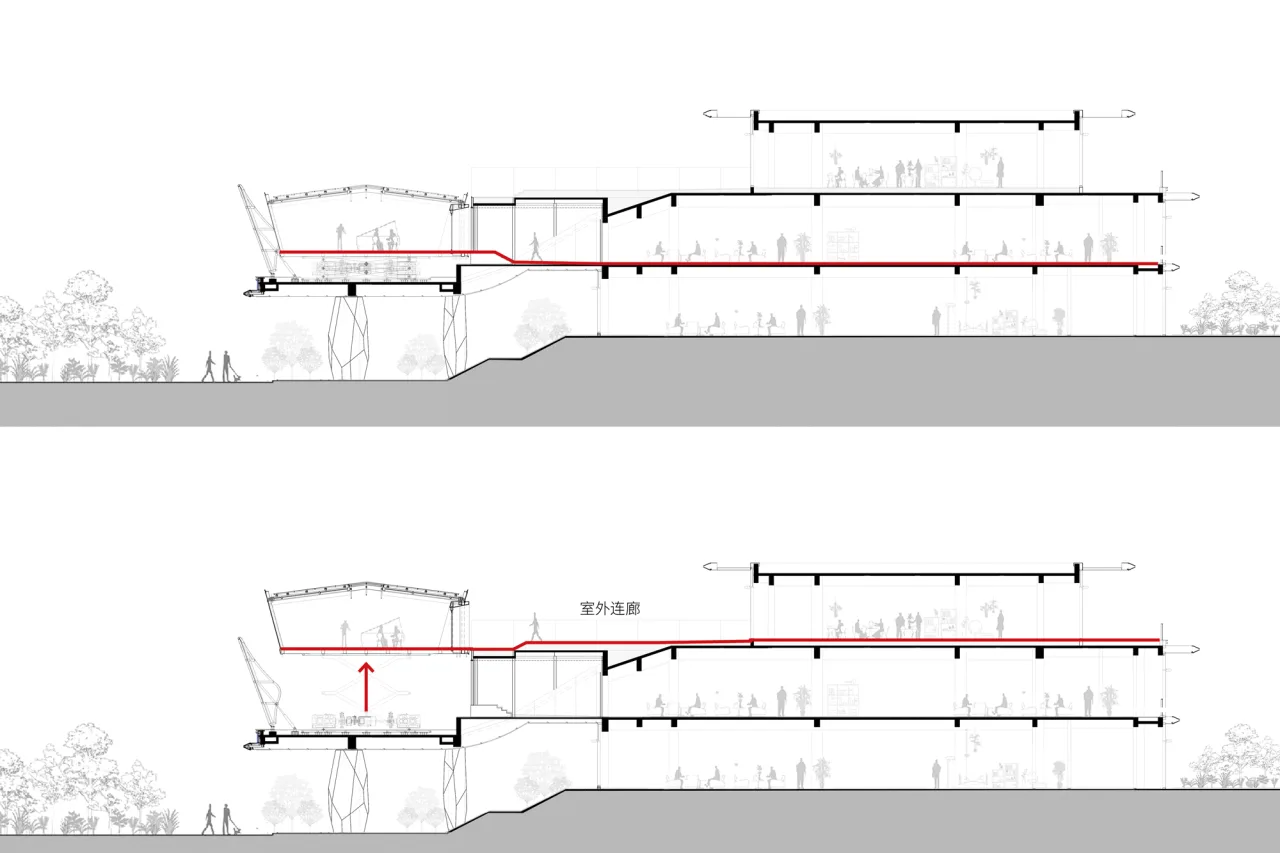
Relationship between landing and rising profiles
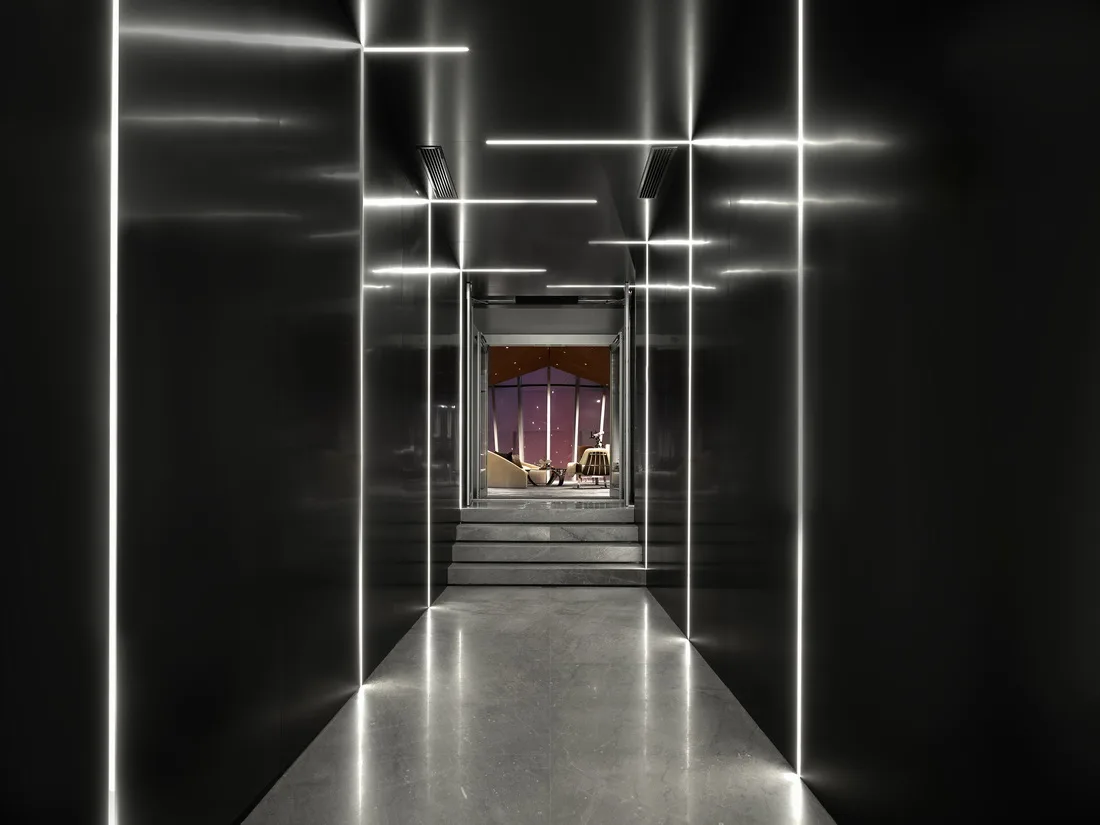
△ Guanjiang Tunnel: Entrance and exit when closed
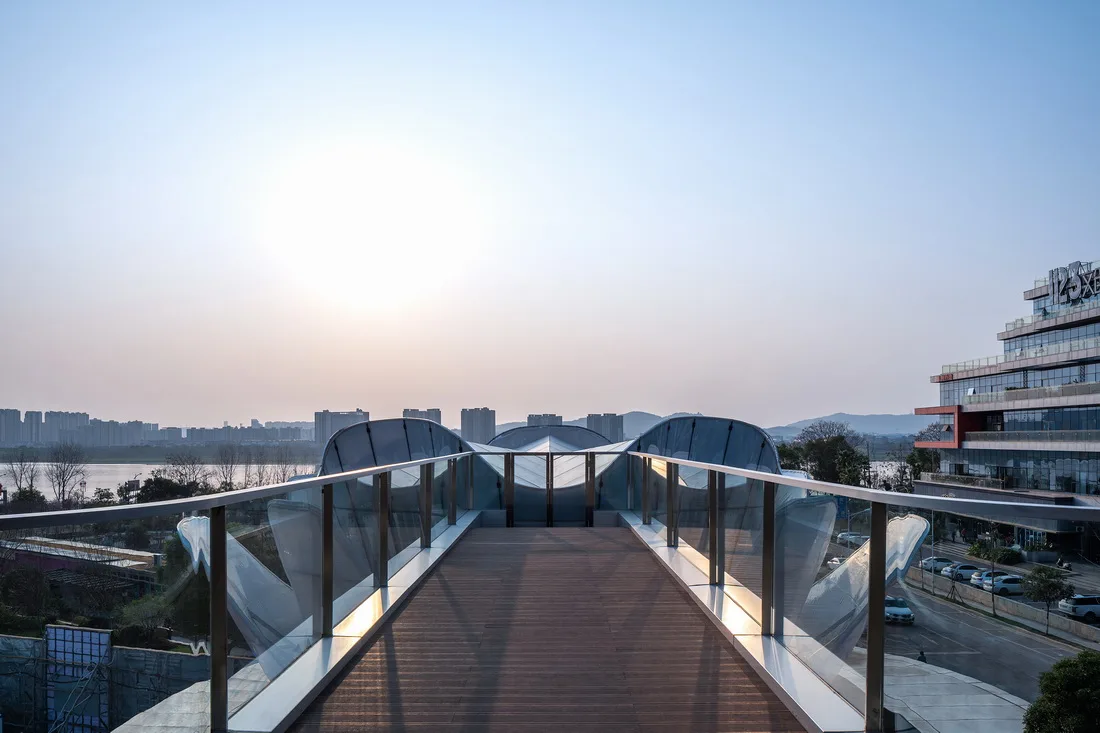
Roof corridor in closed state
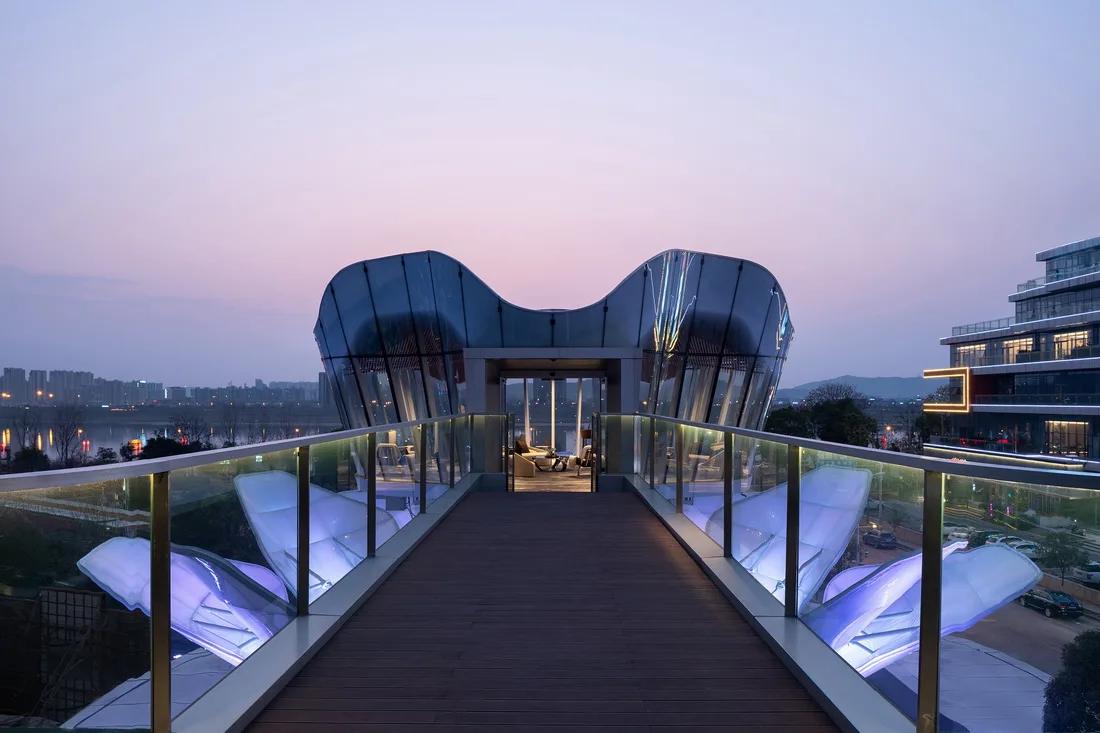
Roof gallery: entrance and exit when blooming and rising
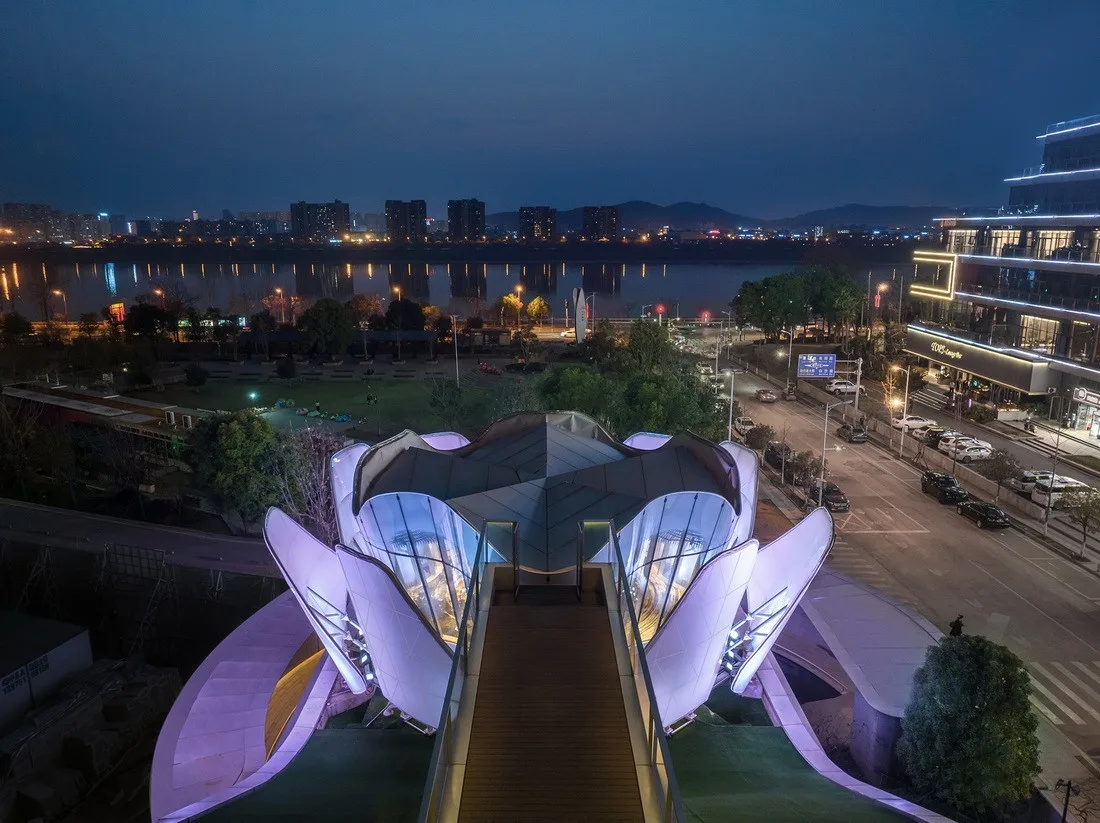
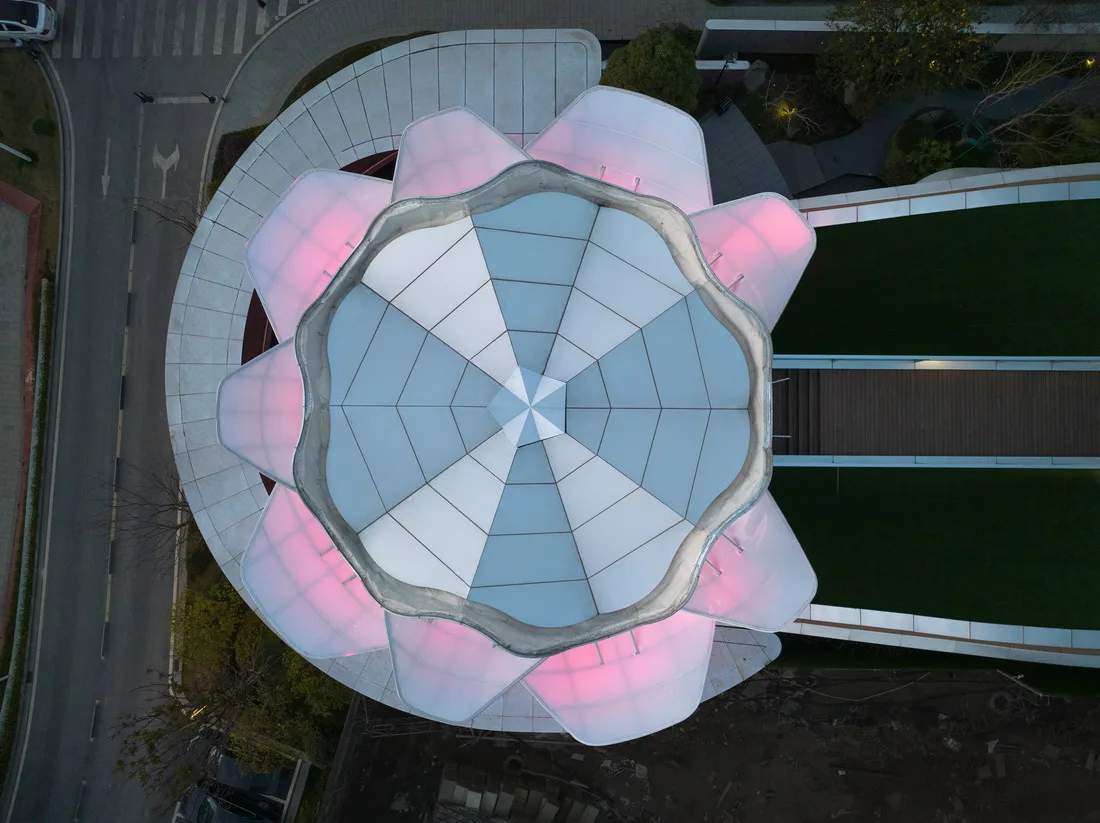
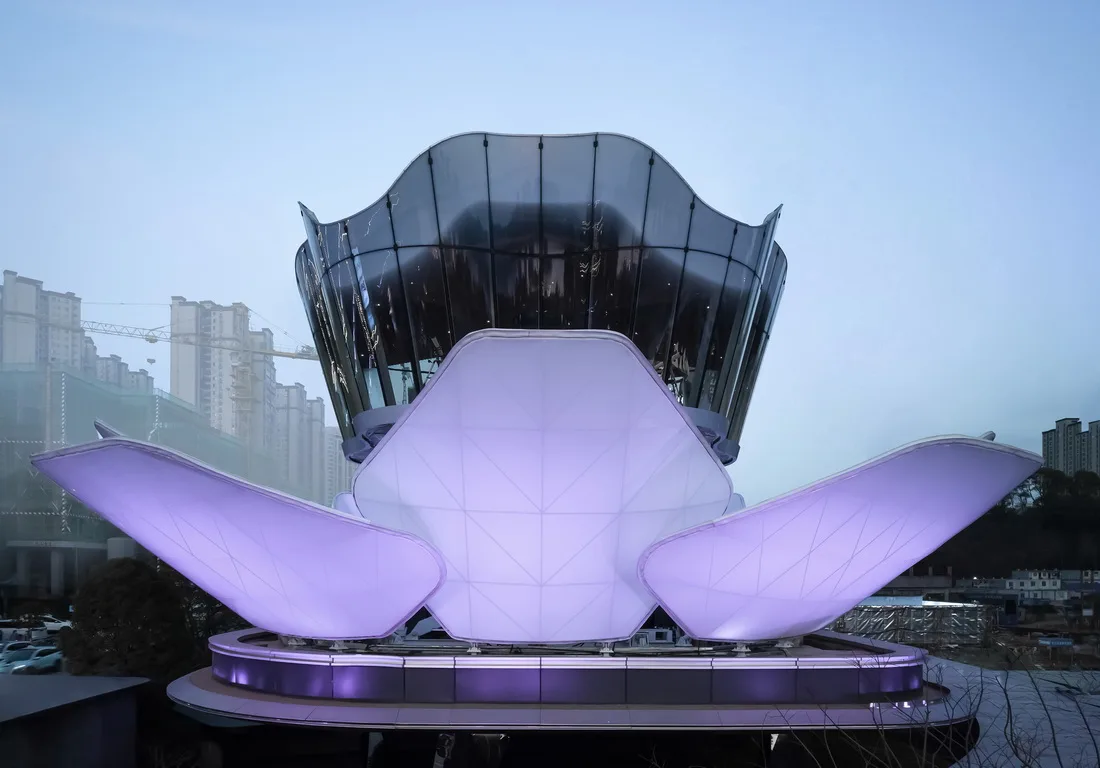
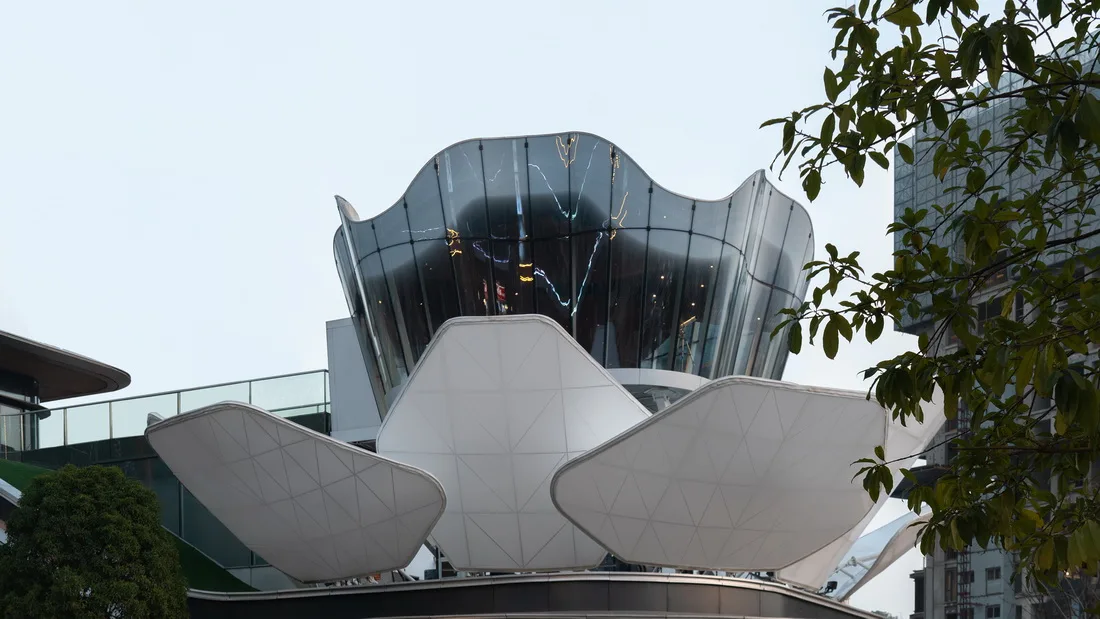
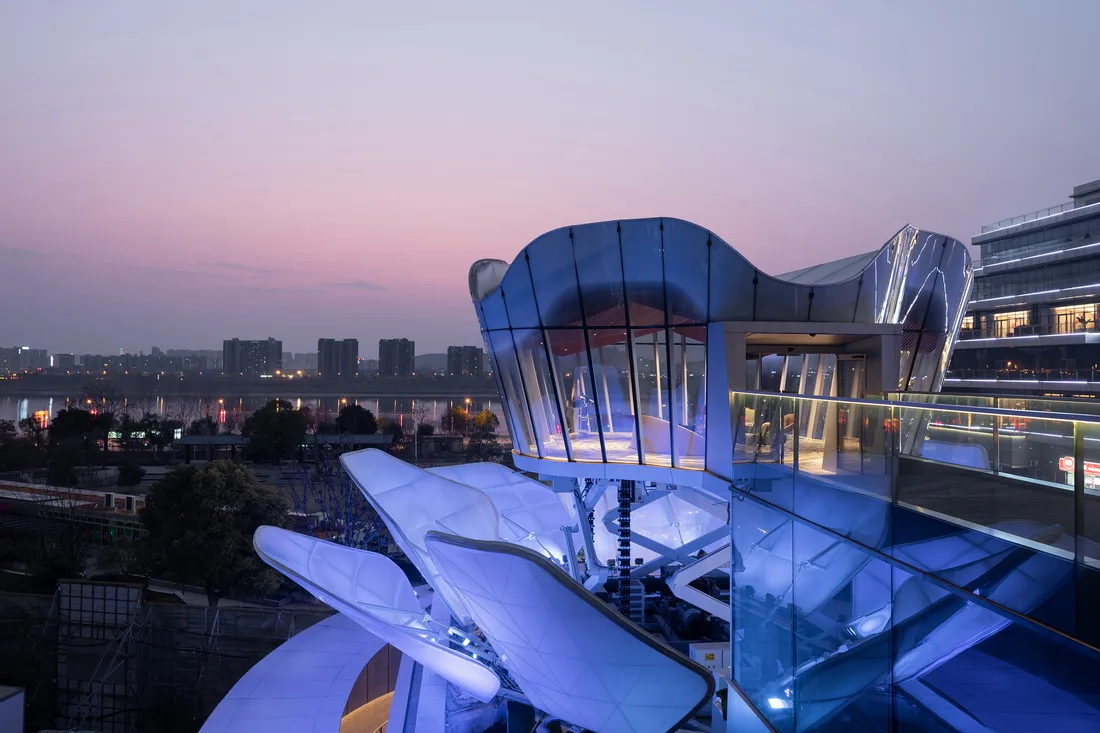
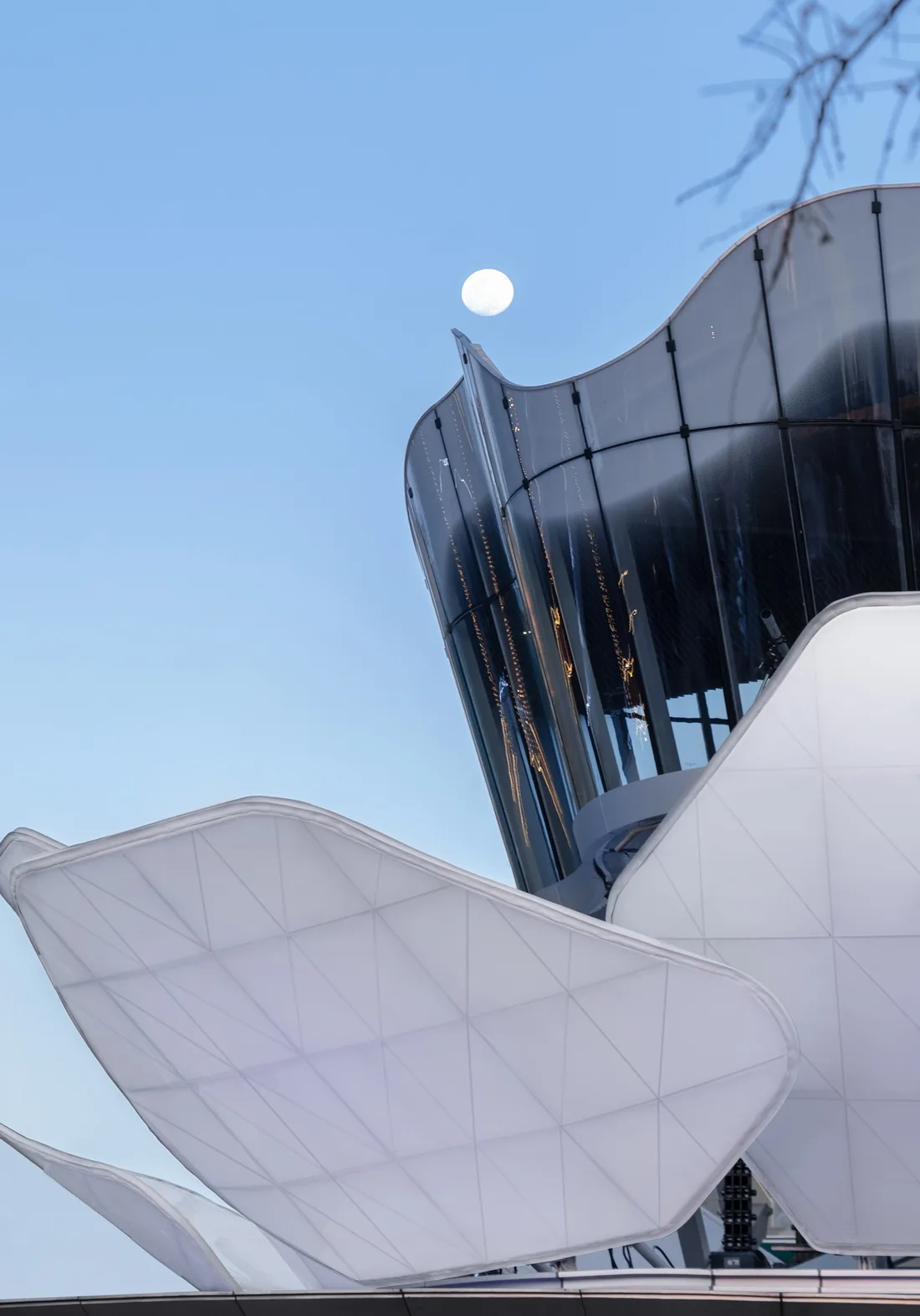
Under the dynamic commands of “open display” and “closed enclosure,” the sightseeing hall lifts from the corridor to the roof level. The facade opens outward to create a transparent viewing experience facing the Xiang River. Conversely, when the retractable skin closes, the hall descends into a private space. The overall form resembles a blooming flower, capturing the essence of the “Eye of the Xiang River.”
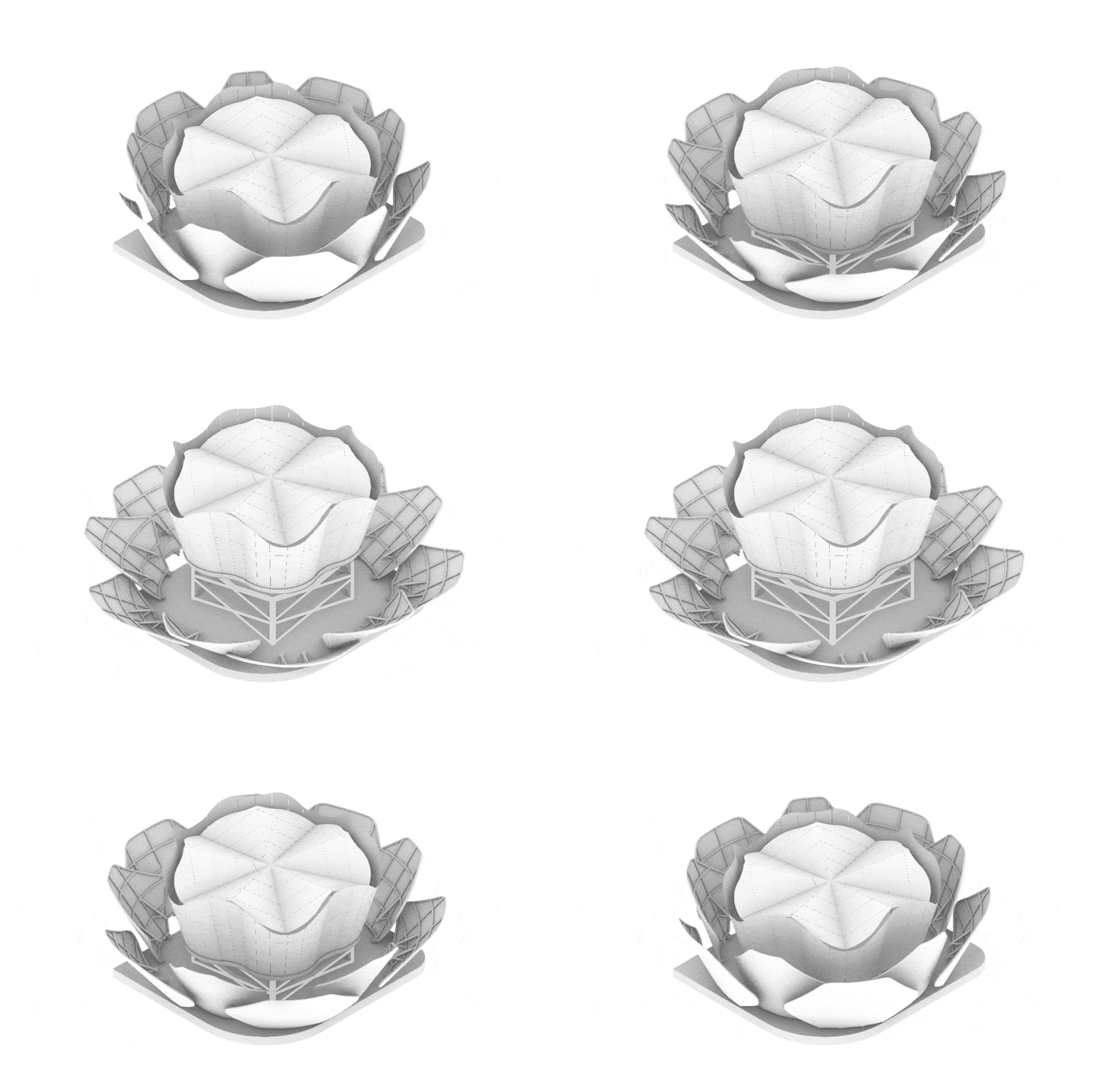
△ Dynamic unfolding sequence
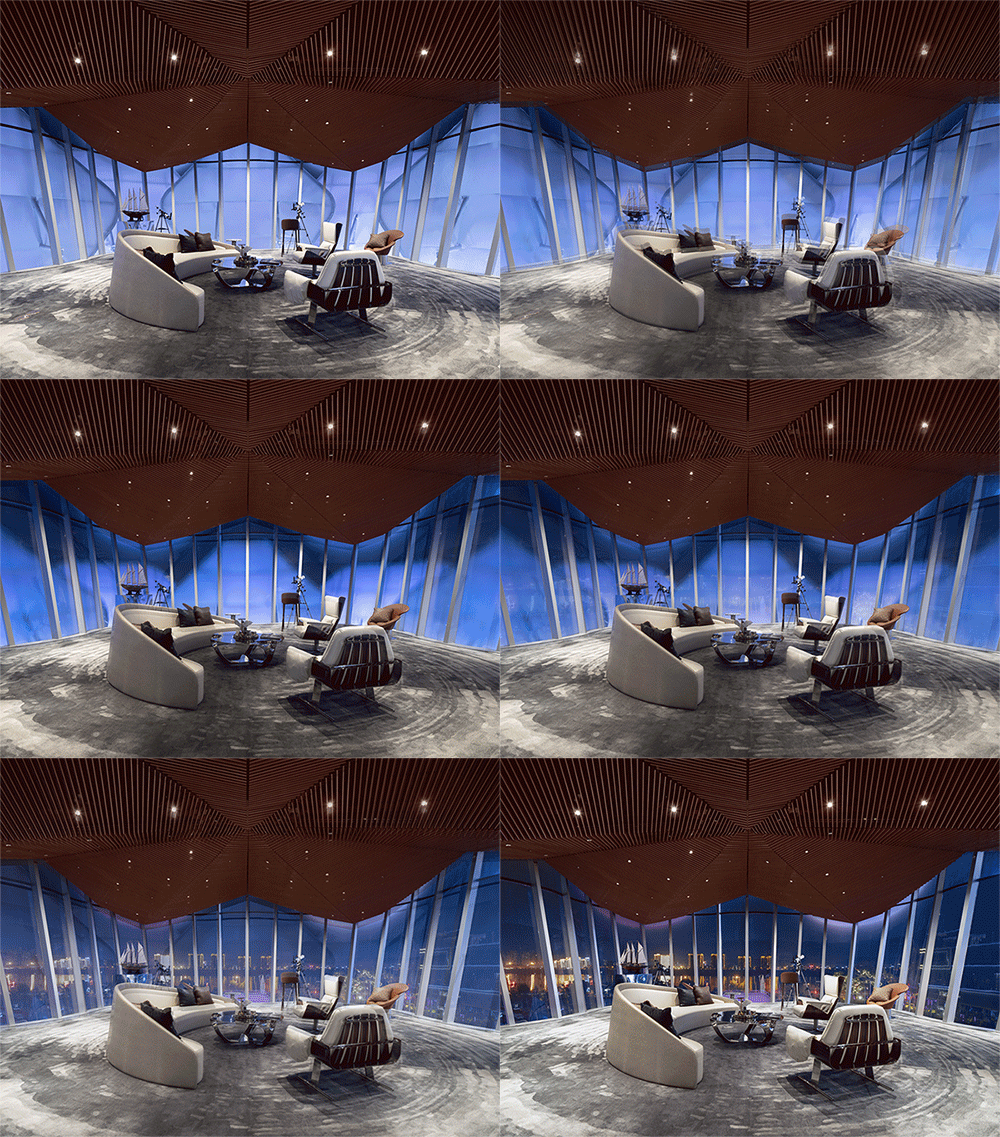
△ Interior transformation from closed to blooming and rising
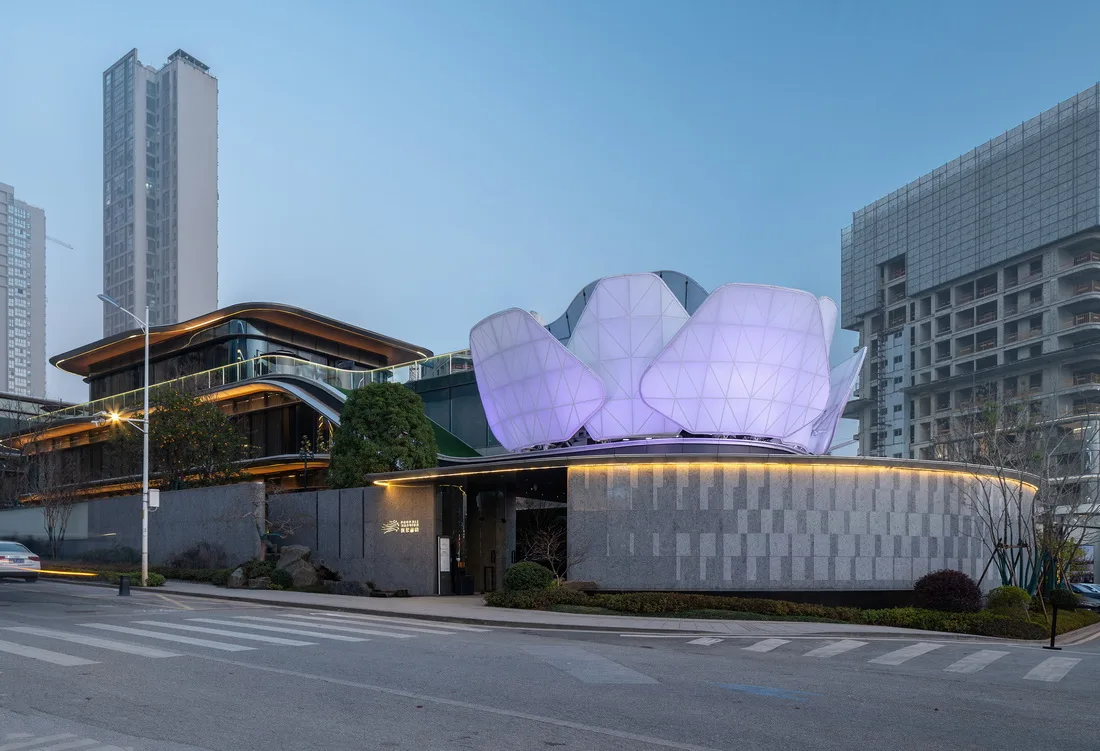
△ Closed state
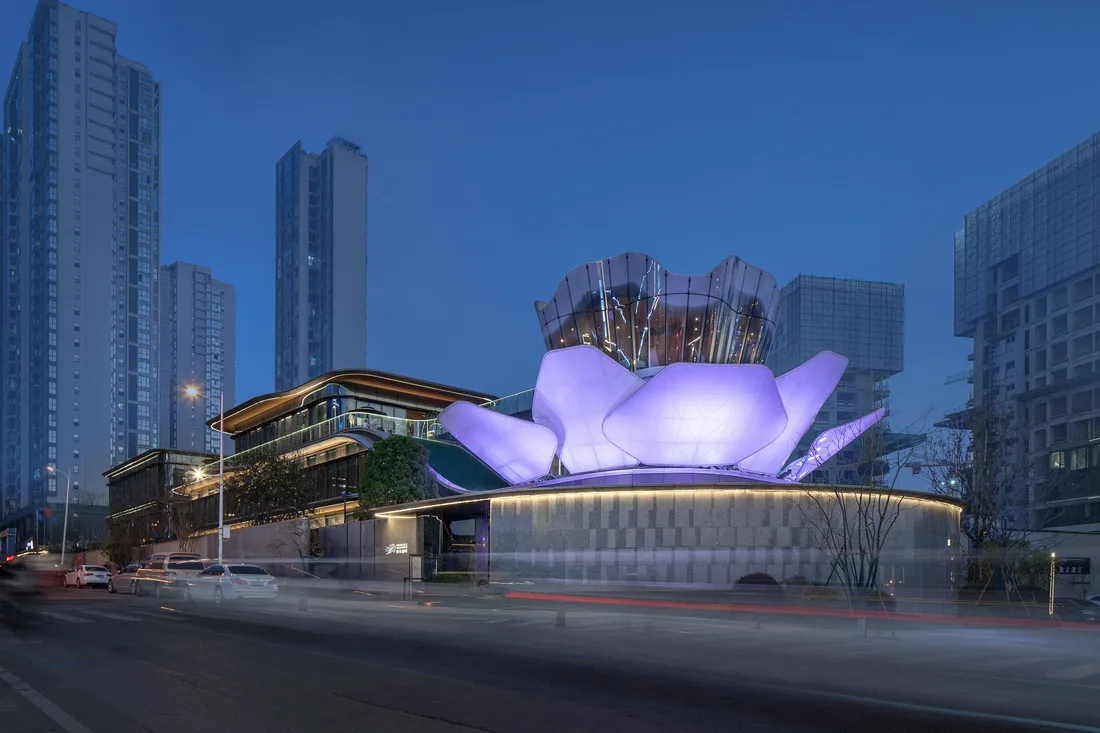
△ Blooming and rising state
During the design development, the team sought a universally recognizable form by applying modular design and standardized component assembly to enhance public resonance and interaction. The operable outer skin is divided into nine sections, combining four outer layers (7m × 5m) and five inner layers (6m × 6m). Optimized based on overlapping “petals” and opening angles, the shape was refined into a rounded hexagon, primarily using low-transparency ETFE film.
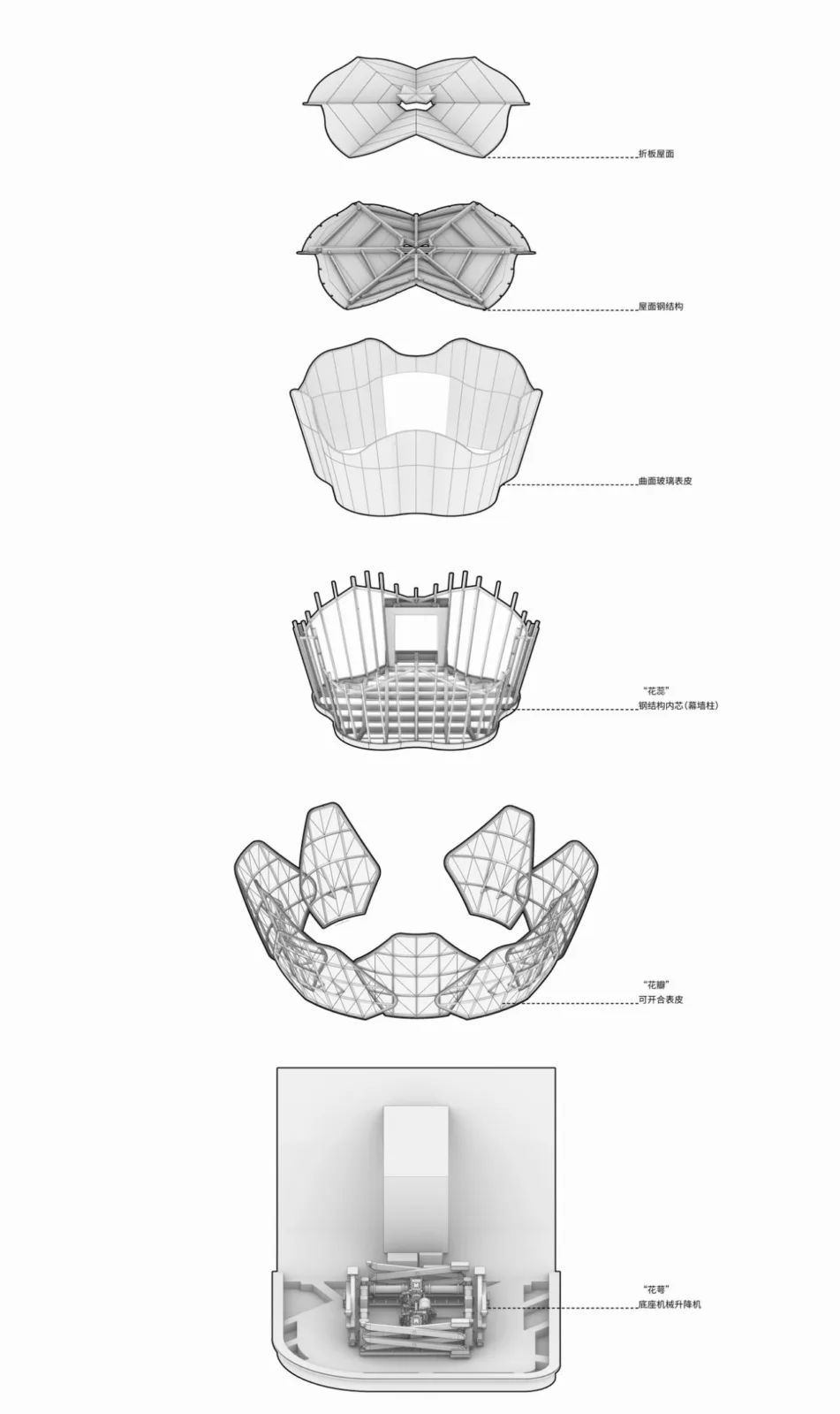
△ Structural exploded diagram
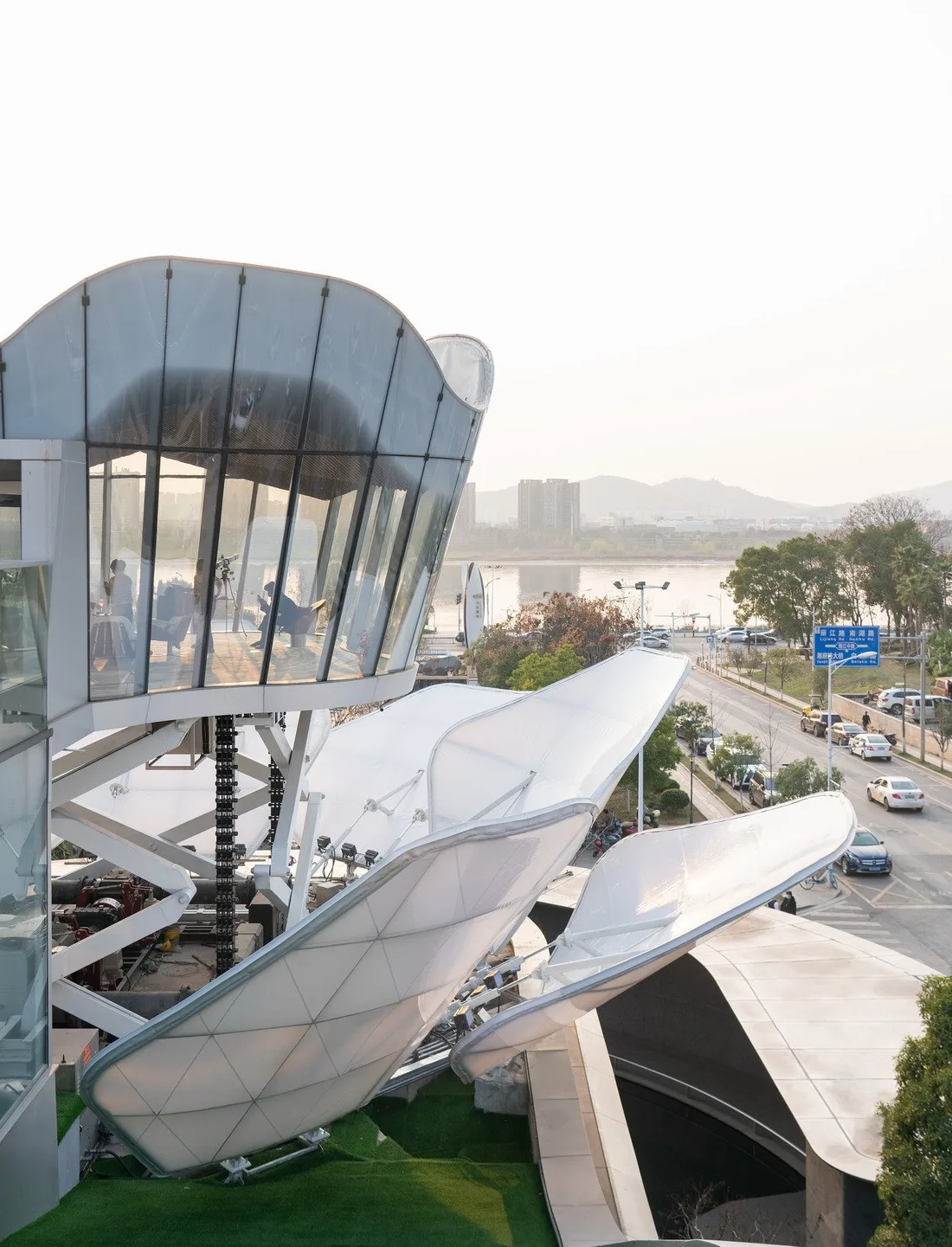
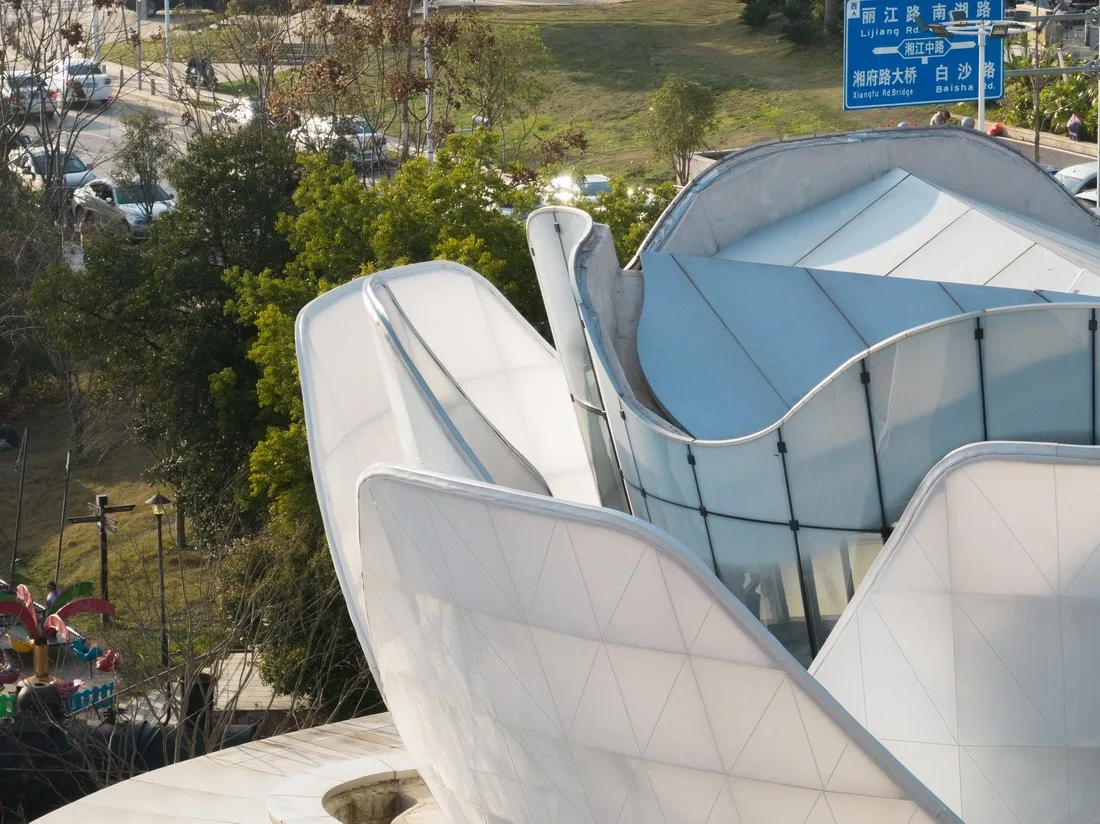
The main sightseeing hall evolved from a basic inverted circular platform, inspired by the spatial effect of flower clusters, and is enclosed by hyperbolic glass.
03 Technical Integration
Load System and Mechanical Technology
A complex load system combined with reliable mechanical technology ensures the building’s stability and dynamic performance.
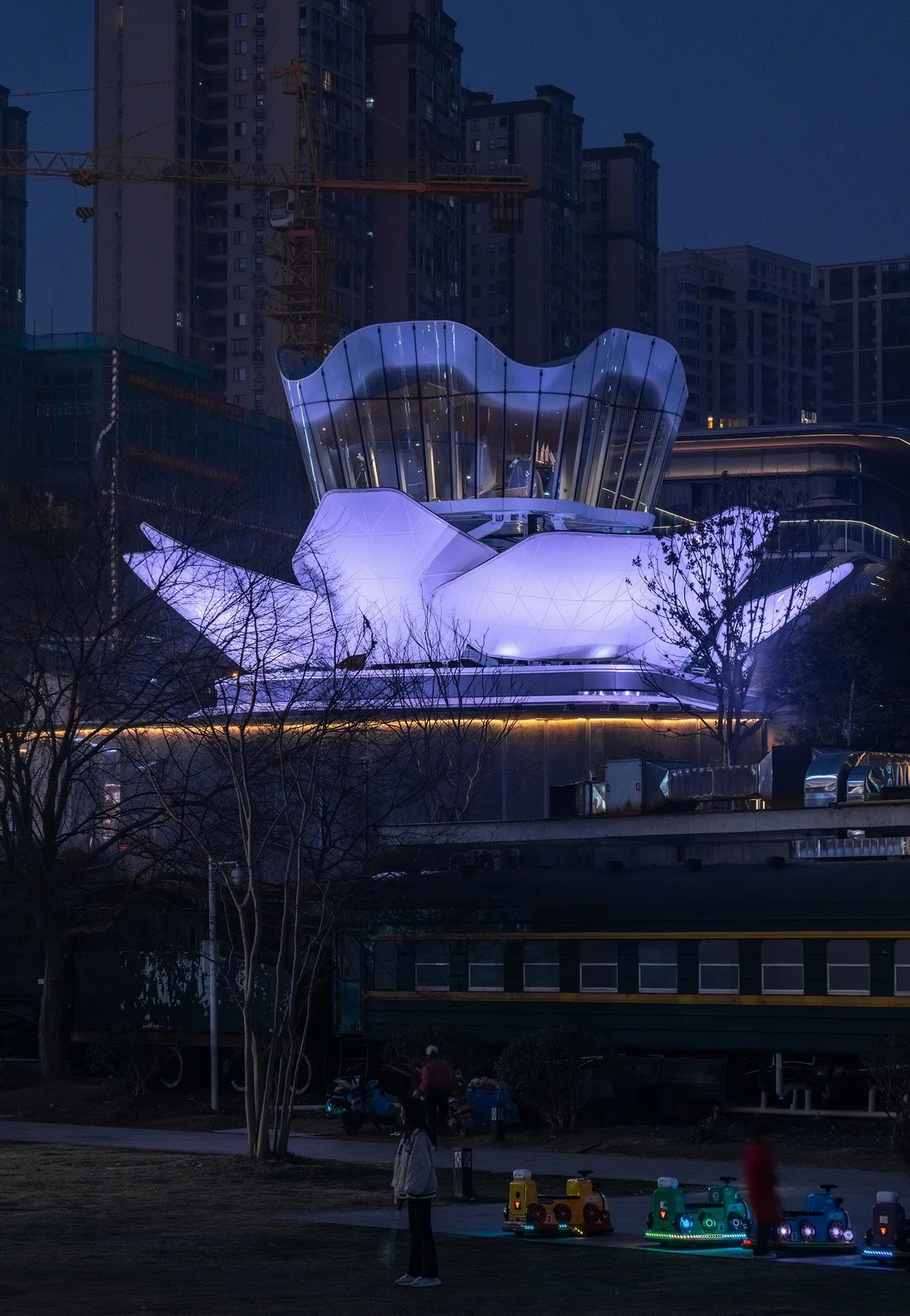
The load system integrates steel structure, glass curtain wall, and MEP components to maintain internal spatial purity and visual transparency. The main structure features a rigid large chassis with a top beam shaped to follow folded surfaces and a planar truss along the perimeter. Columns and curtain wall keels are integrated to form a unified column system that incorporates fire protection, drainage, and air conditioning components. Pipe routing is carefully planned in low-stress areas. The roof system supports window openings, smoke exhaust, fire protection, and ventilation through regional segmentation.
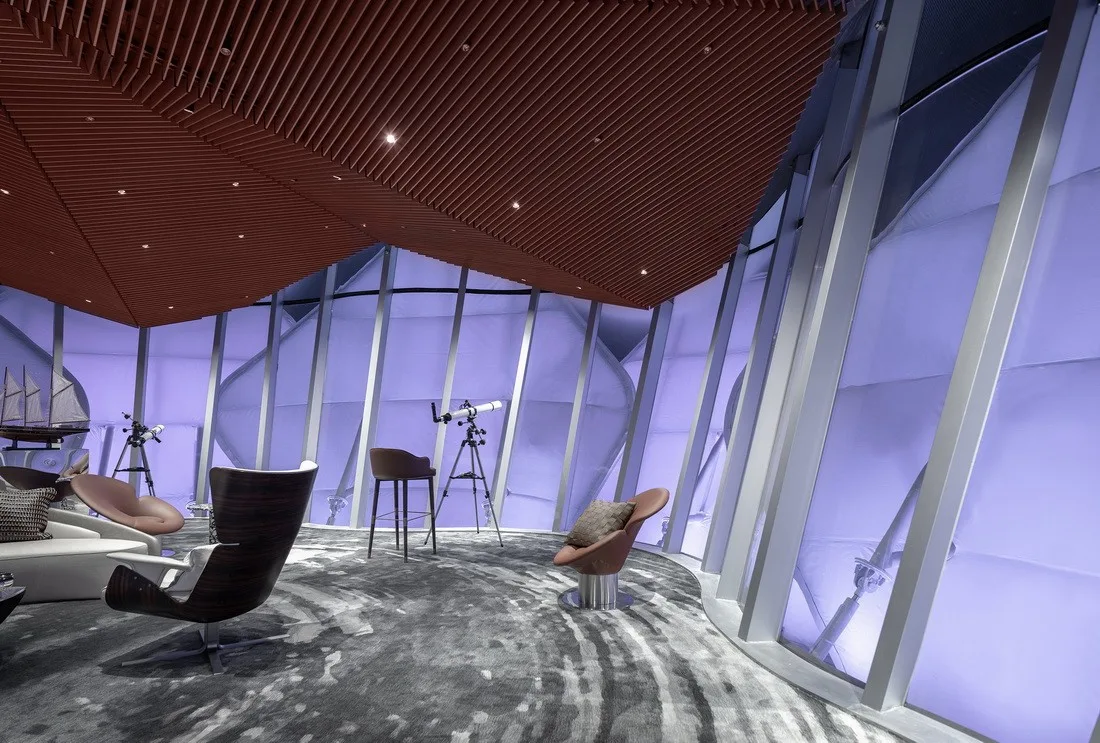
To meet high-frequency daily use and ensure mechanical reliability, the dynamic lifting system uses a “hydraulic scissor support + flexible column” configuration. This solution balances smoothness, comfort, safety, and maintainability.
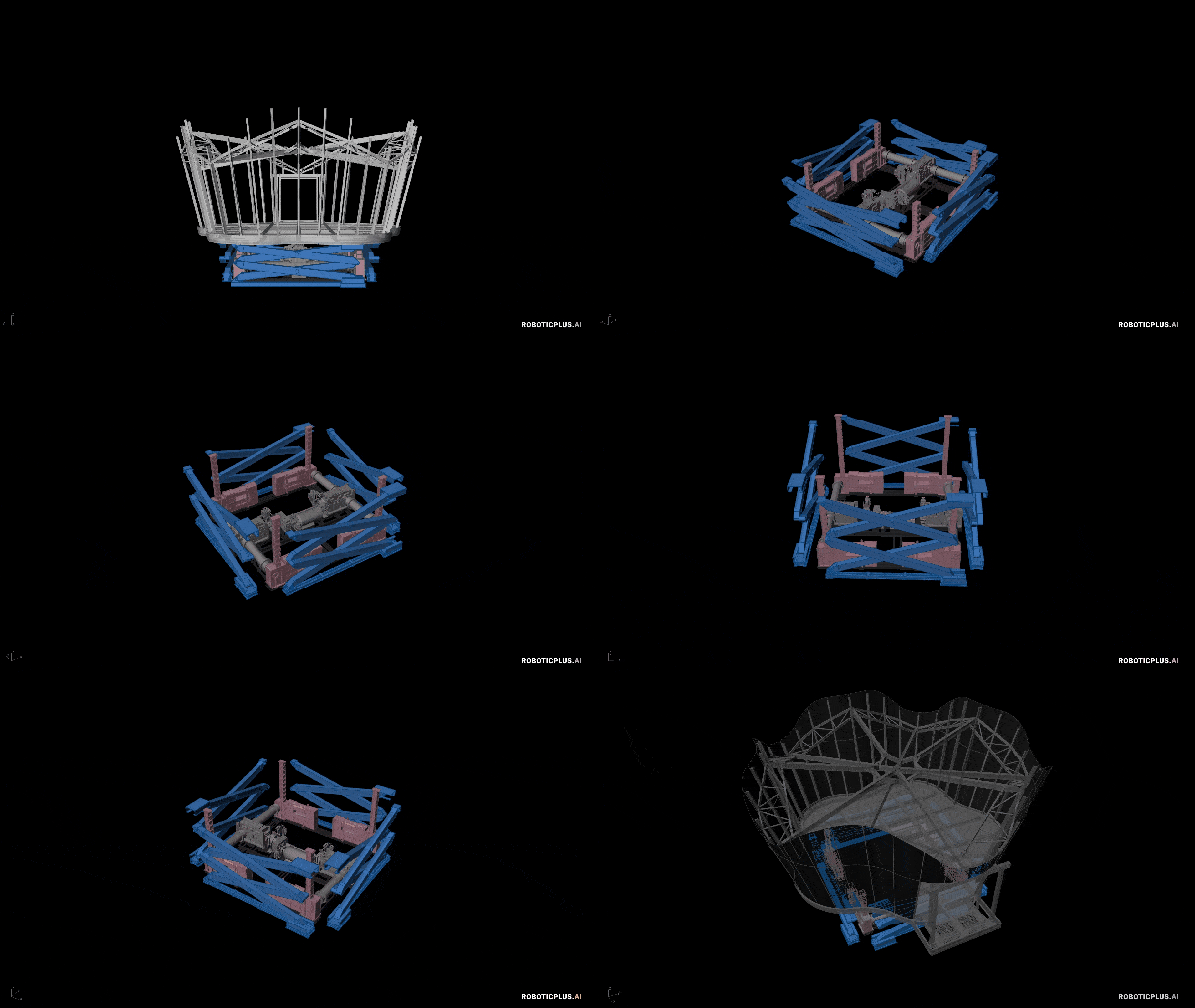
△ Flexible column operation © Da Jie Intelligent Manufacturing
Each petal of the retractable skin is connected to a bottom hydraulic rod via a hyperbolic steel frame. The staggered arrangement enables orderly opening and closing, controlled by an intelligent linkage system combining motor, reducer, and large turntable. Programmed settings adjust angle and speed for petals at different levels, allowing the building to dynamically respond to surrounding office and residential developments by avoiding prolonged visual obstruction.
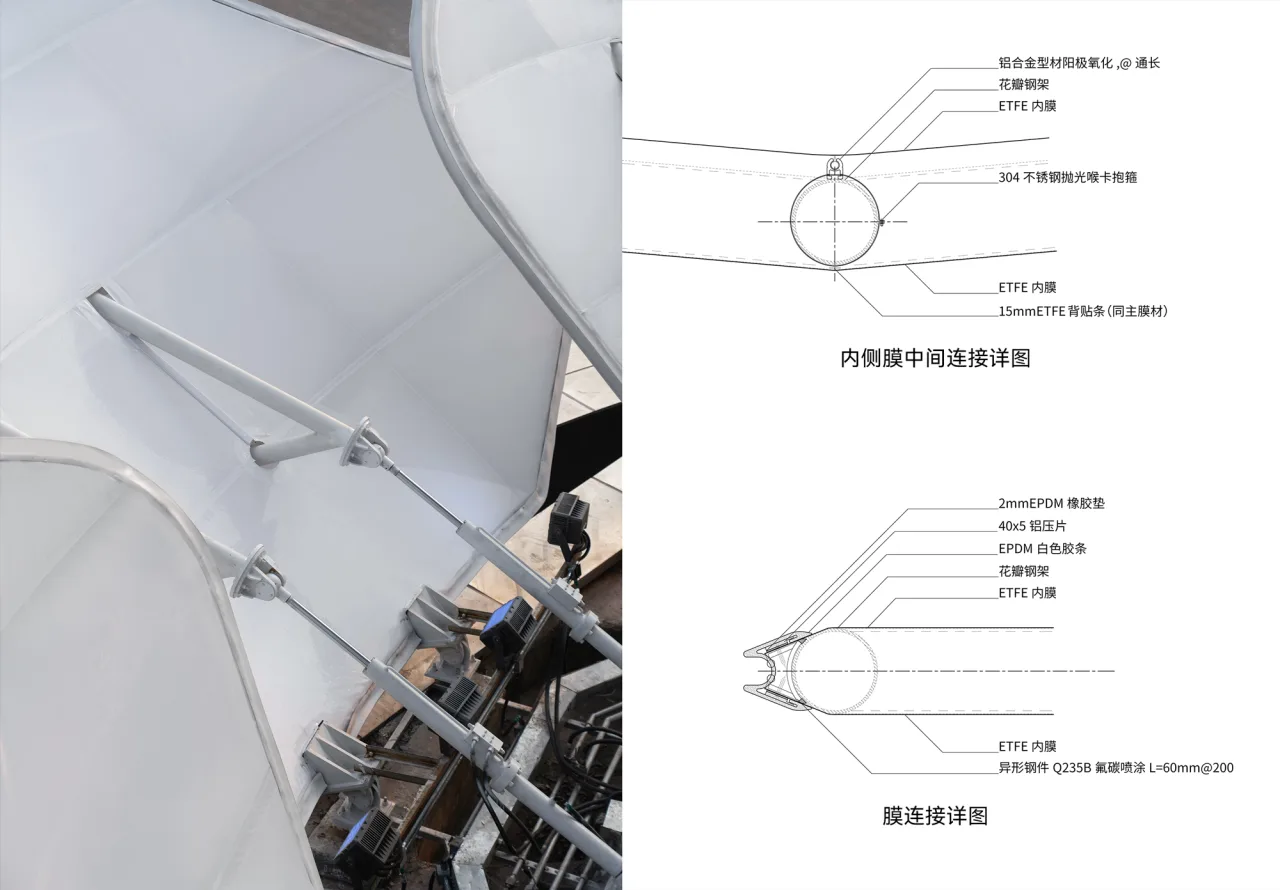
△ Connection nodes
04 Interactive Intelligent Manufacturing
Digital Design and Smart Construction
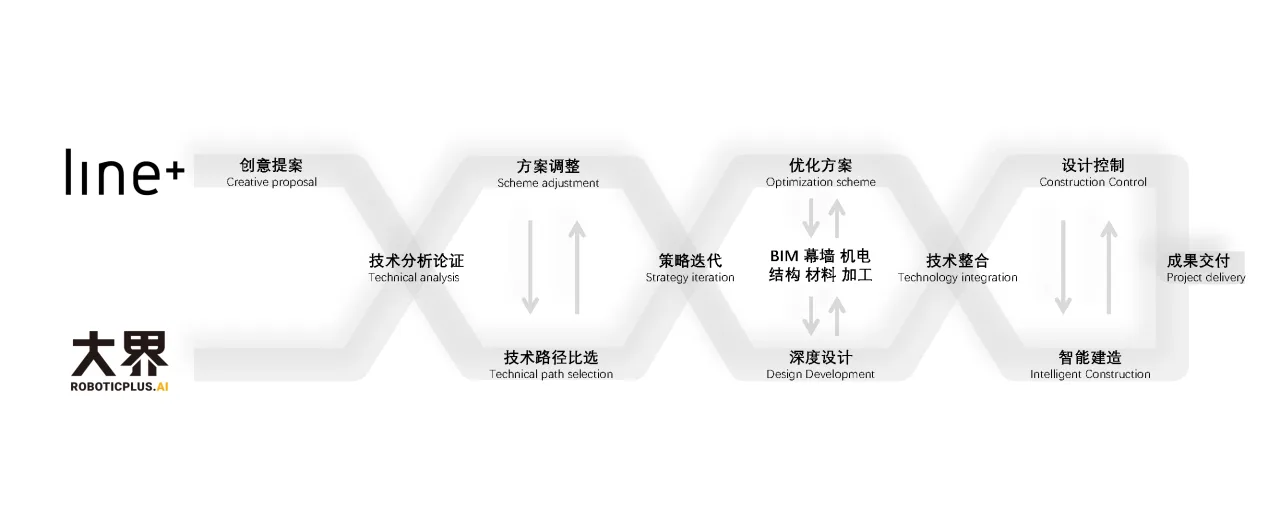
In developing the “Xiangjiang Eye,” interdisciplinary collaboration transformed the traditional linear workflow of “demand → design → drawing → construction” into an iterative, interactive process.
During design development and construction, Line+ partnered with Dajie Intelligent Manufacturing to implement full-process digital optimization, factory-driven intelligent component production, and prefabricated assembly. This approach ensures efficiency, precision, and control throughout the project lifecycle.
Using digital technology and optimization algorithms, the team transitioned from Rhino to Revit, leveraging Dajie’s proprietary RoBIM industrial software. This enabled detailed simulation of steel structure assembly, spatial cutting, drilling, calibration, and joint positioning. Construction joint details were integrated into the overall design and processing data, reducing errors and improving efficiency.
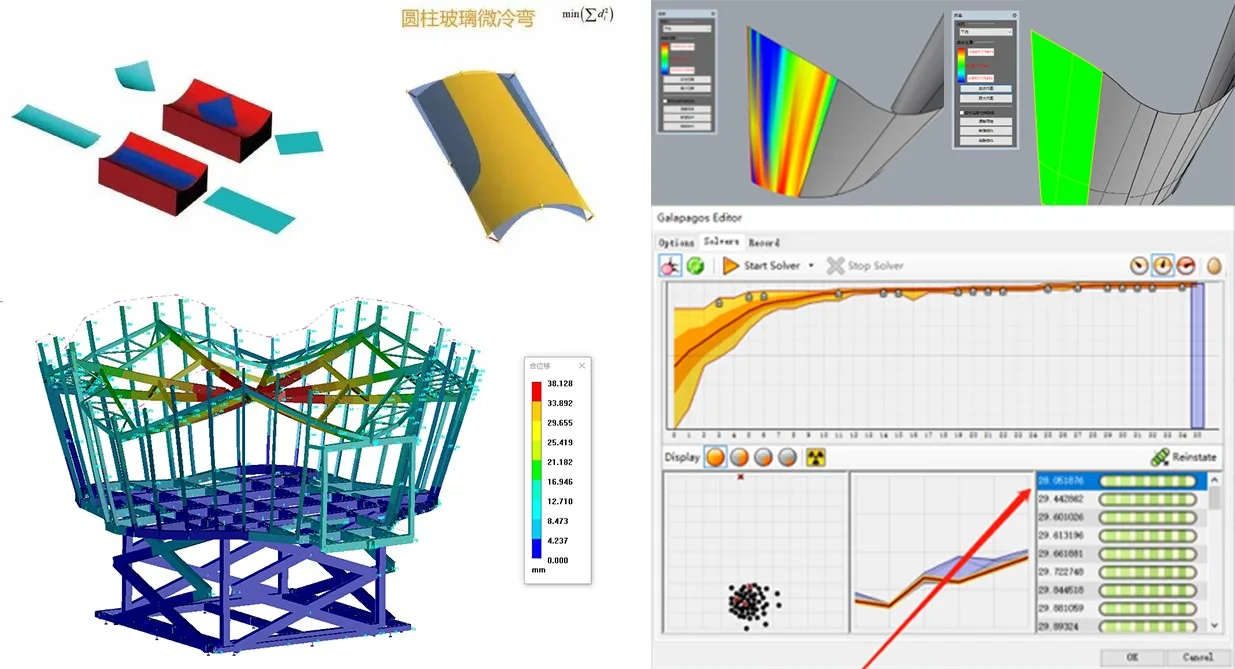
△ Digital Technology and Optimization Algorithms © Da Jie Intelligent Manufacturing
The building parts production information model was developed with BIM at LOD 400 level, detailing every system component. This model interfaces directly with manufacturing plants, supporting simulation of transportation, loading, storage, hoisting, and installation, thereby enhancing project management precision to industrial construction standards.
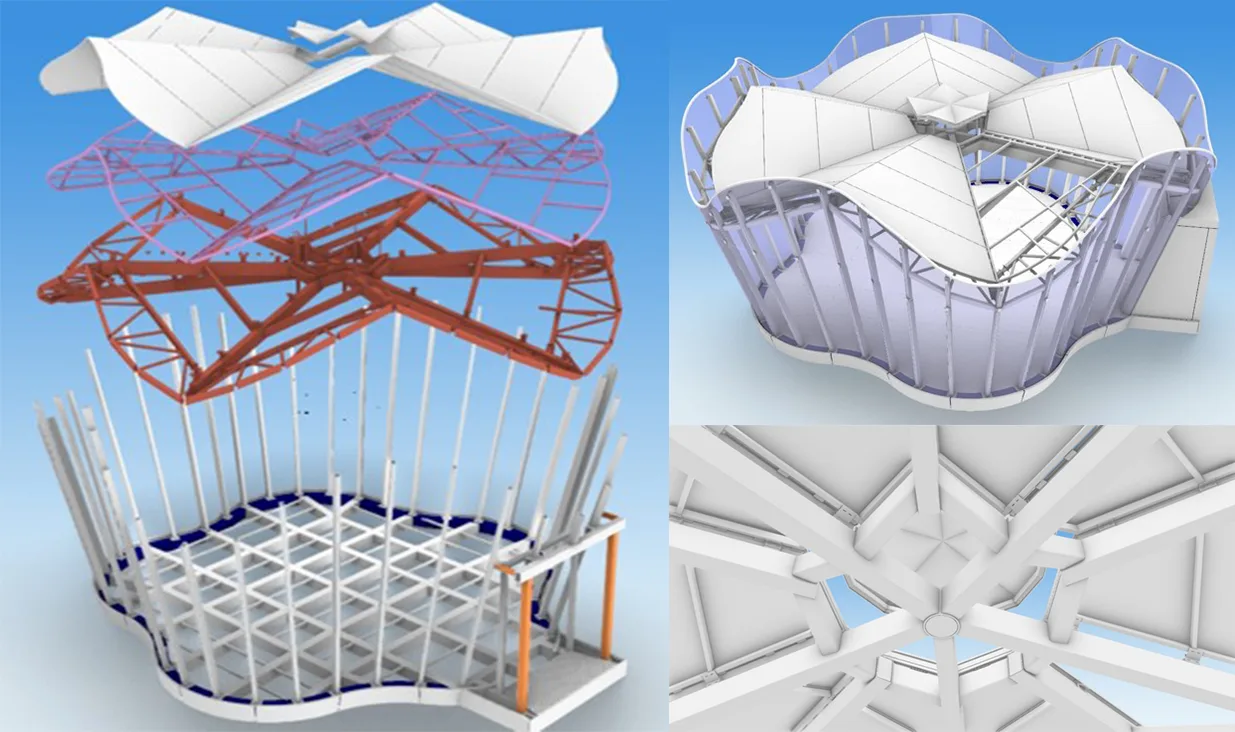
△ Building Production Information Model © Da Jie Intelligent Manufacturing
Intelligent flexible production integrates all model information via the RoBIM platform, enabling data exchange among smart processing equipment. CNC production is automated, including component welding by a 7-axis robotic arm and synchronous pre-assembly and construction.
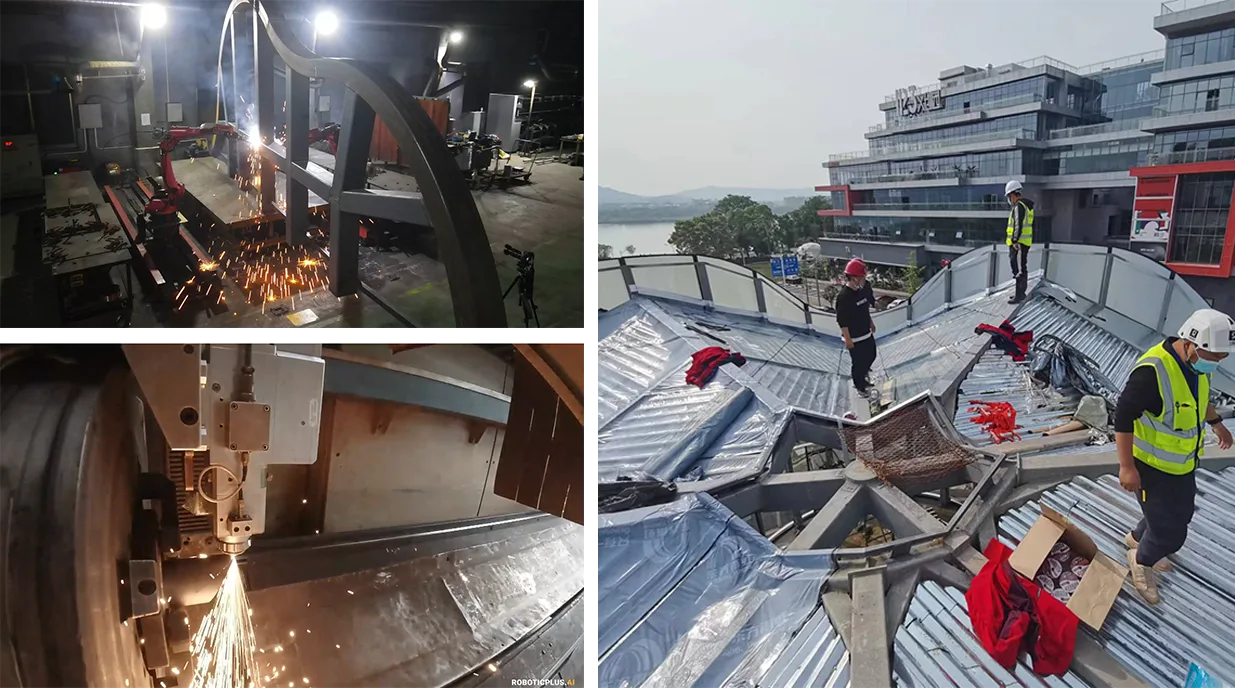
△ Intelligent and flexible production © Da Jie Intelligent Manufacturing
Virtual construction simulation divides pre-assembled components into large sections for truck transport and rapid onsite installation, achieving industrialized manufacturing for custom buildings. Synchronized simulations of mechanical and steel structure assembly optimize construction sequencing, ensuring timely project delivery.
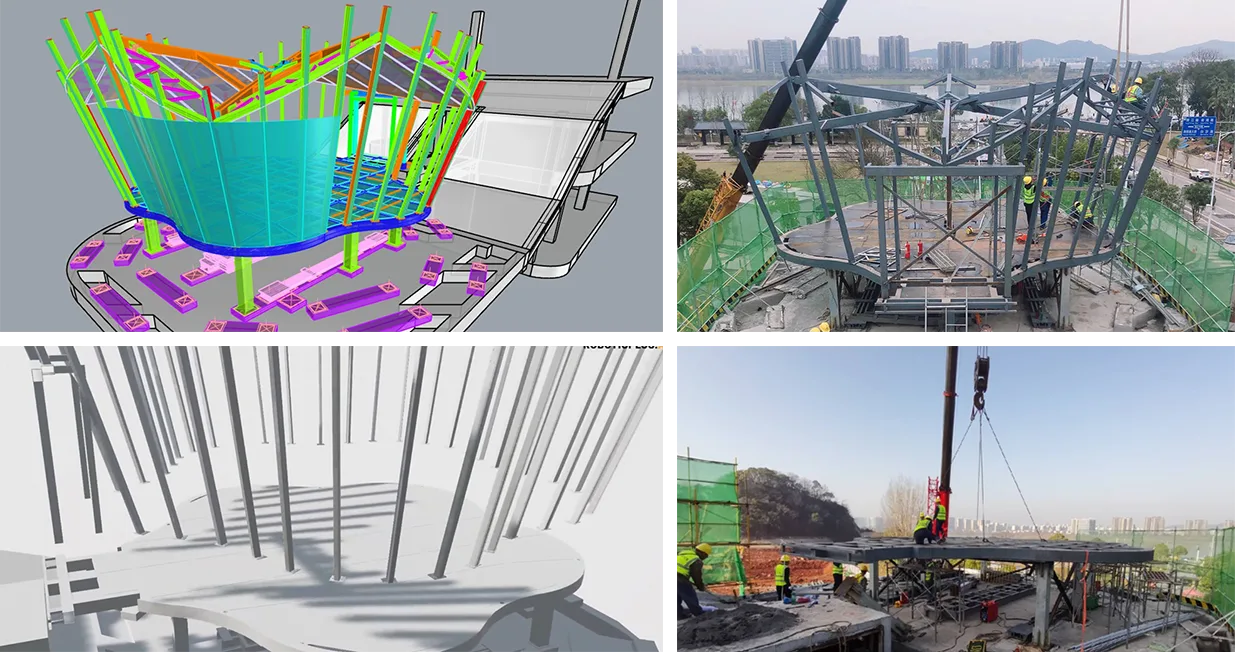
△ Virtual construction simulation © Da Jie Intelligent Manufacturing
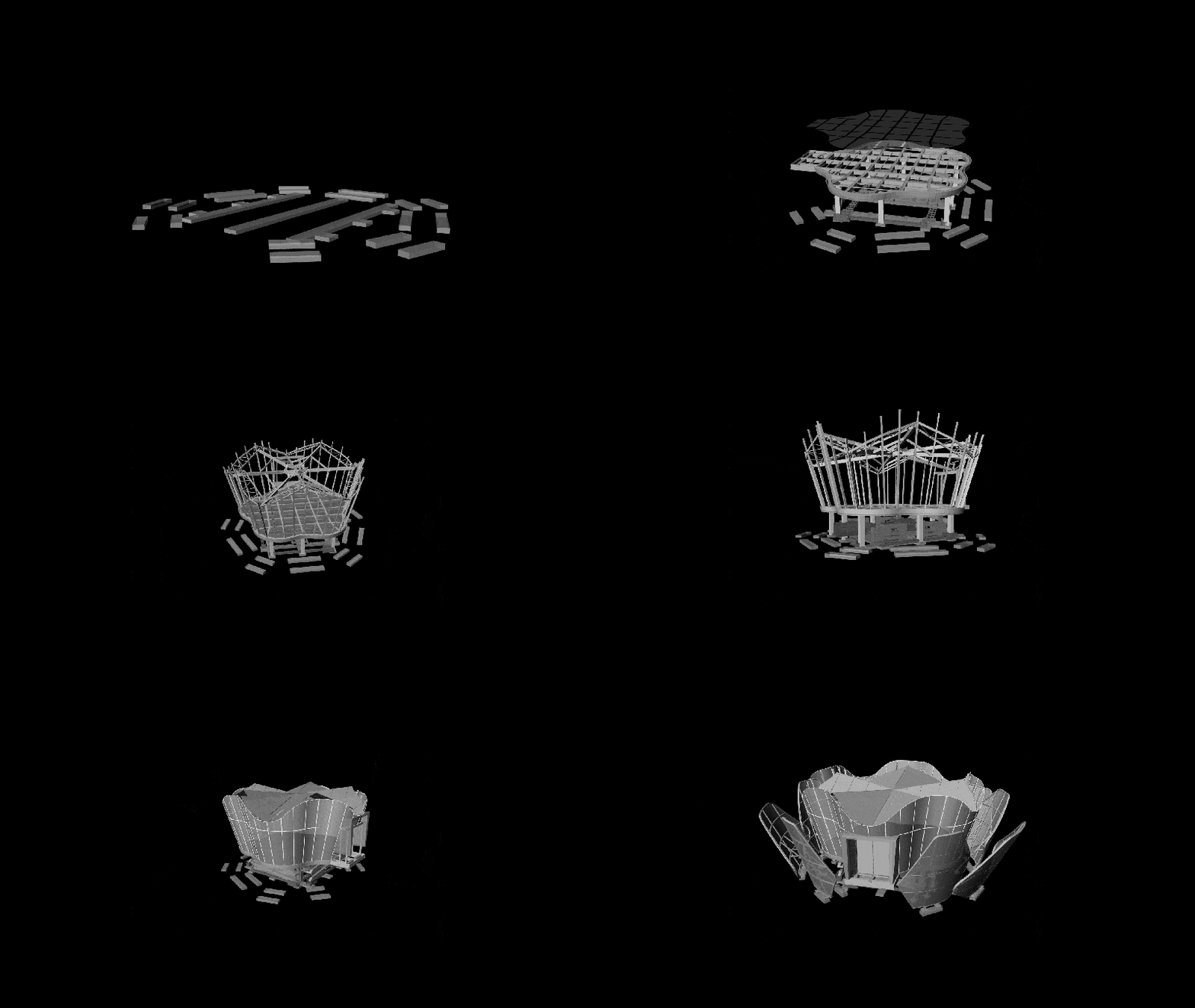
△ Construction simulation © Da Jie Intelligent Manufacturing
Conclusion
Architecture has long been considered “frozen music,” its static nature shaped by traditional construction methods and structural systems. The “Xiangjiang Eye” redefines urban public space by integrating industrial facility design and cutting-edge technologies such as digital modeling, simulation, and intelligent construction. It breaks the dimensional constraints of conventional architecture, pioneering a dynamic approach where space is fluid and ever-changing.
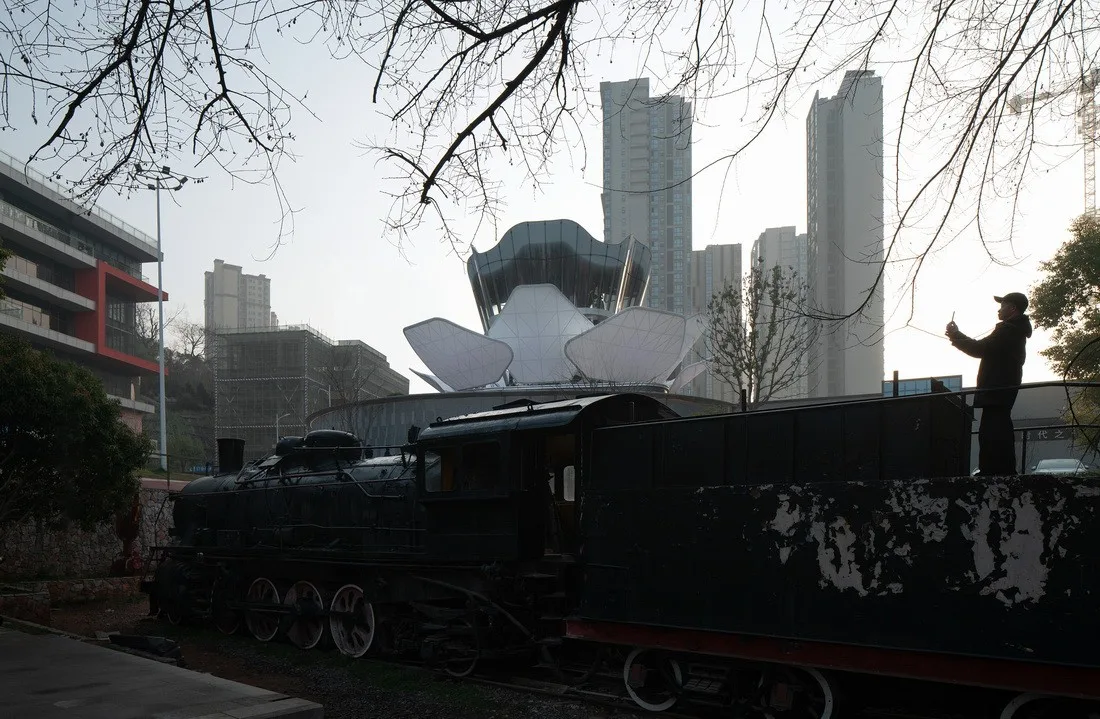
Meanwhile, the rise of AI and industrialized building trends are reshaping the traditional relationship between architects and builders. This project explores how new architectural productivity can empower evolving urban environments and respond to the subtle changes of our era.
Technical Drawings
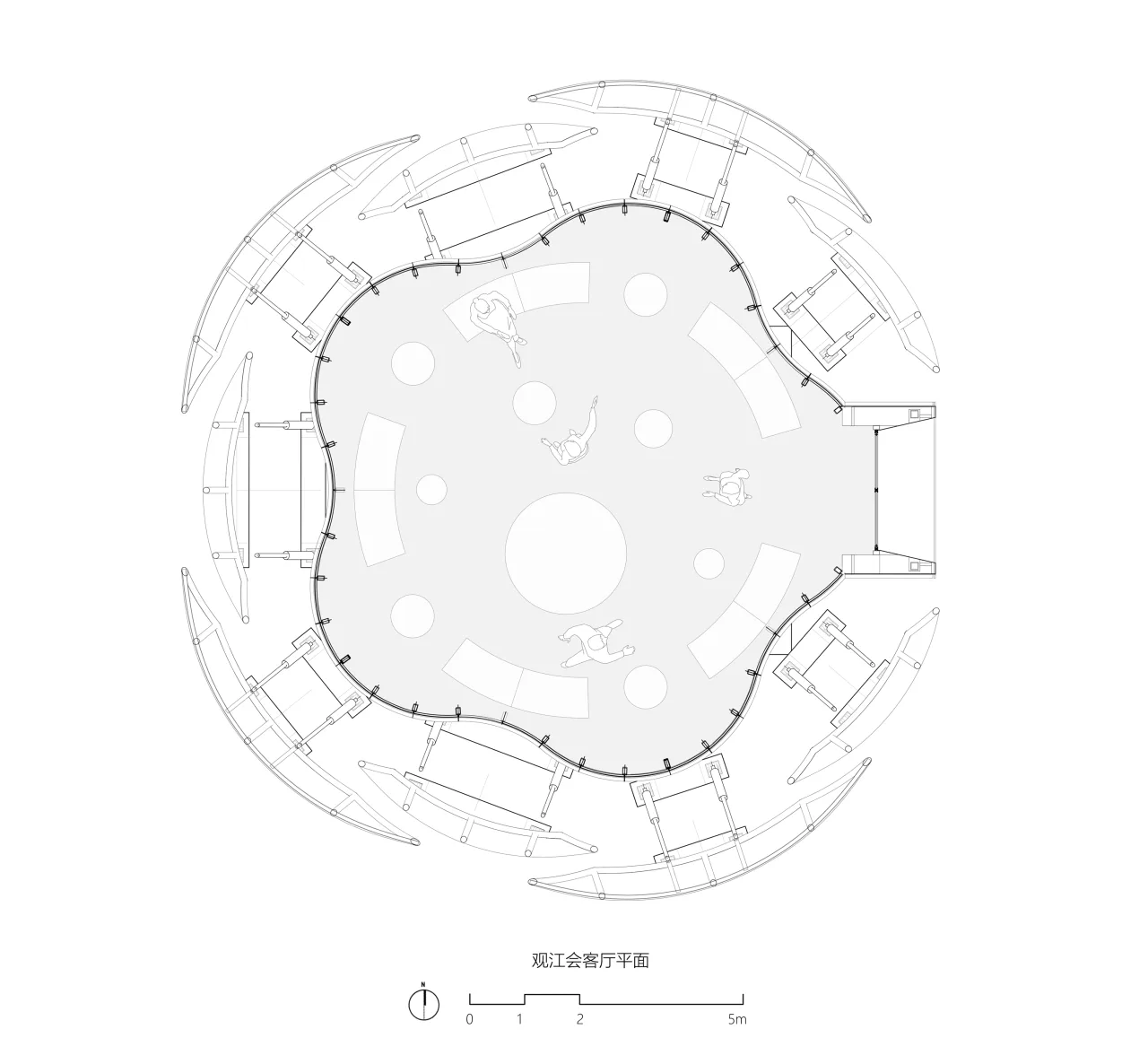
Plan of the “Hua Rui” Sightseeing Hall
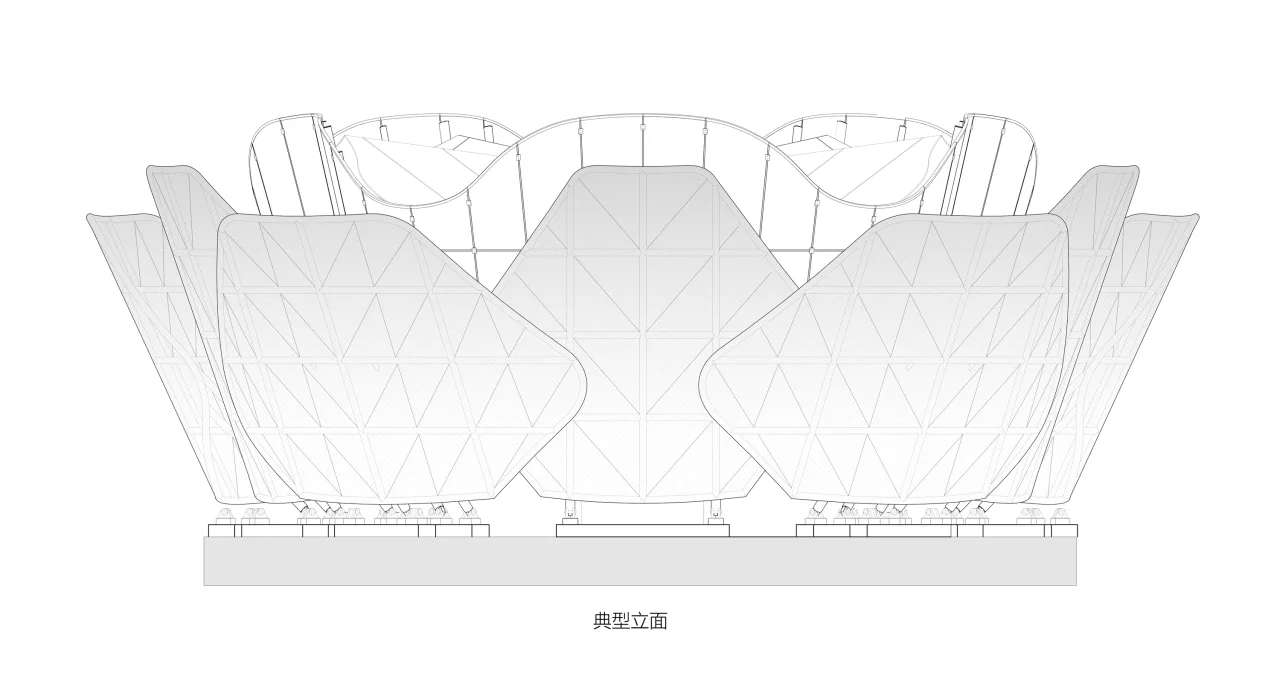
△ Façade of “Hua Rui” Sightseeing Hall
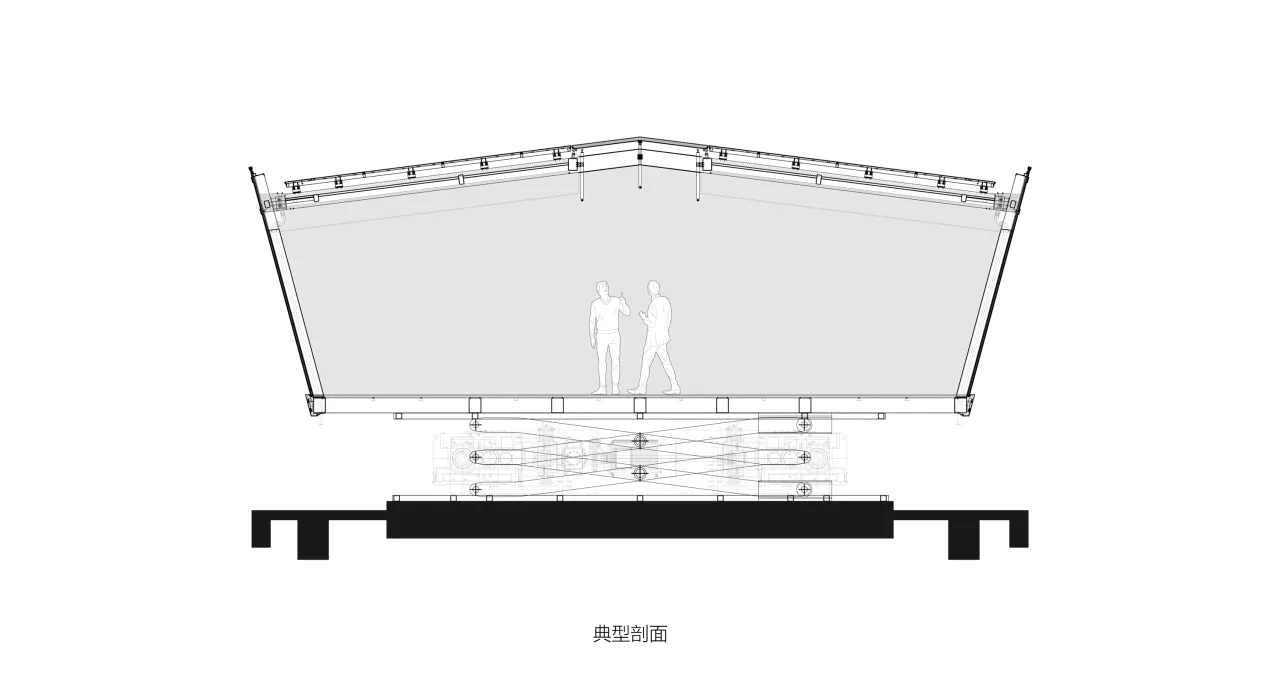
△ Section of “Hua Rui” Sightseeing Hall
Project Information
Project Name: Changsha “Eye of the Xiangjiang River”
Design Firm: Line+ Architectural Firm
Lead Architect / Project Creator: Zhu Peidong
Design Team: Li Binmiao, Bian Qian, Duan Xiajing, Xu Zifeng, Zhang Daozheng
Owner: Greentown China
Intelligent Construction: Shanghai Dajie Robot Technology Co., Ltd.
Location: Changsha, Hunan
Building Area: 78 m²
Design Period: July 2021 – January 2022
Construction Period: February 2022 – July 2022
Structure: Steel structure
Materials: ETFE film, curved glass
Photography: Xingzhi Image – Li Yi















Must log in before commenting!
Sign Up