
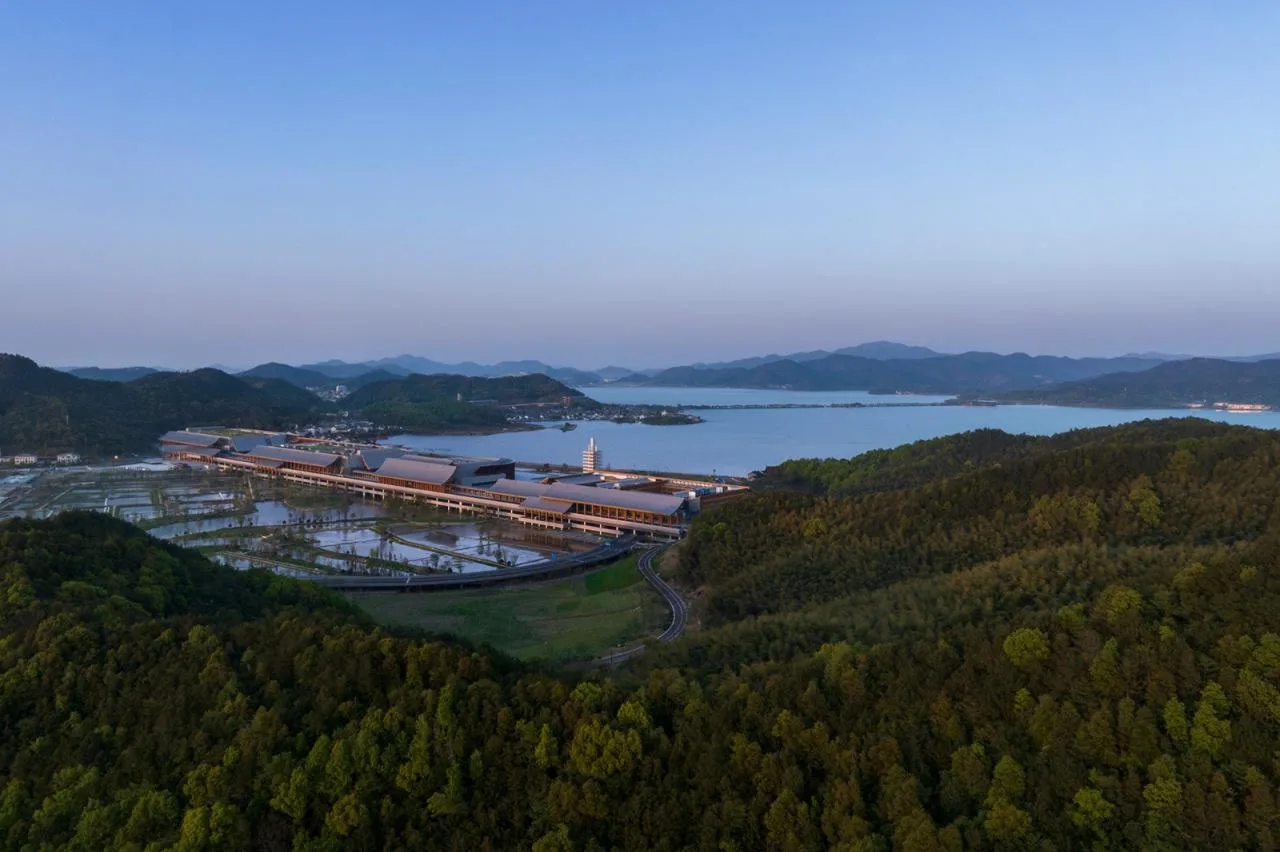
△ Photography: Geek Vision | Xie Zhenguo © Tang Hua Architectural Design
△ Project video, photography: Geek Vision | Xie Zhenguo © Tang Hua Architectural Design
“It is of world-class standard and full of the charm of Jiangnan in China.” This covered bridge conference center, nestled between lush waters and mountains, was born at a historic moment, showcasing distinctive local and unique characteristics. It stood out in global competition and was successfully completed. Serving as a venue for government and business activities related to the “Belt and Road” initiative and “Yangtze River Delta Integration,” as well as a symbol of national culture, it has become a bridge connecting Ningbo to the world.
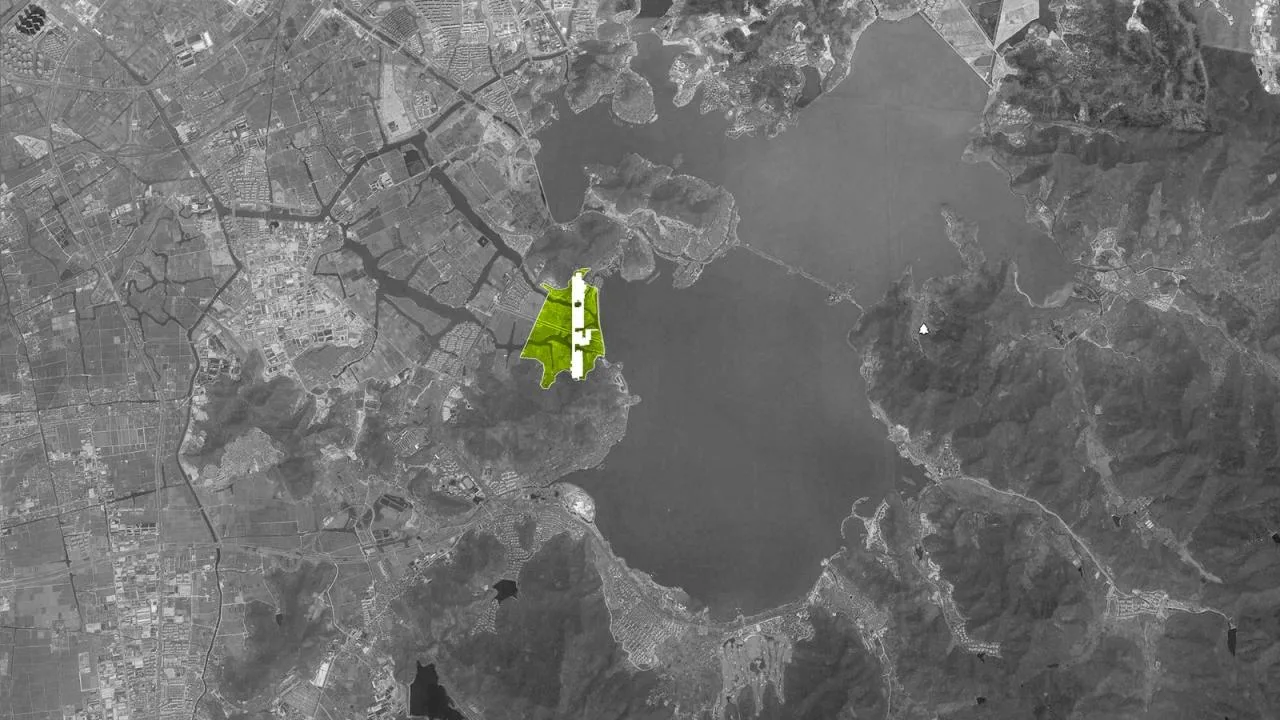
△ Location Map © Tang Hua Architectural Design
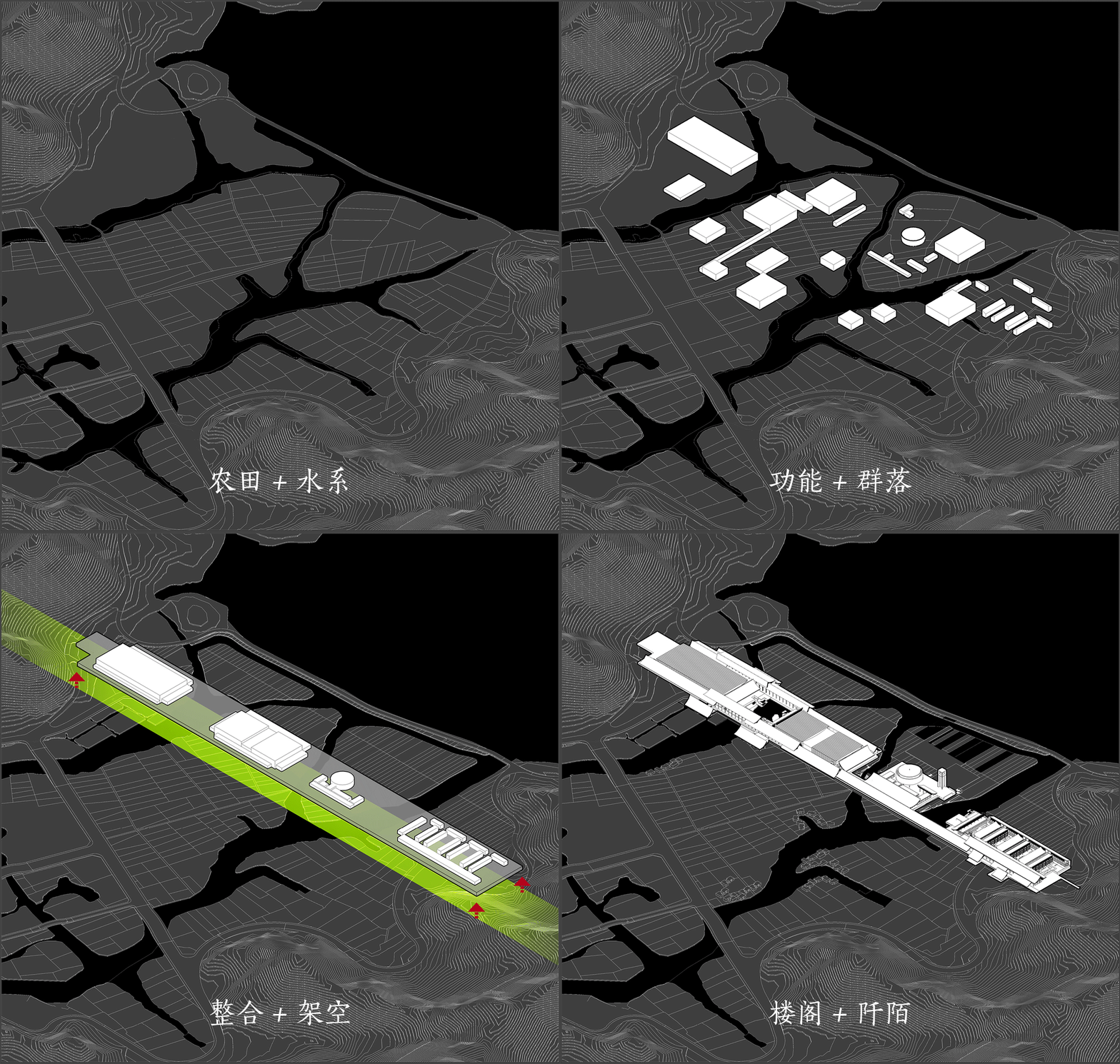
△ Design Evolution © Tang Hua Architectural Design
The conference center is situated in the Dongqian Lake Scenic Area of Ningbo City, adjacent to the west bank of Dongqian Lake. It is bordered to the north by Yidashan and to the south by Dongkengshan. The core site covers approximately 49 hectares (735 acres), where streams, rivers, lakes, mountain streams, lotus ponds, water outlets, and riverbanks converge alongside thousands of acres of rice paddies and wetlands.
#01 Ecological Protection and Environmental Sustainability
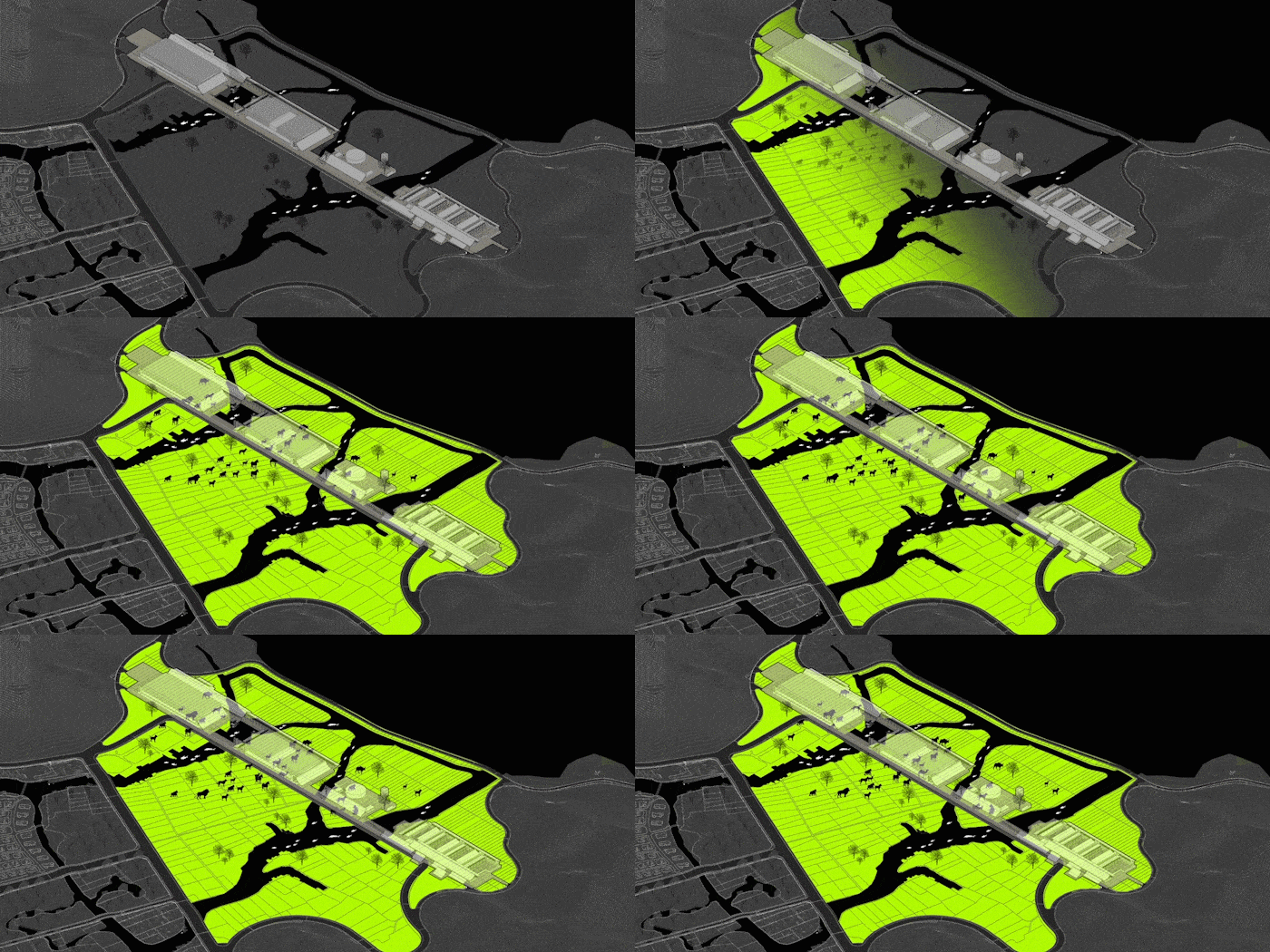
△ Preserving Farmland and Maintaining Ecological Continuity © Tang Hua Architectural Design
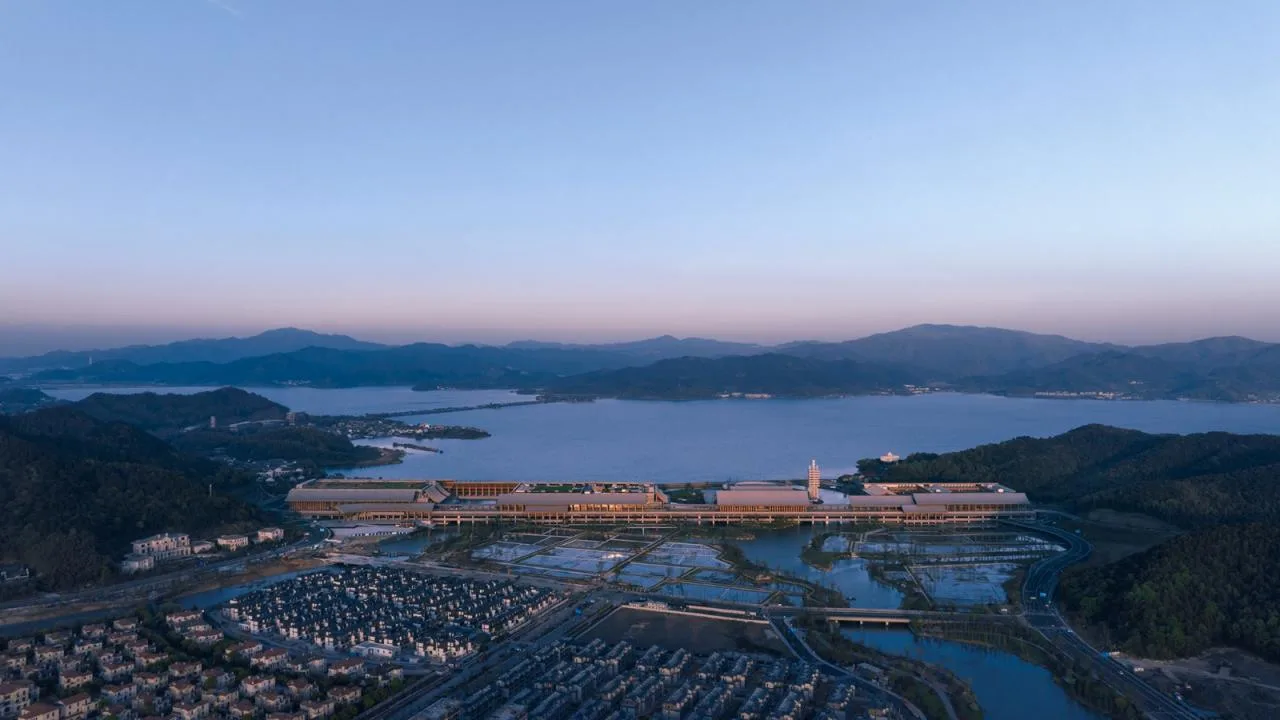
△ Photography: Geek Vision | Xie Zhenguo © Tang Hua Architectural Design
The design fully preserves the existing topography, water systems, and ecosystem of the site. The conference center complex is densely arranged in a north-south oriented belt, extending one kilometer in length and 100 meters in depth. This compact building layout allows preservation of 550 acres of agricultural landscape—a romantic retention of farmland amid rapid urban expansion.
This approach balances building density with industrial development and retains flexibility for future urban growth. The preserved farmland acts as a buffer zone, maintaining ecological continuity and enhancing rain and flood resilience, aptly described as “urban field symbiosis.”
#02 Function Layout and Scale
The corridor bridge is divided into four zones by three water outlets on the site, with urban public functions gradually diminishing from north to south. The northern section houses a large multifunctional hall spanning 11,000 square meters. Moving southward, it includes a main venue of 5,500 square meters, a banquet hall of 3,700 square meters, a summit hall covering 1,800 square meters, and a five-star hotel with 342 guest rooms at the southern end.
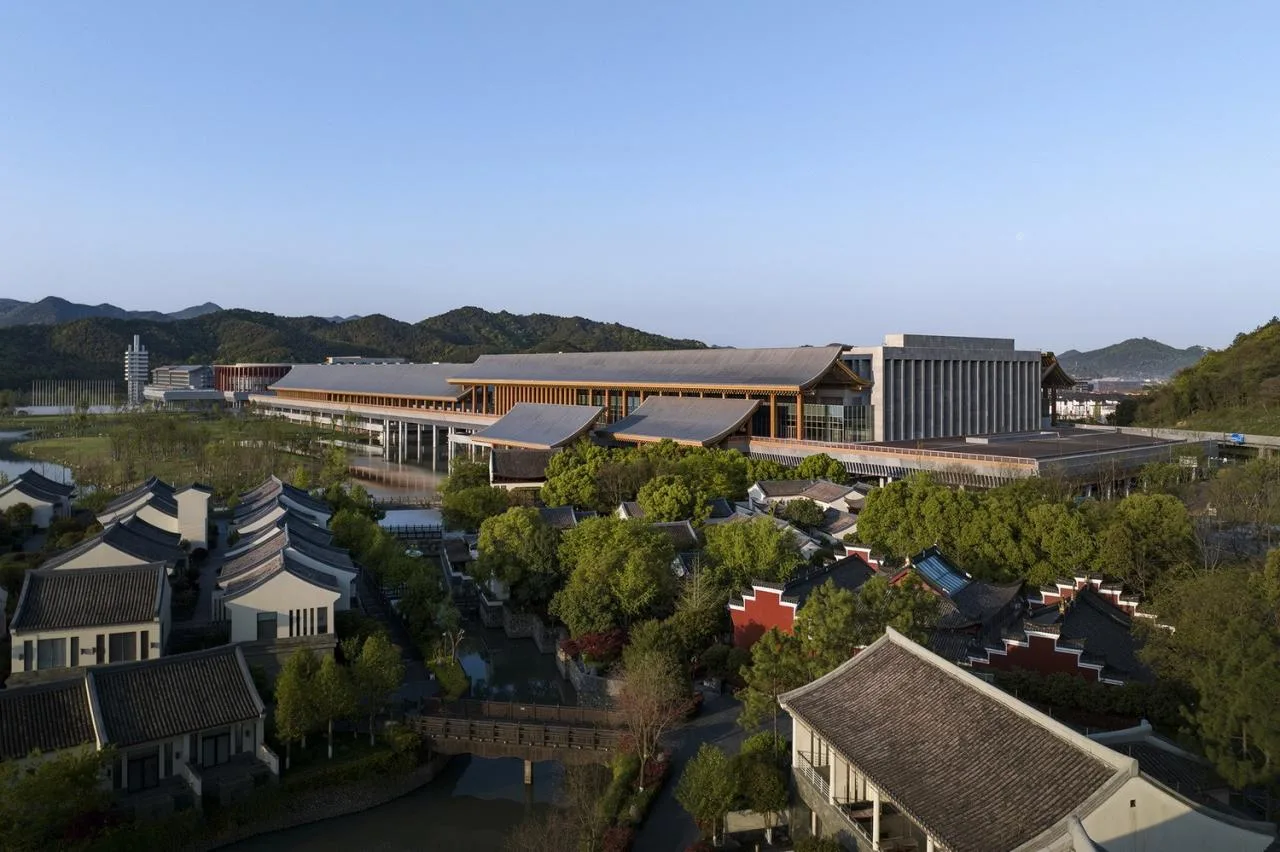
△ Large multifunctional hall, photography by Geek Vision | Xie Zhenguo © Tang Hua Architectural Design
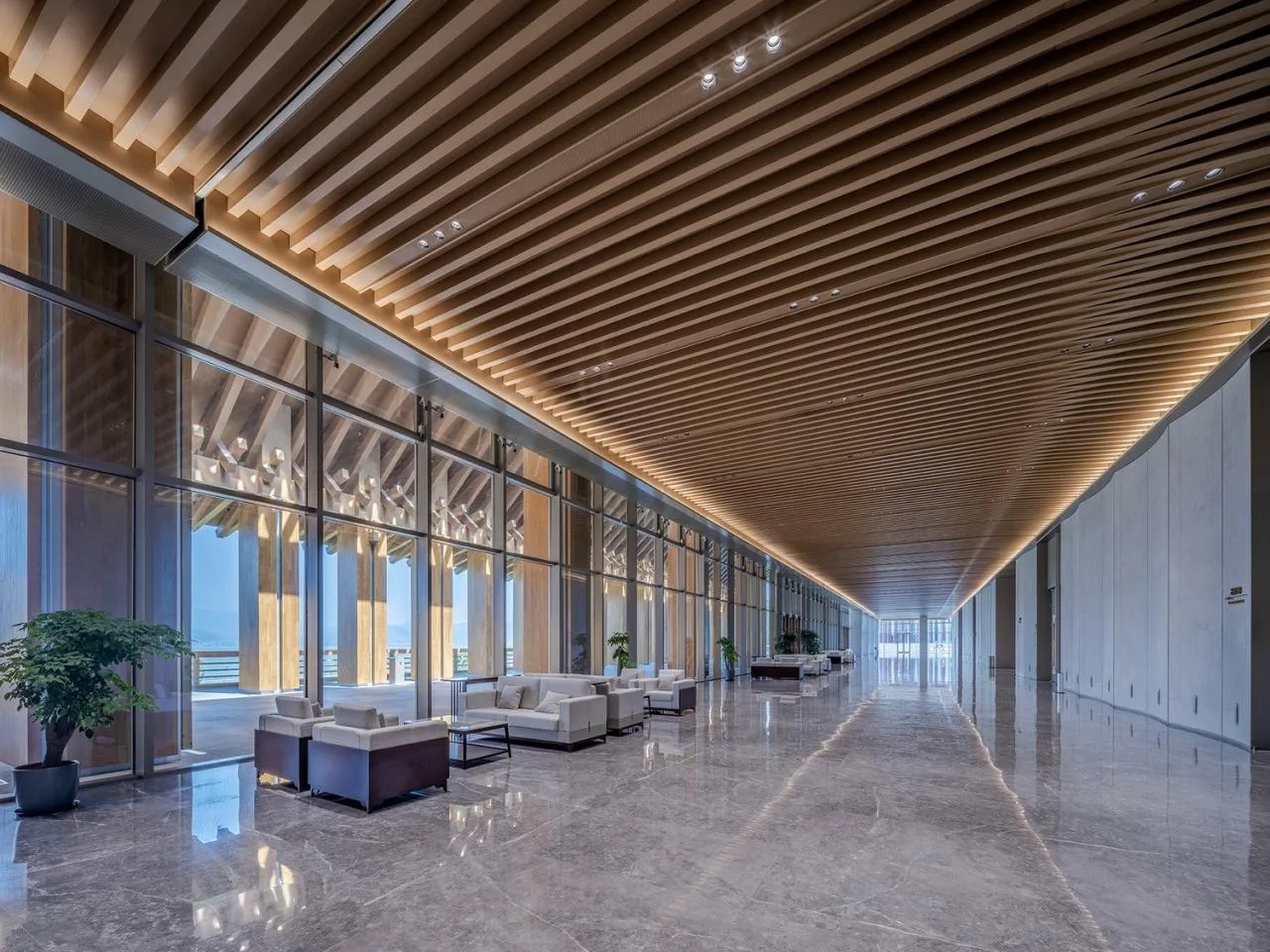
△ Front hall of the main venue area © Beijing Jianyuan Decoration Engineering Design Co., Ltd
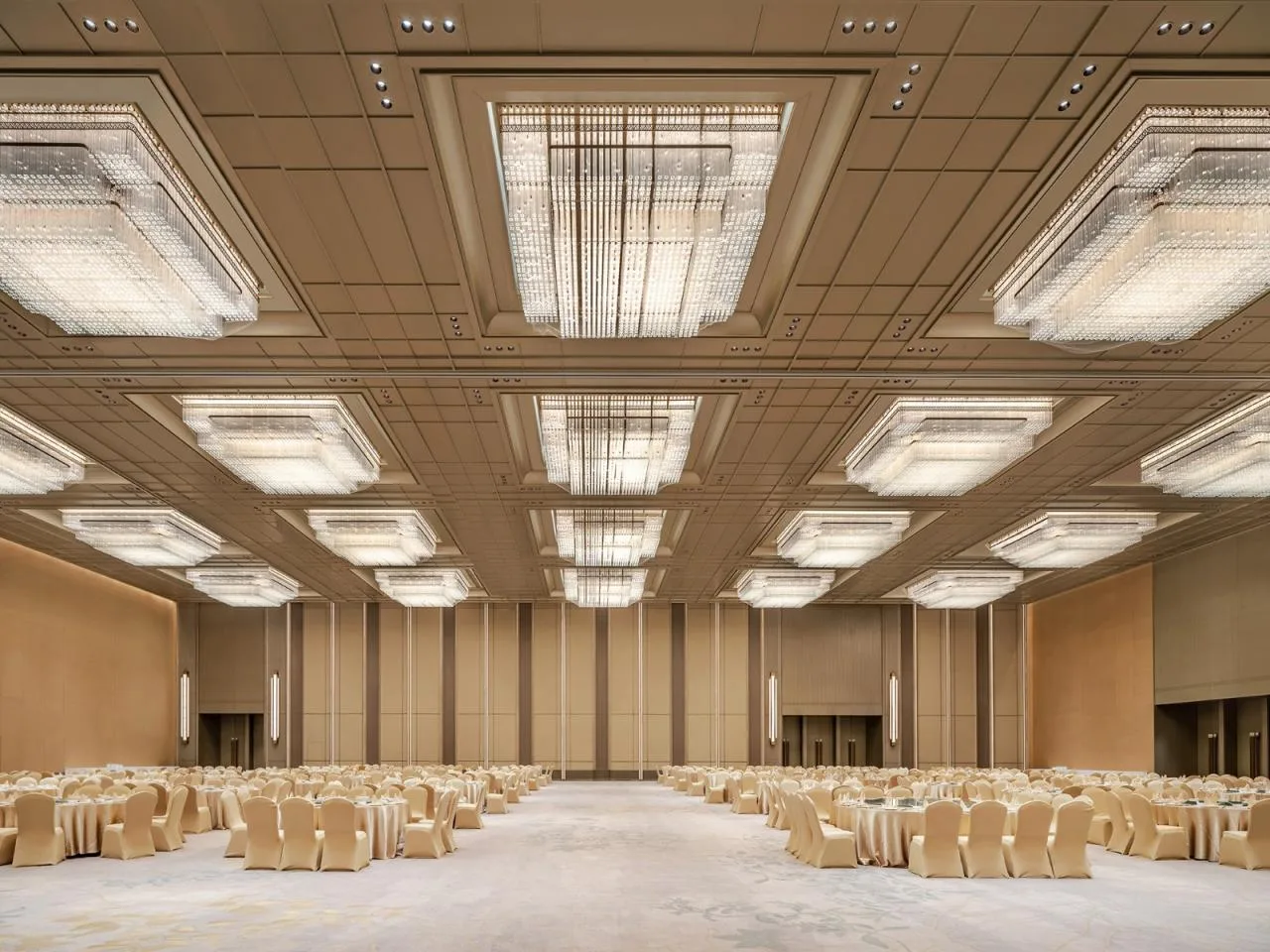
Grand Banquet Hall Wanjin Hall (3,700 square meters, 11 meters tall, seating 1,500) © Beijing Jianyuan Decoration Engineering Design Co., Ltd
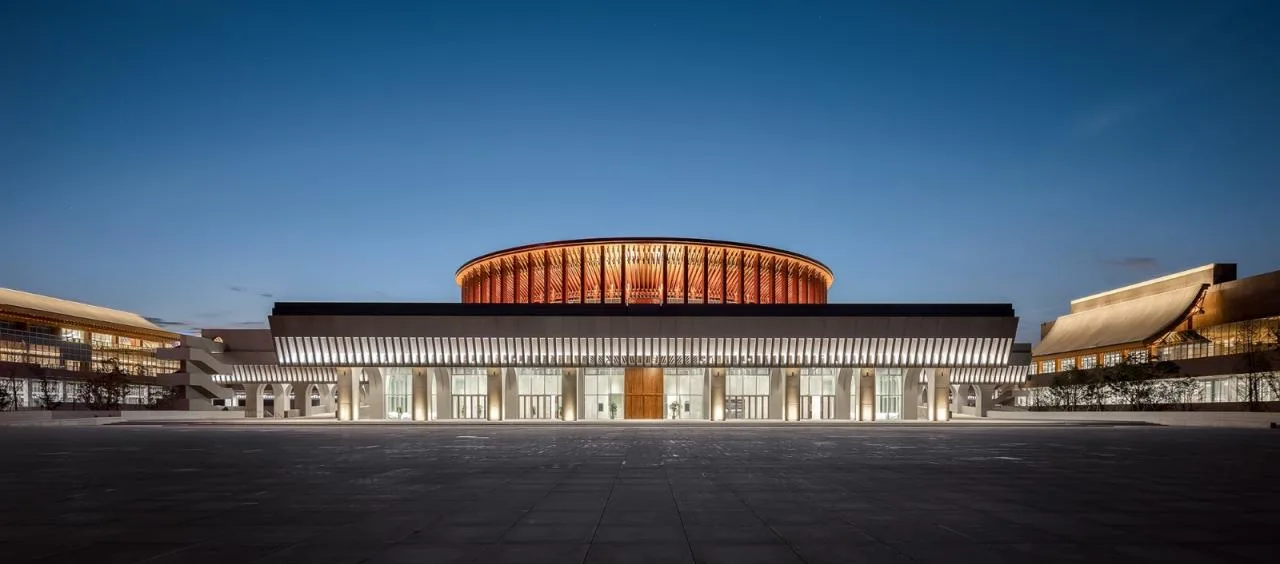
△ Summit Area © Ningbo International Convention Center Management Co., Ltd
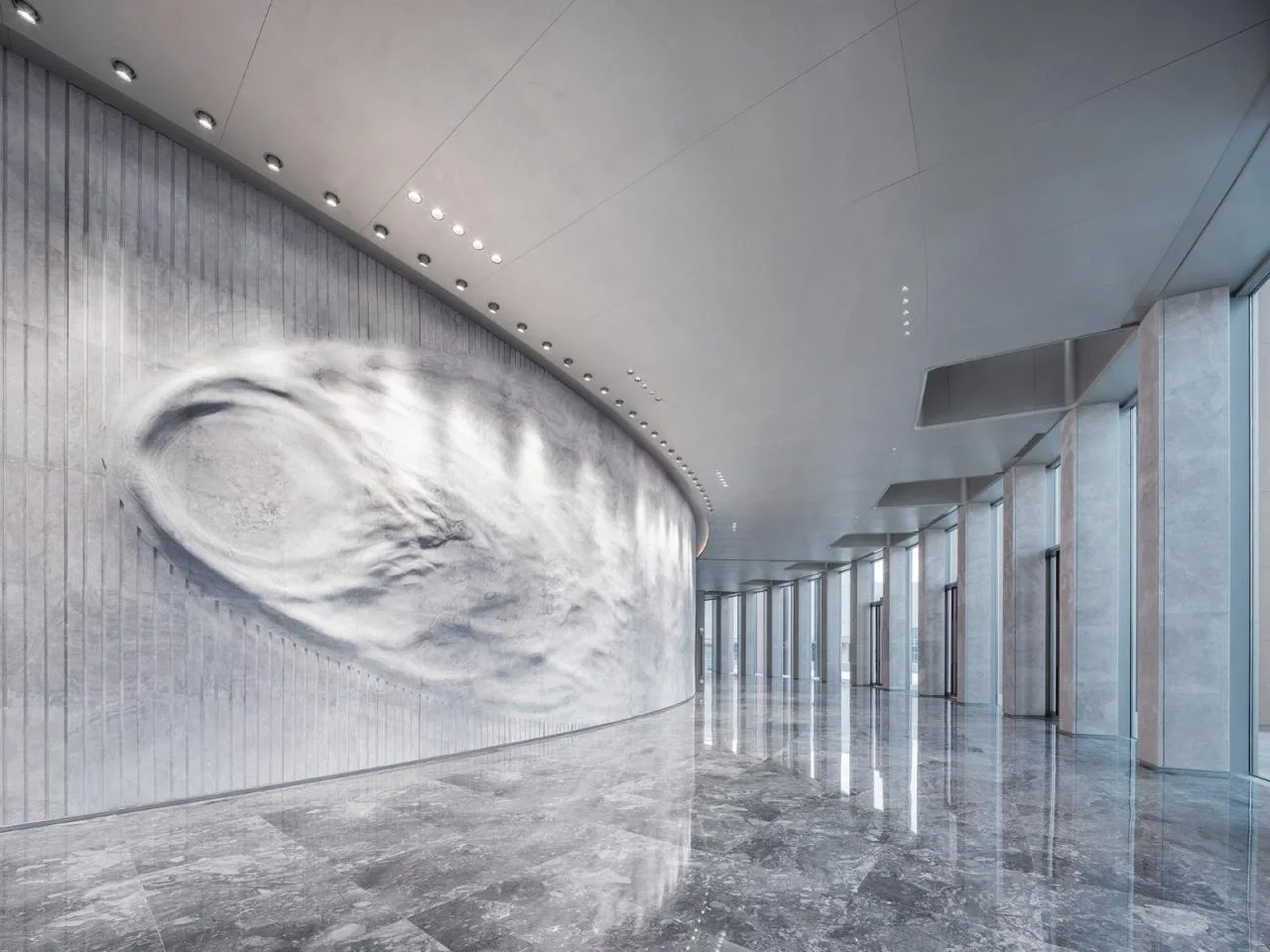
△ Summit Area – Reception and Photo Hall Front Desk © Beijing Jianyuan Decoration Engineering Design Co., Ltd
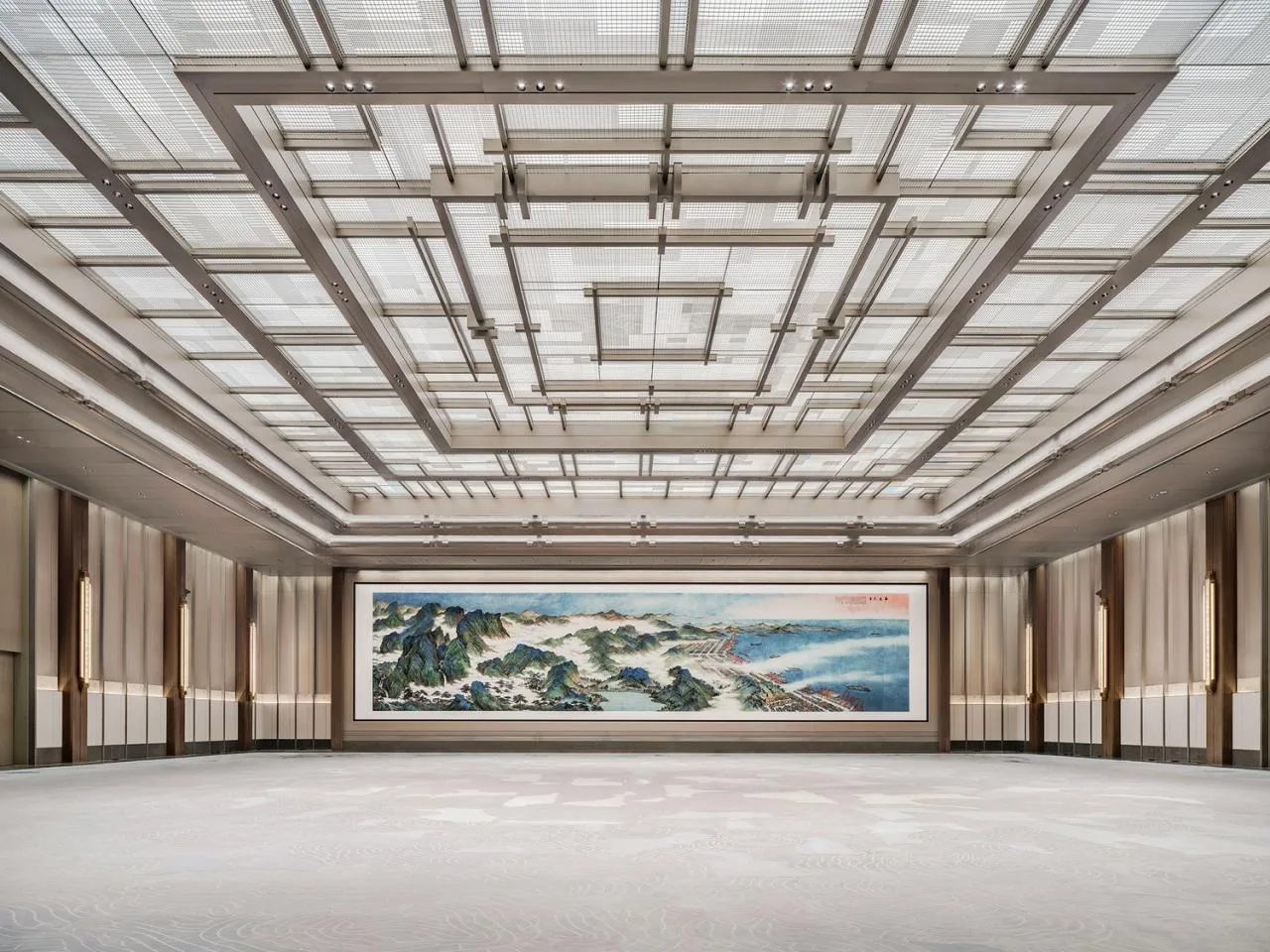
Summit Area – Conference Hall Tianyi Hall (1,800 square meters, 12 meters height) © Beijing Jianyuan Decoration Engineering Design Co., Ltd
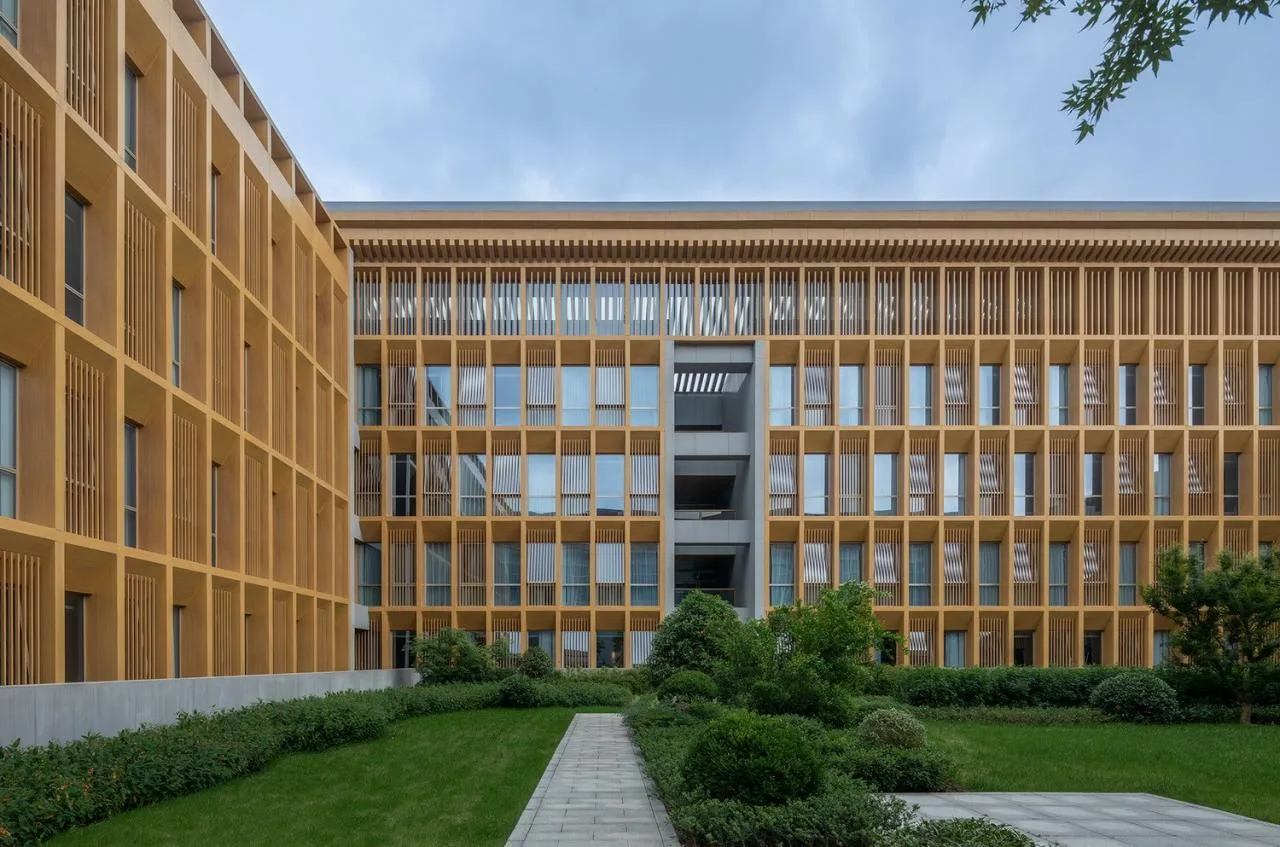
△ Wanglan Hotel Inner Courtyard © Millimeter scale architectural photography
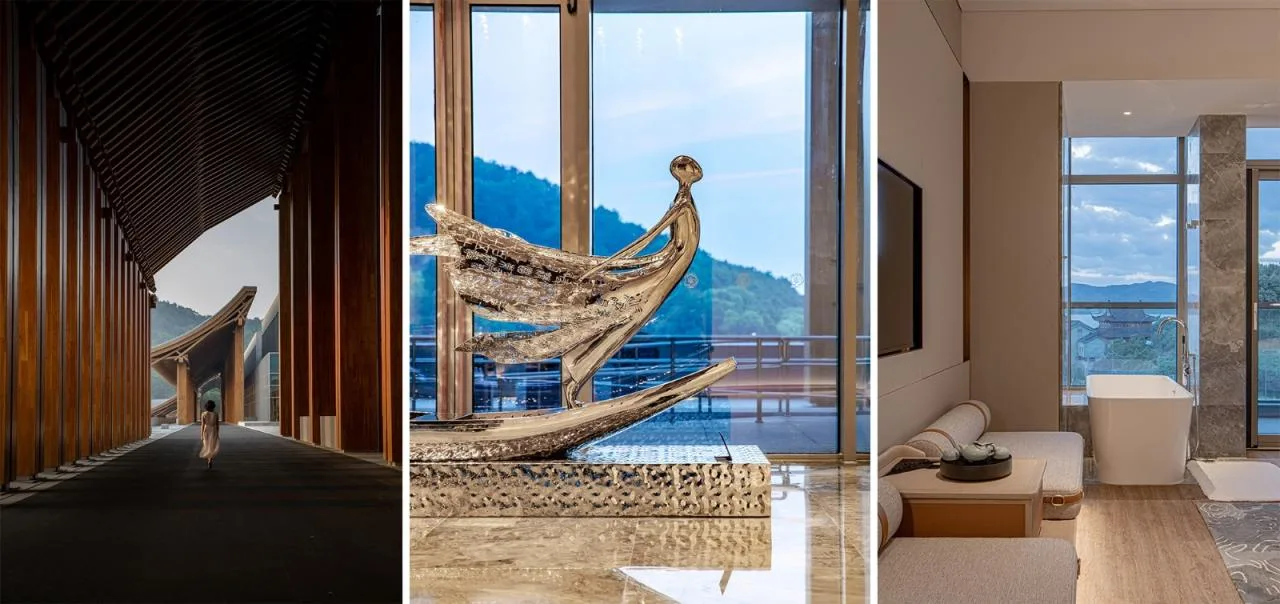
△ Wanglan Hotel © Beijing Jianyuan Decoration Engineering Design Co., Ltd
Three water outlet areas create landscape nodes and visual corridors between the conference’s functional zones. Along the water, small streets and commercial settlements are arranged, with pathways integrating the corridors and courtyards of the conference center. This design reflects the daily life of villages, street markets, and temples, forming a multi-dimensional poetic scroll of the Jiangnan water town.
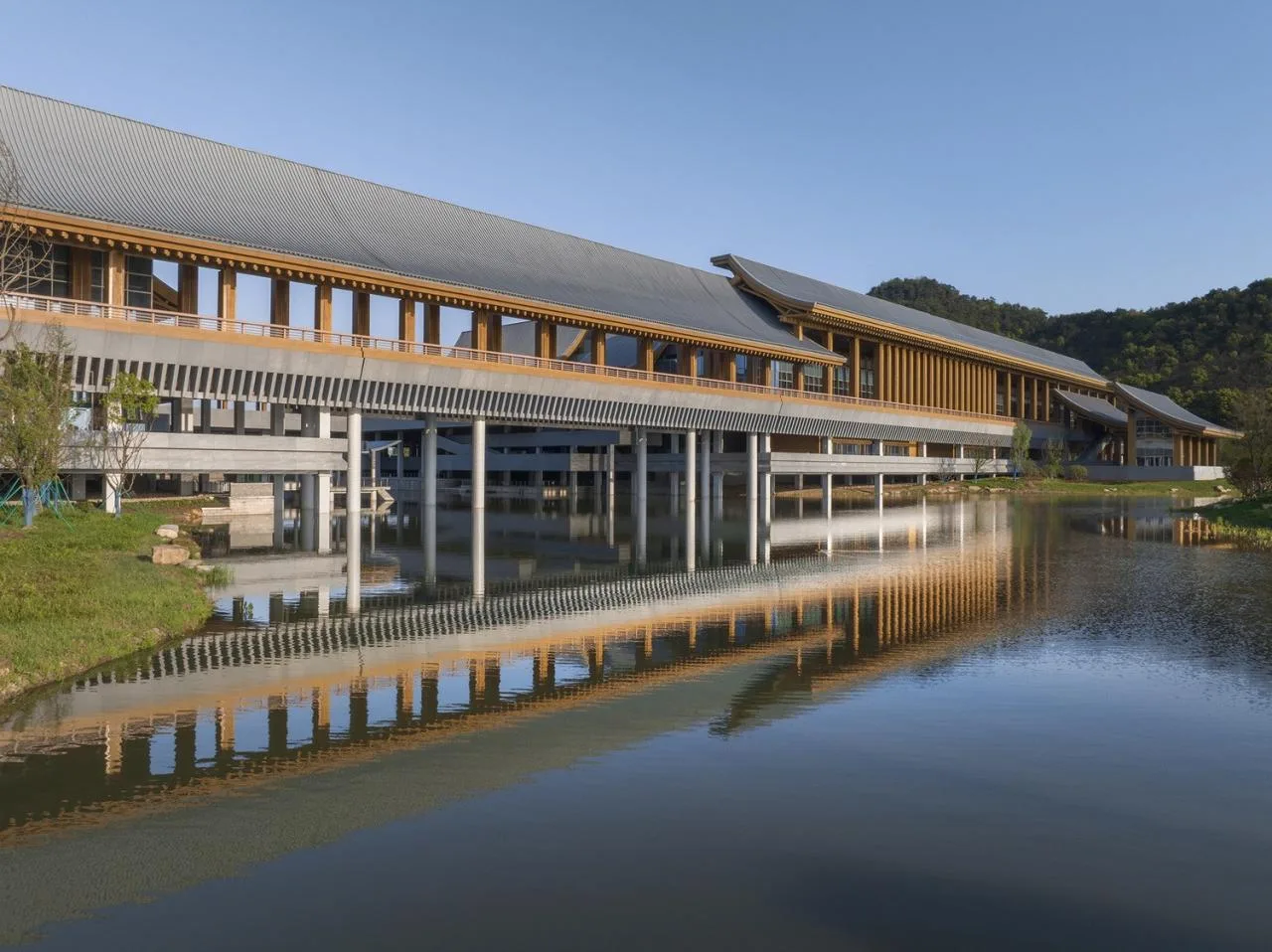
△ The large multifunctional hall and the water outlet of the main venue, photographed by Geek Vision | Xie Zhenguo © Tang Hua Architectural Design
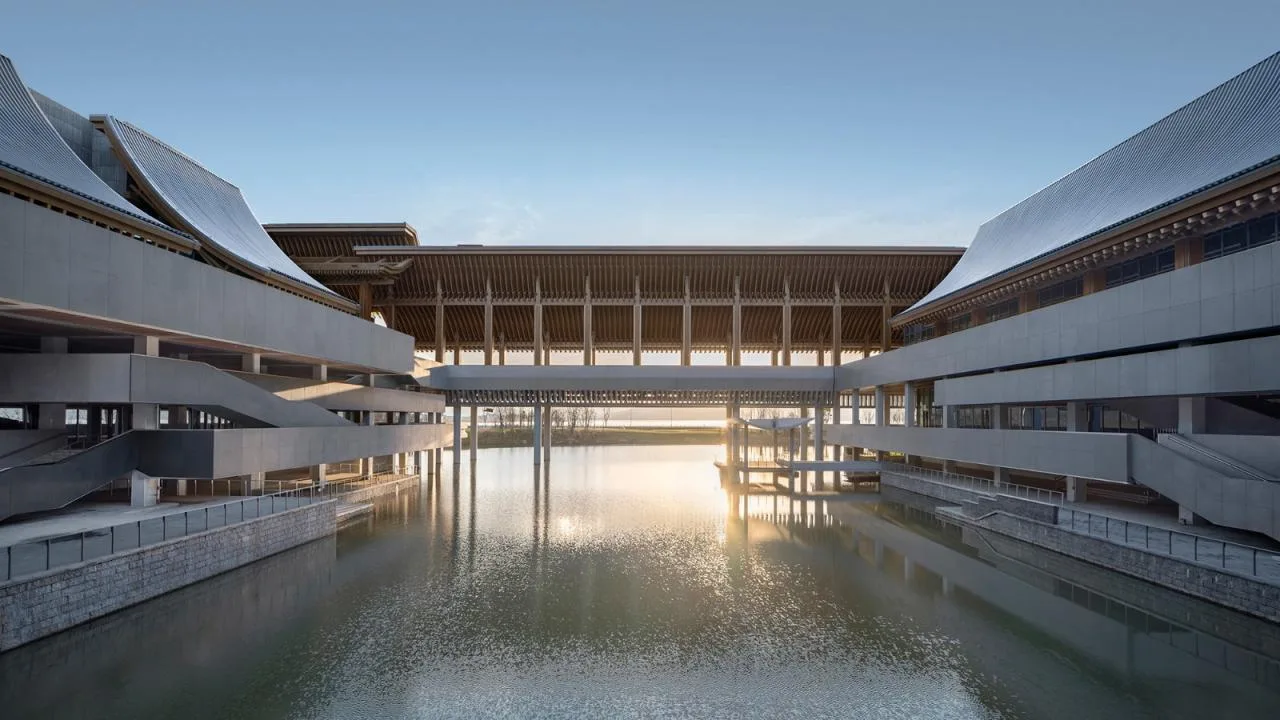
△ Large multifunctional hall and water entrance corridor of the main venue (looking east), photographed by Geek Vision | Xie Zhenguo © Tang Hua Architectural Design
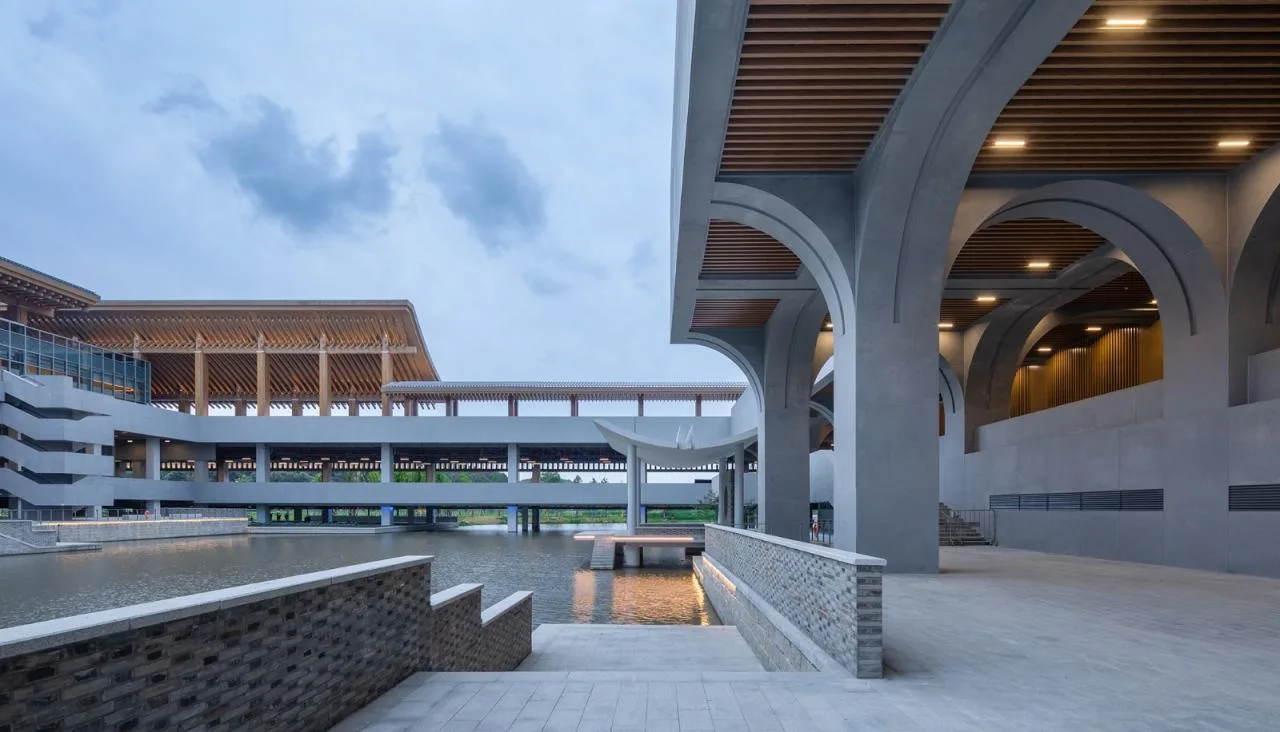
△ Summit area and the water outlet of the hotel (looking west), photographed by Geek Vision | Xie Zhenguo © Tang Hua Architectural Design
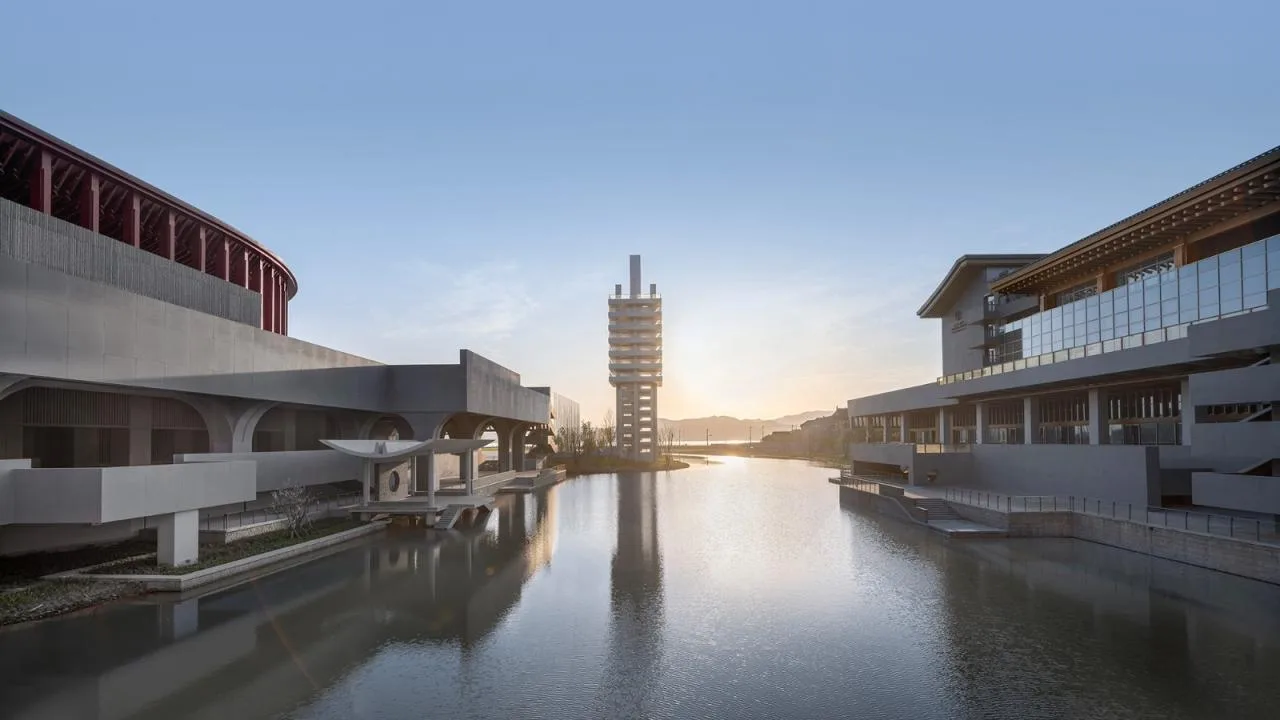
The water outlet of the summit area and hotel (looking east), photographed by Geek Vision | Xie Zhenguo © Tang Hua Architectural Design
#03 Traffic Flow and Organization
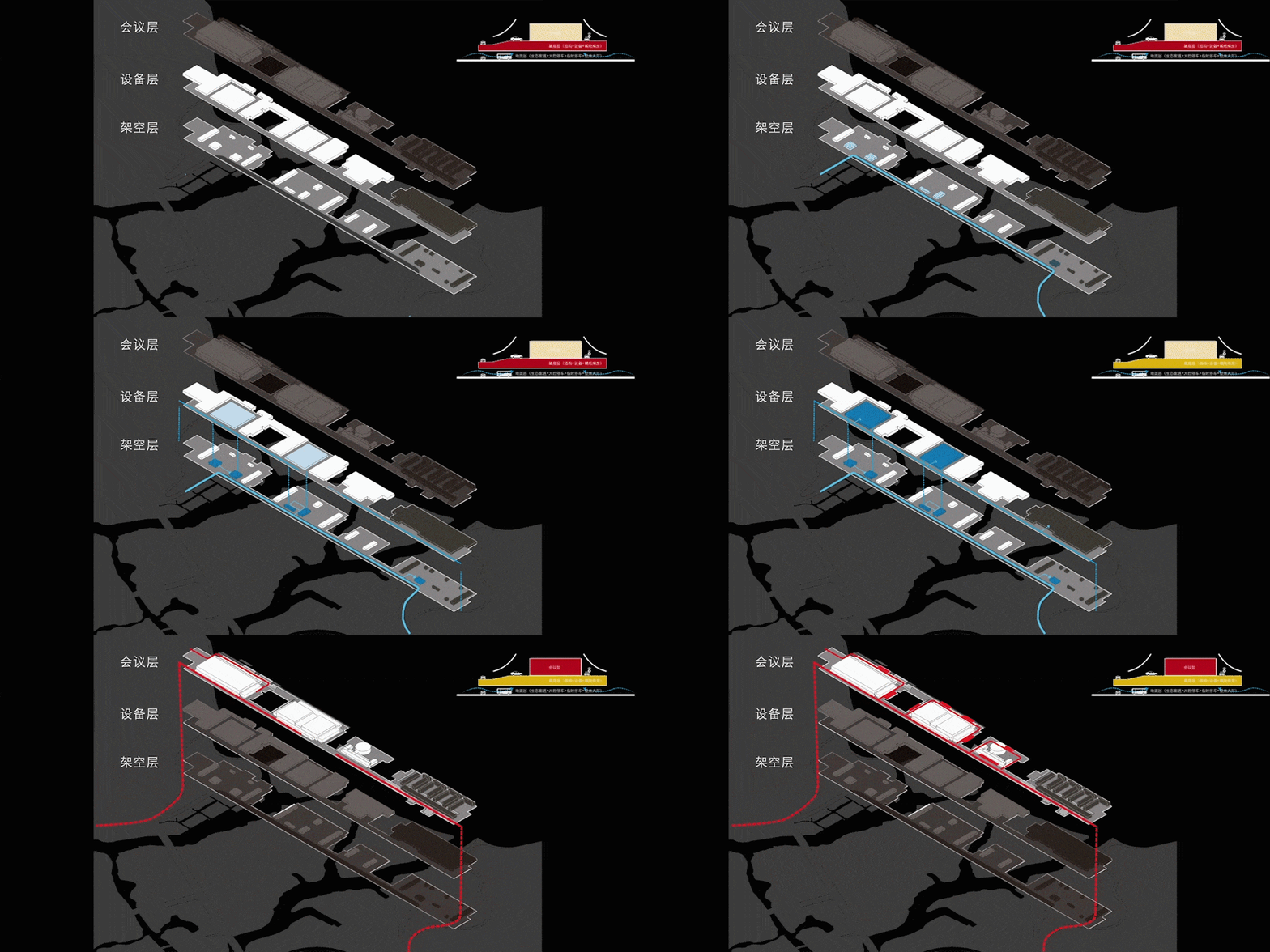
△ Three-Dimensional Traffic Map © Tang Hua Architectural Design
The entire building is elevated five meters, featuring a five-meter-thick structural equipment and service layer beneath. The conference floor sits ten meters above the site’s existing ground, leveraging the natural elevation difference between the northern and southern mountains to create multi-level flat connections with city roads and a three-dimensional traffic system.
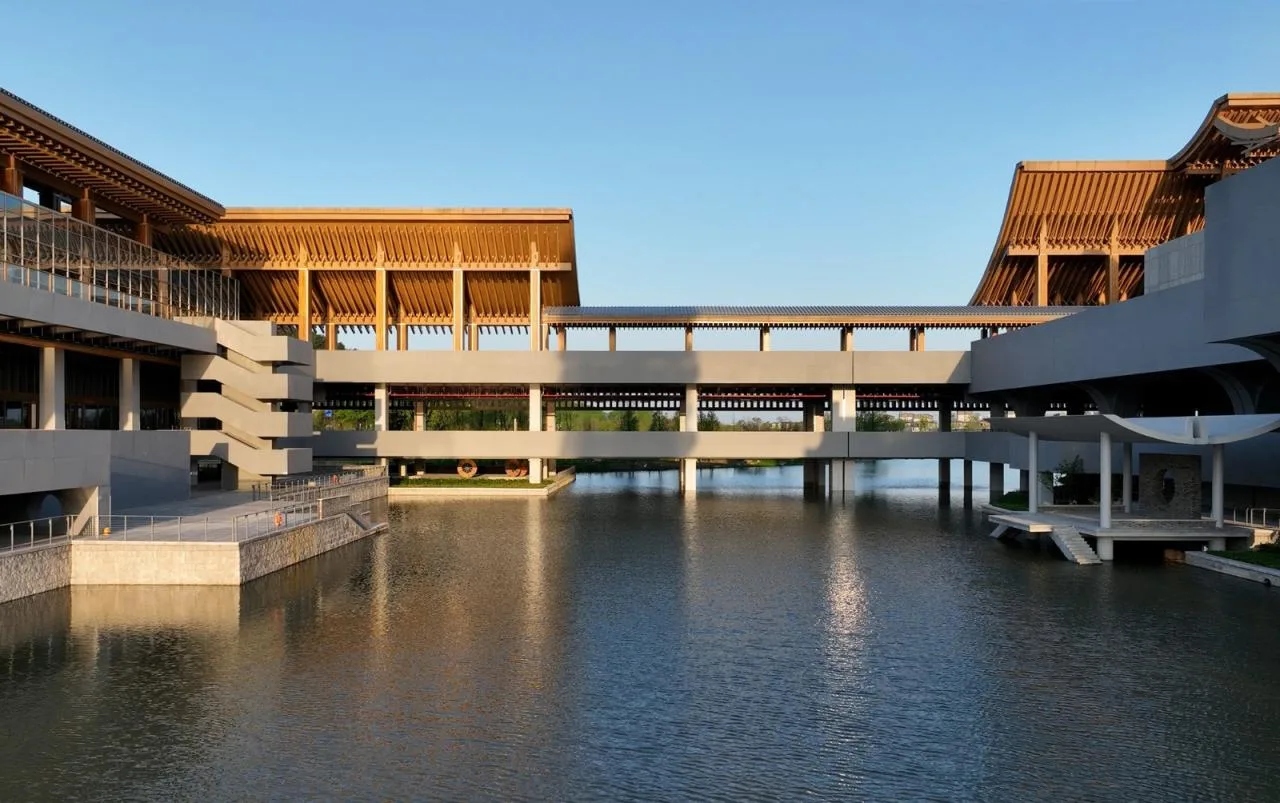
△ Three-layered transportation system, photography: Geek Vision | Xie Zhenguo © Tang Hua Architectural Design
During conferences, attendee traffic, service flow, and freight logistics are independently managed to avoid congestion. Multiple exits connect to the city’s public transportation network, efficiently handling large event crowds.
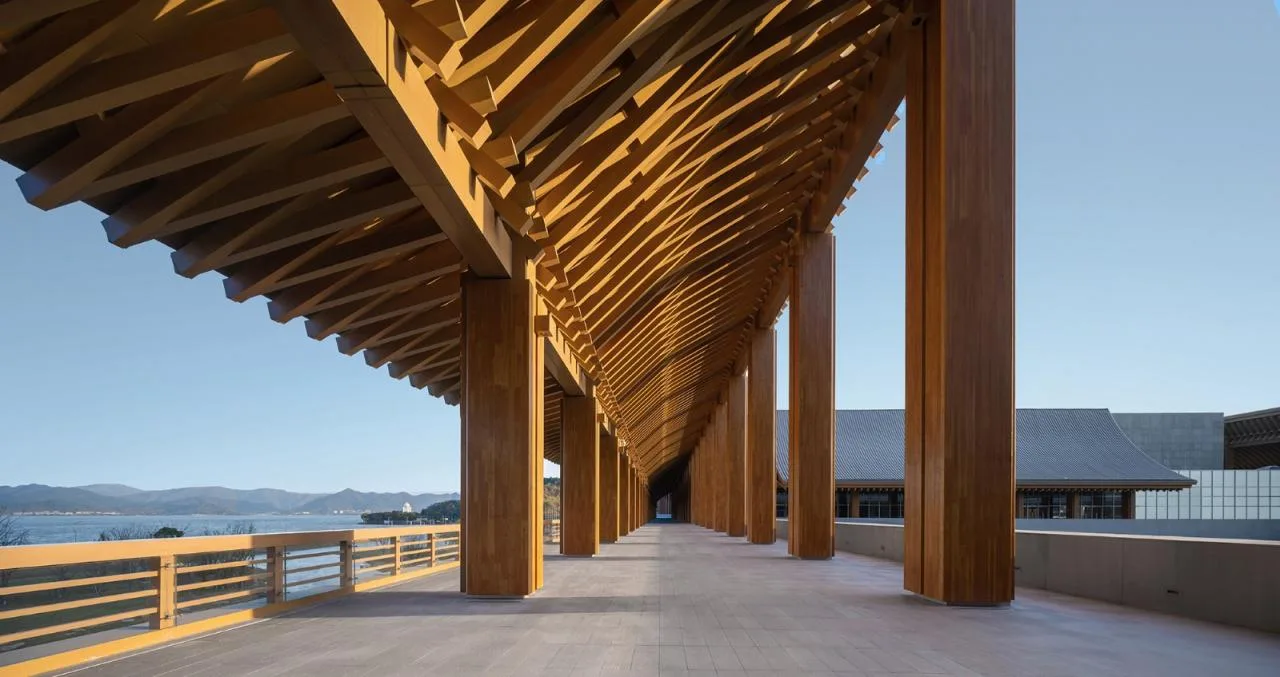
The corridor connecting the large multifunctional hall and the main venue, photographed by Geek Vision | Xie Zhenguo © Tang Hua Architectural Design
On non-event days, the corridor bridge integrates with the commercial street beneath it, remaining open to the public 24/7. This space transforms into a vibrant market and community hub, embodying the spirit of a Jiangnan water town.
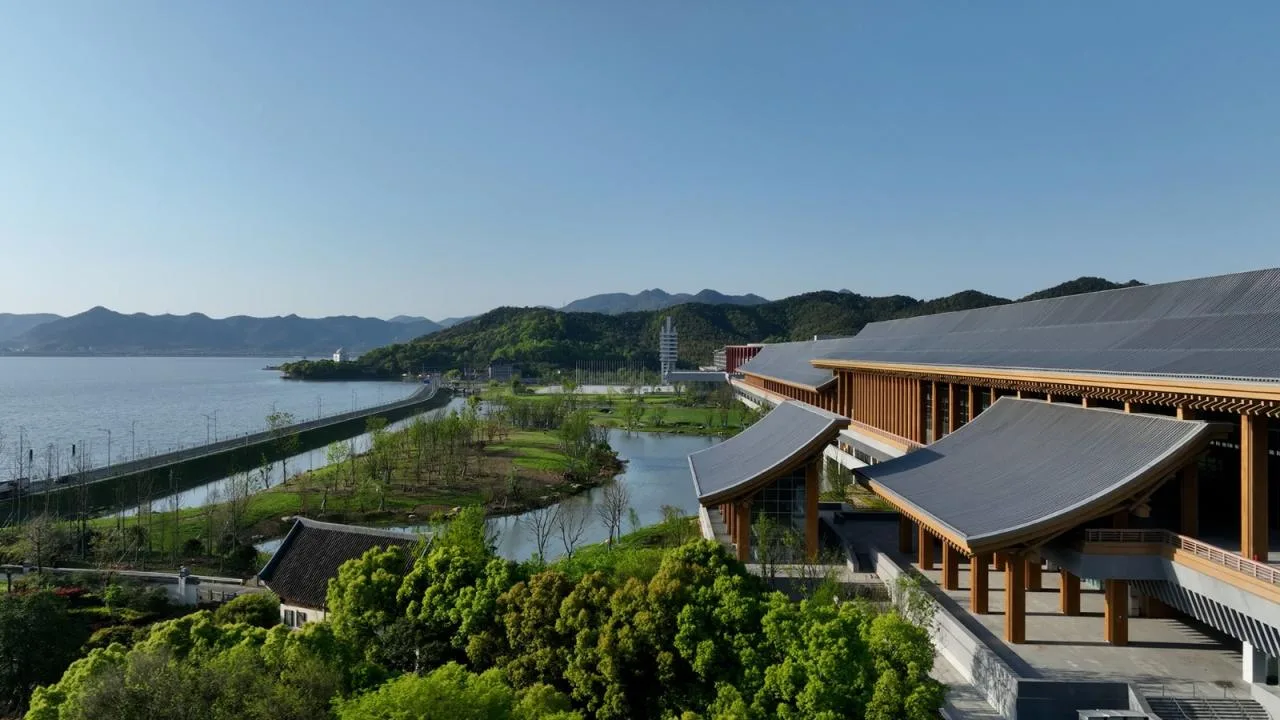
△ Large multifunctional hall area, photography by Geek Vision | Xie Zhenguo © Tang Hua Architectural Design
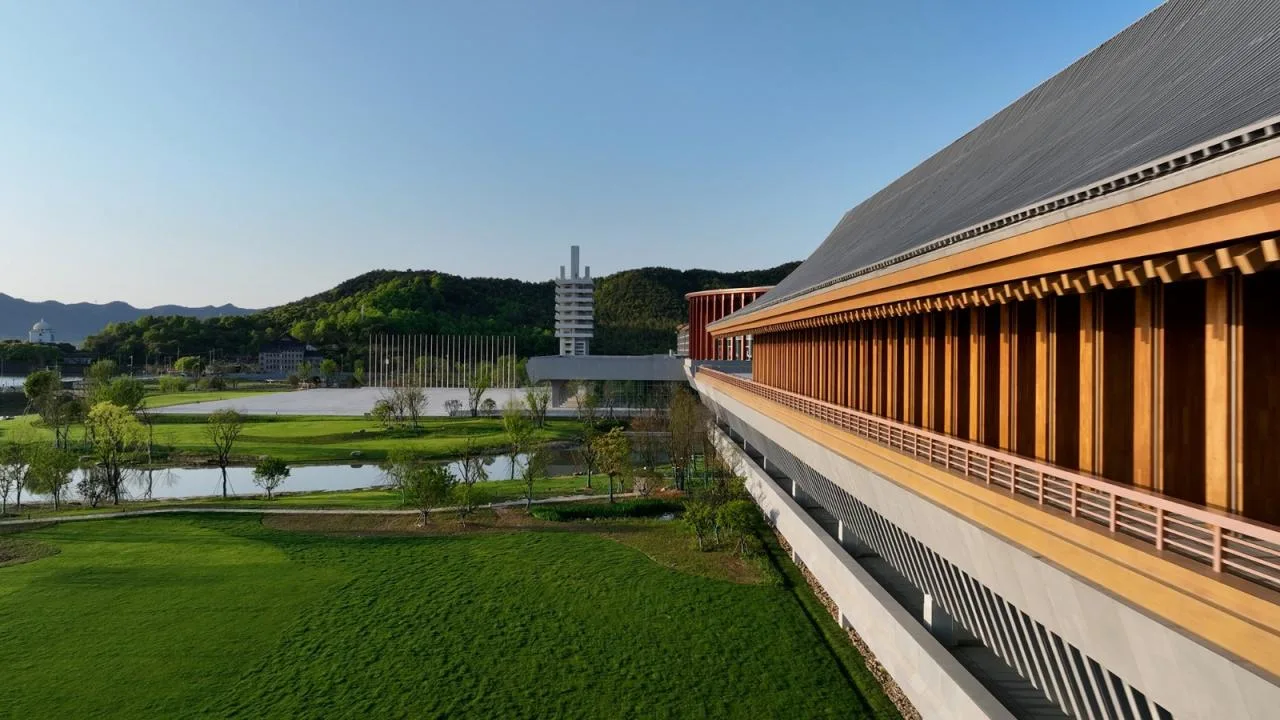
△ Main venue area, photography by Geek Vision | Xie Zhenguo © Tang Hua Architectural Design
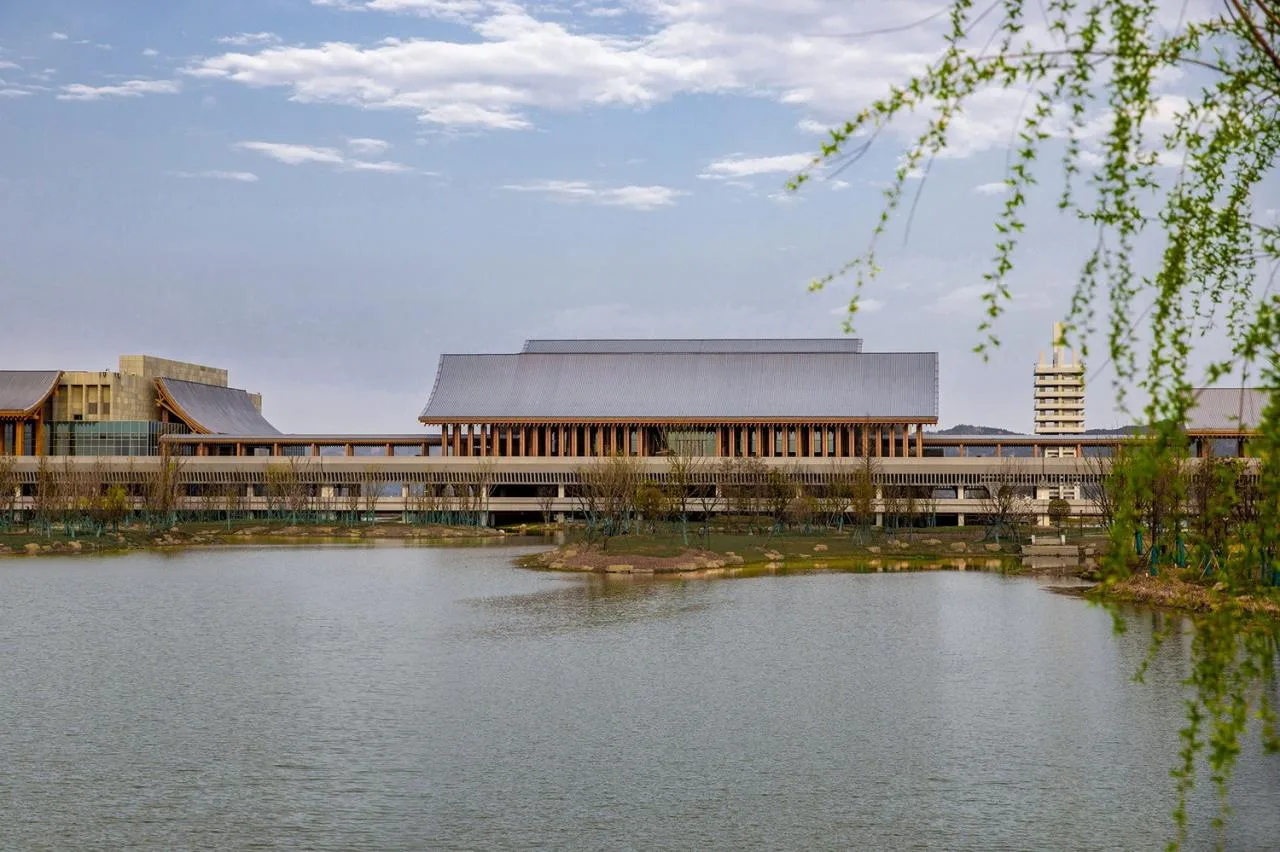
Summit Area (West), Photography by Geek Vision | Xie Zhenguo © Tang Hua Architectural Design
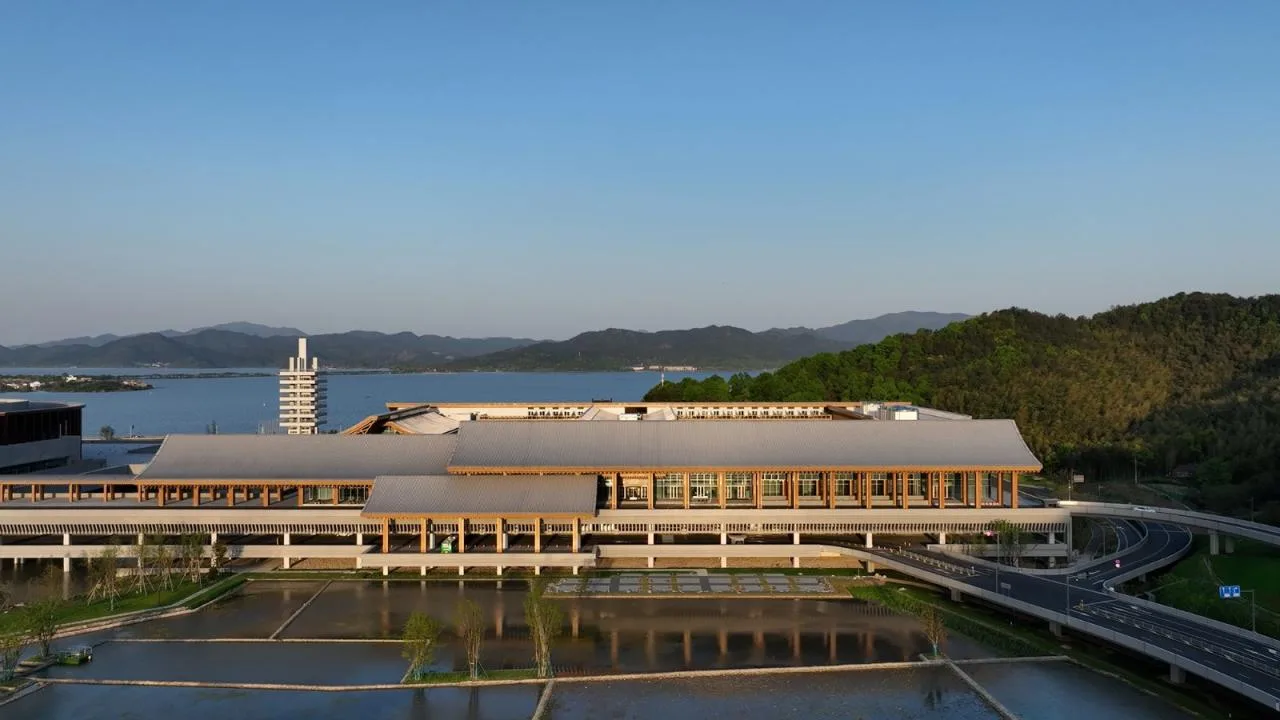
△ Hotel Area (West), Photography: Geek Vision | Xie Zhenguo © Tang Hua Architectural Design
The corridor bridge is not a typical bridge; it is a bridge-shaped building serving as a multifunctional public open space. It offers shade and shelter from rain, while providing a place for relaxation, communication, gatherings, and scenic enjoyment. It has also become a unique cultural, historical, and scientific educational base for the local community.
#04 Green Environmental Protection, Energy Conservation, and Emission Reduction
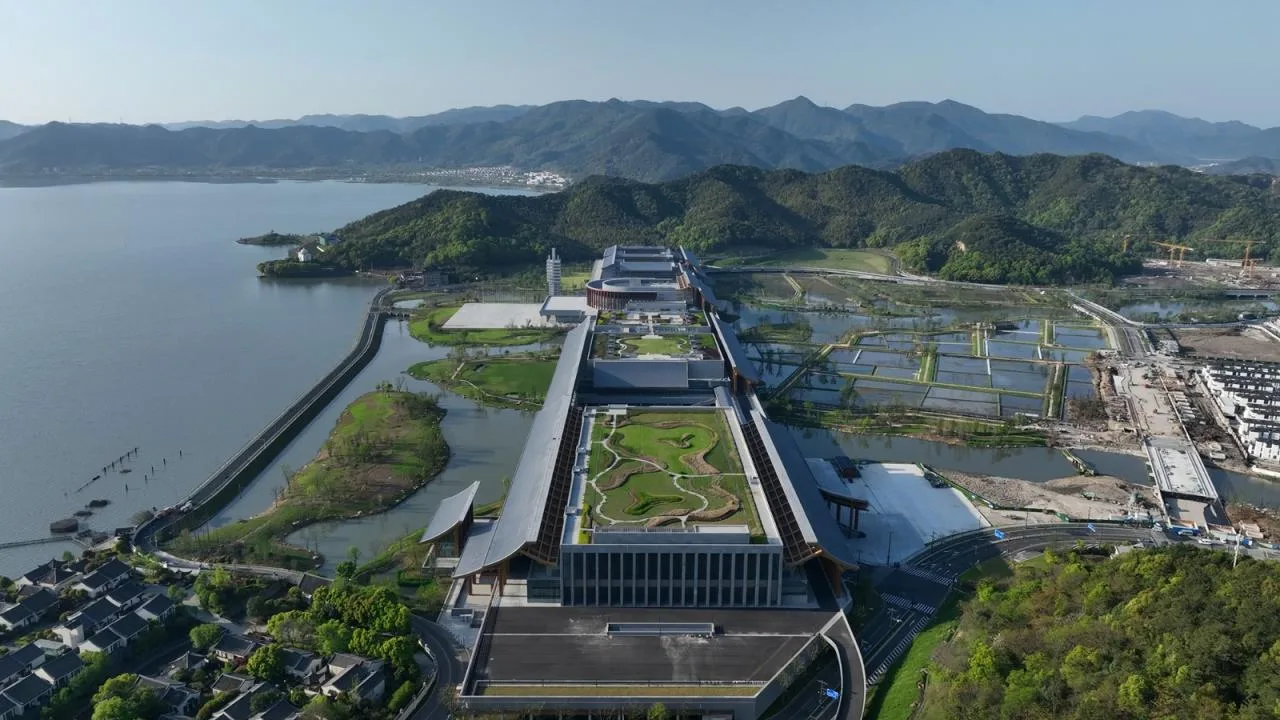
△ Photography: Geek Vision | Xie Zhenguo © Tang Hua Architectural Design
Green environmental protection and energy conservation extend from individual buildings to urban infrastructure networks. The site is near Gaoqiu Dam, a crucial flood discharge and detention area forming part of the Dongqian Lake flood control system. The design prioritizes blocking floodwaters over dredging, featuring a dry-railing style corridor bridge structure suspended above the fields. This approach connects the green mountains and nearby Qianhu Lake without altering the original hydrology of Gaoqiu Weir, avoiding added flood control pressure and minimizing environmental impact.
Rainwater runoff and pollution are reduced through green roofs, permeable paving, and preserved solid soil and green spaces that increase water infiltration and aquifer recharge. Renewable energy is supplied by photovoltaic panels and solar hot water systems on-site. Additionally, a geothermal exchange system improves energy efficiency and saves space.
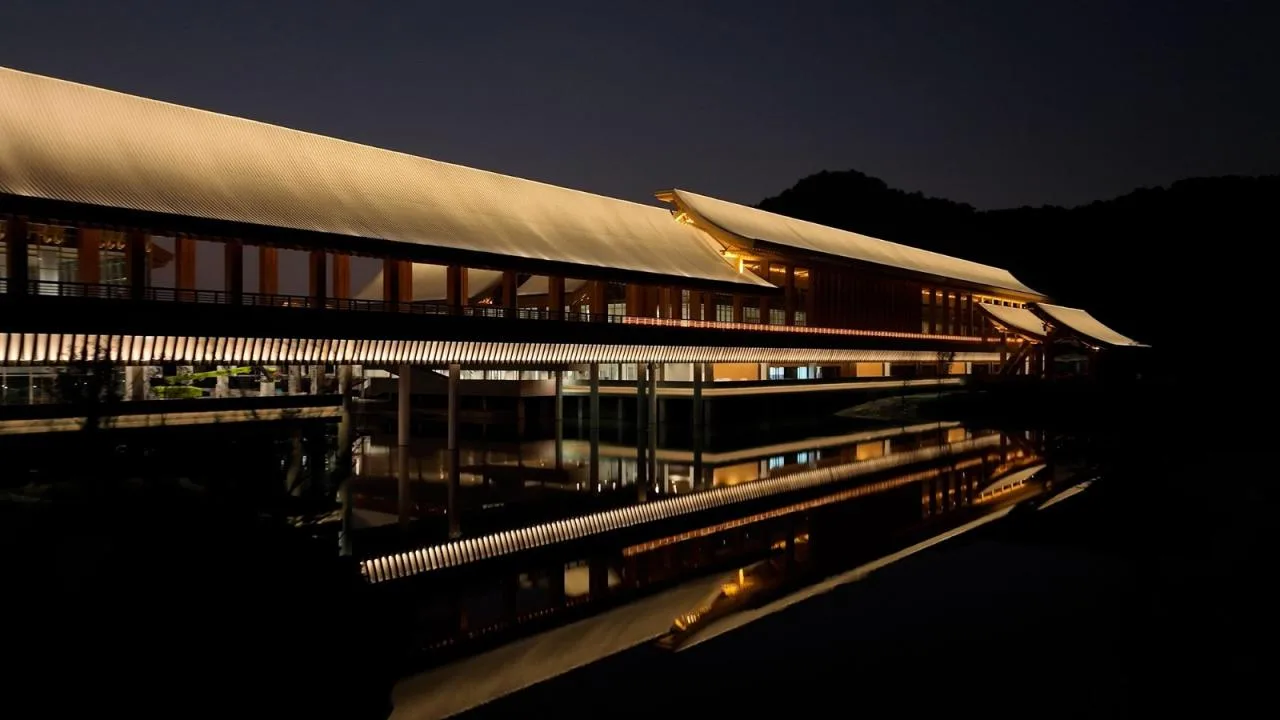
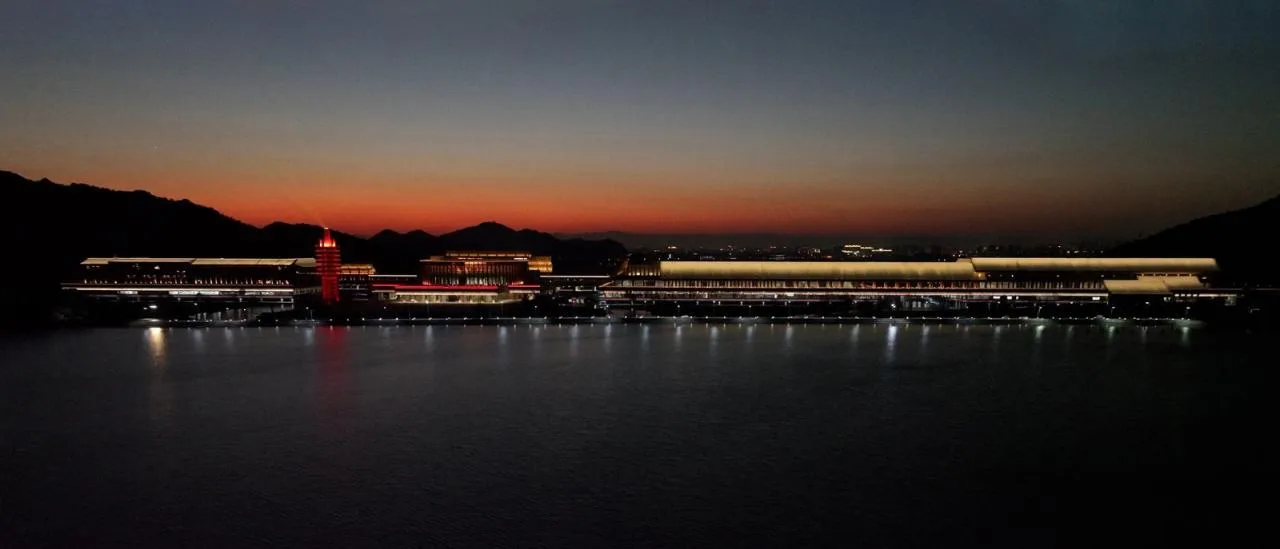
△ Night Scene, Photography: Geek Vision | Xie Zhenguo © Tang Hua Architectural Design
Reflecting on the distant Hemudu civilization, rice cultivation is its foundation. The Ningbo International Convention Center’s plan embraces natural pastoral wetlands, maximizing open space and juxtaposing dense urban development with natural pastoral areas. It integrates cultural tourism with the exhibition industry, connecting regional context to modern cities. The project creates a contemporary Jiangnan water town where rivers and lakes intersect—a place that harmonizes agriculture and commerce, embodying the beautiful life envisioned by the people of Ningbo.
Project Drawings
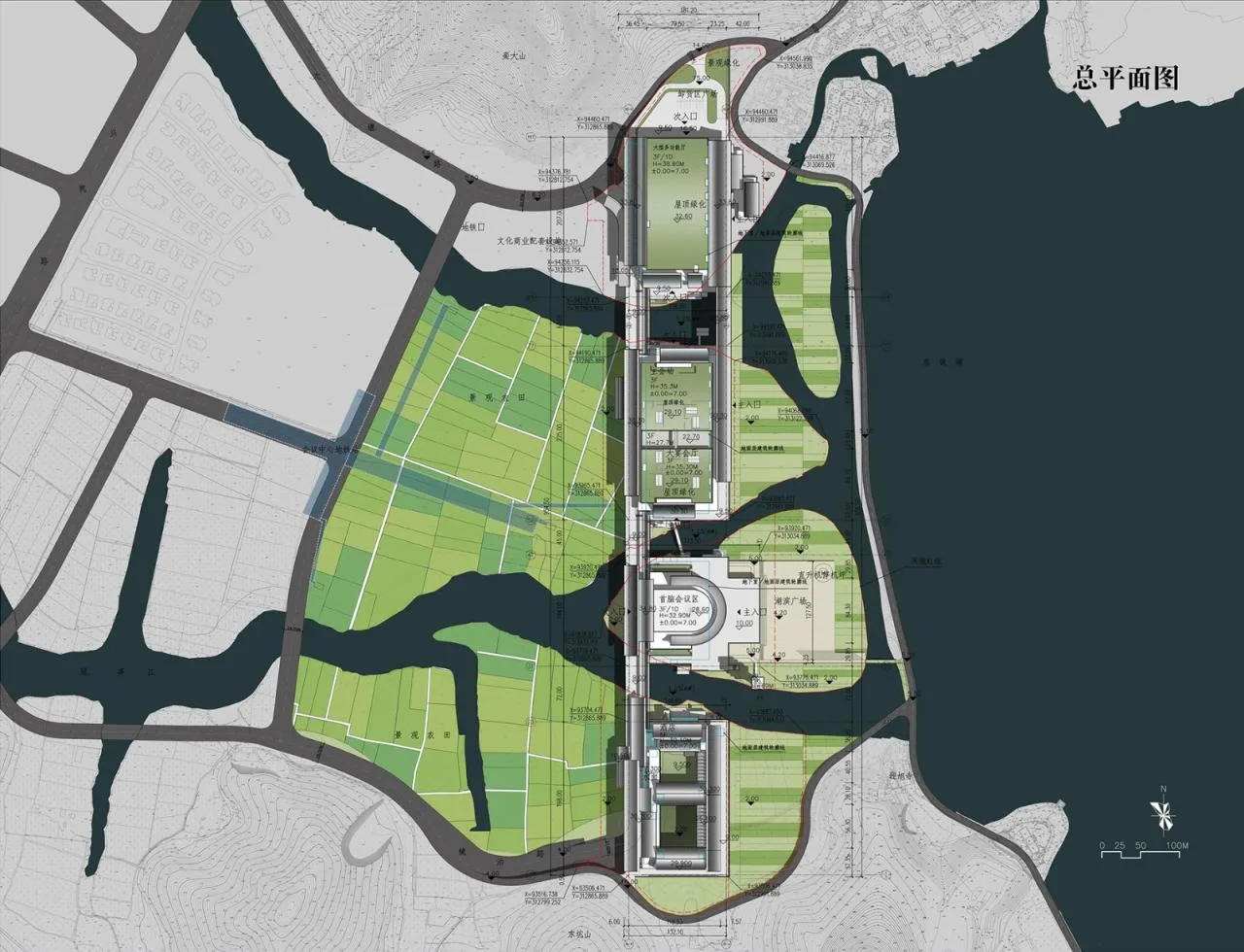
△ General layout plan © Tang Hua Architectural Design
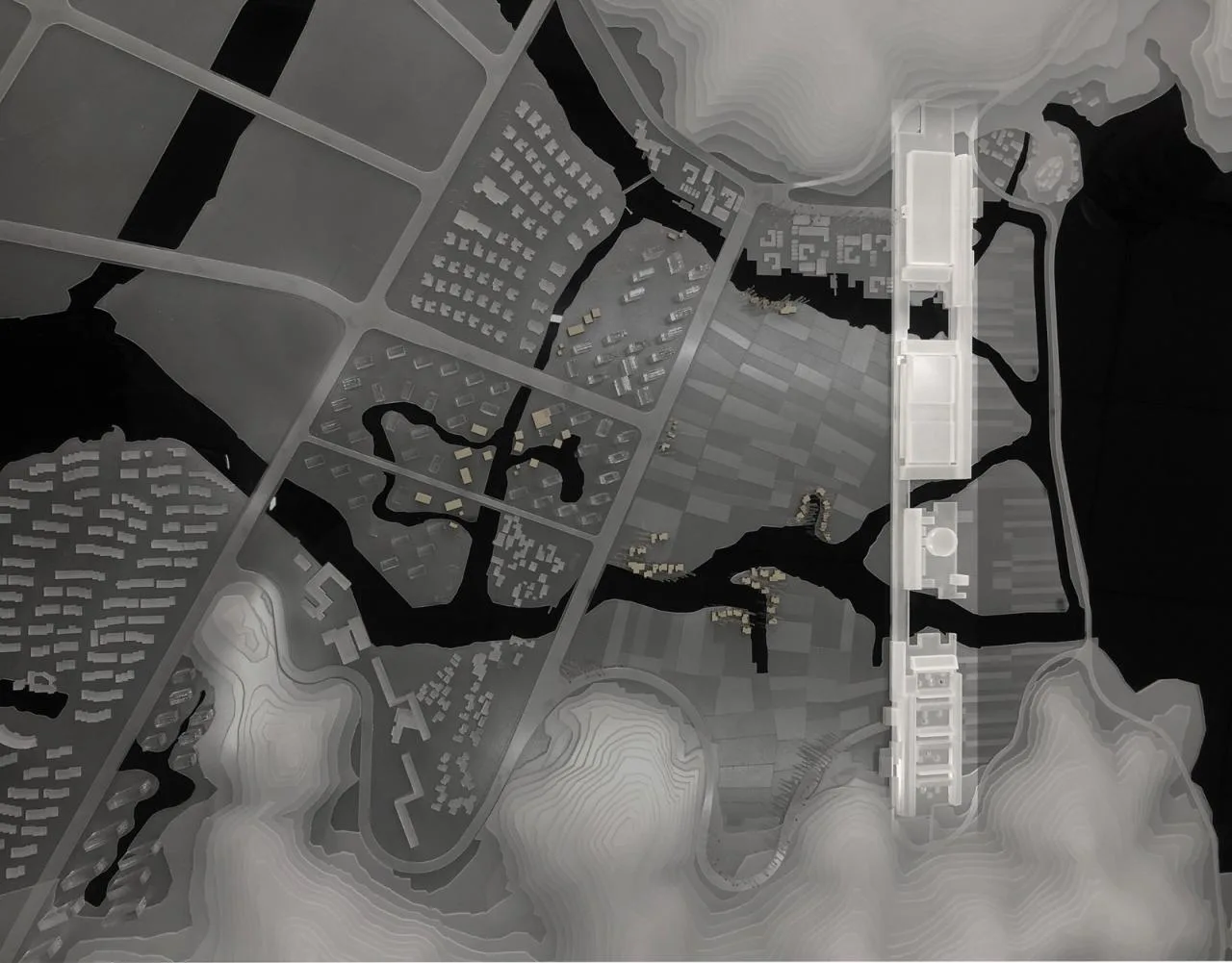
△ Model diagram © Tang Hua Architectural Design
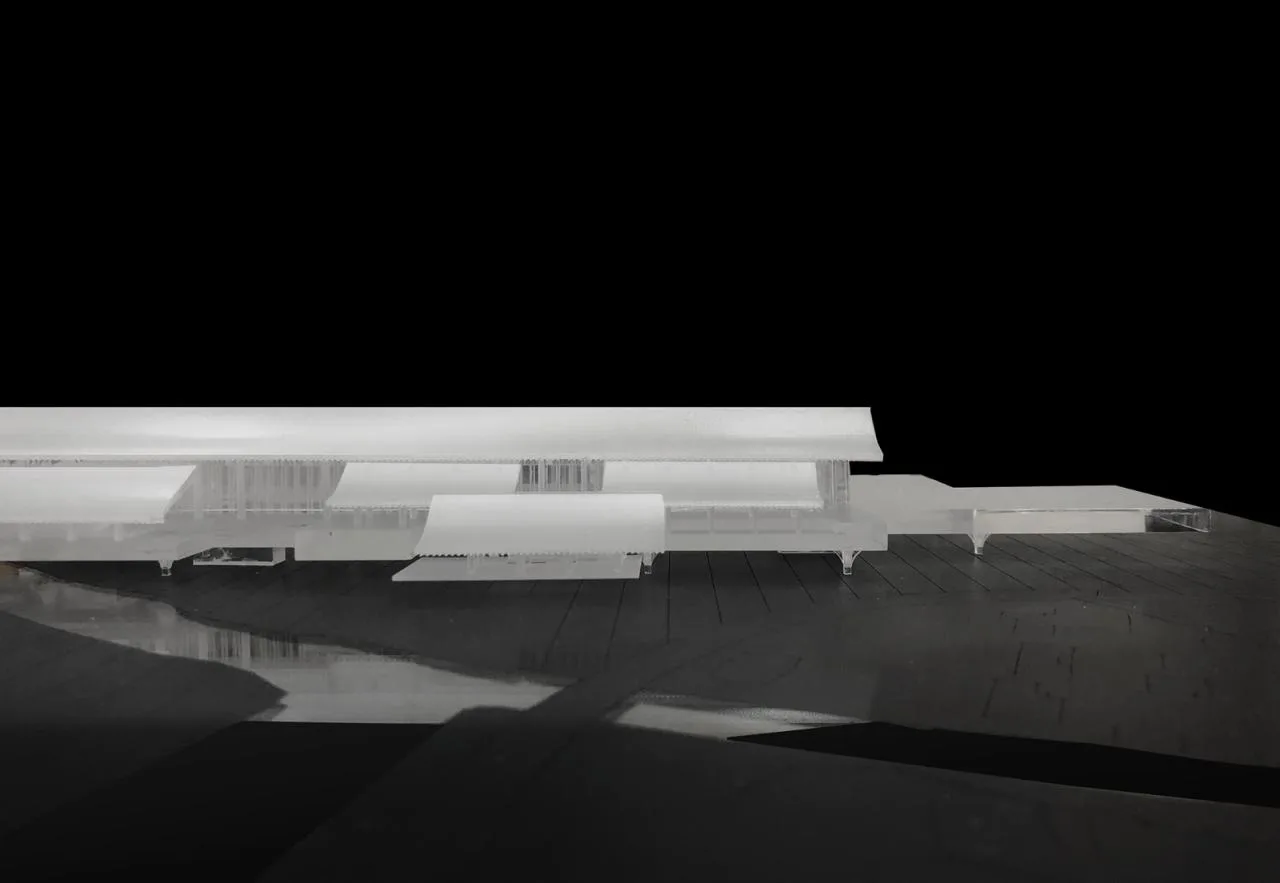
△ Model © Tang Hua Architectural Design
Project Information
Project Name: Ningbo International Convention Center
Location: West Bank of Dongqian Lake, Ningbo City, Zhejiang Province
Land Area: 489,333 square meters
Building Area: 398,413 square meters
Status: Completed
Project Owner: Ningbo International Convention Center Development Co., Ltd
Design Firm: Shenzhen Tanghua Architectural Design Firm Co., Ltd
EPC Engineering General Contractor: Beijing Institute of Architectural Design and Research Co., Ltd., China Construction Eighth Engineering Division Co., Ltd
Tang Hua Architectural Design Team
Lead Architect: Tang Hua
Project Leader: Deng Fang
Team Members: Peng Jian, Zhang Qiulong, Chen Wenfeng, Tang Mengchan, Yu Wenbo, Huang Zhenji, Yi Xihao, Wang Kun, Liu Huawei, Wang Tianhao, Liu Ying, Zheng Xin, Wang Xinzu
Partner Companies
BIAD Design Team
General Managers: Xie Xin, Xie Weijie, Peng Lin, Zhou Junxian
Project Manager: Liu Yue
Architectural Design: Yang Shan, Teng Jun, Qiao Yibing, Guo Xiaochen, Kang Lijun, Sun Shangwen, Zhao Yanhao, Zhao Dawei, Jin Yirun, Li Shujing, Liu Chen, Wei Chengxi, Jiang Chenxi
Structural Design: Wei Dong, Han Wei, Hao Tong, Wu Peijiang, Cheng Hanwen, Li Qian, Chang Ting, Wang Sheng, Fang Qixiao, Su Fulong, Song Zikui, Niu Yanan, Chen Yaxin, Li Xuechao, Hao Zhenyu, Pan Yuchen, Teng Fei
Equipment Design: Xu Honglei, Yang Fan, Wang Jinbiao, Qi Ruiying, Gao Chen, Hu Guixia, Xu Yiheng, Zhao Xin, Zhao Shengquan, Jiang Hang, Chen Huiling, Huang Mengjiao, Sun Qian, Gong Yingqian
Electrical Design: Ren Hong, Hua Jianjiang, Wei Jie, Wang Lingyu, Zhi Jingjing, Wei Hengjie, Ruan Jiaqi, Zhao Cong, Geng Yi, Jiang Luyan
Interior Design: Beijing Jianyuan Decoration Engineering Design Co., Ltd
Indoor Special Manager: Wang Meng
Indoor Design Team: Wang Meng, Gao Pan, Liu Yamei, Liu Yemeng, Zu Haoran, Du Shuli, Liang Xueling, Qu Mingyang
Meeting Deepening: Dong Bing, Yang Tianlun, Liu Jian, Li Ronghui, Tao Pengwei, Zhao Jia, Li Yi, Li Qingxuan, Zhang Qi
Hotel Deepening: Zhao Cheng, Li Minghui, Aisen, Zhao Jing, Dong Tonglang
Indoor Secondary Electromechanical: Wang Sen, Song Junfeng, Gu Yao, Wang Tao
Indoor Soft Furnishings: Tan Xiaoming, Zheng Chunmei, Zhao Qian, Wang Lan, Li Yue, Tian Jingyu, Tao Pei, Chen Ang, Wang Qiong
Indoor Materials: Li Peng, Liu Haidong
Landscape Design: Hangzhou Landscape Design Institute Co., Ltd
Flood Lighting Design: Kaisen Digital Technology Co., Ltd
Curtain Wall Design: Tongchuang Jintai Building Technology (Beijing) Co., Ltd
BIM Design: Ningbo Youchen Architectural Design Consulting Co., Ltd
Civil Air Defense Design: Nanjing Underground Engineering Architectural Design Institute Co., Ltd., Ningbo High-tech Branch
Municipal Design: Ningbo Economic and Technological Development Zone Urban Construction Design Co., Ltd
Logo Design: Hangzhou Jicheng Culture and Art Co., Ltd
Energy Saving and Green Building Consultant: Ningbo Huacong Building Energy Saving Technology Co., Ltd
Transportation Consultant: Beijing Tsinghua Tongheng Planning and Design Institute Co., Ltd
Special Fire Protection Design Consultant: Arup Engineering Consulting (Shanghai) Co., Ltd
Noise Control Consultant: Beijing Labor Protection Institute Technology Development Co., Ltd
Design Consultant: Ningbo Urban Construction Design and Research Institute Co., Ltd
Photography: Geek Vision | Xie Zhenguo, Millimeter Architecture Photography
Some photos are provided by Ningbo International Convention Center Management Co., Ltd. and Beijing Jianyuan Decoration Engineering Design Co., Ltd.















Must log in before commenting!
Sign Up