
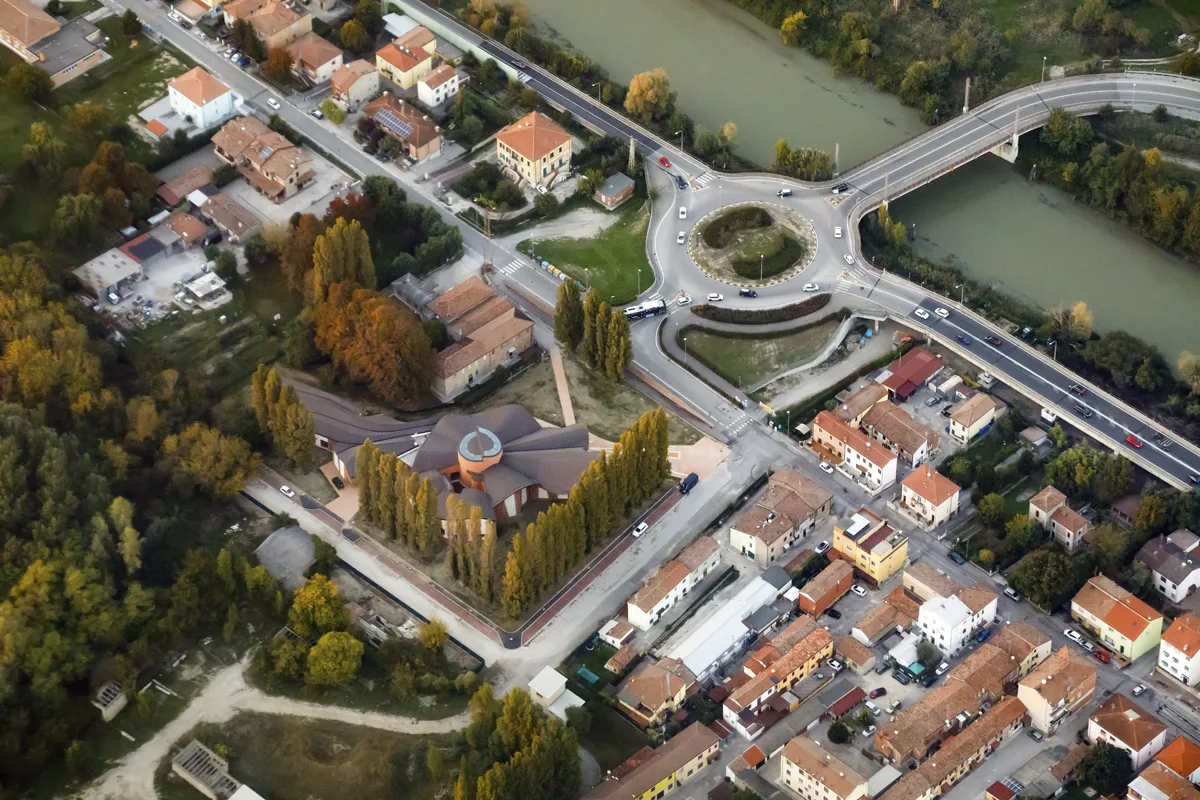
Relationship with the Urban Environment
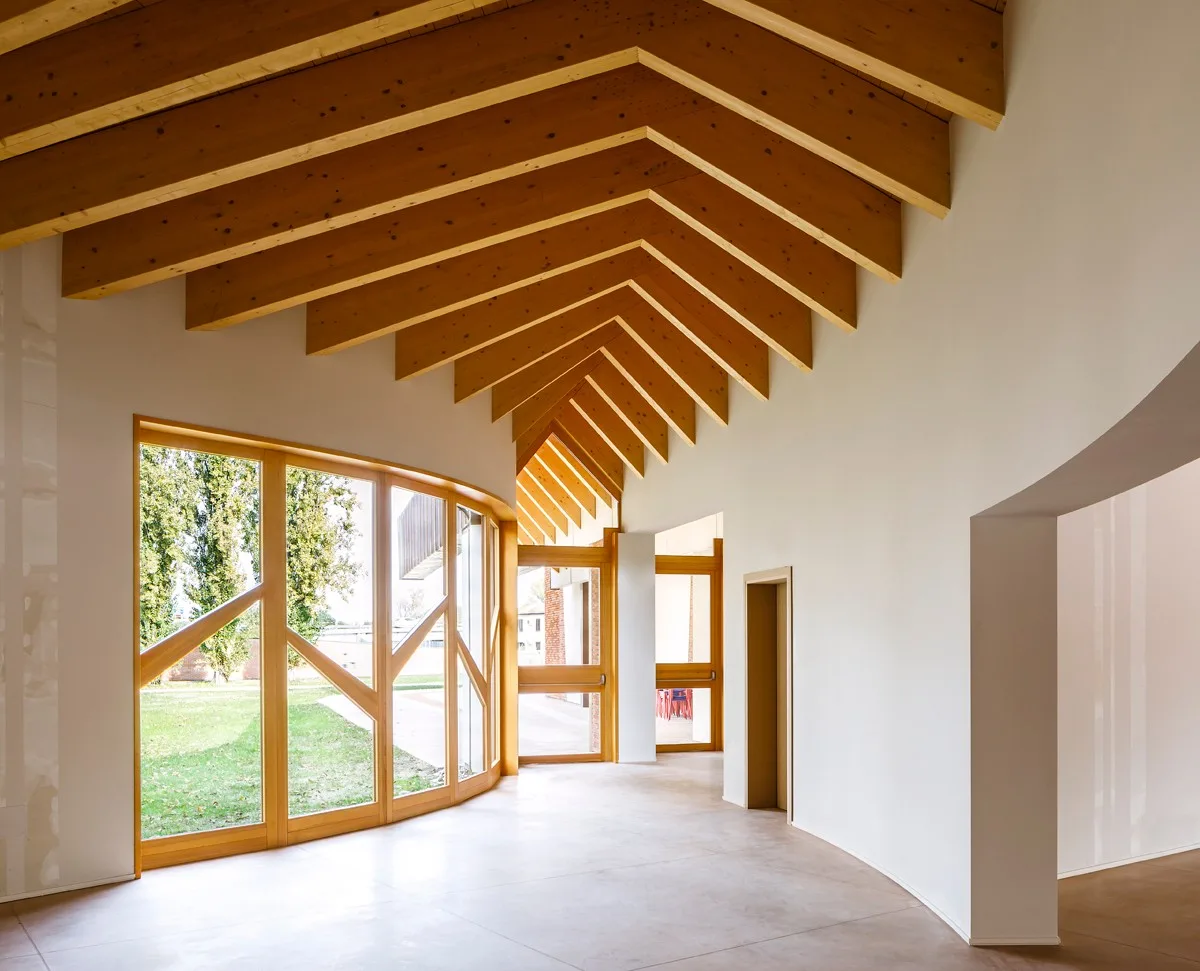
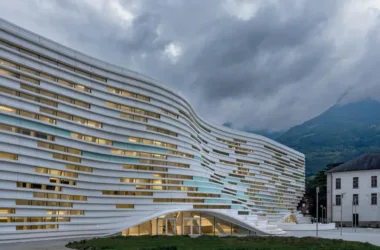
The “San Giacomo Apostolo” church serves as a new focal point and landmark within the community, acting as a catalyst for social and educational activities as well as internal interactions. Its light, organic architecture contrasts sharply with the solid, compact structures characteristic of Ferrara’s historical buildings, offering a warm and inviting presence.
Slender tree branches encircle the entire site, fostering an intimate and familiar atmosphere. The architecture stands as a sculptural centerpiece while maintaining a dialogue with the surrounding nature. This connection is especially evident in the naturalistic design of the expansive square in front of the church, which extends naturally from the church courtyard and functions as a social hub, greatly expanding the church’s communal space and opening it up to the town.
The project is strategically positioned along a visual axis. The new bridge and city lie on one side of the river, with two horizontal roads leading into the church. These roads embrace the church and its community like welcoming arms. The complex offers spaces for education, meetings, and entertainment, including multifunctional areas for nearby schools. It actively engages with its surroundings, emphasizing the relationship between the parish complex and its environment.
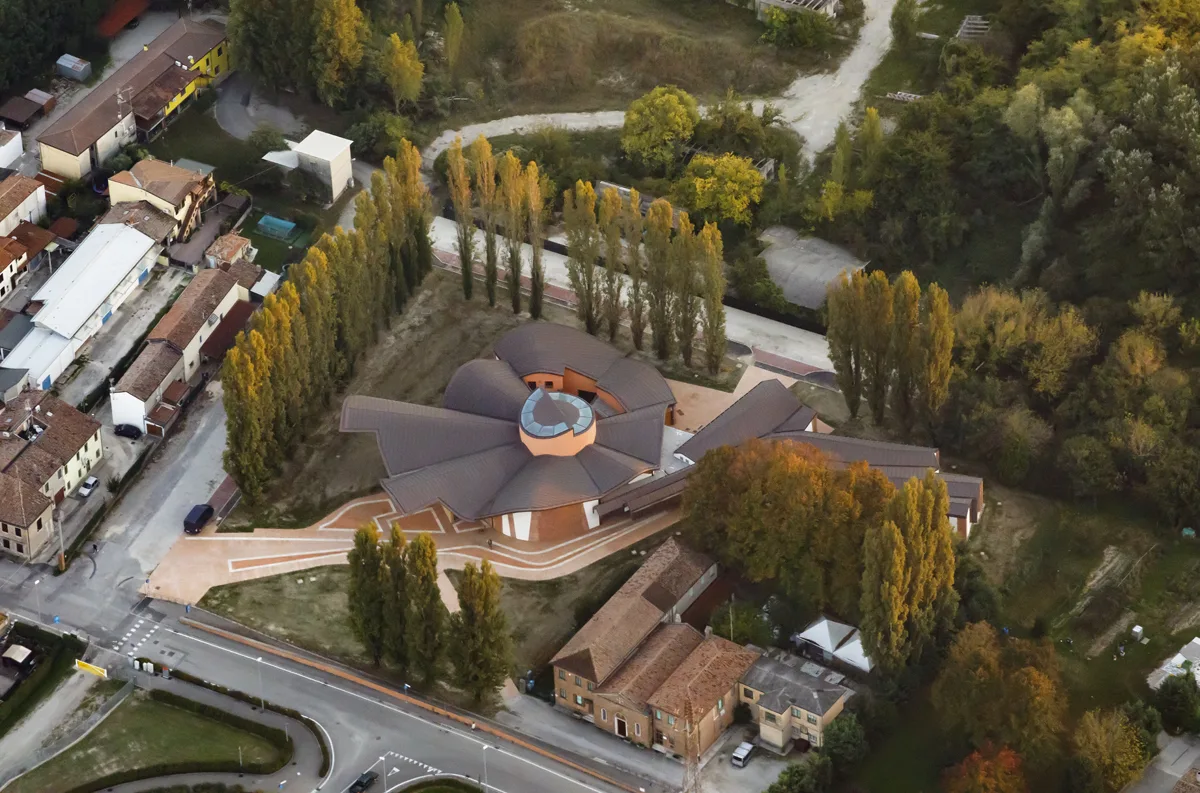
Churches are instantly recognizable sacred architecture, with distinct volumes and forms that give them commemorative significance. This church’s function is expressed through formal prototypes and architectural elements that emphasize its sacred nature.
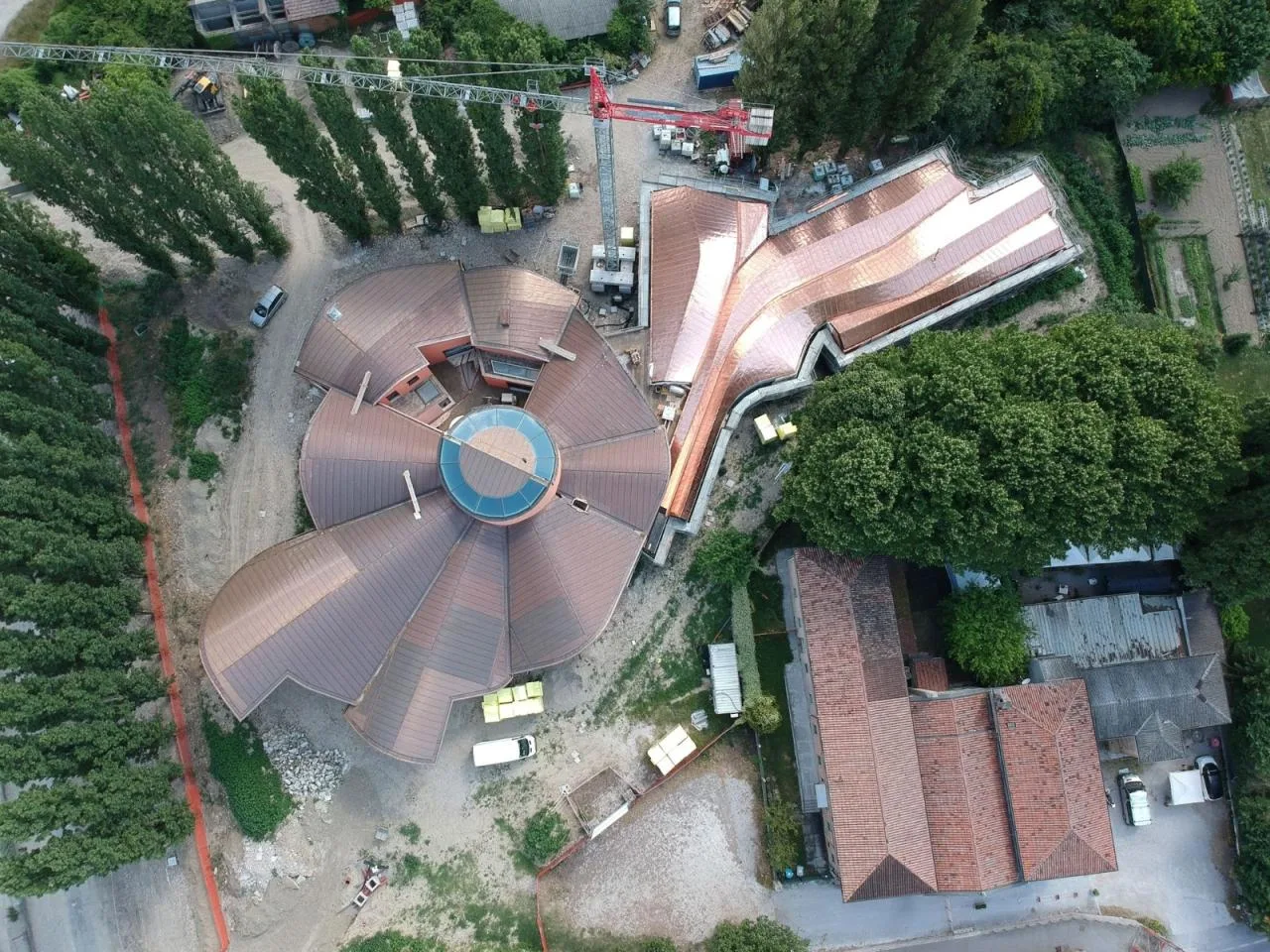
The undulating roof draws inspiration from the arches of Romanesque and Gothic cathedrals. However, the architects reconfigured these parallel lines into a radial pattern, centering the altar beneath the dome and radiating outwards with a parabolic form. The height of the church gate and courtyard threshold symbolizes the temple entrance, highlighting the gathering nature of the interior space in harmony with the exterior walls.
The exterior walls are constructed from brick and gypsum, with specially treated bricks featuring sharp surfaces reminiscent of Ferrara’s renowned Diamanti Palace.
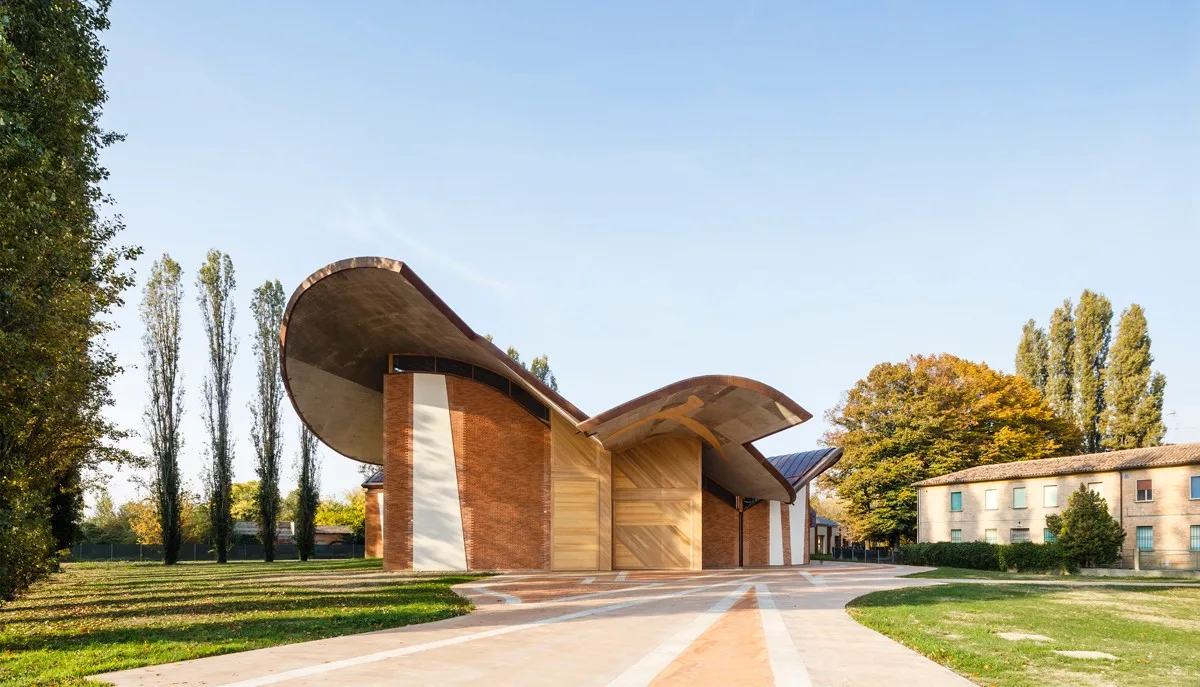
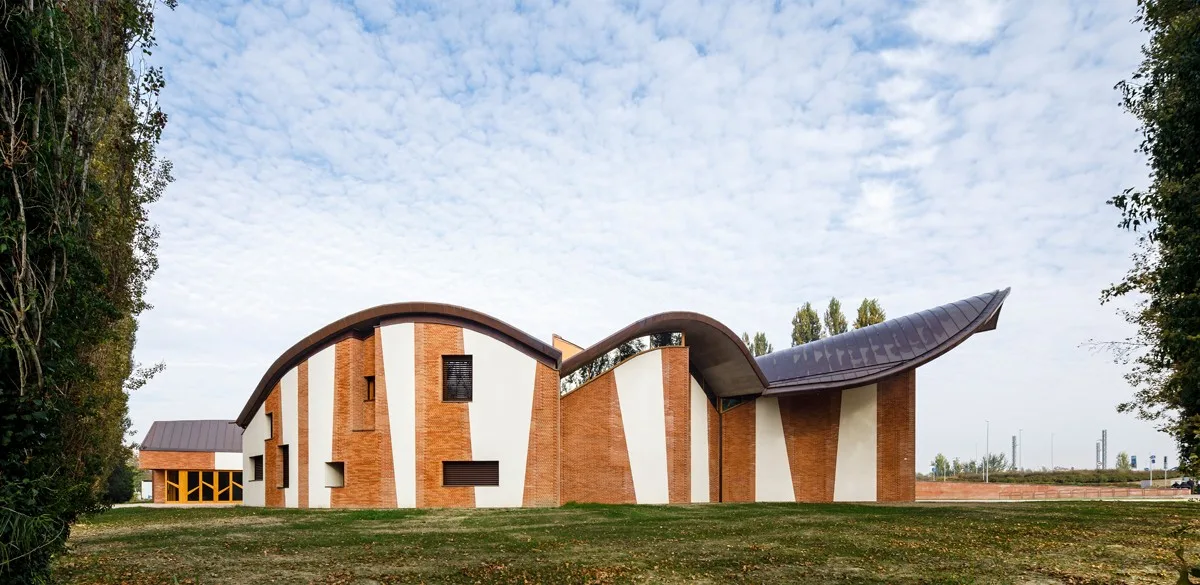
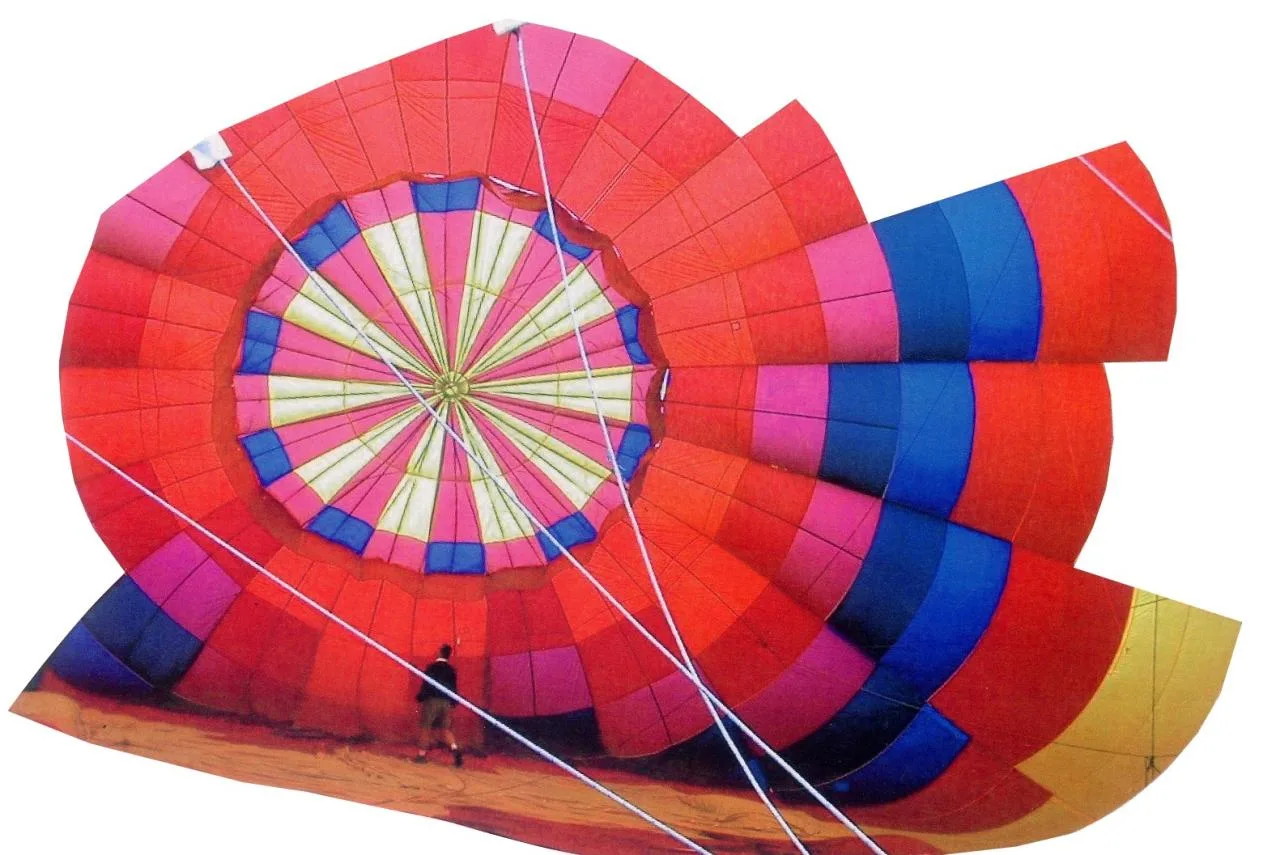
The church’s artistic silhouette resembles a hot air balloon gently resting on the ground, evoking a sense of lightness and delicacy. As an open and inclusive space, it integrates seamlessly with the surrounding environment, providing a social gathering place for the community.
Encircled by tall poplar trees, the building creates an intimate and cohesive space for residents. Its lightweight suspended roof suggests upward movement, symbolizing the connection between nature and geometric design.
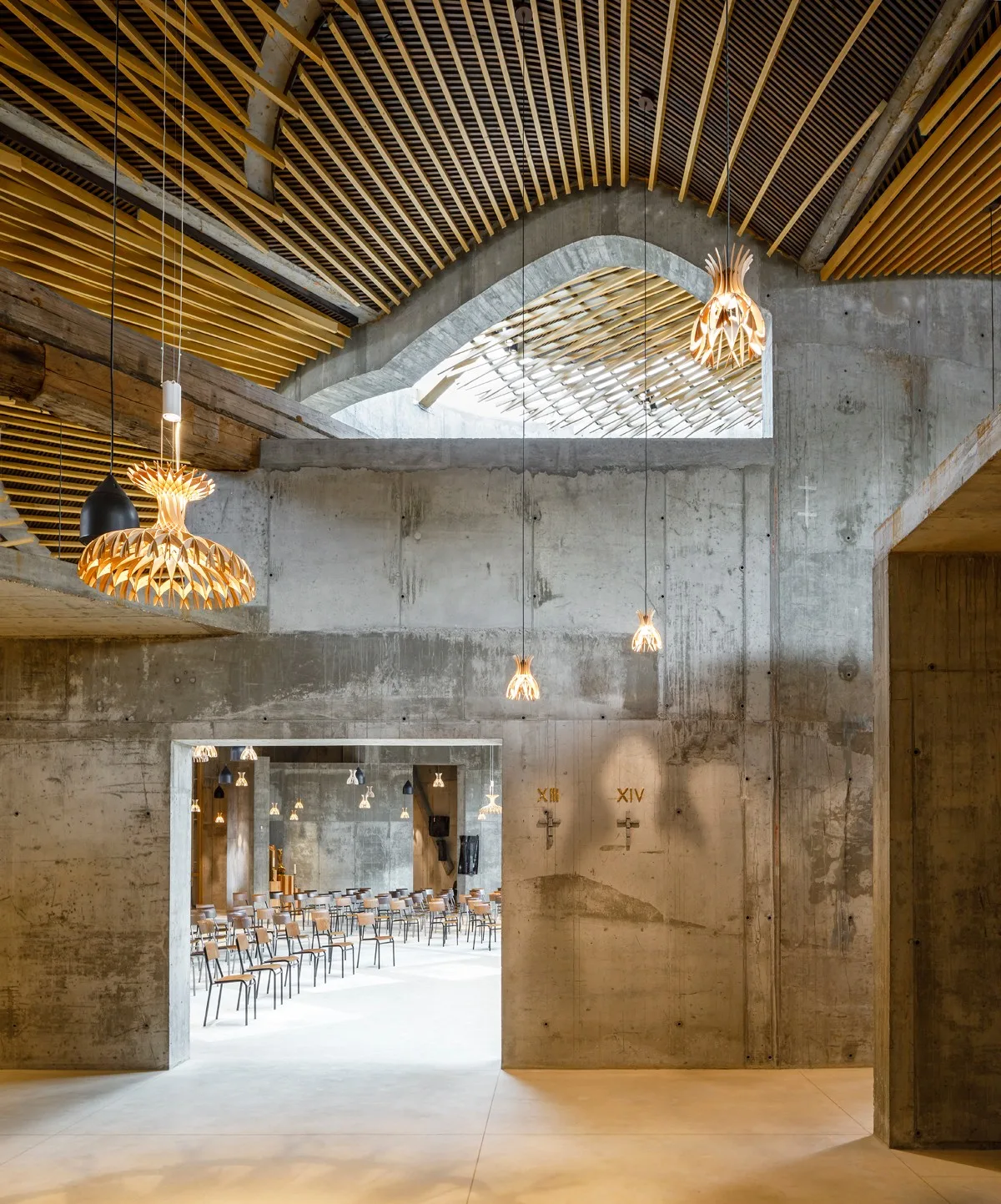
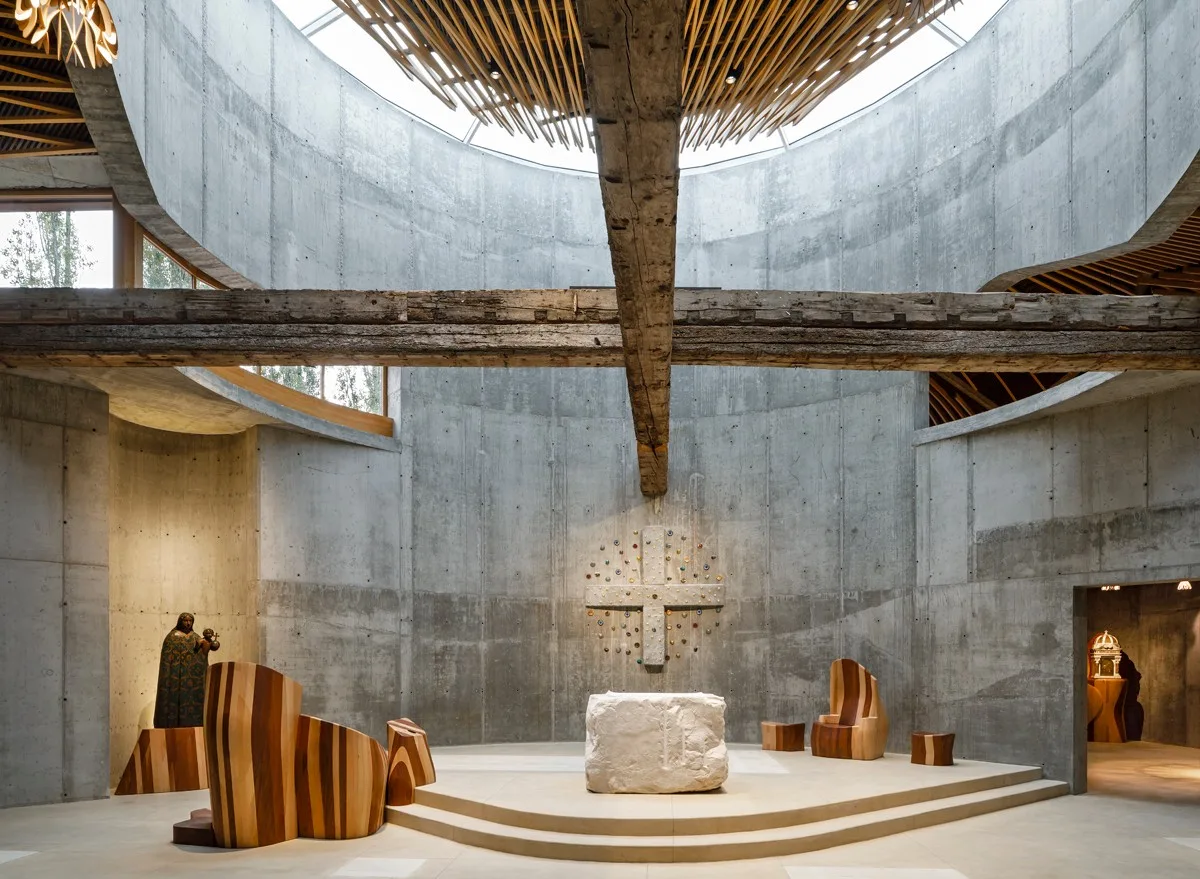
The circular layout is organized radially around the central altar beneath a parabolic dome, surrounded by classrooms, side chapels, baptismal halls, and ancillary spaces. The arched wooden roof inside recalls the nave of a medieval church, enveloped by a halo of suspended sky that echoes the shells of St. James.
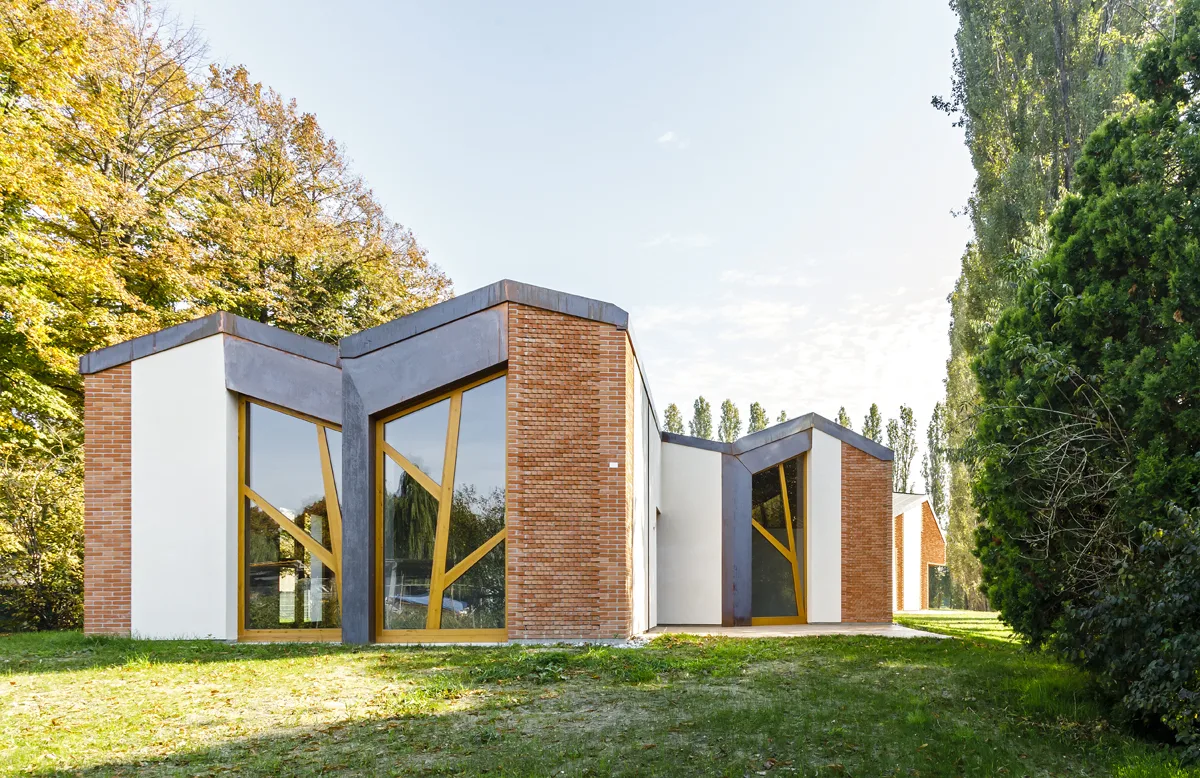
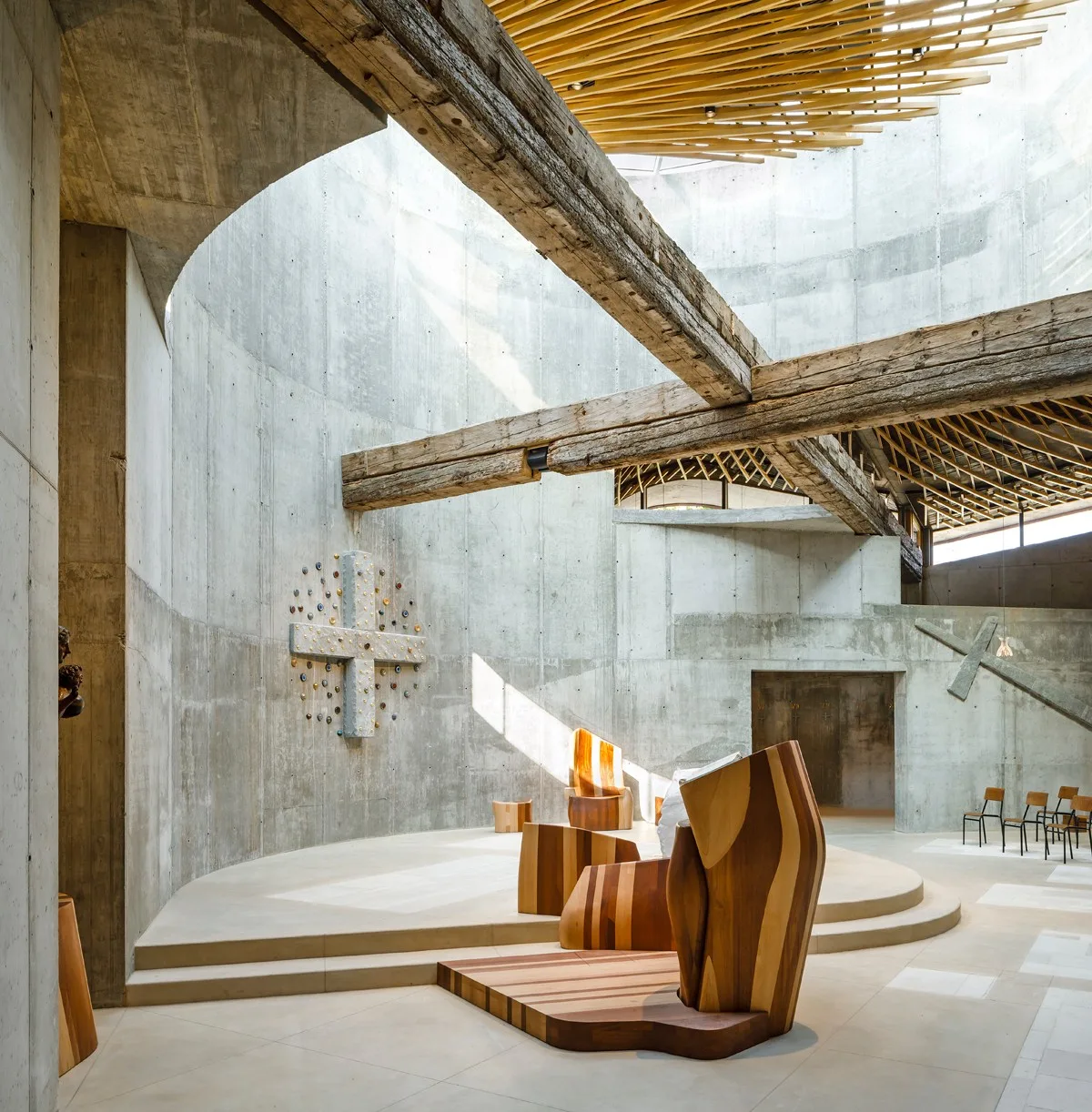
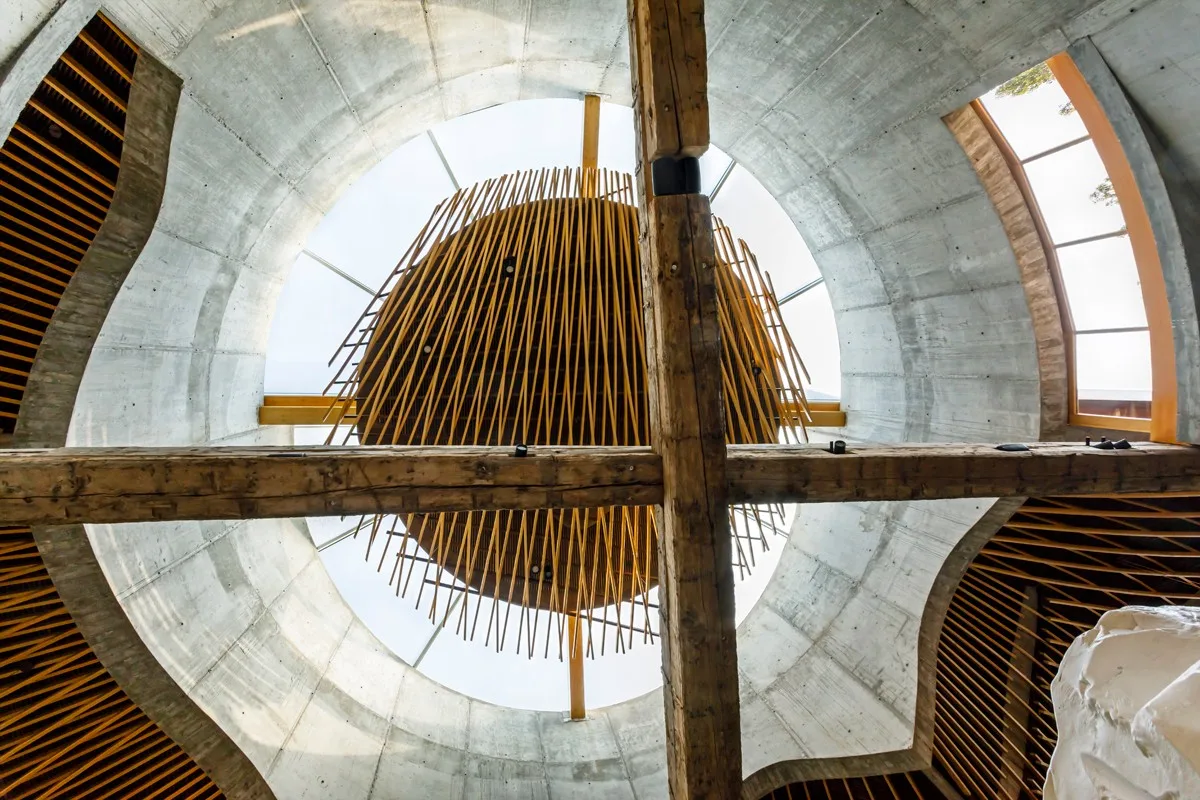
A large wooden beam cross, suspended above the nave, was restored from Ferrara’s old city hall. Some beams were replaced during restoration, symbolizing the deep and enduring connection between the church and the city.
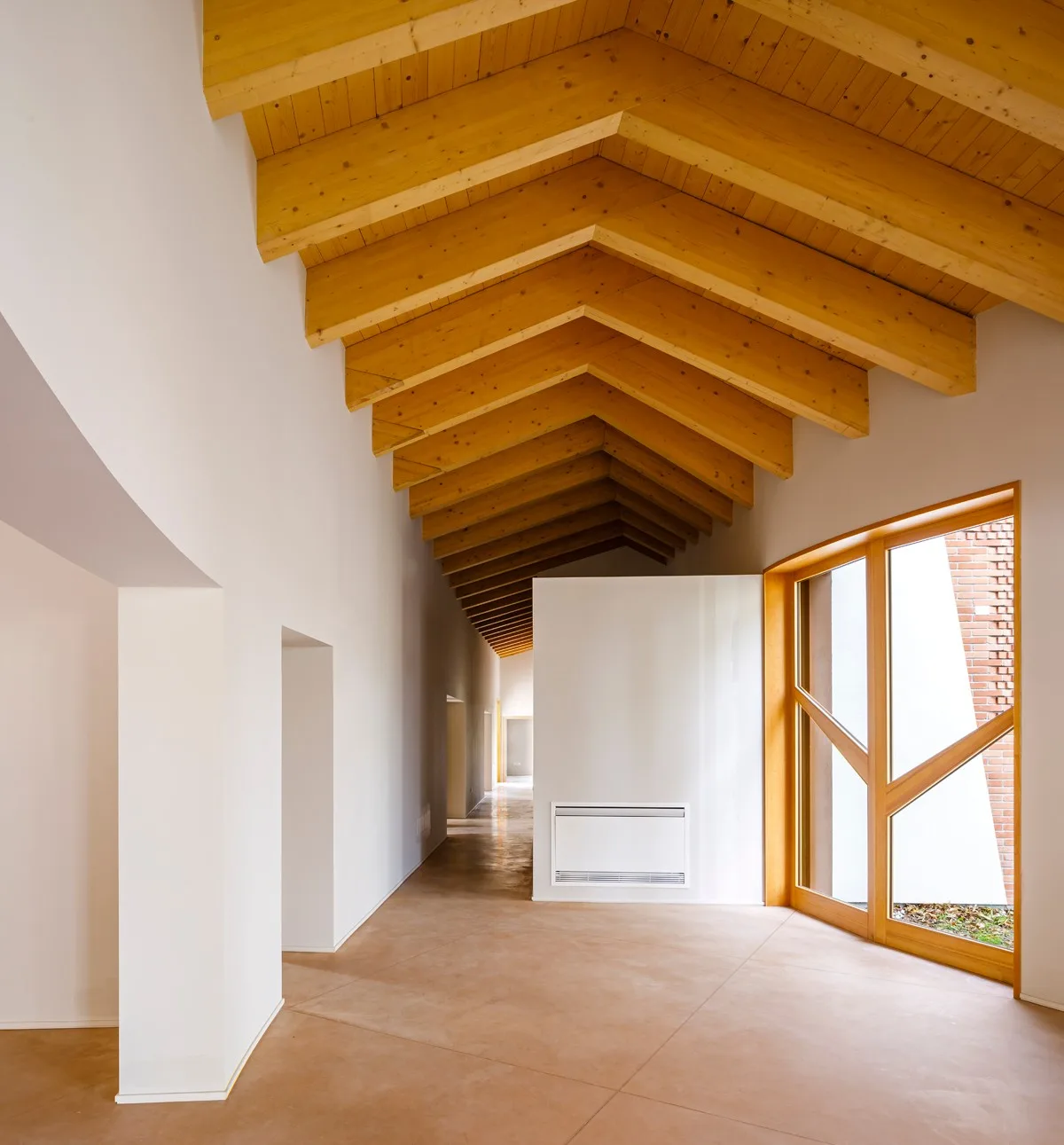
Within the church, spaces include an artifact collection room, parish residences, and areas for communication between parishioners and clergy. Additionally, there is a community gathering area designed to accommodate various social activities.
From the main square, the ground design leads visitors to more secluded spaces, creating a contrast between public socializing and more intimate gatherings.
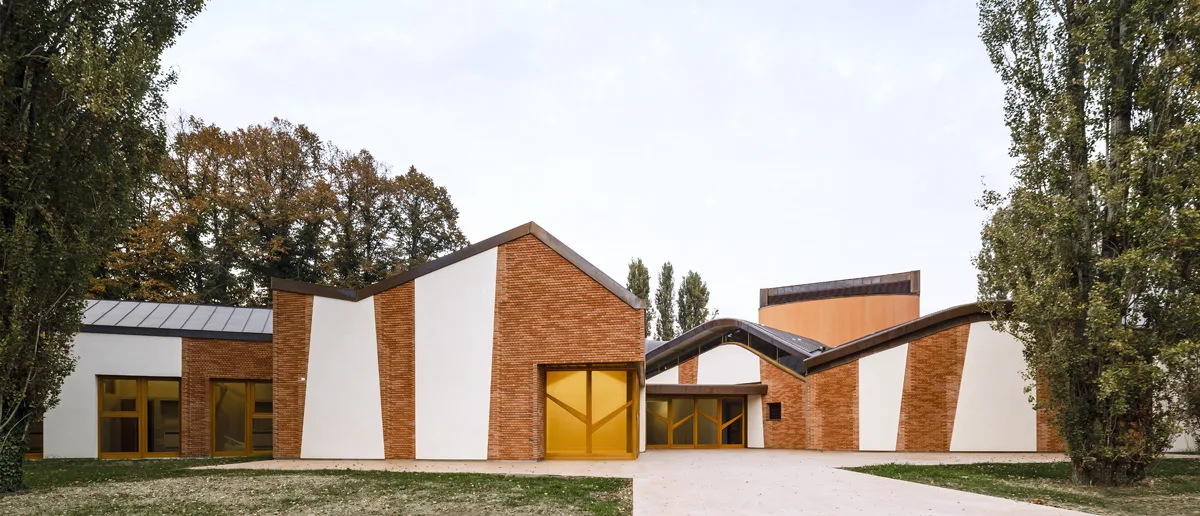
The transition from the worship area to the church is marked by a grand sacred square, with imposing gates that lead to the church and baptismal hall. The temple, rebuilt adjacent to scripture halls, forms a central axis from the main entrance to the altar and elder hall.
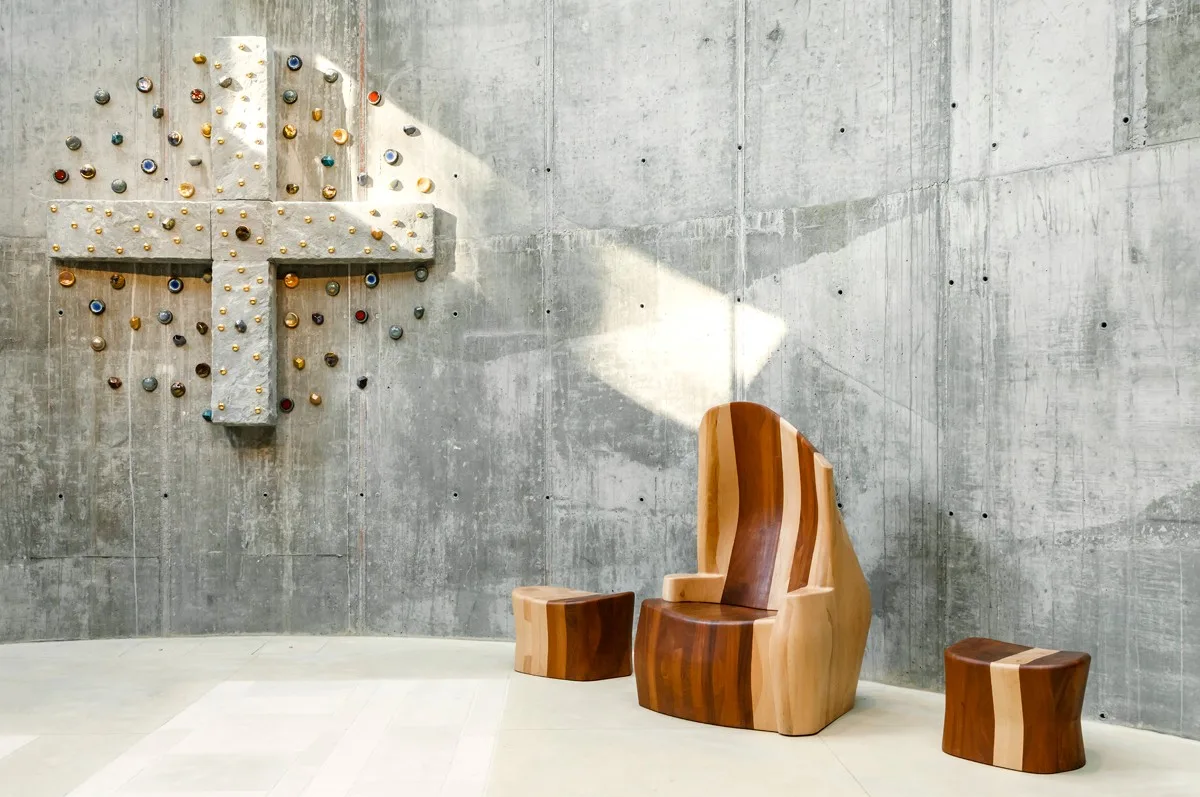
The ceremonial space surrounds the central altar, with seating, pulpit, the pedestal for the Virgin Mary statue, relics of St. James, baptistery, and monastery all crafted from built-in laminated wood blending various wood types. Seating is arranged in a semicircular arc to foster intimacy and facilitate worship.
A central skylight floods the altar area with natural light, changing with the outdoor environment. A large gate from the altar leads to the Baptistery, connected to the central Aula Eclesiástica. The baptismal hall features a tall vertical space with 17th-century baptismal pools.
Relics of St. James are housed in a wooden altar, with a separate niche dedicated to Mary Ann containing a 16th-century wooden Virgin Mary statue in the enclosed Holy Trinity Church. Visitors can access the chapel from the main church area. The chapel functions independently and connects to the artifact collection room, prison, parish residences, and multipurpose classrooms.
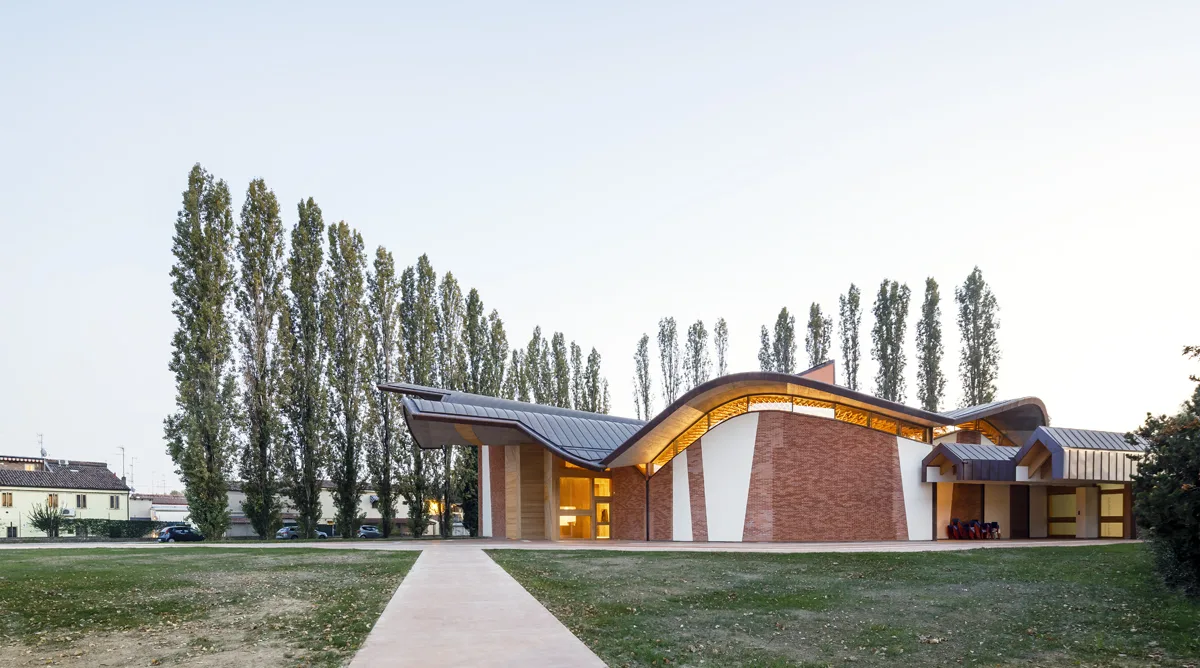
The church and parish complex occupies the most prominent position in the area, underscoring its central role. The altar sits at the church’s heart, illuminated by skylight. Surrounding spaces such as the chapel and baptismal hall offer both independent and integrated areas to accommodate varying worship needs.
The altar is constructed from unpolished white stone from Trani, with a smooth surface imbued with spiritual significance. Each corner features small crosses and hidden drawers storing cultural relics. The simple stone surface recalls early Christianity when Mass was celebrated with newly discovered symbols.
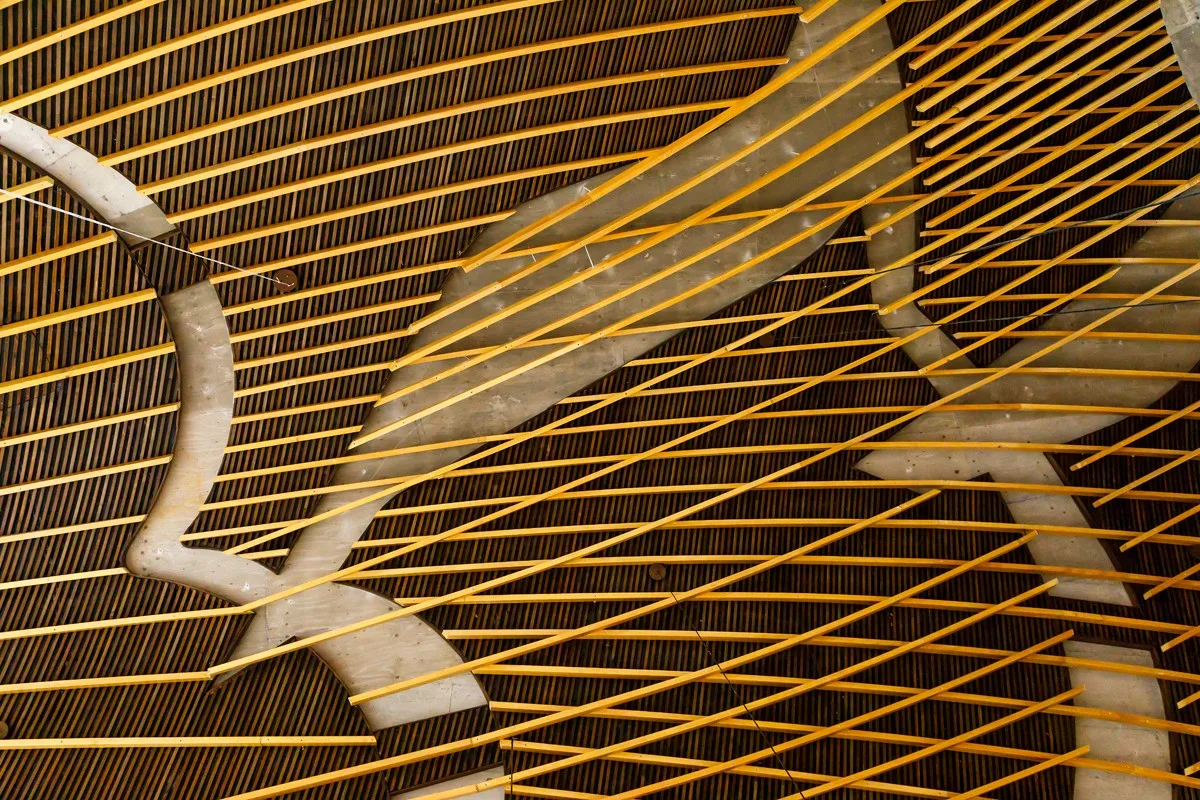
A hanging wooden lamp emits soft light, casting shadows that evoke the presence of angels. The soundproof ceiling is clad in curved wooden cassette panels. This new parish church by St. James harmonizes with Ferrara’s landscape plan, maintaining traditional continuity externally while providing a serene, contemplative interior.
Project Drawings
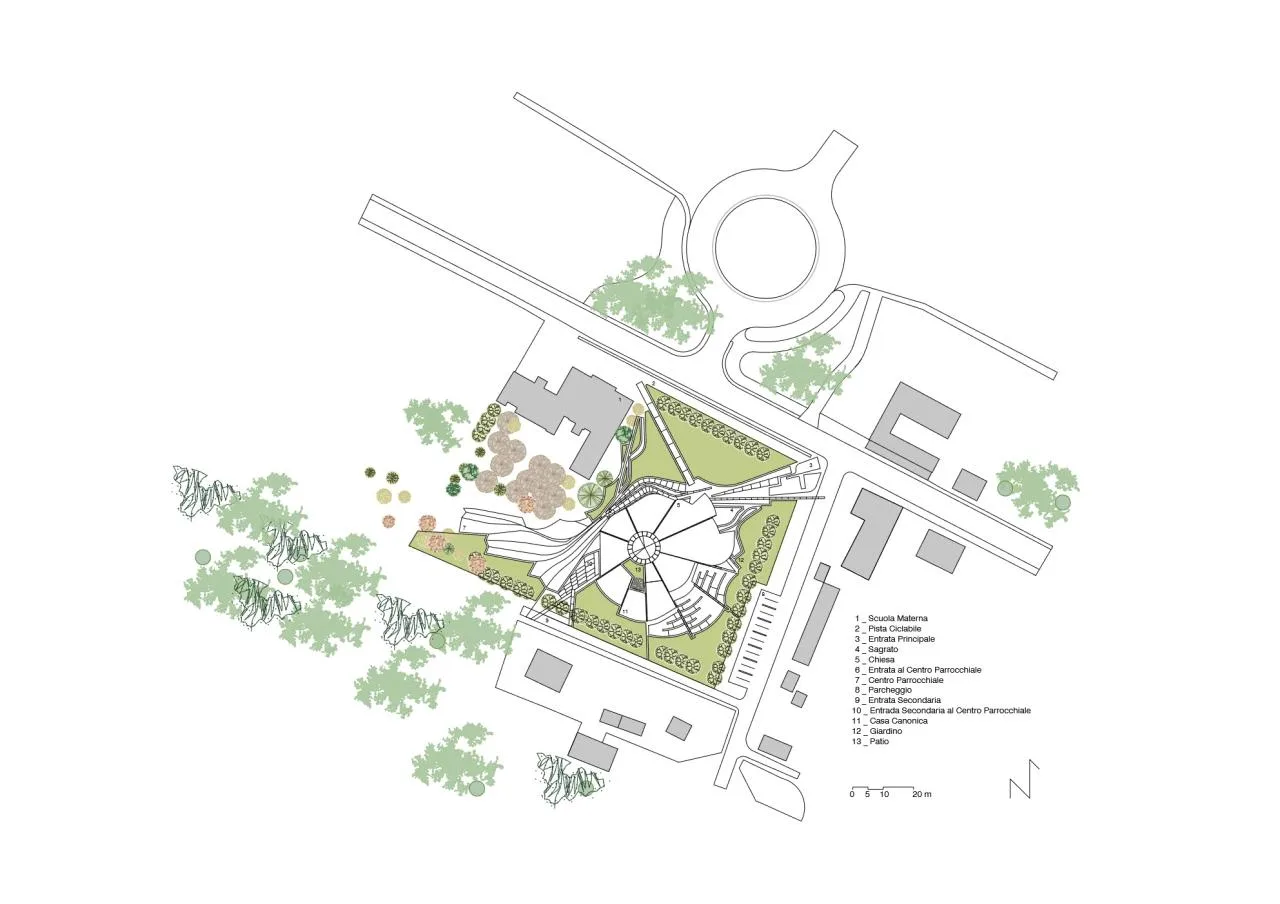
△ General Layout Plan
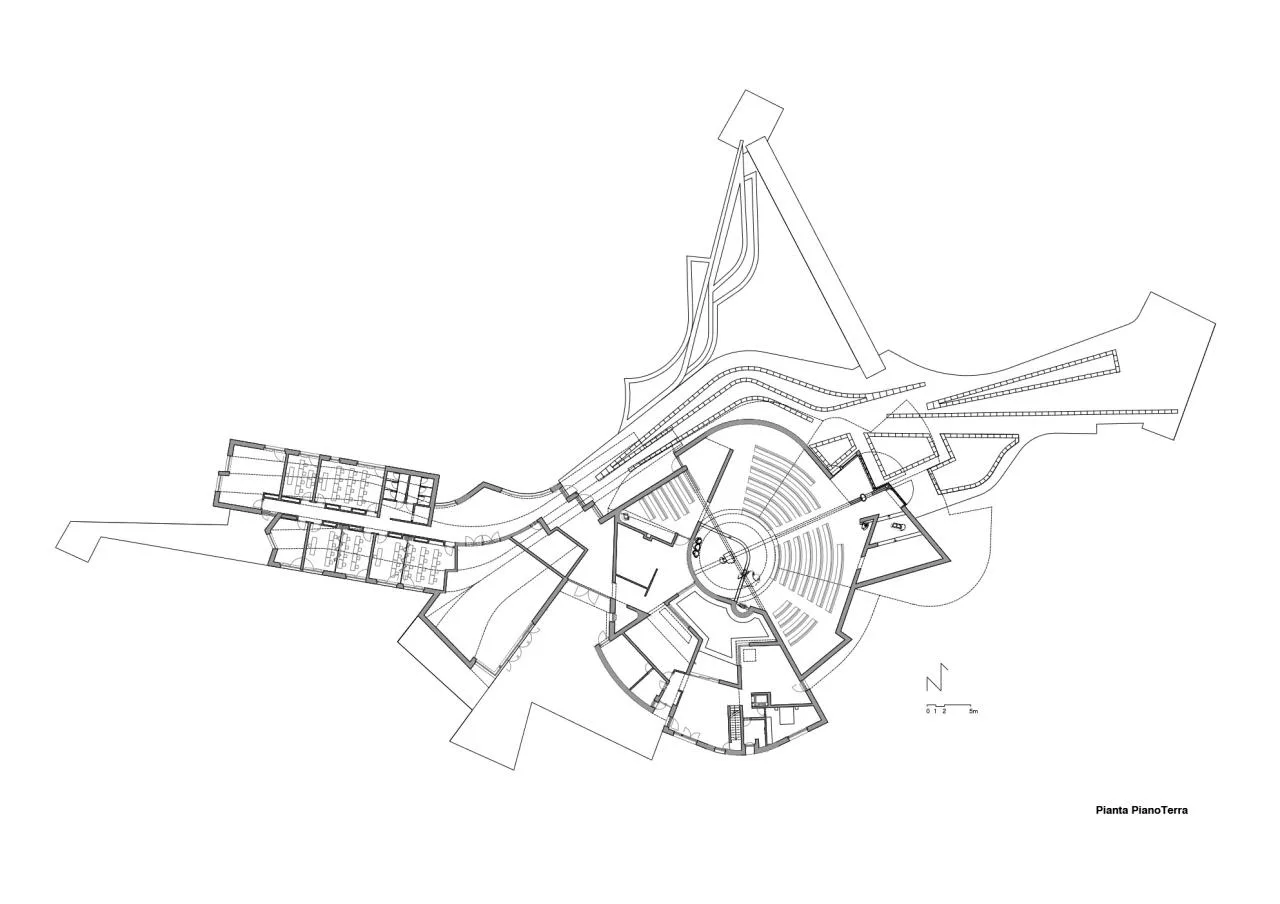
△ Plan View
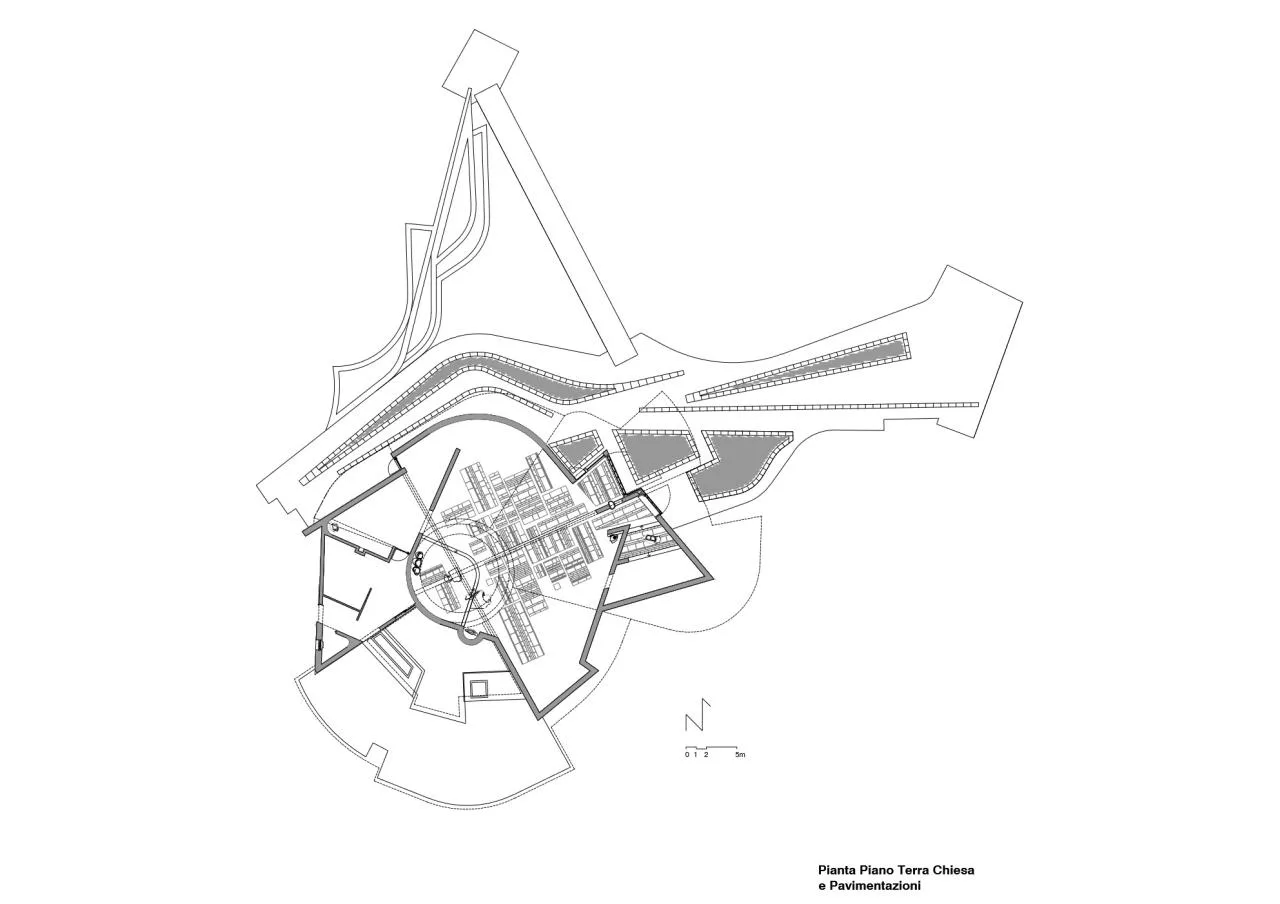
△ Plan View
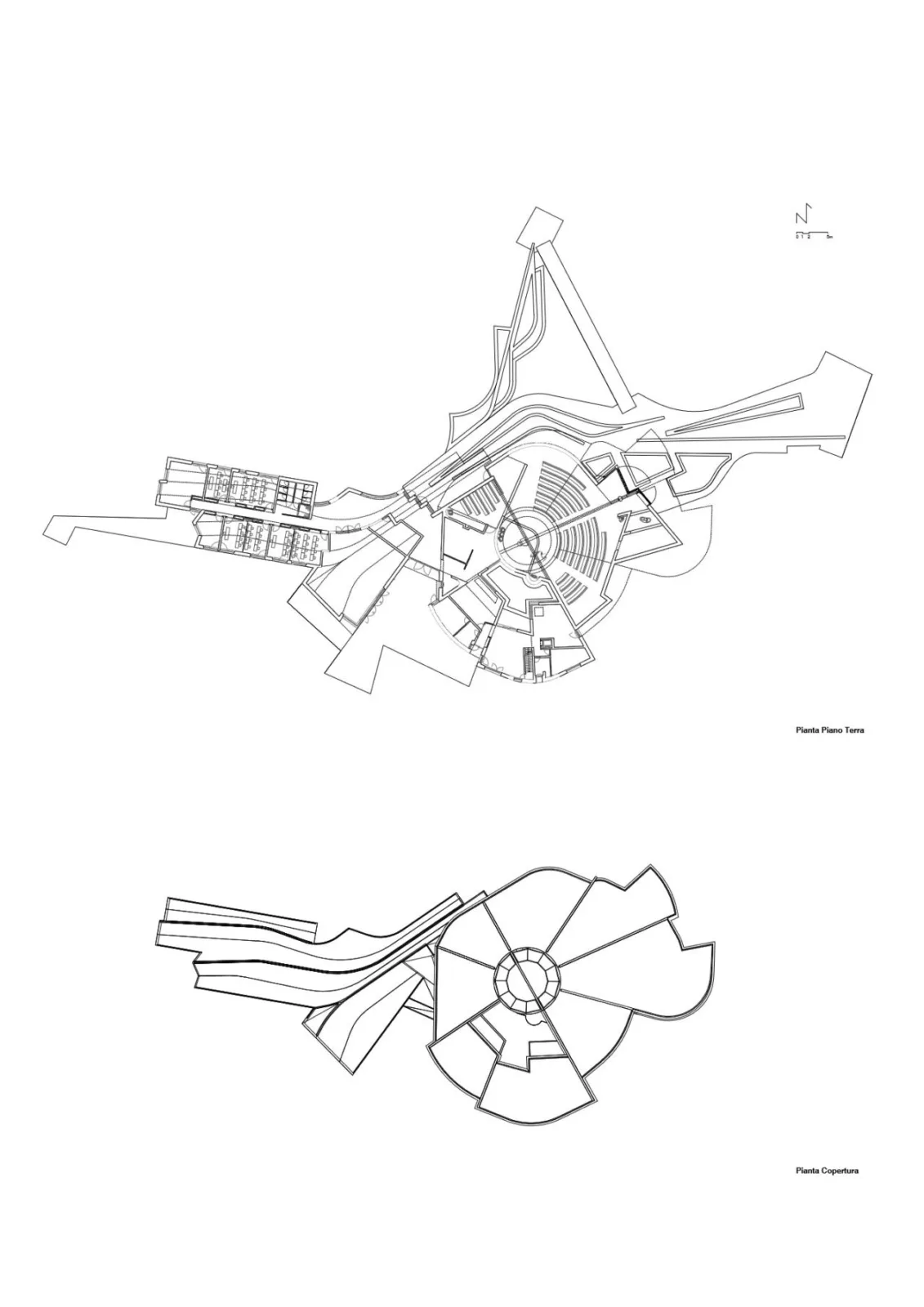
△ Plan View
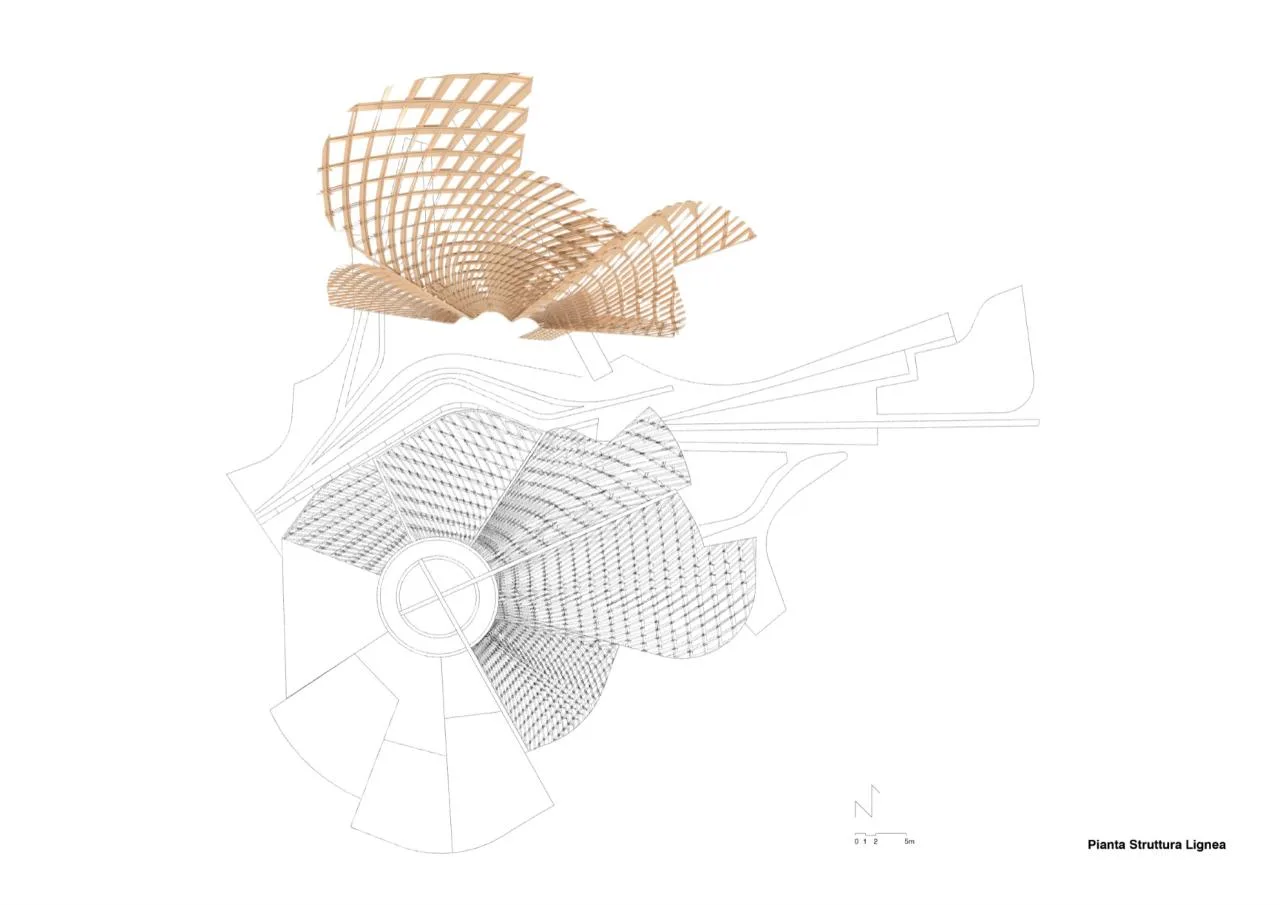
△ Structural Schematic Diagram
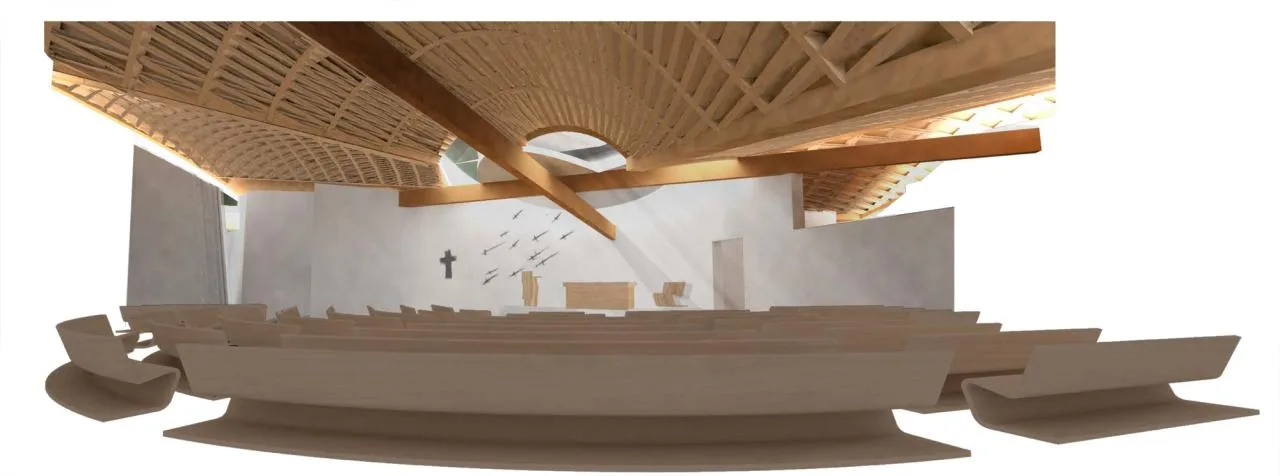
△ Interior Rendering
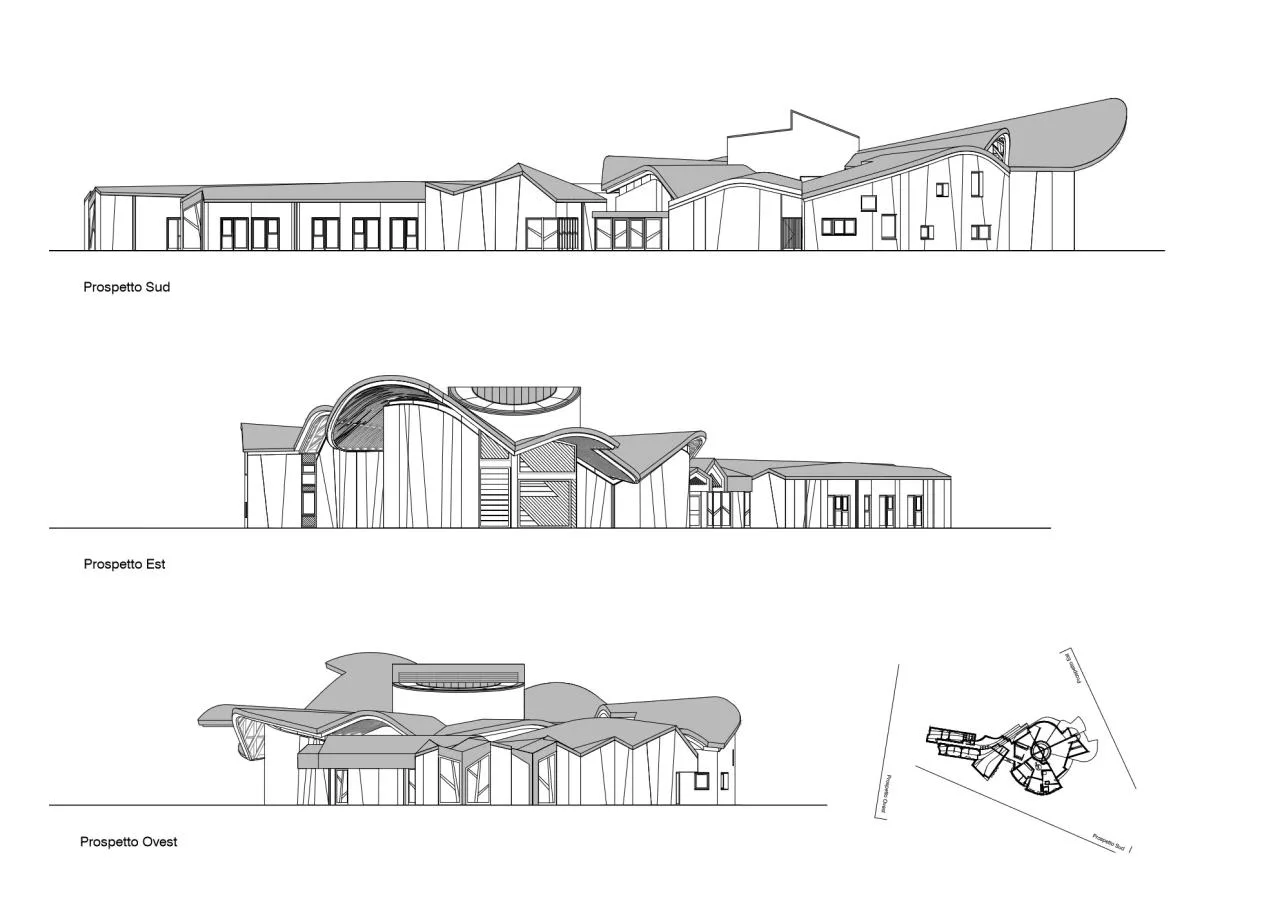
△ Elevation Drawing
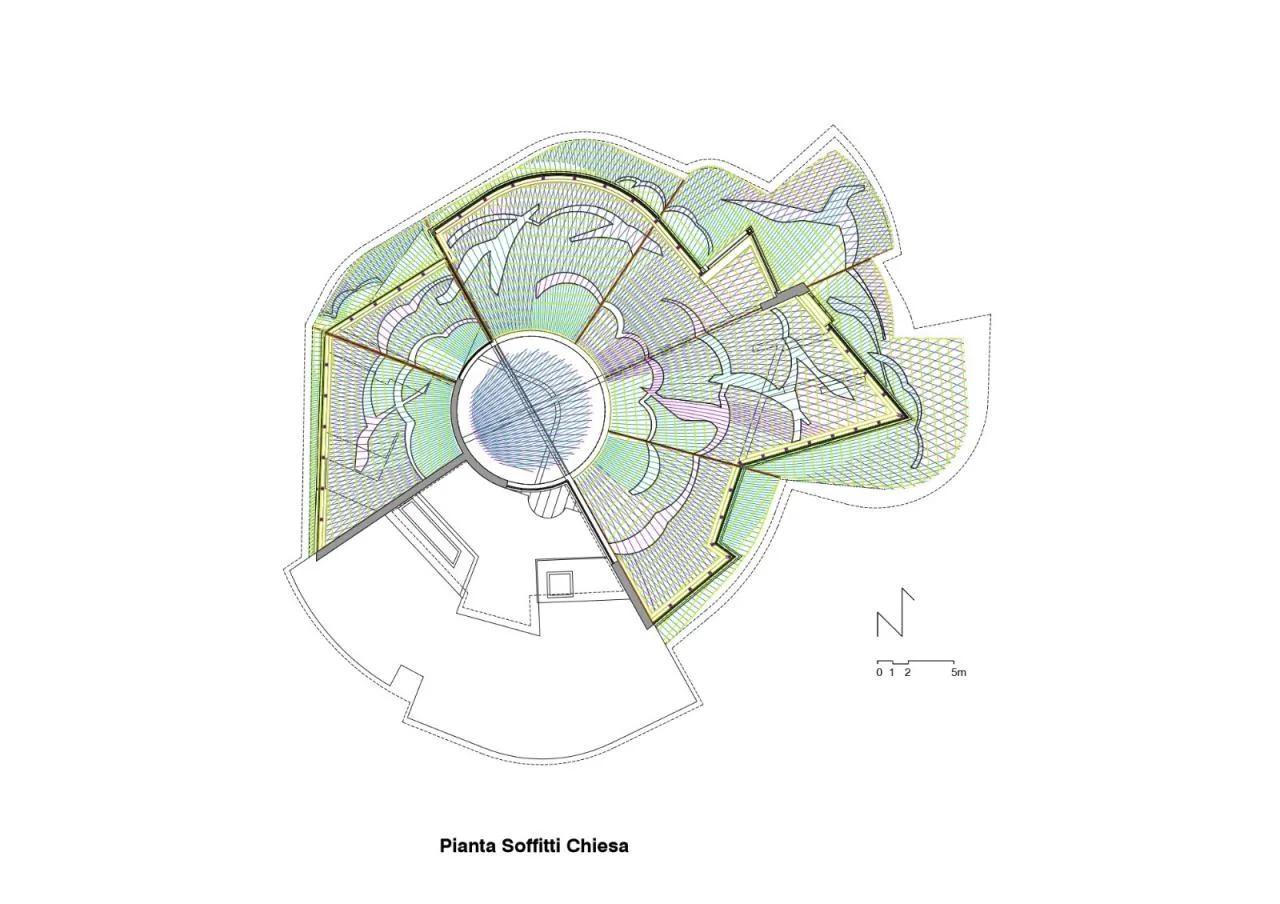
△ Analysis Chart
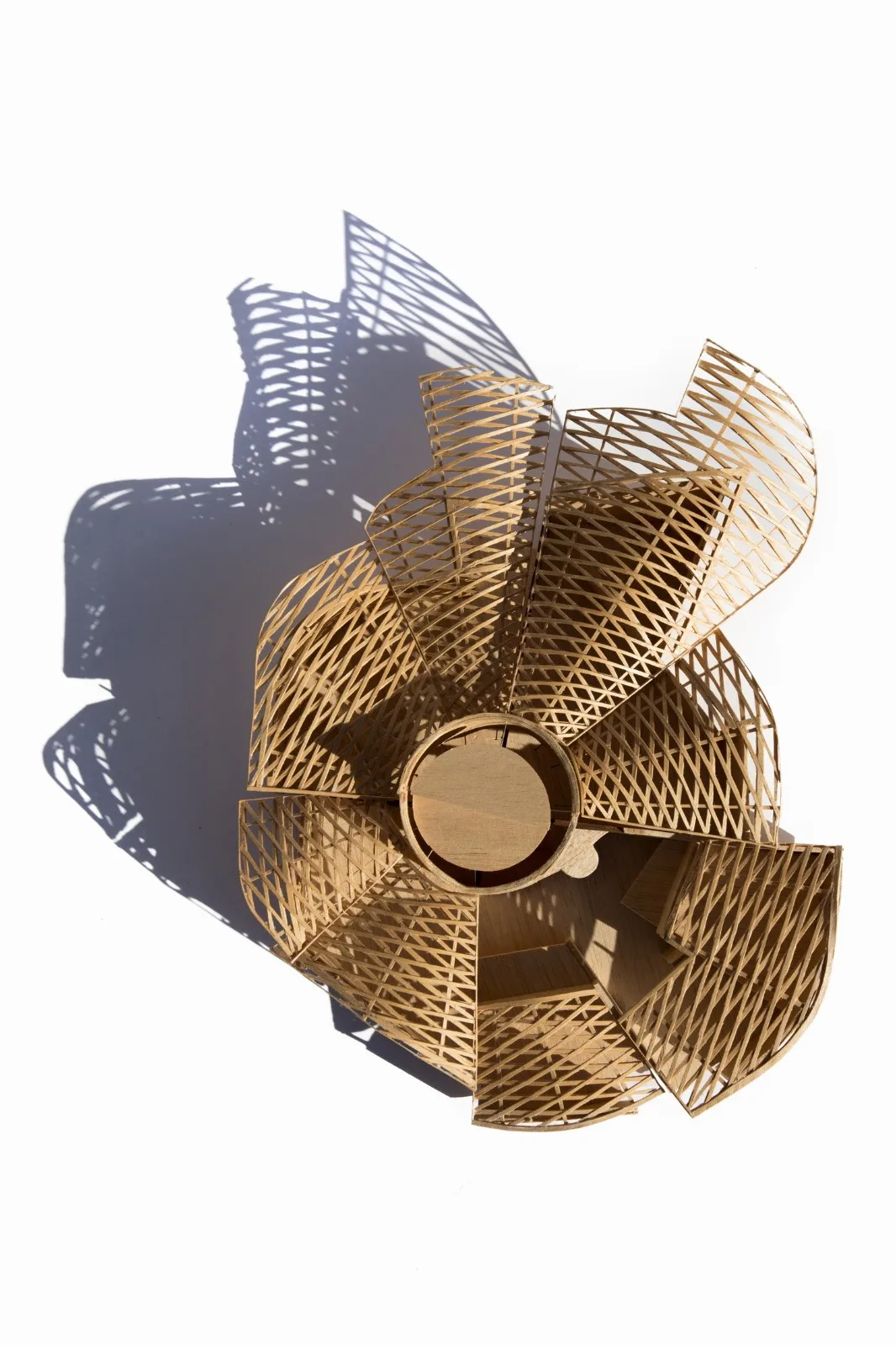
△ Model Diagram
Project Information
Architectural Design: Miralles Tagliabue EMBT
Project Year: 2021
Photographers: Marcela Grassi, Mattia Pedrazi
Manufacturers: Antico Legno SRL, Audio Solutions, Bertani Legno Spa, Berti Sisto & C, Bover, Caoduro SNC, Ceramica Kronos, Cieffe Elettroimpianti, Ebanisteria Loro, Filippetto Srl, Gela SRL, Idealstile Com SRL, Idealwork SRL, Iguzzini Illumination SPA, Manzi Marmi, Mestriner & Small, Square, Roverati Gardens, San Marco Terreal, Sinko, +3
Client: CEI Italian Episcopal Conference, Parish of St. James the Apostle
Architectural Design Lead: Benedetta Tagliabue
Artist: Enzo Cucchi
Host: Don Roberto Tagliaferri
Structural Engineering: Studio Iorio, Francesco Iorio
EMBT Project Leaders: Benedetta Tagliabue, Joan Callis
EMBT Project Coordinator: Valentina Nicol Noris
EMBT Wooden Deck and Sacred Equipment: Nazaret Busto Rodríguez, Julia de Ory Mallavia, Daniel Hernán García
EMBT Coordinator: Camilla Persi
EMBT Collaborators: Paola Amato, Letizia Artioli, Guido Aybar Maino, Sofia Barberena Cantero, Christopher Bierach, Irene Botas Cal, Maria Cano Gómez, Helena Carì, Vincenzo Cicero Santalena, Luis Angello Coarite Asencio, Maria Antonia Franco, Juan David Fawcett Vargas, Paula Georghe, Leonardo Gerli, Francesca Guarnieri, Evelina Ilina, Michael Kowalsky, Philip Lemanski, Erez Levinberg, Lauren Lochry, Ernesto Lopez, Oscar Lopez, Pablo López Prol, Annarita Luvero, Andrea Marchesin, Laura Martín, Beatriz Martínez Rico, Agustina Mascetti, Lucero Mattioda, Grant McCormick, Marianna Mincarelli, Andrea Morandi, Enrico Narcisi, Marco Nucifora, Marco Orecchia, Jiyoun Park, Mikaela Patrick, Gonzalo Peña, Juan Manuel Peña Sanz, Marina Pérez Primo, Eleonora Righetto, Roberto Rocchi, CJ Rogers, Francesca Romano, Gabriele Rotelli, Javier Ruiz Safont, Bárbara Ruschel Lorenzoni, Antonio Rusconi, Raya Shaban, Georgiana Spiridon, Guillermo Sotelo, Astrid Steegmans, Angelos Siampakoulis, Andrea Stevanato, Stefano Spotti, Raphael Teixeria Libonati, Lorenzo Trucato, Katrina Varian, Giovanni Vergantini, Beatrice Viotti, Federico Volpi, Ling Yang, Lisa Zanin
Communication Team: Arturo McClean, Ana Gallego, Lluc Miralles
Project Managers: Concordia SAS – Diego Malosso, Maria Elena Antonucci
Local Construction Coordinator: Beatrice Malucelli
Acoustic Design: Higini Arau
Lighting Consultant: Maurici Ginés – Artec3 Studio
Scientific Advisor: Matteo Ruta – Politecnico di Milano
Facility Management: Studio Simax
Supervisor: Domenico Mancini
Load Testing: Simone Carraro
Land Registration: Sotterri Giulio
General Contractor: Costruzioni Tiziano Geom. Corrado SRL
Doors, Windows, and Roofs: Ebanistería Lucietti
Location: Ferrara, Italy













Must log in before commenting!
Sign Up